Saturday, 20 August 2016

Janáček The Makropulos Affair Prom 45

Karita Mattila was born to sing Emilia Marty, the diva around whom revolves Leoš Janáček's The Makropulos Affair (Věc Makropulos). At Prom 45, she shone all the more because she was conducted by Jirí Belohlávek and performed alongside a superb cast from the National Theatre, Prague, probably the finest and most idiomatic exponents of this repertoire. For Emilia Marty is much more than a diva. She's the embodiment  of a universal life force that transcends time and place. Emilia Marty is one of Janáček's Dangerous Women (read more here) who live life to the full and change those around them, and who symbolize freedom. Yet, ultimately, freedom comes at a price.

The Overture opens like an expansive panorama. Belohlávek's generous style suggested warm, glowing colours, adding richness to Janáček's energetic rhythms, underlining the contrast with the claustrophobic litigation that's drained the Prus and Gregor clans for centuries. Tense, jerky figures in the orchestra. The lines of Dr Kolenatý (Gustáv Beláček) are long and ponderous; Mattila's timbre is lustrous, but she's astute enough to make Emilia Marty's short, sharp lines bristle, but suddenly softens gently.  She knows more about the forebears of  Albert Gregor (Aleš Briscein) than he does. Mattila's emotional range is as extensive as her vocal range: her singing was extraordinarily subtle. In the Second Act, Mattila manages to convey even more complex feelings. She's tender towards Baron Prus (Svatopluk Sem) and his son Janek (Aleš Vorácek). She understands what Emilia Marty must have felt when she sees how Kristina (Eva Šterbová), the aspiring young singer, fancies Janek. But there's still something in EM that drives men mad. "Ha ha ha", she laughs, as if she didn't care.

The point cannot have been lost on Janáček himself. whose best years came late.  Significantly, Count Hauk-Šendorf (Jan Ježek) is written for the same Fach as the protagonist in The Diary of One who Disappeared, which marked the composer's true creative breakthrough.  Hauk thinks Emilia Marty is the girl he loved 50 years before, a gypsy, an outsider beyond the pale of polite society. "I left everything behind,  everything with her".  The song cycle, the opera and the composer's private life are thus linked.  Kamila Stösslová, Janáček's muse but not mistress, was also a "chula negra" (a dusky beauty).  Hauk sings "It's an ugly business, being old" and wants to run off to Spain with Emilia, since making love keeps you young. Emilia packs her bags, but Hauk's doctor intervenes. Hauk's been insane since he lost his gypsy. Like Emilia, he laughs in hollow, mechanical tones, more tragic than funny.

This throws sinister light on the scene in which EM reveals her past, as Elian Macgregor, as Eugenia Montez, as Ekaterina Myshkin and as Elina Makropulos, whose father invented the potion that's kept her young for 337 years. That's the "Věc  Makropulos", the formula that disrupts the natural cycle of life. The opera ends with a kind of Mad Scene, where Janáček's music explodes into manic, yet oddly logical frenzy.  To EM, the explanation makes perfect sense.  Trumpets blare, the tuba howls, the strings whizz like demons. Emilia blasphemes.  "You believe in humanity, in greatness, in love!", she sings, "There's nothing more we could wish for!".  A small chorus (the men of the BBC Singers) appeared, singing responses in a parody of a Mass. Mattila's too good to screech but manages to show how EM unwinds, like a broken toy.  She wants Kristina to take the formula, and be famous. But Kristina is much too down to earth to fall for it.

Jirí Belohlávek was Chief Conductor of the BBC Symphony Orchestra for many years, concurrently with his role as Chief of the Czech Philharmonic Orchestra, which he brought to London earlier this year for Janáček Jenůfa. (Read my review here.)  The BBC SO rose to the occasion for this Prom, welcoming Belohlávek with wonderfully lively playing. They learned much in their "Belohlávek Years" and haven't forgotten.  His rapport with his singers and players was almost palpable.  None of us will make age 337, but the message, as such, is not so much how long you live but how well you live. As Janáček wrote to Stösslová, after attending the Karel Čapek play on which the opera is based,  "We are happy because we know that our life isn't long. So it's necessary to make use of every moment, to use it properly". Belohlávek is looking frail these days, though his conducting is still full of fire. As I watched, I thought how wonderful it was to be able to hear him again. I hope he realizes how much he's appreciated!

This review with extra photos appears in Opera Today
 

Thursday, 18 August 2016

Britten Untamed ! Glyndebourne A Midsummer Night's Dream


At Glyndebourne, Britten's A Midsummer Night's Dream,  in a performance so good that it was the highlight of the whole season, making the term "revival" utterly irrelevant.  Jakub Hrůša is always stimulating, but on this occasion, his conducting was so inspired that I found myself closing my eyes in order to concentrate on what he revealed in Britten's quirky but brilliant score.  Eyes closed in this famous production by Peter Hall, first seen in 1981?  The First Act takes place in dense forest, at night, when nothing is as it might seem. Do we see trees or projections thereof, or both?  What do the shadows conceal, even when the moon slips  fleetingly through clouds?  John Bury's designs are immortal because they are so abstract, and surprisingly "modern", though they ostensibly resemble the well-known Victorian painting by John Noel Paton - another reversal of visual imagery.  Since
Shakespeare's  A Midsummer Night's Dream operates on so many simultaneous levels, the one thing to be wary of is literal realism.

How Britten must have relished the opportunities to express in music what could not be said in words. Like Shakespeare, Britten was poking fun at a world that mistakes power for virtue and convention for truth. Theseus and Hippolyta –  ancient Greeks in Elizabethan costume  – sneer at the Mechanicals' play. But perhaps the joke is on them.  A Bergomask before bedtime might just have unforeseen consequences. Britten's Gloriana was long misunderstood by audiences who took it at face value. (Read my article : Gloriana : Britten's Mock Tudor).  A Midsummer Nights Dream, written barely seven years later, has an infinitely superior plot and the music is much more sophisticated, but there are parallels. And in A Midsummer Night's Dream there are levels which would have had personal resonance for the composer. 

Jakub Hrůša's conducting is so idiomatic that we can almost feel the caustic bite of Britten's humour, while also feeling the pain that lies beneath the surface.  Britten's score sparkles with variety.  Figures shape shift as swiftly as they are delineated, Elizabethan forms pop up from the endlessly elusive and very contemporary stream of consciousness   Hrůša doesn't smooth over the spikiness, but keeps the pace animated, so the orchestral playing seems to fly free, like the Fairies – the Elementals to the earthbound Mechanicals.  The moments of reverie glowed, the lower woodwinds and brass breathing ominous mystery. The London Philharmonic Orchestra seem to shine for Hrůša, even more than they usually do. Perhaps Hrůša brought insight from having conducted Rusalka and The Cunning Little Vixen at Glyndebourne in the past, two operas which also have close affinity with A Midsummer Night's Dream.  Hrůša seems to intuit how pertinent the variety in the score is to the meaning of the opera. Everything changes at the turn of a point, themes transform, like magic, nothing can be taken for granted. Because Hrůša  got such alert, taut playing from the orchestra, he could bring out the innate anarchy beneath Britten's elegantly defined orchestration.  Orchestrally, this was an exceptionally vivid performances, so strong that it will live in the memory.

The cast, acting as well as singing, were of an equally high order.  Matthew Rose first sang Bottom ten years ago. Now, he's matured and so has his characterization of the part, which will probably now be hard for anyone else to improve upon. Bottom is Everyman but no fool. Rose's voice carries authority, which is why his friends turn to him as leader. Even with the head of an ass, and his bottom in the air, Rose makes the part dignified and sympathetic. Rose creates the "donkey" wheeze in Bottom's lines sound so natural that, even in the palace in the final Act, a bit of donkey-ese breaks through irreverently.  Even his body movements worked in synch.  Equally strongly cast were the Mechanicals – David Soar (Quince), Sion Goronwy (Snug), William Dazeley (Starveling), Anthony Gregory (Flute) and Colin Judson (Snout). In ensemble, they were superb, singing and speaking as if to the manner born.  In the play, and in the opera they are much more significant than Theseus (Michael Sumuel) and Hippolyta (Claudia Huckle).

As Oberon, Tim Mead's high, sharp timbre dripping malevolence, reversing the more usual baroque stereotype of counter tenor as hero.  He towered over Kathleen Kim, as Tytania.  Good visual casting, reflecting the power play between them. Kim, though was no submissive. She sang forcefully and with élan – no surprise that she's a Glyndebourne favourite.  Oberon's hair was styled in two peaks, resembling the ears of an ass. Wonderfully subtle touch.  The lovers, Lysander (Benjamin Hulett), Hermia (Elisabeth DeShong), Helena (Kate Royal) and Demetrius (Duncan Rock) were also well cast, DeShong creating Hermia's feisty, strong-willed personality with particular definition.

But Puck is the agent of insurrection, upon which the plot turns, and particularly symbolic for Britten himself.  Puck is not a singing part, but  David Evans stole the show, quite an achievement for an actor stepping in at short notice,  into a part that's so demanding that it's notoriously difficult to cast.   Britten dreamed that it could be played by a young athlete whose voice was beginning to break: a changeling between two worlds, a Britten innocent on the cusp of corruption.  Tadzio, with a voice. And what a voice! Evans is cheeky and shrill like a boy, yet also rebellious and assertive like somone passing into his teens, though he looks younger. He also projects with great force, while respecting the curious rhythm in the text.  Evans runs up and down stage, sailing into space on a guy rope, popping in and out of the scenery, without missing a note.  Did Britten identify with Puck, who could get away with things a nice, obedient boy like Young Ben could not?  And yet Puck is a tragic figure, not so much because he doesn't belong but because his freedom cannot last. Will he be sucked into Oberon's sick games? Evans will grow up, but this moment of glory will live with him for the rest of his life.

This review appears in Opera Today


photos : Robert Workman, Glyndebourne Festival Opera


Sunday, 14 August 2016

Poetic Thoughts : Mahler 8 Chailly Lucerne Festival


The 2016 Lucerne Festival opened with Mahler Symphony no 8.  Mahler's Eighth celebrates a powerful life force, the spirit of creativity itself, pulling together images from diverse sources. Thus it epitomizes the ideals that led Claudio Abbado to found the Lucerne Festival Orchestra, where the finest musicians from the best orchestras in Europe join together in communal harmony. Claudio  Abbado and Riccardo Chailly were very close, and now Chailly carries on Abbado's ideals. Wherever Abbado might be now, his spirit hovered over this performance. This was an extraordinarily thoughtful performance culminating in ecstatic serenity, accessing "the peace that passeth all understanding", absolutely relevant to what the symphony might mean. Listen here on arte.tv (all areas)

Although Mahler's Eighth is known as "the Symphony of a Thousand" the title wasn't Mahler's but a marketing slogan invented by a concert promoter. But quantity is not quality. At Lucerne, the orchestra and soloists were supplemented by 222 choristers , arranged in six rows across the width of the hall, the Tölzer Knabenchor along the sides. Voices and orchestra were well balanced, allowing much greater freedom of expression. The boys choir can often get lost in an uproar, but here their relatively small but important role came through clearly. This matters. "So far I have employed words and the human voice to express only with immense breadth", Mahler wrote specifically of this  symphony, "But here the voice is also an instrument used not only as sound but as the bearer of poetic thoughts".  Poetic thoughts, some so delicate that they can be overwhelmed in interpretations that stress volume over  artistry. No chance of that here. In Chailly's Mahler 8, every voice has its place in the grand scheme of things, a concept absolutely in tune with he concepts behind the symphony.

And what concepts! This symphony often confounds because  it's so unorthodox. The First Part is relatively straightforward, being based on a hymn believed to have been written by Rabanus Maurus,  Archbishop of Mainz (c780-856) which describes the anxiety Jesus's disciples felt after Jesus had gone on ahead. In the Acts of the Apostles, the Holy Spirit descended from heaven upon them in the form of holy flames, inspiring them to go forth into the world, spreading the Gospels.  Throughout his oeuvre, Mahler deals with death, but seeks resolution in some form of eternal life.  Thus the symbol of the Pentecost as a metaphor for divine inspiration and continuity, and by extension, the mission embraced by a truly original, creative artist.

"Veni Creator spiritus".and "Accende lumen  sensibus": images of light and fire illuminate this music. Chailly's clarity let the colours shine unsullied, absolutely essential to meaning. Only technical excellence can produce freedom as exhilarating as this. Everyone on message, singing and playing as if divinely inspired yet in complete harmony. This unity matters, since the concept described in the text applies to all creation. The inspiration was so strong that it seemed to Mahler "like a vision" which struck him "like lightning", making him write so quickly that the notes seemed to fly onto the page as if they were dictated by some unknown force.  Chailly's tempi were brisk, reflecting thus sense of urgency, but were not so driven that they obscured contrapunctual detail and the cross-currents that  give the music depth.

The singing was equally ardent.  Many of this cast are Mahler veterans, like Mihoko Fujimura and Peter Mattei (who was on Gielen's second M8 recording and on Chailly's with RCOA). Andreas Schager is less well known, though he's been a very distinctive Siegfried.  Here, he sang with fervour, giving his parts great character.  The other soloists, all superb, were Ricarda Merbeth,  Juliane Banse, Anna Lucia Richter, Sara Mingardo and Samuel Youn.  For me, they're all like old friends, so hearing them together, singing with obvious enjoyment, gave added meaning to the experience. Some members of the orchestra are spotted smiling too, caught by a camera crew who knew when and who to highlight.

The pause that binds together the two Parts of the symphony was marked with dignity, for out from this silence rises the slow movement  which is in many ways the heart of the symphony.  It marks the transition, a transition so esoteric that its meaning can't be expressed through text.  Although the big choral flourishes catch more attention, this section shows the true measure of a conductor.  Chailly's textures here reflected a sense of wonder and mystery.. Absolute refinement and attentiveness. In liturgical terms, this replicates the moment in the Catholic Mass during which the congregation meditates upon the Consecration which symbolizes the union of God and mankind.  Hence the delicate but firm woodwinds and strings, and hushed, reverential voices. This section also refers to the moment in Goethe's Faust when Mephistopheles thinks he's won Faust's soul, but is thwarted by angels who scatter rose petals from Heaven, marking the beginning of Faust's redemption.

Bergschluchten. Wald. Fels, Einöde. (mountain gorge, forest, cliff, desert), Mahler wrote on the manuscript on the Second Part, a direct reference to the scene in Act Five of Goethe's Faust, which describes a bizarre landscape inhabited by anchorites, complete with tame lions who pace about stumm-freundlich (placid and peacefully).  Anchorites are hermits who live alone in the wilderness, but are so close to God that they can tame savage beasts.  Again, a clue to what the symphony might mean: the disavowal, of earthly games of domination and greed, sublimated in idealized transcendence.  Medieval art wasn't fussed about literal realism. Figures inhabit surreal perspectives, sometimes even hovering over the ground, defying gravity and rational logic.  In musical terms, such perspectives, however, work perfectly well.  Thus we have Pater Ecstaticus auf and ab schwebend (soaring up and down). Later the angels lift Faust’s soul and they fly off in der höheren Atmosphäre. There’s movement everywhere, which Mahler translates into music that soars and flies ever upwards in different levels.  Thus the off-stage trumpets, the organ way above the platform and the Mater gloriosa singing from on high.

Yet for Mahler, as for Goethe, redemption comes through Das Ewig-Weibliche that draws us heavenward, as the Chorus mysticus tells us, the Eternal Feminine, embodied in the Mater Gloriosa, the “Jungfrau, Mutter, Königen, Göttin”  thus dialogue between "masculine" and "femninine" runs through so much of Mahler's post-Wunderhorn work  but few conductors highlight it the way Chailly does. He highlights the interplay between outburst and delicate detail, between combinations like piccolo and harmonium, timpani and harp.  Perhaps this dichotomy represents Mahler and Alma, perhaps not, but Chailly is unusually sensitive to this aspect of Mahler's work.  A few years ago, Chailly conducted Mahler's Symphony no 10 , creating the duality in the first movement with such grace that it drove some listeners crazy; but that reflected I think more on the misogyny of some listeners than on the performance itself.  In Symphony no 8 with its message oif equanamity, union and creative rebirth, that graciousness and sensitivity is paramount.

Thus the luxuriant conclusion, in which triumph is achieved without violence; redemption reached through love, not dominance, affirmation, not neurosis.  This Second Part proved the wisdom of  the size and spacing of the choruses (Chor des Bayerischen Rundfunks, Orfeón Donostiarra, Latvian Radio Choir, Tölzer Knabenchor).  Because the sound was thoughtfully spread across the auditorium, the singers could sing naturally, without undue force, thus exemplifying the idea of angels and innocents, purity trouncing demonic forces.  " Gloria ! Gloria!" for good reasons.  The finale connected extremely well with the final chorus in the First Part.  This performance probably wasn't "Mahler 8th for beginners" because it emphasized the "poetic thoughts" Mahler referred to rather than the "Barnum and Bailey" (Mahler's own words) aspects he so feared.  The technical excellence of the Lucerne Festival Orchestra and the singers allowed a performance of genuinely inspired insight : freedom doesn't come from free for all but from a mastery of the forces at hand.  Conducting Mahler 8 is no joke. This Lucerne performance, with Chailly wasn't "big blast" but extraordinarily beautiful, revealing the true brilliance of Mahler's vision. Ultimately, I think, a performance should be assessed in terms of what fresh perspectives it reveals in a familiar work.  In this case that revelation opens up whole new levels of insight.

Wednesday, 10 August 2016

Thunderstorm the opera Shanghai comes to the ENO


At the Coliseum,  home of English National Opera, Thunderstorm.  The opera is based on the play  Thunderstorm, (雷雨) by Cao Yu ( 曹禺, 1910-1996)  which is an iconic classic of modern Chinese literature, so influential that you need to know it to understand modern Chinese culture. So catch the opera, which the Shanghai Opera House is bringing to London from 11th August. The first night is nearly sold out downstairs but there are three other performances.  The opera reflects the spirit of the play ,which depicts a Chinese household in a time of social transition. This is not a traditional Chinese opera, but, like the play, a "western" piece with music that's recognizably Chinese but acknowledges other influences including modern Chinese song, a distinctive genre which flowered at the time the original play was written, and thus is very much relevant to the meaning of the opera.  In China, the division between high art and popular culture isn't as entrenched as it is in the west, since all "modern" art was cosmopolitan, reflecting  social change.

The opera, written by Mo Fan in 2000,  which is on DVD though in a different production, also reflects the original play with its clean "art deco" aesthetic, so evocative of China in the period up to the time of the Japanese invasion.  Zhou Puyuan, the patriarch, has made his money in mining, the "growth industry" of the period, facilitating industrial change. In feudal China, opening the earth and building railroads, ie modernization, challenged superstition. Thunderstorm is thus an allegory of early modern China.  Hence its immediate and enduring success and its significance. Photo at left is the playwright Cao Yu at the time the play was written.

There have been at least four film adaptations. The first, made in 1938, only five years after the premiere of the play, made by Hsinhua Studios in Shanghai, is a masterpiece in its own right. The remake in 1984 is also extremely good, and includes English subtitles.  There is also a version from 1955, starring the teenage Bruce Lee. This colonial-made version downplays the radical aspects of the drama,  a self-censorship which is in itself rather telling, though the reasons for this are beyond the scope of this short post.  The fourth film version, also in Cantonese, from 1960,  isn't quite as good.

Why "Thunderstorm"? The action takes place in oppressively hot weather, evoking tension and foreboding. The Zhou family live in a grand western-style mansion. Rich as they are, they don't own the house, and have moved many times, each time taking with them the ornate and over-cluttered furnishings.  Hint! This is a symbol of the malaise that affects the family.  In contrast, the young maid Sifeng is innocent and eager, and, as the original stage directions make clear, voluptuous and fecund. Thus the youngest son of the family, Zhou Chong, is drawn to her and wants to split his school fees with her so she can get an education.  Sifeng and and Chong represent the "New China" – vigorous and full of hope.  Sifeng's father, Lu Gui, warns her that the house is haunted. He'd heard voices in the living room, and  Mrs Zhou, Fanyi, (Chong's mother) is a reclusive neurotic.  But is her illness physical?  Something is very not right in this house. There's trouble at the mines, too. The workers are on strike.

Zhou Puyuan thinks Fanyi can be cured by traditional medicine. She knows better. She's desperately unhappy because she realizes that her stepson, Zhou Ping, who is almost  the same age as herself, wants to leave the house.  Fanyi and Ping had a brief affair, but now Ping is in love with Sifeng. Fanyi knows something Ping doesn't know, though. She invites Sifeng's mother, Lu Shiping, who lives far away, to visit.  Why would the mistress welcome a servant? Why does the servant recognize the furniture? Who is the beauty in the old photograph Zhou Puyuan keeps in his study?  And why is Lu Shiping so angry that her daughter is working in this household?

Zhou Puyuan and Lu Shiping both lived in Wixi when they were young. Zhou  asks if she knew where his first love was buried.  Zhou has never got over his first love, but can't recognize her standing right in front of him. She's grown old and careworn. She was thrown out of the Zhou family by Zhou's father, a conservative for whom a marriage across social classes breached rules of propriety.  Zhou Ping is Shiping's son, but he doesn't know.  Zhou Puyuan also doesn't know that Shiping had a second son by him, born after she was thrown out.

Trouble erupts at the mines. The strike leader confronts Zhou Puyuan.  Zhou Ping defends his father but little does he know, he and the strike leader are full brothers.  Sifeng and her father know that the striker, Lu Dahai, is Shiping's son, so they leave, too.  The thunderstorm erupts outside, but no raincoat or umbrella can keep anyone safe in this deluge.

As thunder crashes and lights up the dark, Ping and Sifeng announce that they're eloping.  Sifeng is already pregnant. Lu Shiping reacts with horror. History is repeating itself, and in this case, compounded by incest.  Sifeng runs out into the storm and is struck by lightning, Chong follows and dies, too, and Ping shoots himself in despair.  A house divided by injustice cannot stand, shameful secrets cannot remain unexposed.  If we don't learn from history, we are lost. Although the story is melodramatic, it';s not hard to appreciate why it had, and continues to have, such powerful appeal.  When my school produced the play in the 60's,  it shocked many, not because of the incest and infidelity but because of its deeper social and political meaning.  Although  the play wasn't translated into English until 1958, Chinese audiences knew what it was all about, and why it was important.  .

Tuesday, 9 August 2016

Blazingly relevant Mahler 1 - Salonen, Schoenberg Dutilleux

Prom 32, Best Prom of the Year so far, Esa- Pekka Salonen conducting Mahler,  Schoenberg and Dutilleux  with the Philharmonia Orchestra.  An exceptionally good performance, even by the high standards we've come to expect from this orchestra with a conductor who has stretched and developed them over the years. Superb playing, but also superb programming, typical of Salonen's intellect.   Everyone does Mahler  Symphony no 1 these days but how many conductors would dare  present it in the context of Schoenberg A Survivor from Warsaw and Dutilleux The Shadows of Time ?

Of all Mahler's symphonies, the first allows for the greatest range of interpretation. The way a conductor approaches it can reveal as much about himself as it might about the composer.  Salonen's Mahler 1 dazzled with blinding brightness, but with purpose. In Beethoven Fidelio, the prisoners are suddenly let out from the dungeon into the sunlight, and sing the glorious chorus O welche Lust, in freier Luft den Atem leicht zu heben ! It's glorious, but also tinged with defiance. The prisoners know, and we know, they aren't going to escape, but for one wonderful moment they defy the darkness and raise their voices.  Florestan is  "Der Edle, der für Wahrheit stritt" (the noble spirit that strives for Truth), but the prisoners are, too, in their own way.

In this sense, Mahler's first symphony is an exuberant break for freedom,  a statement of intent. The very first motif shone, and the trumpets rousing the orchestra to life.  Nothing somnolent in this awakening : alert, tight focus.  Ging heut’ Morgen übers Feld : Mahler is striding, confidently out into the world.  The tiniest details were marked with clarity : an important observation since in the grand scheme of creation, all forms have their place. Consider that if you're a prisoner about to be extinguished.  You're not overlooked.  Confidence, but not brashness :  "Nicht zu schnell"  but striding forth with firm footsteps.  The Ländler section danced gracefully, a lovely contrast to the invigoirating brass figures that cut off with the haunting "funeral march"  apparently suggested by Moritz von Schwind's How the Animals buried the Hunter  Death fells the hunter, and power structures are reversed.  The theme Auf der Straße steht ein Lindenbaum. These quotations from Lieder eines fahrenden Gesellen are important and Salonen knows why they count. The image of a linden tree might seem sweet, but its perfume reputedly had supernatural powers. Fall asleep under a Lindenbaum and you may never wake up. Salonen created sensuous textures, but kept the pace flowing. What a mix, sorrowful drones, graceful waltz figures and the tread of footsteps, fading away, tumultuous crescendi and  reflective themes. Mahler is looking backwards and looking forwards, in a sophisticated way.  Sometimes this complexity can be muddied, but the Philharmonia are such good players that they can define the different textures with absolute clarity.  How that final fanfare blazed, glowing all the more forcefully because it connected so well to what had gone before. Strengthened by the spirit of Wunderhorn, Mahler can set off on his mission, whatever obstacles he might face.

"I remember only the grandiose moment when they all started to sing, as if prearranged, the old prayer they had neglected for so many years – the forgotten creed! ! David Wilson-Johnson, the narrator, spoke in Schoenberg's A Survivor from Warsaw, with which the Prom began.  As the prisoners are facing death, they spontaneously remember what the prayer stands for.  They may be killed but their spirit will not be extinguished. Like the prisoners in Fidelio but in much worse circumstances. Gas chambers and in freier Luft den Atem leicht zu heben ,a juxtaposition too horrible to contemplate.  But confront such things we must or they could happen again.   Salonen is a brilliant Schoenberg conductor and the Philharmonia Voices and orchestra did the piece justice.  Salonen is also an admirer of Henri Dutilleux The Shadows of Time, which he has conducted many times.  The piece also refers to war and specifically the deaths of children like Anne Frank.  Salonen again understood the importance of lucid texture in the piece, letting its multi-coloured harmonies shine undimmed.

Mahler Symphony no 1 is heard very often - often "too" often - but Salonen and the Philharmonia made it feel utterly different, new and relevant. I'm not going to forget this experience in a long while.

Sunday, 7 August 2016

On Chosen Hill Gloucester, with Gerald Finzi


On Chosen Hill,  in Churchdown outside Gloucester, in summer.  Chosen Hill is one of those "power spots", like Wearyall Hill in Glastonbury, which seem to have the power to draw out positive energy.  Perhaps they connect to sites of prehistoric cosmology, to leylines or force fields or whatever; they seem charged.  For me,  it's a kind of "sacred site" with its connections to music and creativity.  Nearly every evening, Ivor Gurney used to trek up Chosen Hill from the city of Gloucester five miles below. You can still hike the path up through the wooded slopes he might have used: it's too steep to build on, and rather overgrown, but safer for walkers than  using the road for cars.  

Chosen Hill isn't really just a hill, but  a hill reconstructed as a mound during the Bronze Age, possibly a fort or site of religious significance, commanding a panoramic vista over the plains and estuary.  At its summit, the Normans built what is now St Bartholomew's.  Once I visited when the slope beside the church had collapsed in a  landslide.  The church was cordoned off, "Danger" signs warning people to keep away from the crumbling cliff.  When you're young, you think you're immortal, so I climbed over,  peering precariously over the buttress and looked at the exposed foundations.  Now the area is restored, and safe, and there's even a bench where you can sit and look out towards the ocean, but on this last visit, I got stuck on the steep grass verge where you're not supposed to walk. Luckily, I was saved – ordinary people can be guardian angels when they are in the right place at the right time.

In the early 1920's, shy, repressed city boy Gerald Finzi visited the Cotswolds for the first time. He met up with Detmar Blow and other arts and crafts types, who introduced him to exotic things like yoghurt and alternative living.  In the 1930's Finzi and his wife Joy, who knew herbal lore, set up Ashmansworth (near Newbury)  as a haven of natural self-sufficiency.  Decades later, when  Daniel Barenboim visited Jacqueline du Pré (Hilary Finzi's sister), he was horrified  by their hippie ways!

But first, back to Chosen Hill.  Below the church is a tiny cottage, low slung, almost invisible from the road. On New Year's Eve, 1925, Finzi went to a party there.  At midnight, the guests came outside, into sharp frost, the night sky filled with stars, and "heard bells ringing across  Gloucestershire from beside the Severn to the hill villages of the Cotswolds". Stephen Banfield, Finzi's biographer, calls this the "hilltop epiphany", for it released in Finzi a surge of original music. This was the inspiration for In Terra Pax and Nocturne whose sub-title is in fact New Year's Music, filled with bells and joy. Finzi needed an impetus to find himself and something happened that night under the stars. "I love New Year's Eve," he told a friend later, "Though it's the saddest time of the year..... a time of silence and quiet". And soon after asked himself "must knowledge come to me, if it comes at all, by some awkward experiment of intuition, and no longer by the familiar process (of reading other's work)?" ie,  Finzi was learning to trust his own artistic instincts.

Chosen Hill remained so dear to Finzi that in 1956 he took Ralph Vaughan Williams up the steep hill.  Presumably they drove in Finzi's big 50's car, since RVW was 83.  There are several photos of the two composers taken that week outside Gloucester Cathedral, where they were attending the Three Choirs Festival. The new tenants of the cottage in the churchyard had young children who were suffering from some childhood malady. Finzi's  immune system was weak, as he had cancer. He caught the children's illness, and three weeks later died in the Radcliffe Infirmary in Oxford.  For Finzi, Chosen Hill marked a beginning and an end.  For me, being there this summer was also a kind of pilgrimage.  How blessed I felt! Please read my review of Mahler's Symphony no 8 at Gloucester Cathedral, highlight of this year's Three Choirs Festival. 


Photos: Roger Thomas

Friday, 5 August 2016

Nightscape with Dog : Knussen, Reinbert de Leeuw


In Prom 26, Oliver Knussen conducted the BBC Symphony Orchestra, Reinbert de Leeuw and Brahms. Knussen was a teenager when he first met de Leeuw. They have much in common, both specialists in contemporary music, extraordinarily good interpreters of other composers' work, to the extent that they themselves have had to put writing on the backburner. Both have also headed the Aldeburgh Festival. But as we know, when Knussen writes, he writes so well that he creates remarkable work. So news of Reinbert de Leeuw's biggest work in many years was eagerly anticipated.

Reinbert De Leeuw Der nächtliche Wanderer  is based on a poem by Friedrich Holderlin  It's very different to the poet's earlier, elegaic visions of idealized Classical Antiquity, but heroic nonetheless in its intensity and depth. It's worth quoting in its entirety since like most of his poetry the meaning and syntax are so intense that they are almost impossible to translate.

Hu! der Kauz! wie er heult,
Wie sein Furchtgeschrei krächt.
Erwürgen - ha! du hungerst nach erwürgtem Aas,
Du naher Würger, komme, komme.

Sieh! er lauscht, schnaubend Tod -
Ringsum schnarchet der Hauf,
Des Mordes Hauf, er hörts, er hörts, im Traume hört' ers,
Ich irre, Würger, schlafe, schlafe.

( Huuu, howls an owl, whose terrifying screams, strangle and squeeze the life from Ajax, the the hero in Greek mythology.  And nearby circles the Shrike, another nocturnal bird of prey.  Notice the syntax, umlaut u's one after another, as if the speaker is choking.  Yet "Komme, Komme" Maybe the poet sunconsciously wills it? See! He (Death) laughs, sneering, encircling the snorting heap (ie the body). As the heap is murdered it hears, it hears, in a dream hears. I go mad. Shrike, sleep, sleep.   It's not, I think a poem about insomnia or a grimmer Der Wanderer an den Mond,  but a gruesome mix of death and insanity. Again, notice the syntax and relentless repetitions. )

De Leeuw Der nächtliche Wanderer begins with the sound of a dog, barking in the distance : a warning.  From a background of low, rumbling sounds, a viola emerges, tentatively probing its way. As the chords stretch, they're illuminated by flashes of sparkling light.  A sense of circular movement yet also of stillness. Muffled drums beat and the large string section creates an elliptical swirl of sound.  Small quiet sounds, deliberately elusive, contrasting with the broad sweep in the strings and rising, angular figures in the brass, themselves interrupted by clicking sounds. In this dream, how the sounds are made is less material than what we might think they are.   Tension mounts. Bells call out, tolling with hollow hardness. 

Whirling, rushing figures, then silence broken by dull thuds.  This quiet interlude is surprisingly beautiful, suggesting not just the moon but the infinite darkness beyond. This time, the viola emerges  playing a kind of melody which I found poetic and very moving.  This time the melody continues, its tessitura rising higher and higher til it suddenly breaks over, hovering in a sense beyond our ears.  Then, from the quietness, flashes emerge and oscillating figures. Do we hear distant trumpets playing in cacophony?  The BBC SO play with deftly defined detail so the different directions in the score aren't muffled into mush. Frantic tumult: a panic attack in music, yet deftly, carefully orchestrated and performed.  

Cymbals crash: are we in the the throes of a death struggle ? Distorted moans from the strings.  More thoughtful contemplation, from which a disembodied man's voice emerges, whispering the text of the poem  The orchestra surges to life, sprightly dancing figures and animated swirls of sound, woodblocks and searching chords. This time, though, the mood is more confident. When the bells ring this time they sound present and bright, and the woodwinds play a passage that reminded me of the viola melody., especially when joined by the strings evoking the passage with rising tessitura.  Perhaps De Leeuw's wanderer has woken, wiser? 

De Leeuw's  Der nächtliche Wanderer reminds me of Der Leiermann in Winterreise,which heralds change, but one which is elusively equivocal. Der nächtliche Wanderer is intruguing because it's so evocative and repays thoughtful listening. . 

Preceding De Leeuw, Brahms Piano Concerto No. 2 in B flat, Op.83 with Peter Serkin, another Knussen buddy. Another big beast, and nicely done. When Knussen first met de Leeuw, Knussen looked like the young Debussy. Now he resembles Brahms. But this Prom will remain in the memory for De Leeuw and his Der nächtliche Wanderer.

Thursday, 4 August 2016

George Butterworth 100 years ago today


One hundred years ago today, George Butterworth was still alive. On 5th August 1916, his body lay dead on a battlefield in the Somme.  He was leading a party of men on a sortie up Munster Alley, when  shortly before 4.45 am on 5th August 1915, he was shot in the head. The best authority on Butterworth remains Michael Barlow's biography "Whom the Gods Love" and this is the one to get. Barlow's book is an invaluable source, much of it  drawn from family letters (now in Oxford)  and material at Cecil Sharp House. Curiously, though, there's little in his book on Butterworth's war record, since he relied on papers collected by Butterworth's father.  So 15 years ago, I went to the War Office archive thinking his details would be easy to trace. Then  I hit a brick wall. No Lt. Butterworth! No wonder Barlow was stymied

Next step, then, was to go to the list of medals, which are meticulously documented.  There, I found that Butterworth had enlisted as "Kaye Butterworth!"   He'd only been awarded one Military Cross, not three, but that's still an important achievement since MC's are not handed out except in exceptional cases.  Although I didn't have time to access the main regimental records, which aren't in London, I did find the original War Diary of Butterworth's Regiment. War diaries are moment to moment records of what was happening in battle, written down verbatim as the action was happening.  They're sent to higher command behind lines so the generals can follow what's happening on the front line, while action is still in progress. In 1914-18 field communications weren't what they'd be today. Sometimes these diaries are written on scraps, sometimes in pencil and sometimes they're stained with mud and darker substances.  And here is what I found :

2.53 sent following message to Lt Butterworth at B Company "Send a strong bombing platoon up Munster Alley to hold and block". Note owing to our artillery shelling our front line Lt Butterworth cannot have received this message until after 3.45 am
3.40 received from Lt Clarke "we must have reinforcements at once...the men I have got are being kept there by revolvers". 3.41 gave Lt Batty message for Lt Butterworth to reinforce Munster Alley with one platoon at once.
4.19 Forward observation reported that our party at Munster Alley was being heavily bombed but we were apparently holding our own. 4.43 (Brigadier sent 25 men from another unit to relieve)
4.45 Lt Butterworth killed.
Casualties 5th August : Lt G S Kaye-Butterworth, Lt N A Target killed, 2nd Lt Rees
and Batty wounded. Other ranks : 4 killed. 18 wounded, 3 shell shock, 5 missing. 
(Note: the unfortunately named Lt Target featured in the Diary many times. He seems tto have been a charismatic fellow who had been awarded a Military Cross in June. He was much admired by the Brigadier and the man who wrote the diaries. Butterworth would have known him too.)
Plenty on Butterworth on this site, please explore.  Including

A Jonquil not a Grecian Lad - Butterworth Songs (Roderick Willliams)  

The  photo at the top shows the officers of the 13th Durham Light Infantry  The man circled is supposed to be Butterworth.It's possible since we know the Kinora films and Morris dancing stills that Butterworth was short and self effacing. Below, Butterworth second from left, in 1912.


Wednesday, 3 August 2016

Sublime, spiritual Haitink Mahler 3 Prom


Bernard Haitink conducted Mahler Symphony no 3  with the London Symphony Orchestra at BBC Prom 18 on Friday, available audio  and video on BBC4 TV.  I couldn't be present live since I was at Gloucester for the Three Choirs Festival Mahler Symphony no 8 (read my review here)  Repeat broadcasts are a boon especially with Haitink because he doesn't do "instant gratification" but rewards thoughtful concentration.  In a career spanning over 60 years, Haitink has probably conducted more  Mahler than anyone else, and with orchestras that have long Mahler credentials, like the Royal Concertgebouw Amsterdam, which Mahler himself listened to when Willem Mengelberg conducted, over 100 years ago.  Haitink has authority: in London, we've been lucky enough to hear him conduct several times a year, with the LSO and with the Royal Opera House – so often indeed that he feels like part of the family.  Yet even though he's conducted so much over so many years, he nearly always finds something new to say. Never take Haitink for granted! His Mahler carries authority.

Mahler's Symphony no 3 unfolds like a spiritual journey across a vast terrain. A friend perceptively observed that this performance was "not a young man's Mahler" but something much more unusual – a wise, mature traversal born of a lifetime's engagement with Mahler and his music on a very deep level.  It carried authority.  The LSO horns called out, projecting into the vast expanses of the Royal Albert Hall. I thought about the Salzkammergut, and the mountains of the hoher Dachstein range which tower about the Attersee, on whose shores Mahler spent summers, working in a "composing hut" by the edge of the water. Scale counts, but it's not the size of the orchestra that counts, nor the length of the symphony that matters, but context, the bigness of vision.

What matters is the way Mahler evokes  the power of Nature through powerful blocks of sound, which rise like mountains, drawing the listener ever upwards.  Haitink understands the "hiking pulse" in the steady pace which suggests purposeful footsteps and strength. No neurasthenic neurosis! Mahler was a hiker and mountain biker, who understood the physical discipline involved. Just as you can't do mountains ill prepared, you can't do music without first mastering the basic discipline of respecting the score and its execution.  Thus the firmness of Haitink's conducting, honed by experience. The snare drums rattle and the brass breaks free, but notice the taut control and the quiet rumble of concentration: greater peaks lie ahead. The trombones evoke mountain horns, whose sound is meant to carry across vast distances in space.  The "hiking pulse" in the violins sets the tone for the expansive exuberance to come. The moments of warmth  were particularly moving: as if  Haitink was reflecting on happy times. Yet this was much more than a sunny, open-air interpretation. We can't stop in the "meadow" with the flowers, however sweet they might be.  Lovely dialogue here between then "earthly" instruments and the "celestial" off-stage flugelhorn.  Pan rushed in with anarchic vigour.

Sarah Connolly sang the haunting "O Mensch". Take heed, for the woodwinds curl and twist around the voice evoking the images of death, pain and night in the text. But the solo violin enters, connecting to the fifth movement where the women of the London Symphony Chorus and the Tiffin Boys Choir sing of angels and of celestial bliss. For all the "Nature" elements in this symphony, for Mahler, the spiritual is never far away.  The Finale was proof of Haitink's concept - emotions as deep and as complex as this can't be expressed with surface bluster. Haitink's wise, calm confidence is powerful because it is sincere: it's grown almost organically from a lifetime of experience. When the timpani boom and the strings shine, we have reached a destination beyond mortal ken.

Tuesday, 2 August 2016

Spooky Sounds Prom 23 Widmann Schumann Sibelius Nielsen

Prom 23, with John Storgårds and the BBC Philharmonic Orchestra, began with an extremely eclectic programme : Jörg Widmann's Armonica, with Robert Schumann's Violin Concerto in D minor, followed by the Overture to Sibelius The Tempest and Carl Nielsen's Symphony no 5.

The glass harmonica (seen at right being played by soloist Christa  Schönfeldinger) is an instrument consisting  of 20 to 54 blown crystal or quartz bowls  fitted concentrically onto a rotating rod controlled by a pedal reminiscent of a treadle sewing machine. Sound is created by the player rubbing their wetted fingers on the edges of these. It can be tuned, but its distinctive wailing drone is so strange that it can be used to create sounds that suggest forces beyond the control of nature.  Mozart heard it performed by a blind musician, Marianne Davies, who specialized in its use, being introduced to her by her opera-singer sister whilst he was rehearsing Idomeneo. He went on to create the short solo work  Adagio K356/617a from which Widmann took his inspiration.  Thus Widmann instructs the soloist to sing into the sound waves produced by rubbing the instrument, so the singing voice itself distorts, much in the way a voice sounds strange when you blow into a bowl.  Widmann amplifies the effect of glass harmonica and voice with an accordion with Teodoro Anzellotti, the accordionist of choice these days. Like the glass harmonica, the accordion transform invisible airwaves into sound: both instruments "breathing" and singing like strange alien beings. Indeed, the glass harmonica  was believed by many to induce insanity and even demonic possession.  Donizetti employed it in Lucia di Lammermoor, where its surreal drone would have added an extra frisson of danger to early performances, enhancing dramatic impact. The full impact may be lost on modern audiences used to horror movies and the ondes martenot, but the glass harmonicas still serve to suggest alien forces and the breakdown of tonality. Thus it's not surprising that there are quite a few players around these days, and new repertoire for the instrument.

Widmann's Armonica makes the most of the instrument's ability to create long lines, wailing and probing space, buffeted by the wheeze of the accordion. Armonica is a well integrated piece you can enjoy as music regardless of instrumentation. It is more convincing than Michael Berkeley's Violin Concerto, heard earlier this week. Berkeley used tabla and other exotic instruments for a genuine purpose, in memory of his late wife, but I suspect the piece was somewhat ambitious.

Clara Schumann, Brahms and Joseph Joachim thought that Robert Schumann's Violin Concerto WoO23 (1853) should be suppressed for 100 years after the composer's death. .  Perhaps they were right, because its bizarre sonics and wailing timbre might have seemed disturbing at the time, especially given the fear of mental illness that prevailed before modern psychiatry.  Bizarrely, it was revived after Joachim's grand nieces were supposedly contacted by Schumann's ghost in a  seance in 1933.  In comparison the strangeness of the Violin Concerto might not be so mad after all. Certainly, nowadays we can better appreciate its quirky originality and mystical strangeness.   Thomas Zehetmair played it exquisitely, letting its legato flow with seductive - and dangerous -  langour.  It's a remarkable work, a tantalizing insight as to where Schumann might have headed creatively had time, and health, been on his side.

More eclectic music followed. Sibelius's The Tempest Op90 (1926) is, in its own way, every bit as singular as his Symphony no 7 and Tapiola.  It is music of such character that Eric Tawaststjerna has suggested that part of the reason Sibelius suppressed what might have been his Symphony no.8 was that his creative visions were raised so high that he couldn't be satisfied with anything but ultimate perfection.  The Overture, which we heard here, sets the stage so to speak for a play based on Shakespeare's The Tempest.  Large orchestral forces, describing the driving winds of the storm at sea which throws Prospero and Caliban together - a storm of supernatural, cosmic forces, strings swirling with demonic violence, rolling percussion, wailing brass, undercut by shafts of brightness, suggesting magic and caprice.  As the "storm" clears, shimmering strings suggest swathes of diaphanous light, rising heavenwards, floating as if propelled by invisible winds.  But the "storm" returns, even more savagely, trumpets and brass ablaze, timpani thundering, strings screaming fury.  John Storgårds conducted the BBC Philharmonic Orchestra with such clean definition that the colours shone, intensifying the dramatic contrasts inherent in the music. The adaptation of the play can't have lived up to its incidental music. For Storgårds, the BBC PO play better than they do for almost any other conductor, and this is his core repertoire. The only full recording of Sibelius The Tempest conducted by Osmo Vänskä,  doesn't even come close.  Until Storgårds or someone of his calibre does the full Tempest, we won't be hearing its full impact.

Storgårds is also a specialist in the works of Carl Nielsen, so his account of Nielsen's Symphony no 5 Op 50 1922 was something to look forward to after a somewhat pallid performance in 2012 (Vänskä and a somewhat better one in 2014. (Søndergård).  The first movement begins in relative peace soon interrupted with drumbeats and a march, interspersed with fragile  flickering figures which suggest tension.  Although Denmark was neutral in the First World War, Nielsen, despite his sunny disposition, had no illusions about the way the war had changed things. This movement ends with a chill, which hangs over the relatively more expansive passages that follow.  The flickering figures stll haunt the piece, and the hollow beating of drums.  Trumpets call, from a distance, the drums ricochet like machine gun fire.   The strings soar upwards and silence descends again heralded by a solemn oboe, singing a plaintive lament.   For a moment, we hold a breath, before the orchestra explodes with a wild scherzo which introduces the second movement. Tense, jagged angles flailing across the strings: as if fields were being mowed with a giant scythe,  the crop not wheat nor corn.  So much for the notion of Nielsen as pastoralist.  Crashing timpani, whizzing figure speed past with demented fury.   A new theme emerges, like a grotesque dance, squat and crude, mocking the angular driving measures.   Yet again, diminuendos descend. For a moment,  a kind of chill calm prevails, but the strings rise upwards again,  but there is no resolution.  The pounding percussion and angular chords return and the pace once again becomes manic.  I thought about the famous photo of Nielsen knitting, the repetitive rhythm soothing his nerves and slowing his heart rate. Astonishingly good performance - Storgårds is a tonic for the BBC Philharmonic Orchestra. He raises the bar for them, and they respond.

Sunday, 31 July 2016

Mahler Symphony No 8 Three Choirs Festival, Gloucester Cathedral


"The Three Choirs are the Three Choirs Festival", said the Very Rev Stephen Lake, Dean of Gloucester Cathedral, introducing Mahler Symphony no 8.  The combined chorus of the three cathedrals that make up the Three Choirs Festival are the epitome of excellence in their genre. Every Sunday, most Holy Days and at Evensong, members of the choirs of the cathedrals of Gloucester, Worcester and Hereford sing together: no professional choruses can quite do the same. Moreover, members of these choirs sing for the sheer joy of singing, and as a communal celebration of faith.  The Three Choirs Festival is very much "value added music", because performers and audience come together for something even greater than music: a belief in higher ideals and in the Life Everlasting.  Ideal, in many ways for Mahler, a composer whose whole output dealt with the transcendence of mortal life.

Mahler's Symphony no 2 "The Resurrection" features regularly at the Three Choirs Festival, as has his Symphony no 3, but his Symphony no 8 is an altogether more formidable beast.  I've heard it many times live, and nearly always, when it's become unstuck, it's been because the choral forces don't cohere.  No chance of that happening with the combined choirs of the Three Choirs Festival!  Three hundred years of coming together for common purpose does make a difference. Although I've heard many excellent choirs in Mahler's Eighth, never have I experienced more unity and intense focus.   Such sharpness of attack, such alacrity: hundreds of voices singing together with absolute clarity. An ideal balance of voices, not easily achieved with disparate  forces with different ways of doing things. Absolutely, this Mahler 8 will be one to remember for the sheer brilliance of the choral singing. Good music deserves no less.

Structurally, Mahler's Eighth is not a "symphony" and its spiritual cosmology is highly unorthodox. It's a hybrid that defies conventional form.  The first part uses a medieval Latin hymn attributed to  Rabanus, Archbishop of Mainz (c780-856) which describes how Jesus's disciples wondered what would happen to them since Jesus had gone on ahead.  In the Acts of the Apostles, the Holy Spirit descended from heaven upon them in the form of holy flames, inspiring them to go forth into the world, spreading the Gospels. But The Apostles this is not.  Mahler adapts the Pentecost as a metaphor for divine inspiration and, by extension, the mission embraced by a truly original, creative artist.  "Veni, Creator spiritus" connects the spirit of creation with the Spirit of the Creator, who may not necessarily be God in a Christian sense.

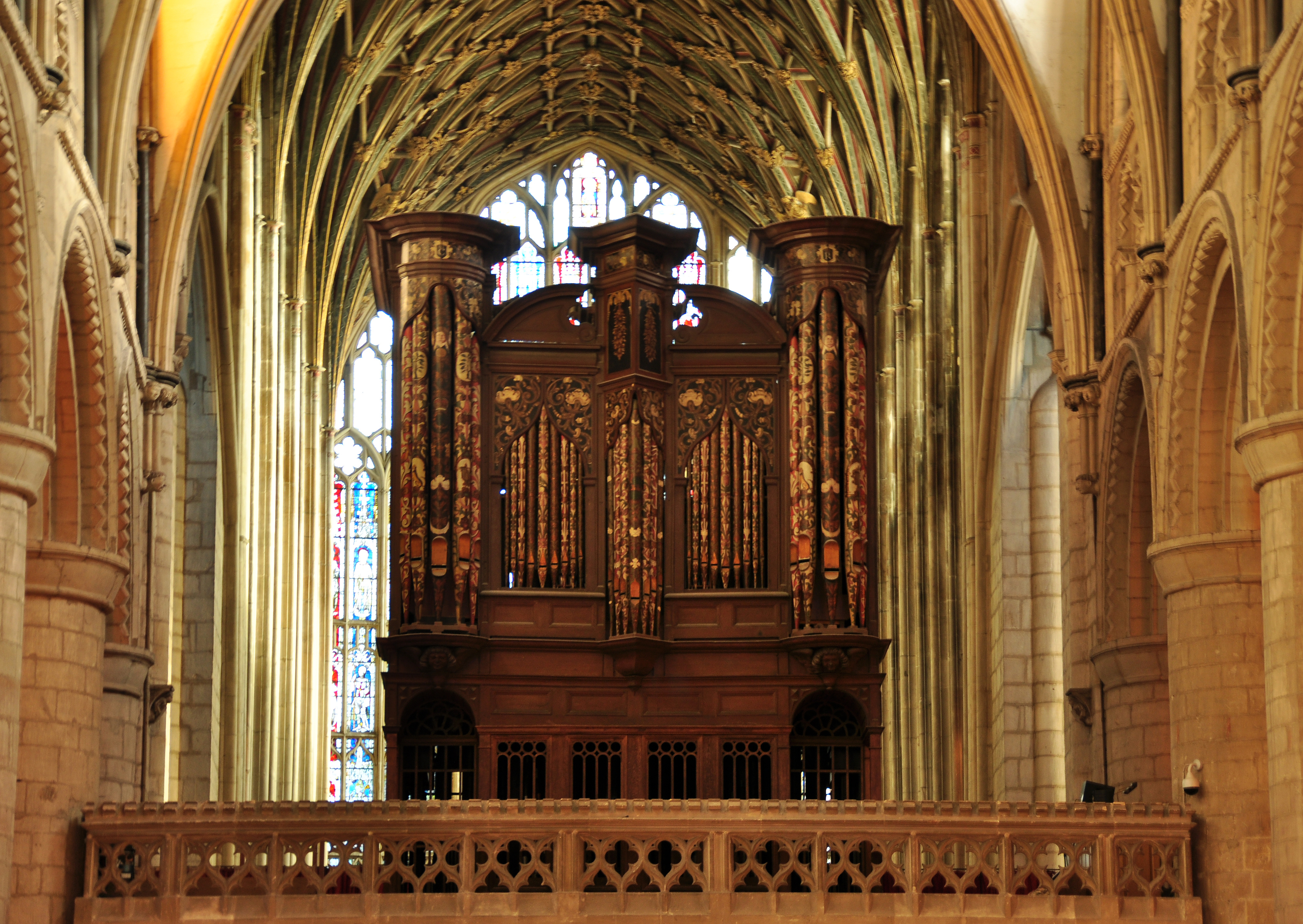
At the Three Choirs Festival, it's perfectly acceptable to hear an interpretation of the piece from a Christian perspective, and why not?  Thus the resounding chords of the vast Gloucester Cathedral organ, with its magnificent "personality". Yes! Organs have unique voices and this one is very distinctive indeed. Though organists travel, organs don't, so it does matter when a player knows the particulars of the instrument as intimately as Jonathan Hope does.  Far too often Mahler 8 performances are diminished because concert hall organs are lesser creatures, and even big brutes like the Royal Albert Hall organ don't have the innately warm character of the one at Gloucester Cathedral.  Moreover, at Gloucester, the choruses are used to singing with this organ, avoiding the problems of balance that can happen elsewhere. The natural affinity between this organ and this combined chorus was a wonder to experience, probably not something we'll hear anywhere else.  Even if the "bells" sounded rather too church-like, again, why not? Gloucester Cathedral is a church, so context is perfectly valid.  It seemed that the bells might indeed have been the bells of Gloucester Cathedral itself, a unique touch. 

The First Part of this Mahler 8 zipped along with such brio that details were lost, but the glorious choral singing and organ were more than compensation. Indeed, this performance, conducted by Festival Director Adrian Partington, a supremely experienced choral conductor, made me realize just how strongly the choral parts are written. Because so many well-known recordings of Mahler 8 were made by conductors with an opera background, we've become accustomed to listening to the piece as if it were quasi-theatre, assuming the soloists are roles in a drama.  That's a valid way into the piece, but its meaning is far more esoteric and mystical.  So I was delighted that, for a change. the soloists, while good, especially favourites like Hye-yoon Lee and Catherine Wyn-Rogers,  didn't overdominate.

After the tumult of the First Part, Partington observed the pause for reflection before the long, ruminative section where the orchestra sings, not the voices.  Although this section isn't showy and no voices are present, it is critically important to meaning. "Accende lumen sensibus" refers to the concept of light rising upwards linking to heaven, illuminating those it touches, cleansing them of ego, selfishness and petty concerns.  Truly original creativity, like meditative prayer, comes when the pollution of toxic detritus is expunged. Goethe's anchorites live in humble isolation, communing only with  God.  Thus this part is like quiet prayer. It's not an interlude but the soul of the symphony.  Please read my article Mahler, silence, creativity and Holy Saturday.  (click for link) Since Partington is a magnificent choral conductor, I was happy enough that, on this occasion the Philharmoinia Orchestra didn't play with the refinement they gave for Esa-Pekka Salonen, their usual Chief, when they did Mahler 8 in 2014, when some parts of the choirs seemed to be thinking about their chorus masters, not following the conductor.  

With the return of the choruses, this Three Choirs Mahler 8 flared once again into blazing glory.  Such wonderful singing banished all quibbles.  In this final section, the Veni Creator Spiritus shone magnificently. The Three Choirs Youth Chorus sounded particularly fresh and innocent, underlining the critical importance in this symphony of concepts of birth and renewal: creativity as continuity of life as well as of artistic regeneration.  Some of the boy singers looked extremely young. I very much  appreciated their vulnerability and piping English accents. Perhaps one day these boys will carry on the Three Choirs Festival's values, whether as musicians or in the audience.

Gloucester Cathedral has the strongest acoustic of all the three Cathedrals, maximizing the impact of this performance. "I could hear the rehearsals" said the Dean, "in my garden".  In a way I was glad to be seated where one of the vast Gothic pillars shielded me from the force of direct impact, so I could hear the music, not just the noise.  This piece was dubbed "The Symphony of a Thousand" not by Mahler, but by a canny promoter who knew that some audiences prefer quantity to quality.  In a relatively small performance place like Gloucester Cathedral, a little goes a long way.  But the choirs were so wonderful, and their enthusiasm so infectious, that I was carried away by the "spirit of creativity".

Bottom photo: Roger Thomas

Thursday, 28 July 2016

Potato Fudge and the Proms


Will things start livening up at the Proms next month? In July, the fare was predictable, with rehashed reheated leftovers which were good first time round but not so exciting second time round.  Maybe this pasteurized blandness represents the Future of Classical Music, as defined by government thinktanks and BBC suits who think the public can't cope with real sustenance. Sir Henry Wood must be rolling in his grave!  He believed that the public would rise to the challenge of interesting work, and that ordinary people could develop listening skills. Now, instead, we get pabulum like Ten Pieces, catering to the lowest possible denominator, and to those who don't even want to pay attention.  "We don't like experts!" the end of civilization?

So here we are, coming to the halfway point in this year's Proms, what do we have ahead?  On Monday 1/8 I'm looking forward to John Storgårds conducting Nielsen 5 and Jörg Widmann's Armonica for glass harmonica. On 4/8,  Oliver Knussen conducts Reinbert de Leeuw Der nächtliche Wanderer. On 8/8 Esa Pekka Salonen conducts Schoenberg A Survivor from Warsaw, with Mahler's First  – interesting combination! Janacek The Makropulos Affair on 19/8 will be a high point, with Karita Mattila and Jiří Bělohlávek.  I'll be listening to a lot (eg Mirga Gražinytė-Tyla with the CBSO on 27/8) but, while there are good things, there's a lot of not so good and little that's thrilling.  Some odd mismatches between performer and repertoire. 

So on to September when things wake up. Baldur Brönnimann conducts a very interesting late nighter on  2/9 with Ensemble Intercontemporain, and on 4/9 Mark Elder conducts the OAE in Rossini's Semiramide. In the Last Week, the Big Bands: The Berlin Philharmonic, Staatskapelle Berlin and Staatskapelle Dresden with Rattle, Barenboim and Thielemann. The media are playing this up as some kind of battle, but that's silly. People really into music don't need to play games with musicians as pawns. At this level there's no "competition", just excellence.  All is not lost, yet.

Wednesday, 27 July 2016

Prom 15 Anthony Payne, RVW

At Prom 15, the world premiere of Anthony Payne's Of Land, Sea and Sky, with Andrew Davis and the BBC SO. A strange, but fascinating piece with clear antecedents in the British choral and orchestral tradition, yet, like Payne himself, utterly individual, even idiosyncratic. A landscape of visual images described in sound, yet also a landscape intuitively felt and interpreted.  It begins quietly, eddying ripples of sound, a woodwind calling us forward, and then the words, "Of land and sea...." from the male chorus and "and sea and sky, and water" from the women. Immediately I felt a sense of confluence, of swirling forces separate yet moving together. "Calling, calling" the voices sing. But in the percussion we can hear the thud of thundering hooves. "Galloping, galloping" sing the chorus. The image apparently is of wild horses in the Camargue, running through waves on a windswept beach.

For a moment the music stills and changes direction. This time bright, clear shards of sound dissipating into smaller, shining fragments.  The voices create swathes of shimmering sound: a pity that diction smothered words but that added to a sense of mystery. Brasses thrust us along swiftly, then tense, pumping ostinato, swept away by trumpets, contrasted with circular pools of resonant sound, swelling and rising like a giant wave. .As an impressionistic piece Of Land, Sea and Sky engages the imagination, which is more than can be said for many works. Phrases such as "like symphony" pop out like signposts in a  landscape of shadows and illusions. (On re listening I think the abstraction increases as the piece goes along : assessing it in  pictorial terms might be a big mistake)  Towards the end, the choruses sing "Of land and sea", but I don't think we're back at the beginning at all.  Like the landscape, something has changed in us, if we've been paying attention.

Ralph Vaughan Williams Toward the Unknown Region (1906-7) reaffirmed Payne's connection to very deep roots in the English tradition, which perhaps spring from the transcendentalist poets of the 17th and 18th centuries, where conceptual ideas - not necessarily religious - underpin expression.  "Walk out with me " wrote Walt Whitman, "Towards the Unknown Region, where neither ground is for feet, nor any path to follow".  Mystical concepts, yet ideas which very much connect to the music of our own times. Luigi Nono, for example, might have understood, given his thing for the blurring of boundaries between land, sea and sky. He'd have got Payne, I think. . In 1906/7, RVW was setting forth, too, leaving behind the stolid certainities of Charles Stanford, and finding his own voice via Ravel. Andrew Davis, the BBC SO and the BBC Symphony Chorus at their finest.

Prom 15 might have been an opportunity for the BBC to explore this strand in music in greater depth. Tchaikovsky's The Tempest actually worked very well, with its magical romance, beautifully realized. But the Powers That Be want Box Office  rather than challenge. Hence Max Bruch's Violin Concerto noi 1 in G minor, which never fails to delight, even in a non-challenging generic performance.  Maybe Ray Chen and his followers are the future of classical music, but folks like me would prefer accounts with more character.

Tuesday, 26 July 2016

Les Indes galantes Munich - dance and intelligence


Rameau's Les Indes galantes is shockingly audacious, defying boundaries of time and place with exuberant high spirits.  William Christie's staging with Les Arts Florissants (Andrei Serban 2004) is so stunning that all other contenders are dazzled by its glory.  But Sidi Larbi Cherkaoui's production at the Prinzregententheater Munich, via the Bayerisches Staatsoper and BR Klassik, rose to the challenge, staging it with a different perspective, while also remaining true to the adventurous spirit.  If anything, this new approach confirms Rameau as visionary.  First, be prepared for a surprise.

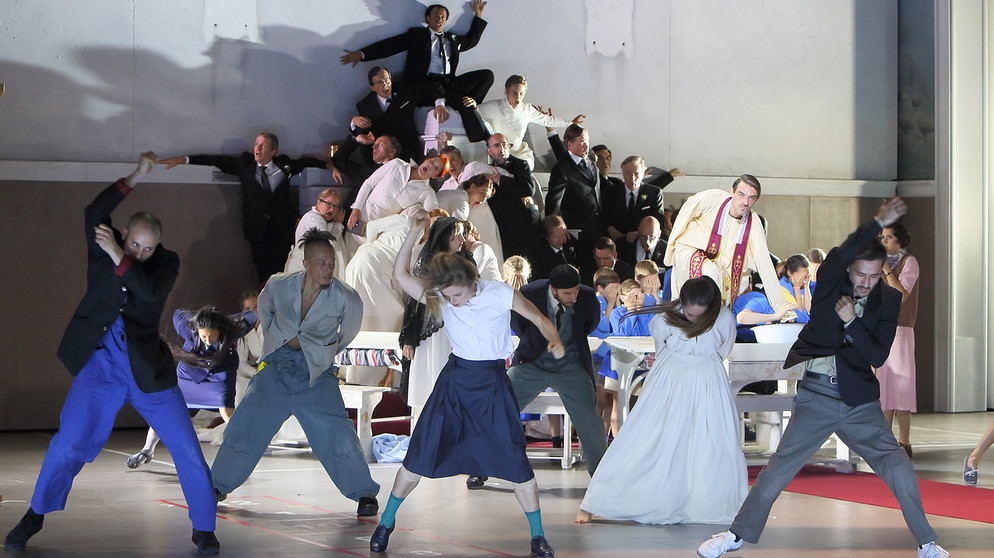
What are Hébé, L'Amour and Bellone doing in a schoolroom?  But in a classroom, kids learn about the world. And Les Indes galantes is about the world, and universal themes of life and love. Hébé  (Lisette Oropesa) is the "nice" teacher confronted by an apparition in drag. Will Hébé's charges be confused by Bellone, his trumpets and rousing cries of "La Gloire vous appelle" ?  Goran Jurić in travesti isn't exaggerated, though hardly comforting, for he represents opposing systems.  This Prologue, (dramaturges Antonio Cuenca and Miron Hakenbeck)  reaches much deeper than the nudity in the Laura Scozzi production for Christophe Rousset and Les Talens Lyriques in 2014, since it deals with the tensions that underlie the plot, or rather non-plot, reminding us that Les Indes galantes is allegory: entertainment to engage the mind as well as the senses.  Rameau's audiences, versed in the classics, weren't stupid.  In idealized allegory, conflicts are resolved by L'Amour (Ana Quintans).

Brilliantly, the idea is followed through in each of the four Entrées and in the ending, unifying the whole, bringing out connections. The world, after all, is "one", whether you're French, Spanish, Greek, Inca, Turk or Native American.  For example Osman  (Tareq Nasmi) appears in a long tunic over trousers. Not non-European attire, but in these xenophobic times, "alien" outfits suggest danger, even more so, perhaps than they did in Rameau's time. Bellone cross-dresses, parodying the usual trouser-role meme, and pretty much the whole Entrée of 'Les Fleurs' predicates on mistaken identity.  The message is clear: don't judge by superficial appearances.

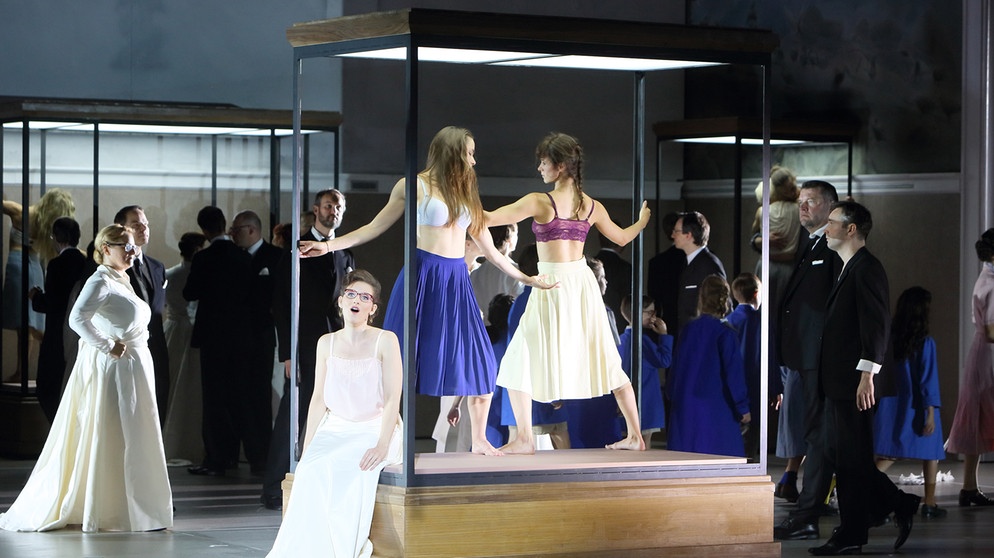
Dance is absolutely integral to Rameau, so this new production is valuable, too, in its emphasis on movement as abstract expression.  In 'Le turc généreux'  singers and dancers move in and out of structures which resemble display cases.  Slave traders? People treating each other as objects of consumption ? Image or reality? The lustful Turk turns out to be the good guy after all, uniting Émilie (Elsa Benoit) and Valère  (Cyril Auvity) so they can go home, where they belong. Despite their differences, Osman and Valère are mates. "Au plus parfait bonheur il a droit de prétendre, Si la vertu peut rendre heureux"
    
In 'Les incas du Pérou', Anna Prohaska is magnificent as Phani, singing with smouldering intensity, conveying with her voice the conflicts  she must feel betraying her heritage for love. So Huascar (François Lis)  is a Catholic Priest and not an Inca High Priest? Again, it's not robes that make a man malevolent.  We don't need Inca kitsch to remind us that priests of all types are fond of invoking divine retribution on those who question.  And symbols like the sun and blood sacrifice occur in many religions.  Think on that when blaming the Alien Other.  Husacar thinks he has an exclusive hotline to God. "Triomphe soliel" was delivered with suitable fire and brimstone. The volcano explodes but even more explosive was the interpretation. This 'Les incas du Pérou' drew its power from the potent, provocative ideas inherent to the plot.  Rameau might not have dared question the Church publicly, but a whiff of revolt rumbled in the background. exploding in the Revolution which came only 50 years after the opera's premiere.

Dance also brought out the deeper levels of 'Les Fleurs', without resorting to prurience or bad taste. The "Flowers" here are the secluded women oif the harem, waiting to be plucked.  Thus the stylized hand and foot gestures, nodding heads and swaying gestures, Middle Eastern dance sublimated.  Tacmas (Cyril Auvity ) loves Zaïre (Ana Quintans) the slave of Ali (Tareq Nasmi ) who is loved by Fatime (Anna Prohaska).  There would have been practical reasons for Rameau to employ the same small group of principals, but interplay of familiar voices also contributes to the sense of disguised identity. The correlation between singing and dancing was particularly lively.   Flowers are fertilized by butterflies, which shift-shape, and whose fragile beauty soon fades. The beautiful "Papillon" aria was exquisite, made even more so when followed by the image, shot from above the stage, where the dancers move in formation, swaying awkwardly like the segments of a caterpillar.  The sub-themes of renewal which connect the apparently disparate parts of  Les Indes galantes are subtly depicted by minor details of cleansing and replenishment which come to blossom fully in 'Les Fleurs'.  Sidi Larbi Cherkaoui's choreography is so vivid that it evolves into directoral thinking, much more effectively than some theatrical directing translates into opera.

Perhaps symmetry comes naturally to a dancer, but the staging of the Final Entrée, Les sauvages connected beginning to end with poise and elegance,  We returned to the "classroom", which isn't at all a bad metaphor for the innocence of childhood, and the idealized simplicity of "natives" living in harmony with Nature.  The wonderful "Forêts paisibles".  Ivor Bolton doesn't conduct with the vivacious finesse of William Christie or even with the flair of Christophe Rousset, but his Handelian solidity works well with the down to earth physicality of Cherkaoui's choreography.  The excellent singing and dancing more than compensate. Cherkaoui's interpretation gets to the soul of Les Indes galantes with great intelligence and sensitivity.  We need more of this, especially in these times.