Saturday, 28 October 2017

Sakari Oramo Sibelius 3 Ravel Franck Schmitt

Sakari Oramo's saga through Sibelius with the BBC Symphony Orchestra at the Barbican London  got into stride with Sibelius Symphony no 3 op 52 (1907).  Sibelius symphonies we can hear any time, and Oramo's very, very good, so the challenge lies in programming. How do the combinations work to enhance Sibelius? In the first concert in this series, the answers were obvious - the perennial Sibelius 5 with Richard Strauss and Alban Berg.  In this second concert we heard Sibelius  with César Franck's Symphonic Variations, Ravel's Piano Concerto for the Left Hand (soloist Jean-Efflam Bavouzet)  and Florent
Schmitt's Symphony no 2 op 1957. Ostensibly a curious choice, but on reflection, rather interesting.
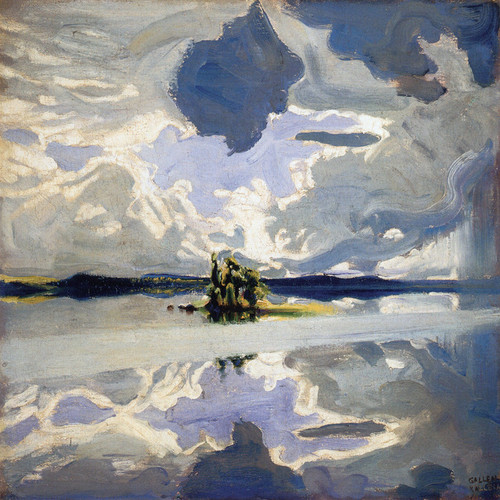
Sibelius Symphony no 3 isn't as omnipresent as Sibelius 5 and 7, both so remarkable that they are frequently recorded together, though less often performed together live :  an experience too overwhelming for either audience or orchestra.  Sibelius's Third, like his Sixth, is more rarified, almost more "Finlandia" than Finlandia (1899).  Its impulse is distinctively"Finnish"   But it was written long before Finland was free from Russia.  Thus the political and artistic need for a uniquely Finnish identity. The revival of interest in the Kalevala and in the heartlands of Karelia shaped Sibelius's artistic imagination.  In this third symphony, Sibelius engages with an aesthetic that seems inspired by open horizons, clean air and fresh springs flowing from melting ice, water, a landscape where people live close to Nature, uncorrupted by the excess of "civilization".  Hence the picture at left of Lake Keitele, by Sibelius's close friend Akseli Gallen-Kalleja, painted in 1905, and his painting Clouds above a Lake, above, from the same period.  Notice the almost abstraction, capturing essence with free spirited spontaneity. The complete opposite of 19th century over-elaborate excess. A similar aesthetic informed the Secession first in Munich, then Vienna, and influenced the Impressionists and Art Nouveau in France.

Sibelius Symphony no 3 is relatively short, three movements in which ideas are compressed with a clarity which even harks back to Classical Antiquity as defined by 18th century idealism.  The symphony begins with a theme which will later become almost a Sibelius signature - rushing, angular rhythms for strings, celli and basses lit by single calls from brass, leading passages of exquisite simplicity where individual, woodwinds sing.

Oramo defined the pace with vivid energy, so details shine. The suggestion of bells (on a cart?) , spiralling figures that fly like objects blown in a breeze.  Strong chords, before the music subsides into chorale-like serenity. The mood in the second movement is quieter and more mysterious. Single notes plucked with deliberate clarity, shimmering, dark hued strings, lit by single instrument figures dancing elusively. The flowing rhythms returned, more muted, but persistent.  Wonderful symmetry between the first two movements, elegantly  executed, which are in turn reflected in the final movement.  Edgy rushing rhythms resolve into firm blocks of sound then to a glorious coda which shone with positive affirmation.  Clarity over chaos,  multiple life forms operating in cohesion. Like Nature itself.

Thus the wisdom of pairing Sibelius 3 with César Franck's Symphonic Variations, where themes differ and vary yet hold together, supported by coherent logic.  Flowing energy in the performance too. In each concert in this series, a concertante piece, so this time one for piano, in Ravel's Piano Concerto for the Left Hand . Jean-Efflam Bavouzet is relatively new to the piece but played with great depth of feeling, which I appreciated, since the piece was written in response to tragedy. Paul Wittgenstein lost his right hand in war. His career would have ended were it not for friends like Ravel. (On the BBC rebroadcast, it was mentioned that Bavouzet's mother, who loved the piece, died a short while ago). It's a virtuoso piece which requires superb technique, proving that a good player can do more with one hand than some can do with two. Florent Schmitt's Symphony no 2 op 134 (1957).  received an infinitely better performance than it got from Leif Segestam. Oramo has clearly thought about the piece, analysing its merits, and the BBCSO is grande luxe compared to some of the orchestras who've done Schmitt.  (read my piece on Antony and Cleopatra here)  Schmitt's best works are those where florid colours conjure images of exotic luxury but the Symphony is lower key. It's by no means "old fashioned", since it reflects a lot of music from the 1930's to 50's and later. Glitter rather than 24K.  It's pleasant but without the inventive flair of Stravinsky or the panache of Korngold.  At the age of 87, Schmitt might have been enjoying a retrospective of his own, which is fair enough.

Coming up in the BBC SO Sibelius series :

29/11 Sibelius 6 & 4 with Anders Hillborg Violin Concerto

6/12 Sibelius 1, Press Celebrations and works for cello

6/1/18 Sibelius 2 & 7. Luonnotar (Anu Komsi) and Aare Merikanto Ekho

Thursday, 26 October 2017

Not Hollywood - Eisenstein October LSO Barbican


Tonight at the Barbican the London Symphony Orchestra provides live soundtrack for Sergei Eisenstein's silent movie October - Ten Days that Shook the World presented by Kino Klassik in a new edition of the film made in 2012.  The LSO will be playing the original music, composed by Edmund Meisel (1894-1930), not the better known music by Dmitri Shostakovich written for the revival of the film for the 50th anniversary of the revolution.  This performance is significant because Meisel was an extremely important figure in the very early years of cinema, writing scores for several films, including Eisenstein's Battleship Potemkin and Arnold Fanck's The Holy Mountain and other works still being unearthed.   Hollywood most certainly didn't dominate early film and music, for early film was decidedly not "Hollywood".

Meisel was connected to experimental film makers like Walter Ruttman who created Lichtspiele, using the medium of film as if it were pliable, like painting, to create abstract works. Think Cubism as movie.  See clips of Ruttmann's early work here.   Ruttmann's Lichtspiele were Like music! . They were made in co-operation with Hanns Eisler, who wrote music to be played live as the films were screened.  So again, the concept of music combined with film before the technology to make sound movies was even possible.  Eisler's contribution to music and to film goes much further than agit prop.  Yet again, he's a reminder that there's more to cinema than Hollywood, even in Hollywood.

 Meisel also wrote the music for Ruttmann's Berlin : Symphony of a Great City one of the most important films of its era, still an icon.  Why a symphony of a Great City?  Early film makers thought in terms of music, often describing scnes as "acts" as if music drama.  Ruttmann's film isn't narrative, but literally a portrait of the city, filmed on the streets, real people, real events, lovingly observed. The raw shots were edited and ordered much in the way that the sounds of an orchestra are put together by a composer writing music.  The subject is the city itself, the drama the drama of urban life.   Ruttmann employed innovative techniques  like odd angles and perspectives, expanding the idea of visual expressiveneess.  

Berlin : Symphony of a Great City is more than a movie, it embodies the concepts of modernism in art, film and music. It's not a film in theusual sense of a narrative motion picture.  Multiple, diverse images are used like themes in music.  They're layered and juxtaposed
like musical ideas. The images are grouped in several main "movements"that as a whole follow a trajectory from morning to night. A snapshot of the life of the city. Please read my analysis of this wonderful work HERE, describing the structure and individual images some of which aren't readily obvious.

Early audiences were often more used to music than movies, and several early films unfold as "movements". The full title of Nosferatu is Nosferatu : eine synfonie des Grauens, "a symphony of horrors". But Berlin : Die Sinfonie der Grossstadt develops the idea on a grand scale. Because it's abstract, much more detail is possible, and thus more possibilties of interpretation Truly "modern" art.  

And of Eisenstein's October ? It, too, was innovative, inspired by the new Soviet Union's brief fascination with futurism before Stalinist conservatism froze the tundra of Russian creativity.  Kaput to the dreams of the revolution and ideas of new art !  Shostakovich's score is thrilling, but Meisel's connects more to the spirit of the era,

Like Ruttmann, Eisenstein uses film like painting, creating collages and images applied in  painterly ways.    A statue of the Tsar is seen outlined against the sky. It's torn down by diagonal ropes.  A crowd cheers, arms raised heavenwards. Scythes are seen, en masse. Close ups of soldiers faces, grinning, then suddenly, we're in an ornate palace, with elaborate mosaic floor tiles. Cut to angular shots of heavy machinery, to images of starving children dwarfed by huge columns of stone, to shots of a crowd waiting, at night for a train. "Ulyanov ! It's him !"

Diagonals fill the screen, shaking up flat, "natural" order.  Flags and banners wave, crowds march, individuals lost in orchestrated movement.  Gunshots are fired. Suddenly the tightly packed march disintegrates,figures running wildly across a huge city square.  Cannons, horses fallto the ground, crippled.  The gates of a huge bridge open, magnificent abstract lines : but a horse is impaled in the machinery; the modern age versus the past, in one horrific image. In a palace, the Provisionalgovernment  gathers. Officials walk up and down grand staircases, pre-dating the works of M C Escher.  Hurried footsteps, leading nowhere.When the words "For God and country" appear in subtitles, we see, notOrthodox depictions of God but alien Gods - primitive sculptures,Buddhas, Gods so primitive and atavistic that they can't be identified.Tanks arrive to crush the revolution. What we see are rolling tracks, machines of destruction  terrifying because they are impersonal.  Close ups of guns and individual bullets : the proletariat will fight back.

The bridge across the Neva is raised again,  but a ship- with fourimpressive funnels. We see sailors, and cadets marching, as the massive
gates of an imperial palace are pulled shut.  A  half naked woman cavorts on the billiard table of the Tsar.  What's going on ?  Through a
collage of images,   Eisenstein recreates the tension and uncertainitythat people must have felt in the upheaval.  This is cinematic techniqueas art, not unlike the fractured visuals of Cubist painting.

The Bolsheviks mobilize. Eisenstein shows images of hands operating telegraph machines, of armed men rushing up and down staircases, men with bayonets. swathed in smoke.  A ravaged looking woman looks up at a marble sculpture : without explicit dialogue, is Eisenstein suggesting the idea of redemption through the high ideals that art can symbolize ? Or something completely different ? Because the nature of art is notnecessarily specific, but the opening up of possibilities. Foir all we know, that's why Stalinists needed conservative "realism" where no-one needs to think.

The army declares for Bolshevism: a forest of bayonets. Wheels are turning, the machine surging ahead.  Machine gun clips fire, and
cannons, in such rapid sequence that the images hardly have time toregister.   Troops swarm into the palace, ascending the marble
staircases : we can "hear" the sound of their boots in short, sharp images.  The Revolution is won ! we see the faces of clocks mark the
moment, in Petrograd, in Moscow, around the world.

Tuesday, 24 October 2017

Sunday, 22 October 2017

Julian Anderson Total Immersion Barbican


Julian Anderson Total Immersion at the Barbican with the BBC SO. yesterday.   The evening programme was a well chosen retrospective.  Anderson is prolific to a fault, so he can be uneven, so this was a good opportunity to relive his Greatest Hits.  Nearly all these pieces are available on the NMC recording The Book of Hours (Knussen, Sakari Oramo, Martyn Brabbins etc) so it was good, also, to hear them conducted anew by Edward Gardner, who started conducting Anderson even before he started at the ENO.  Indeed, Gardner conducted Anderson's Symphony in his very first concert at the Barbican 10 years ago (see my review).
Despite its non-committal title, Anderson's Symphony, too, was inspired by art and nature; in this case Axel Gallen-Kallela’s painting of Lake Keitele. It doesn’t matter what the picture looks like,, since the piece isn't literal but an abstract mood piece. For a full minute, all you can hear are vague sounds, like the rushing of a stream almost at freezing point. It’s wonderfully impressionist – you imagine the cold and the stillness, the wind, birds flying overheard. Ultimately, though, it’s the inventive, multi-layered orchestration that entrances. Flurries of harmony take off in different directions, and melody starts in one part of the orchestra, to be completed in another. Symphony isn’t formally divided into parts, but the development is fascinating. 

Anderson's Eden (2005) was inspired by Brancusi’s sculpture ‘The Kiss’, where two solid figures become one monolithic whole through their kiss.  Despite the plangent textures, this isn't the Eden of the Bible so much as Adam and Eve before the Fall, animal instincts without knowledge of sin.  It's not a literal representation.   Viola and cello curlU sensuously around each other, embracing, so to speak, in melody. The spirit is passionate, yet austere and simple, as clean as the lines of Brancusi’s style. As the orchestra takes over, the melody expands into something much more open and primeval. Anderson’s use of "medieval" references evokes the timeless imagery of ancient sculpture.
He uses "hockets", melodies shared out between two or more instruments, which create a fluid sense of movement. It evokes thoughts of medieval part-song, as well as of the pealing of bells. The unsteady timbre of non-tempered tuning adds to the sense of strange unworldliness.


Eden and Imagin'd Corners are companion pieces, which explore the potential of non-tempered tuning in the latter case for five horns and orchestra. These make a more "natural" sounding intonation.. Early music in a sense, but also verging on atonality while connecting to a more ancient tradition.  Four of the soloists move from different parts of the hall in a pattern that recreates "imagin’d corners", while one remains ensconced between brass and woodwinds. In this exuberant piece, the trumpet calls out, answered by the horns in joyous non-harmony.
Best of all, the most recent work (2015), Anderson's In lieblicher Bläue based on the poem by Friedrich Hölderlin.which inspired Hans Werner Henze's Kammermusik 1958 (Please read my review of the landmark new recording by the Scharoun Ensemble Berlin).  Anderson's version is scored for violin and orchestra (soloist Carolin Widmann) . Though wordless, it's almost music theatre since Widmann moves around the performance space coming in and out of view, eventually turning her back on the audience.  Channeling  Hölderlin, isolated in his visionary fantasies, cut off from the "real"  world, not giving a damn !  Thus the single chords, the violin tentatively "exploring" space, responding to the "moonlight" shimmering in the orchestra  first with long stretching lines. then with vivid bursts of excitement.  A huge arc of orchestral sound, swirling and spinning round as if the moon were illuminating the poet's troubled mind. Delicate touches of poercussion, bell-like sounds but also violent chords.  The violin emerges again, long beautiful lines behind which the orchestra rumbles disturbingly.  Then a flurry of single plucked notes: too disjointed to form melody. Hölderlin's fragmented mind.  Scurrying figures and high tessitura. Squeaks of excitement ?  Darker angular chords in the orchestra and elusive figures, half-formed and a more haunted terrain.  The violin (and Hölderlin)  remained unperturbed, long serene lines lit by "moonlight". No resolution. Gradually the textures thinned out and the violin sang , alone sound so high thatn it dissipated into silence.  

Chamber Mahler Wagner Zemlinsky Lyric Symphony

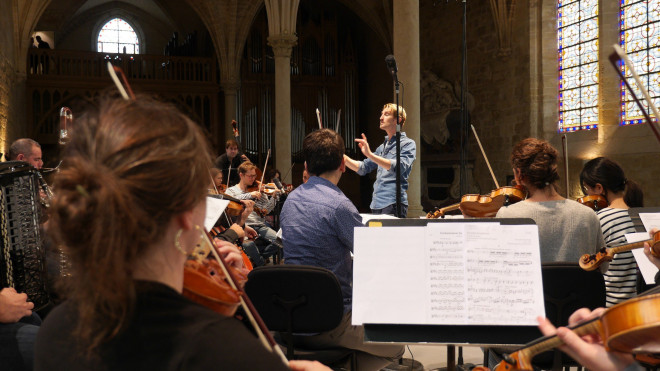
Secession Orchestra dirigé par Clément Mao-Takacs à Royaumont (© DR)

A very unusual concert last month at Royaumont in the L'Île-de-France,"Jardins d'amour", for all three pieces deal with gardens, lushness and enchantment. - Mahler Blumine, Wagner Good Friday Music and Zemlinsky's Lyric Symphony  with the Secession Orchestra, conducted by Clément Mao-Takacs with soloists Stéphane Degout and Elsa Dreisig, now on France Musique.  Royaumont, despite its royal connections, was a Cistercian monastery, not quite the place for full-scale Wagner, or Zemlinsky or Mahler, so this was an opportunity for close-up, detailed listening.

It was also a good way to hear Mahler's orphan Blumine (1884) written as incidental music for the play Der Trompeter von Sakkingen, now lost.  At first, he incorporated it into his Symphony no 1, but discarded it. It wasn't published together with the symphony, and was also thought lost  until Donald Mitchell discovered the manuscript in 1967.  Though it does get played, it doesn't really fit well with the symphony, so is generally heard as a stand-alone. It's a very early piece which has its charms but is also rather slight. As Prof. Henry-Louis de La Grange said, soon after the discovery,"It is the music of a late-nineteenth-century Mendelssohn, pretty, charming, lightweight, urbane, and repetitious, just what Mahler’s music never is." All the more reason for enjoying it as an entrée. The instrumentation is so spare that it's effectively a chamber piece anyway.  The horn call, which will become a Mahler signature, rises above a shimmering background of strings, til it's joined by oboe, clarinet and flutes in serenade. Eventually the textures thin out, with a long high note hanging in the air. Wagner's Good Friday Music from Parsifal fares less well in chamber reduction. Though it's suitably reverential it's not easy to capture the power of the original.  Nonetheless it connects well with the theme of regeneration central to Zemlinsky's Lyric Symphony, the highlight of this programme, in the 2012 arrangement by Thomas Heinisch.   .

Regeneration and renewal, the handing on of enlightenment, even after death. Although Zemlinsky's music is lush, Tagore's texts don't depict a love affair in the usual romantic sense.  The music is sensual, but the longing here is for higher goals than earthly lust. At the end, the Prince sings  Ich halte meine Lampe in die Höhe, um dir auf deinen Weg zu leuchten. (I hold my lamp up high to light your way. .Lovers must part, for life has a higher purpose.). Zemlinsky compared this work to Mahler's Das Lied von der Erde , wishful thinking on his part since there really aren't many points oif comparison apart from the exotic setting.. But what they do share is the idea that things go on, even when one generation gives way to the next. Please read my piece on what is still the finest recording of the work : Eschenbach, Goerne, Schafer. I've written lots on this symphony and composer. 

Thus the piece adapts well to chamber arrangement where the emphasis goes towards essential meaning, as opposed to lushness for its own sake, which throws some performances way off beam. No problem here, with cleaner textures, and the soloists, Elsa Dreisig and Stéphane Degout, whose clear, pure baritone captures the images of light in the text.   This new arrangement, published by Schott, should have a place in performing spaces where a full orchestra isn't feasible, because it's very true to the original.

Heinisch writes "To my surprise, it was relatively easy to arrange the first three movements for ensemble, as the orchestra never goes beyond the traditional four-part harmony, with a texture that – interestingly enough – is closer to Brahms than, for instance, to Schönberg. From an instrumentation perspective, the exquisite slow fourth movement “Sprich zu mir, Geliebter” (Speak to me, my love) in the middle of the work poses a challenge, given the subtle separation of the string parts. As the string parts are not played by several instrumentalists, it was necessary to assign some of them to the harmonium or accordion (either can be used in my version). I feel that this movement has lost none of its mysterious charm through this alteration. It was also necessary to make changes to the short yet massive fifth movement. By introducing the shrill E-flat clarinet, which does not feature at all in the original, Ihave attempted to do justice to the abrasiveness and corporeality of this movement."  


Definitely worth a listen ! 

Friday, 20 October 2017

Czech Philharmonic Ochestra - Hrůša Shostakovich Mahler 4


The Czech Philharmonic Orchestra's 122nd season opened with Shostakovich and Mahler, conducted by Jakub Hrůša.  Interesting background to this concert, given the recent announcement of Semyon Bychkov as Chief Conductor.  Memories are still fresh of last year's opening concert where Jiří Bělohlávek conducted a golden, autumnal Mahler Das Lied von der Erde  (read more here)  uniting the Czech Phil's characteristic style with  Mahler, who was born in Bohemia, but was not a Bohemian composer.  Hrůša conducted the Czech Phil's memorial to  Bělohlávek in June. With Bychkov, the orchestra's management may be seeking a new style  that will appeal to record companies and foreign audiences, and might make good business sense, but Hrůša represents the Czech Phil's unique heritage.

An elegaic quality, then, for Shostakovich's Violin Concerto no  1 in A minor op 77. Leonidas Kavakos created the haunting violin line in the Nocturne so it suggested intense sadness, surrounded as it is with bassoons, low winds and strings.  It's not festive, but there was something firmly resolute in the way the violin line developed, illuminated at the end by harps.  The scherzo is a battle of wits between the violin and various instrumental groups in the orchestra, underpinned  by fast-flowing figures: energy defying repression, angular shapes growing fiercer til they cut off suddenly.  The dark resonance the Czech Phil does so well came to the fore in the Passacaglia, the tuba leading as if in a funeral procession. As the orchestral sounds grew muffled, the violin continued, alone . Kavakos played with firm assertiveness, not afraid to stress the harsher, angular moments in the bowing.which give this section such personality. Thus the burlesque took on demonic character.  Hrůša whipped the orchestra into wild, frenzied dance, so Kavakos’s playing seemed to fly free. Freund Hein, the fiddler of Fate !  An excellent introduction to Mahler's Symphony no 4 where the violin serves a similar function.  Of course Shostakovich was influenced by Mahler but it's delimiting. I wish people would stop using lazy clichés instead of listening and thinking.  There is a strong flavour to this piece which draws on Russian traditions which don't connect to Mahler at all.

A sprightly opening to Mahler Symphony no 4, which emphasized its fresh, vernal nature.  The instruction "ohne Hast" doesn't mean slow but rather "without rush".in order that we might relish  the joys of the present, which inevitably cannot last.  The sleighbells and sprightly figures suggested youthful energy.  Since we know what is to come, this enhances meaning. We can hear the children in the final movement as they once were, making their loss all the more poignant. Hrůša defined the dance-like figures, making connections to the Ländler to come.  The children might even be dancing to a Dudelsackpfeiffer: innocence, not sophistication, is of the essence.   The horns defined "winds" of change and a change of mood but the third movement, marked Ruhevolll,  is the real transition, a purgatory in which the issues of death are resolved into a more perfect "heavenly life".Thus the calm but determined pace and the repeated "waves" of sound.  Horns and winds here were impressive, coloured in Dvořák hues.  Maybe I've been listening to too many Stabat Maters lately, but the connections are perfectly relevant and valid in the context of Mahler's Fourth.   An excellent  climax, timpani pounding, horns blazing, the strings shining, the harps adding heavenly light, the sustained woodwind lines calling out into space.     

In Marta Reichelova, the Czech Philharmonic have a gem of a soloist.  She has a very distinctive voice, balancing sweetness with the enthusiastic boyishness Mahler said he wanted in the part. She's still very young, so retains a natural innocence with just a hint of vulnerability that's very endearing.  She cares about the words she sings.  The child in the song may be dead but he or she hasn't lost its love of the simple pleasures of life.  Better Reichelova's genuine child-like charm than blandness, any day !


Thursday, 19 October 2017

Worldwide Simulcast concert 290,000 players !


Exclusive news ! International simulcast concert with 290,000 musicians. (no idea why that's significant)  In defiance  against unprecedented catastrophes, environmental and political.(not unconnected),  the good people of the world get together to celebrate the true values of this earth  290000 musicians, possibly a billion listening in together. Mahler 8 or Beethoven 9 depending on the local situation, but the basic concept is rebirth, renewal, symbolic unity.  Of course it would make more sense to use resources for humanitarian support but we need more than band aid to address the causes of toxic meltdown. But it was all a dream I had : a bubble that burst the minute I woke. 

Tuesday, 17 October 2017

What Semyon Bychkov will bring to the Czech Philharmonic Orchestra


The news that Semyon Bychkov has been named new Chief Conductor of the Czech Philharmonic has gone round the world, but what does the news portend ?  Jiří Bělohlávek's contract had been renewed to 2020. Though he had been ill for some time his sudden death was unexpected.  The Chief Conductor position is a figurehead who defines an orchestra's profile and artistic direction.

Conductor Chess is not a beauty contest but hard business sense.  In June, the  Prague press was abuzz with speculation. The orchestra's management were quoted as saying the choice would depend on "publiku, nahrávacím společnostem, zahraničním pořadatelům i k ministerstvu kultury".ie the public, recording companies, foreign organizations and The Ministry of Culture.

Among the contenders mentioned were Christoph Eschenbach, John Eliot Gardiner, Fabio Luisi, Kent Nagano, and Jaap van Zweden.  So they wanted big names.   Bychkov's a big name,  but his  advantage was that Decca recentoy recorded the firsts two discs of his Tchaikovsky Project with the Czech Philharmonic in Prague.  Bychkov's recorded with  the Vienna Phil, the Berliner Phil, the Concertgebouw Amsterdam  and otthers, and he's been doing Tchaikovsky nearly all his working life, so the Czech Phil are on to a winner.   Bychkov also conducted Tchaikovsky's Francesca da Rimini, which marked the opening of Smetana's Litomyšl Festival 2017,  Presumably Francesca's next on nthe recording schedule as it was part of Bychkov's  "Beloved Friends" Tchaikovsky Project tour around Europe. (Please read my piece about the Barbican concerts here)

"As is evidenced by everything that he undertakes", the orchestra's announcement states, "Bychkov's commitment to the Czech Philharmonic will be total. In addition to conducting the opening concerts of the season, six subscription weeks and two weeks of studio recordings, he will lead the Orchestra on tour, and at the major Czech festivals and concerts that are an important and integral part of the Orchestra's presence including Prague Spring, Dvořák's Prague and Smetana's Litomyšl."

Bychkov himself has said "The Czech Philharmonic is among the very few orchestras that have managed to preserve a unique identity. In a music world that is increasingly globalized and uniform, the Orchestra's noble tradition has retained authenticity of expression and sound, making it one of the world's artistic treasures. When the orchestra and Czech government asked me to succeed beloved Jiří Bělohlávek, I felt deeply honoured by the trust they were ready to place in me. There is no greater privilege for an artist than to become part of and lead an institution that shares the same values, the same commitment and the same devotion to the art of music."

So what of he orchestra's unique  heritage? One of Bělohlávek's great achievements was to remind the world that the Czech idiom has a distinctive flavour, deriving from the languages of the region.  Interpretation, too, is enhanced by knowing the history and culture.  Of course that doesn't mean you need to be Czech, but it's a good foundation.  Unusually, nearly all the musicians in the orchestra are native speakers, and they also serve the National Theatre, the nation's premiere opera house.  
Together with the news about Bychkov was the announcement of two Principal Guest Conductors, Jakub Hrůša and Tomáš Netopil.   Hrůša is exceptional, with such distinctive flair that he's destined to go a long way.  His Time Will Come !  He's outstanding because he brings intelligent insight into what he does.  Please read here about his programme based on the role of the Hussite Hymn in Bohemian history and music.   In London, we are fortunate that Hrůša is now Principal Guest with the Philharmonia Orchestra.  He's also Chief  of the  Bamberg Symphony Orchestra, with its great pedigree.  The Czech Philharmonic has a new Concertmaster, too, in  Josef Špaček, the youngest concertmaster in  the orchestra's history.

Monday, 16 October 2017

Jonas Kaufmann Tenor for the Ages the Hagiography

+
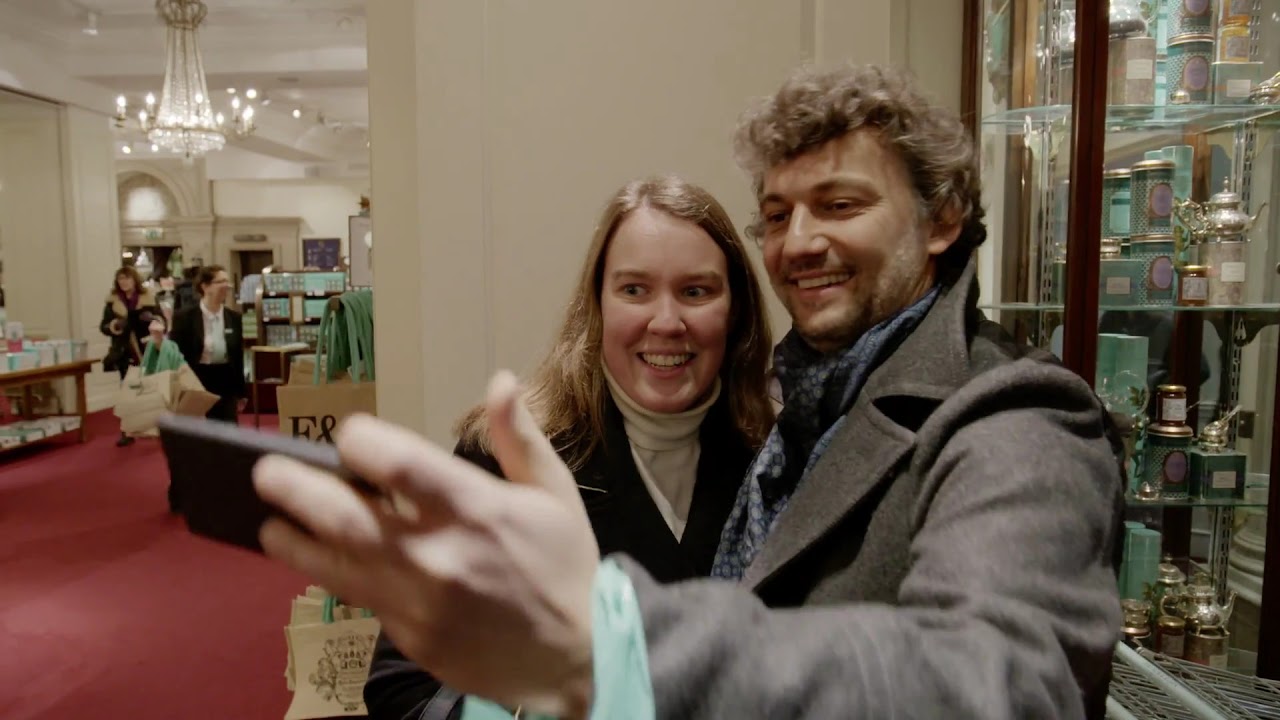
One giant selfie ! Jonas Kaufman Tenor for the Ages, hagiography not documentary. The Curse of Celebrity.  It's not JK's fault.  When marketing hype takes over, the artist becomes Commercial Product, his art incidental by-product.  Kaufmann truly is one of the greats. "A singer who thinks" as Antonio Pappano "with matinee idol presence". Absolutely. We're incredibly lucky to have JK, he's more than just a singer.  But this film, by John Bridcut, is  embarrassing, catering to a market that thrives on hype.  So, love JK, don't love the promo video.
True fans love the artist, and love the art. They don't bitch if he cancels even if they lose money because they understand voice and don't expect singers to deliver like machines.  They aren't obsessives who push themselves above all else,  it's not good for  mental health.  JK is so charismatic that his personality is magnetic, which is something to celebrate.  Nothing wrong with being sexy, either.  But knicker throwing is daft, and the media types who play it up are cynical manipulators, who care more for clicks than quality.
It was good to see the dressing rooms at the Royal Opera House again and recall the buzz that goes into making a production.  Antonio
Pappano's enthusiasm is always fun. And it was good to hear the clips of the Vienna Tosca where things might not have gone to plan.  JK is a genuine artists whose love for repertoire spurs him on to new challenges.  Taking JK to Aldeburgh struck me more as a thing than a serious attempt on JK's part to take on Peter Grimes. But who knows ? JK has the intelligence to realize that it's always prima the repertoire, and how it can be explored. Sadly not many get that  Please read my piece on  JK's Mahler Das Lied von der Erde. No-one is so expert that they know everything and don't need to learn.  But a lot of the script seemed geared towards the mantra that art can't be taken seriously.. 

 Thank goodness that the show was followed by real opera,  Verdi Otello at the Royal Opera House, good enough to convert anyone to the genre if they care enough to listen and pay attention.  Here is a link to the thoughtful review in Opera Today of the live performance. Please read and enjoy. The range lies low, so it suits JK well : If his interpretation wasn't macho, so what ?  Otello's a much more complex figure than macho man. Delicious singing !

.  

Sunday, 15 October 2017

Hans Werner Henze Kammermusik 1958 Scharoun Ensemble

 
"....In lieblicher Bläue" .  Landmark new recordings of  Hans Werner Henze Neue Volkslieder und Hirtengesänge  and Kammermusik 1958 from the Scharoun Ensemble Berlin, with Andrew Staples, Markus Weidmann, Jürgen Rock and Daniel Harding.

A landmark recording because it reflects the Scharoun Ensemble's years of experience with Henze and his music. Their relationship began in 1983, shortly after the ensemble was formed. Kammermusik 1958 is one of their signature pieces. "It  soon became clear" they write "that the composer's interpretation of Kammermusik 1958 was freer than the written score. Henze took some tempi more slowly, which resulted in more songful, indeed quite romantic music". This performance is outstanding, more assured and more idiomatic than the original recording made in November 1958 with Peter Pears and Julian Bream. Though Henze himself conducted that premiere, he was young, still very much in thrall to Britten, Pears and their cliquey circles.  As Henze developed, he became himself, finding the freer, more poetic approach this recording honours.  Obviously the first recording is part of the archive, but this new performance opens horizons: very much in the spirit of the poetry of Hölderlin's text and of Henze's mature work.  This performance  also uses Henze's 1963 revision of the score. 
Kammermusik 1958 is also a landmark because it represents a  period in which Henze made a creative breakthrough.  It connects to the sensuality of Undine and to the esoteric Being Beauteous, but also explores ideas which Henze would develop in later years.  The piece begins with a horn call, which is repeated more quietly, as if in response - a deliberate reference to Britten's Serenade for tenor, horn and strings. Almost immediately, though, Henze breaks into new territory - long, shimmering lines that seem to stretch into endless space. The clarinet leads, like the call of a shepherd's flute sounding out over distance.
From this evolves the first song with its long, arching lines that rise expansively, accompanied by guitar.  The text is abstract, almost impressionistic in its evocation of colour and mood. ."In lieblicher Blue blühet mit dem metallenen Dache der Kirchtum."  Hölderlin in his tower, singing to the moon,  Andrew Staples and Jürgen Rock, eternal troubadours.   Hölderlin's poetry fascinates modern composers.This particular hymn has also been set by Wilhelm Killmayer and Julian Anderson (whose version will be heard  21/10/17 at the Barbican.)  Staples's singing is pristine, for "Reinheit aber ist auch Schönheit". Two Tentos for solo guitar frame the second song in which Henze sets another section of Hölderlin's hymn.  Innen aus verschiedenem entsteht, where the poet connects humble mankind with the vastness of the universe.   "als der Mensch, der heisset ein Bild der Gottheit". Rock's playing creates intimacy, cradling the song with protective warmth. It also recreates the flowing rhythms of Tento I which Henze titled "Du schönes Bächlein"   a reference to images in the text, which resurface in the third song, where the pace picks up.   Staples sings the phrase "Du schönes Bächlein" with minimal accompaniment, as if the poet were transfixed by a vision.
As the voice falls silent, the ensemble emerge in a short Sonata for the ensemble, brisk, turbulent figures that seem to have a life of their own.  "Möcht ich ein Komet sein?" Staples sings.  Key phrases like  "eine schöne Jungfrau" deliciously savoured. The final line "Myrten aber gibt es in Greichenland" shone with intense light, for this epitomizes Hölderlin's  concepts of beauty, from the ideals of antiquity far into the future.  For Henze, the guitar is more than a “Mediterranean" device. It connects to the lute of Orpheus and all that implied in classical mythology.  An inventive cadenza, where the strings dance and cor and bassoon moan, until strong chords in ensemble introduce the next song, "Wenn einer in den Spiegel siehet".  which flows  with great freedom, as if the clarity of the  mirror were drawing ideas into sharper focus.  The tento for guitar, which follows, is titled "Sohn Laios" which connects to the references to Oedipus in this and the final song, "Wie Bäche reißt des Ende von Etwas mich dahin".  Henze  creates a stream of consciousness, weaving text, music, ideas and images together in a stream that's at once elusive yet intriguing.  Hölderlin contemplates the destiny of suffering. "Leben ist Tod , und Tod ist auch ein Leben". Long, plaintive vocal lines,yet oddly  affirmative, merging into a beautiful wind melody, which might suggest ancient flutes. Horn, cor, bassoon and contrabass create mysterious atmosphere, lightened by strings. This last Epilogue, added by Henze in1963, is extraordinarily moving, very "inwards", true to Hölderlin and his visionary imagination.  In the notes, Jürgen Rock comments on the connections between the Oedipus legend and Henze's socio-political views and his work in music theatre.  In some ways, the Oedipus theme might also apply to other things in Henze's life,including his relationship to Britten. 
The Scharoun Ensemble Berlin paired this Henze Kammermusik 1958 with Henze's Neue Volkslieder und Hirtengesänge  (1983/1996) for Bassoon, Guitar and String Trio. Excellent choice, for these extend the idea of Arcadian "Shepherd" songs and fit well with Hölderlin.  These songs were premiered by the Scharoun Ensemble Berlin in 1997, presumably with Henze himself in attendance.   


Friday, 13 October 2017

Oxford Lieder Festival - a Different Rosenkavalier


As part of the Oxford Lieder Festival's 2017 season, focusing on Mahler and his contemporaries, a very different Der Rosenkavalier, with the Orchestra of the Age of Enlightenmnt, conducted by Thomas Kemp. Not Der Rosenkavalier the opera, as we know it, but a screening of the 1926 film by Robert Wiene, the director of The Cabinet of Dr Caligari (1921) and Genuine the Vampire (1920)  Tickets still, available, book here.

The film was made with the enthusiastic support of Richard Strauss himself, who appreciated the power of the new medium of cinema. The film was  first screened at the Dresden Opera House, where the opera itself had premiered fifteen years previously.  It wasn't an "opera movie" in any modern sense of the word, because it was made when movies were silent. In those days, films were accompanied by live performance, with music adapted to the action on screen. Obviously, the music for the opera would not fit. In any case, what would be the point in a silent movie?  Instead Strauss wrote a new soundtrack, based on an orchestra of 17 parts, which mixed extracts from the opera with snippets from other works  including Arabella, Burleske, Till Eulenspeigel and  Also sprach Zarathustra. He  threw in bits of Wagner and Johann Strauss for further effect. Strauss himself conducted the blend live while the movie screened.

The plot follows the novel from which Hugo von Hofmannsthal  derived the libretto, with extra scenes like the battlefield on which the Feldmarschall rides to victory and an opera bouffe in a small theatre, where the principals watch their dilemma being acted out.live while the movie is screened. How will today's opera snobs react?  Methinks they take themselves too seriously, because the "silent" Rosenkavalier is a heady cocktail of good film and fun. It captures the savage satire while dressing it up with visuals so frothy they border on excess. This in itself is a dig at the materialistic culture that values frills, yet turns fresh young women into commodities in a cynical marriage marketplace. Swoon at the wigs and acres of lace, but this is no costume drama.

The technical film values are very high, as one would expect from the director of Dr Caligari (full download here) and Genuine the Vampire (more here). Scenes are carefully planned so they seem like tableaux in some elegant object of art, designed to distract from the grubbiness around it.  The Marschallin's boudoir suffocates in luxury: one imagines that any man kept like this would lose his masculinity. For all her wealth, the lady isn't happy. She sighs and uses exaggerated gestures and poses: Wiene is satirizing popular theatrical excess. Baron Ochs wears embroidered silks but is a boor. He somersaults, arms and legs akimbo like a broken puppet. Later, when Octavian challenges him to a duel, he collapses  though he's barely been scratched. The camera pans closeup on his face and then his mouth, wide as a grotesque sculpture. We can almost hear the screaming.  

Lots more about this Rosenkavalier some years ago, and also, about Robert Wiene, other Weimar films and music, and of course Mahler and his contemporaries, who are my main thing. This is one of the most comprehensive sites on the internet -I am frequently borrowed from, to put it delicately. So check here first for many things.

Thursday, 12 October 2017

Unique Santa Rosa Firestorm Photo

Photo copyright : Emily Wood
From the Tubbs Firestorm in Northern California, this photo above.  The fires are still raging. Embers are falling, swept by the wind, for many miles around.   The fragment above landed on a house very near Coffey Park which was flattened, block after block  Everyone's seen Coffey Park before and after on TV, but this photo is unpublished til now. Credit the photographer !  This is professional quality work.  Someone, somewhere, once had the book, which is now dust. But the fragment speaks.  Enlarge the text, identify the book and imagine who the owner might have been.  A reminder that not everything is up in smoke.  

Monday, 9 October 2017

Secret Lutosławski - Derwid Songs

Witold,Lutosławski Cabaret songs ! Derwid, Lutosławski's "concealed Portrait".  In the jpc.de sale, which often produces interesting things, I found this CD, originally recorded in a castle in Warsaw in 2004 but more recently re-released on Acte Préalable,  a leading label promoting Polish Music. I put it on without reading anything about it. Snare drums, bongos, tenor sax and piano ! 

Yes, "the" Witold Lutosławski  writing songs under the pseudonym Derwid for Polish radio between 1957 and 1963. A touch classier than commercial, pop, resembling the middle of the road  feelgood music that swept the world before  Rock and Roll and Teenage Rebellion.  The last vestiges of the old Lieder tradition, or dance band music, or even both  genres?   They aren't quite as sophisticated as semi-art songs  by poet/composers like Kosma and Prévert or Jacques Brel or Bob Dylan, but they are worth listening to.   Lutosławski's originals, written for voice and piano were apparently very simple, lending themselves to more elaborate orchestration. Orchestral versions were done for Polish Radio who recorded them with famous singers of the era.  This particular version, arranged by the pianist Krzysztof Herdzin translates them as semi-jazz with bluesy riffs -nothing too low down and dirty., because it wouldn't suit the period for which the songs were written.The singer, Mariusz Klimek, is classically trained and musically erudite, and  sings with fluidity and lyrical freedom, which I think suits the composer very well indeed. The songs come over with refreshing charm, the accompaniment adding a bit of exotic spice.   In Cold War Poland this might  have been plenty racy enough ! 

Some of these songs are good enough to stand on their own, as concert pieces.  Warszawski dorozkarz (Warsaw Taxi Driver) (1958) is atmospheric, with long curving lines: perhaps the guy spends a lot of time waiting for custom, observing the world around him. But when he gets a fare, he connects with people and has to rush.  Another good song, Nie oczekuje dzis nikogo (I haven't been waiting for you today (1959) is subtly understated.  It seems casual, even nonchalant, but the voice drops to near whisper, as if the feelings therein are too private to voice aloud. No translations. The singer is so clear that Polish speakers will, get every nuance. The rest iof us have to be sensitive and guess.  And Z lat dziecinnych (Childhood Days) (1962) carefree but nostalgic.   See this site for more details and other recordings.  Definitely an addition to the repertoire. 


Unfinished Business: London Sinfonietta 50 years


"Thank goodness for the London Sinfonietta!" (as the London Sinfonietta quotes me on the front page of their website. True, indeed ! without the London Sinfonietta, music in this country would have been dull indeed. The London Sinfonietta were pioneers, much more than "just" an ensemble. They were a powerhouse of creative, innovative thinking, generating a sea change in musical thinking which continues to flourish today.  Thus Unfinished Business, marking the forthcoming 50th anniversary of the London Sinfonietta, which starts Wednesday 11th October at St John’s Smith Square, starts with Hans Werner Henze's iconic Voices. Henze  himself conducted it with the Sinfonietta on their 1978 recording, re-released a few years ago. Please read my summary here.
 
Henze was closely associated with the London Sinfonietta who played a lot of his music, composer and orchestra both defined by the events of 1968.  They hosted a major retrospective to mark his 75th birthday, which is when I  met him.  He was a lion, but kind hearted enough to be nice to a nobody like me.  Henze is dead, but not forgotten. Currently I'm enjoying a new recording of his Neue Volkslieder und Hirtengesänge  and Kammermusik 1958 with Andrew Staples and the Sharoun Ensemble Berlin, conducted by Daniel Harding - it's wonderful, read more here.  This time round, David Atherton conducts Voices.  He's a Sinfonietta veteran too : the concert should be an almost historic occasion. 


Later in the season, Iannis Xenakis, Luciano Berio, Harrison Bitwistle, Gyorgy Ligeti, Wolfgang Rihm, Karlheinz Stockhausen and others, just a few of the numerous composers who have been associated with the ensemble from way back. The London Sinfonietta has a lot to be proud of !   A welcome return to its Glory Days, when it presented excellence with style and commitment.  For a while, it seemed that the ethos had changed. Governments promote the idea that orchestras should make education a priority but that's a political argument, not artistic logic.  If governments really cared about education they';d fund it in the first place, and let orchestras do what they do best., which is make music that inspires listeners to learn.   Excellence itself "is" education.  Please see a few of the numerous concerts and recordings I've covered over the years, including:
Beat Furrer FAMA 2016

Hans Abraham Schnee Simon Holt

George Benjamin Into the Little Hill

Stockhausen Trans und Harmonien

  and loads more ........click on composer names

Saturday, 7 October 2017

Bunny Girl Lin Dai

Lin Dai 林黛, forever young and cherished.


Lin Dai was loved because she was much more than an actress. She was a symbol of the hopes of her era. When she died, it was as though those dreams were shattered. Lin Dai's father was a powerful politician in Guangxi, a province with a tradition of fiercely independent reformist leaders. A very few year later, the demographic upheaval reversed, and millions fled the Communists.  Everyone was a refugee of some kind. A whole nation with subliminal psychic trauma. In the west, it's hard for people to understand.  Hong Kong boomed, thanks to the influx of people, money and expertise from the North, transforming the city from quiet bywater to metropolis.  Chinese cinema boomed, too, serving the worldwide diaspora. Lin Dai was an icon of the optimism of the time - progressive thinking, despite on-going struggle.  She was a "modern girl" but even more so, a girl whose freshness and innocence symbolized something even more eternal.  So when she died, aged only 29, it was as if the lights went out all over  the world.  Please read my piece Lin Dai Remembered here and also numerous other articles on Chinese cinema, culture, history etc.