Thursday, 17 January 2019

Clara Schumann 200th Anniversary Festival, St John's Smith Square


Clara  Schumann 200th Anniversary Festival at St. John's Smith Square, London,  22nd - 24th February  : "a weekend of music and discussion on Clara Schumann – pianist, composer, wife, mother, friend, and muse.".  Clara  was a pioneer - one of the first "celebrity pianists" like Chopin or Liszt.  She toured Europe, drawing  large audiences wherever she went, so much in demand that she was effectively the breadwinner in the family. She organized her own schedule, bookings and what  today we'd call "management". And all this at  a time when women were expected to eschew public activity, and middle class married women in particular were supposed to stay at home. She certainly had enough children to keep her occupied, and Robert must have been hell to live with at times.

All the more reason to honour her, not merely as the wife of a great composer. Without her, Robert might not have produced the masterpieces of his Liederjahr, and much else.  Indeed, Robert and Clara as a pair were social pioneers, too, since Robert  supported her career and independence. Not many men were so progressive.  He also encouraged her to branch out as a composer. The Festival begins on Friday 22nd with a recital featuring Clara's complete works for voice and piano with Sophie Karthäuser, Alessandro Fisher and pianist Eugene Asti, who recorded the songs for Hyperion.  The recital,is preceeded by a talk by Natasha Loges, who is an excellent speaker : definitely recommended.  On Saturday 23rd Eugene Asti will lead a masterclass in Clara's songs for singer-pianist duos  from Oxford Lieder Young Artists. This should be high quality, a notch above many masterclasses. This scheme is an offshoot of the OxfordLiedervFestival, organized by Sholto Kynoch, with which Asti, Natasha and Stephen Loges have been connected for many years. 

Two further concerts on Saturday 23rd February.  "The Old Masters", (a term used by Clara to refer to the likes of Bach and Handel) juxtaposes Bach’s Prelude and Fugue No. 3 in C sharp BWV848 (a staple piece from Clara’s recital repertoire) with three of Clara’s own works from 1845, all performed by Gamal Khamis. The concert ends with another piece that nods towards the Baroque – Brahms’ Handel Variations Op. 24 (dedicated to Clara), performed by Mishka Rushdie Momen. In their early years of marriage, Robert and Clara devoted
considerable time to the study of fugue and counterpoint, notably Bach’s complete Well-Tempered Clavier which Robert referred to as his “daily bread”.  The evening recital, titled "Clara and Robert" concludes with familiar numbers from Robert’s Myrthen, which he presented to Clara as a gift on their wedding day, and some Rückert settings from Clara and Robert’s joint opus. This progarmme includes Clara’s early Variations on a Theme by Robert Schumann Op. 20. The second half of this concert follows a similar vein; Beethoven’s song cycle An die
ferne Geliebte
Op. 98
, with its longing for a distant loved one, precedes Robert’s Fantasy in C which includes a brief quotation from the Beethoven cycle, undoubtedly penned with Clara in mind.


Three concerts on Sunday 24th February.  The first,  starting at 11 am, is "Clara and Brahms" and features Clara’s Piano Trio in G minor Op. 17 (her only piano trio) togetherwith one of her personal favourites – Brahms’ dramatic and turbulent Piano Trio in C minor Op. 101. Both works will be performed by the Busch Trio.  Felix Mendelssohn and his close friendship with the Schumanns (and Brahms) is celebrated in “The Mendelssohn Connection” in the afternnon. The tight-knit nature of this friendship group is reflected by the opening works – 2 Brahms settings of poetry by Felix Schumann (son of Clara and Robert, who they named after Felix Mendelssohn). The rest of the programme consists solely of works by Felix Mendelssohn – a selection of Lieder; his Lieder ohne Worte Book 5 Op. 62 for solo piano (dedicated to Clara), with its well-known Ein Frühlingslied; and, to conclude, the stunning Piano Four Hands in A MWV T 4 ‘Allegro Brilliant’ Op. 92, which Clara and Felix played together in Leipzig.Mhairi Lawson (soprano) joins Asti, Momen and Khamis.

The final concert begins with two pieces as a memento of Clara's friendship with the violinist Joseph Joachim: firstly, Clara’s own 3
Romances
, one of her more frequently performed works nowadays; and secondly, the F-A-E Sonata which the composers dedicated to Joseph. This piece was first played through at a friendly get together by Clara and Joseph at Clara’s home. Both works will be performed by members of the Busch Trio. The Clara Schumann Festival ends with Brahms’ Vier ernste Gesänge, written towards the end of his life. The songs were first played to a group of close friends at a private gathering immediately after Clara’s funeral. After the cycle was published, Brahms sent a copy to Clara’s daughter Marie Schumann. Accompanying the score was a letter in which Brahms wrote: “…You will not be able to play through these songs just now because the words would be too affecting. But I beg you to regard them… as a true memorial to your beloved mother.” Brahms passed away 11 months after Clara. Stephen Loges sings, accompanied by Eugene Asti, with Omri Epstein and Mathieu van Bellen (violin).

Tickets available HERE, for individual recitals or weekend pass.

Hell in a handcart


Tuesday, 15 January 2019

Between Mendelssohn and Wagner : Max Bruch opera Die Loreley

Max Bruch Die Loreley recorded live in the Prinzregenstheater, Munich, in 2014, broadcast by BR Klassik and now released in a 3-CD set by CPO.  Stefan Blunier conducts the Münchner Rundfunkorchester with Michaela Kaune, Magdalena Hinterdobler, Thomas Mohr and Jan-Hendrick Rootering heading the cast, with the Prager Philharmonischer Chor.  Bruch (1838-1920) may be best known for his Violin Concerto no 1, but this first ever recording of his full opera should broaden interest in his output as a whole. Bruch's Die Loreley is a very early work indeed, written between 1860 and 1863, and shows how the composer responded to the influences around him.  The text, by eminent poet Emanuel Geibel (1815-1884), was conceived for Felix Mendelssohn, whose music Geibel loved dearly. He so identified the text with Mendelssohn that he was reluctant to give Bruch permission to use the libretto. But Bruch (in an era before copyright enforcement) was not deterred.  The Mendelssohn connection is significant, because it shows the context in which the opera was written, which shapes the way in which the opera should be assessed.  Far from being retrogressive, Bruch was in tune with the values of Gernan music theatre, as represented by Mendelssohn, Carl von Weber, Heinrich Marshner (whose 1833 opera Hans Heiling addresses the Lorelei legend) and even Robert Schumann.  Though Bruch's Die Loreley  doesn't, understandably, have the astonishing originality of mid and late period Wagner, it can be heard as a young composer's response to the "new", heralded by Richard Wagner.

Immortalized by Heinrich Heine's poem Die Lorelei (1822) the Lorelei legend epitomizes the aesthetic of the early Romantic era, where Nature spirits inhabit idyllic landscapes where humans encounter extraordinary adventures.  Seduced by beauty, mortals meet their doom. The Romantic spirit wasn't "romantic", but haunted by a sense of death, mystery and inevitable change. In Heine's words, "Ich weiß nicht, was soll es bedeuten, Daß ich so traurig bin".

In Geibel's libretto, Leonore, (sung by Michaela Kaune), daughter of a ferryman who works on the Rhine, sings a love song for a hero of her dreams, as she sits on a rock above the river.  Hearing her voice, Pfalzgraf Otto (Thomas Mohr) becomes entranced, but he's due to be married the next day to Bertha the Gräfin von Staleck. Leonore is so pure that when she sings, she's accompanied by an angelic chorus who sing the Ave Maria.  Leonore lives in a world of the imagination, so Geibel introduces, for contrast, Leonore's father Hubert (Sebastien Campione), the boatmen and the vintners, busy at work on the river bank.  Bruch uses energetic, simple rhythms to suggest physical labour and stability, with choruses for men, women and combined voices. A procession passes by, bearing Gräfin Bertha (Magdalena Hinterdobler,) who is loved by the villagers for her kindness.  Banners fly, and presumably horses prance, suggested by jaunty march. 

Act II is short, but pivotal. A storm gathers and the Spirits of the Rhine rise up from the waters.; Surging figures in the orchestra evoke Mendelssohn, choral lines swaying wildly. Heartbreak has changed Leonore's personality. She calls on the Spirits to avenge her : they echo her words, leading her on. "Mein Herz versteine wie dieser Felsen!"  If she cannot have Otto, her heart will turn to stone.  She throws her golden ring to the Spirits and pledges herself to them if they'll enact a curse on the unwary. In Geibel's version, Leonore herself initiates the curse, and suffers for it., and the Spirits of the Rhine are both male and female. In Wagner's Der Ring der Neibelungen, the Rhinemaidens were innocents, tricked by Alberich, who placed a curse on the Rheingold.  But such is the nature of art : each approach to the legend inspires new  ideas.

In the Pflazgraf's castle, the wedding feast is being celebrated with cheerful choruses. A Minnesänger, Reinald (the veteran Jan-Hedrik Rootering, still in good form) sings of love and fidelity. Otto is terrified, but no-one knows why. Suddenly, Leonore materializes, singing the song of the Loreley. Otto can hold himself back no longer and claims Leonore, raving and starting a fight among the knights. The Archbishop (Thomas Hamberger) and priests accuse Leonore of witchcrafth and have her sent, in chains, for trial.  But she sings her defence so beautifully that all who hear it are enchanted. Otto still rages, and is excommunicated and driven away. Bertha dies of a broken heart.  In Hubert's village, the boatmen and vintners mourn her. Otto sits outside the church , hearing their hymns but still cannot escape the curse. He heads back to the rock where he first encountered Leonore , begging her forgiveness, but she's no longer of his world, her lines plaintive and keening.  "Zwischen dir und mir steht einfort eine dunkele Macht.  The orchestra surges, and the Spirits of the Rhine well up around her. Their curse is fulfilled, and they claim her for their own, the "Köningin vom Rhein". 

Given the connection between Geibel and Mendelssohn, it's almost impossible not to hear echoes of Mendelssohn in Bruch's score, though it's clear that Bruch was responding to Wagner, with echoes  of Tannhäuser, and to much else popular in the period.  Giebel's libretto for Die Loreley is superb, so well written that Bruch can set each scene to catch the atmosphere. The Grand Scene of the Spirits, which forms the Second Act, is quite an achievement for a composer in his early 20's.  Though the opera is not a major milestone, it is well worth hearing as part of the evolution of German music theatre in this period.  Stefan Bunier and the Münchner Rundfunkorchester give a rousing account, which probably won't be improved upon for some time, since the opera was only recently revived in full.  A good cast all round.  Kaune and Mohr are particularly impressive, she at turns meek and ferocious, malevolent and wistful, epitomizing the complexity of Leonore's character. Mohr's clear tenor rings as though Otto were a hero, which he is, in a way, since he was cursed through no real fault of his own. 


Saturday, 12 January 2019

Off on adventures ! François-Xavier Roth, Les Siècles, all Berlioz livestream Paris


Livestreamed from the Philharmonie de Paris, François-Xavier Roth and Les Siècles in an all-Berlioz programme featuring Berlioz Harold en Italie, with Overtures from Benvenuto Cellini, from  Le Carnaval Romain op 9, and Béatrice et Bénédict and the sections "Roméo seul" and "Grande fête chez Capulet" from Roméo et Juliette op 17

A Romantic Harold en Italie op 16 H68 1834 in the true sense of the term "Romantic". Roth and Les Siècles capture the aesthetic of the early 19th century when wild dreams, adventure and concepts of freedom and individuality transformed European culture.  The modern use of the term "romantic" is a dumbing-down of the Romantic vision : we need to re-engage with what Romanticism was to appreciate Berlioz and other composers of his time. That is what "historically informed performance" really is : not instruments per se but performance practice that grows from an understanding of a composer and his influences.  In the case of Berlioz, this is particularly important since Berlioz was fascinated by new instrumental colours. His Grand Traité d’Instrumentation et d’Orchestration Modernes - note the word "modernes" was published at around the same time as Harold en Italie was written, so Les Siècles use instruments from the time in which Berlioz was working.  The result is brighter, cleaner, less "polluted":  Byron and his hero Harold travelling in landscapes still unexplored and unknown.  Roth, his orchestra and Tabea Zimmermann the soloist, make Harold en Italie feel fresh and new, as it might have when it was new.

"Berlioz", Roth has said, "like other innovative orchestrators, brought out the best qualities of the instruments he had at his disposal at the time. He kept up with the latest developments in instrument making and, like a chef, was keen to use the right ingredient to season his musical recipe. It’s really exciting to encounter the original flavours of the instruments of his time because you realise almost instantly what these new combinations of timbres were........"With Harold en Italie, things are much more complex: the viola is not a concertante soloist, as it would be in a Romantic concerto, but rather a musical character, a narrator, an actor in the story of Harold that is related to us. Berlioz

invented a genuinely new role here in the relationship between the soloist and the orchestra."


In the Romantic aesthetic, heroes are loners in a vast landscape, accentuating the monumental challenges before them. Berlioz's first

movement is titled "Harold aux montagnes". Ominous figures loom up in the orchestra, ascendant lines stretching outwards. When Zimmermann enters, her line is quietly confident, garlanded by harp and winds. Just as the hero engages with the panorama, the viola engages with the orchestra : a good balance here, the soloist not overwhelmed by larger forces. The movement ends with a sense of adventure. In the "Marche des pèlerins", the understated melodic line in the orchestra suggests the humility of pilgrims, singing as they journey. Thus the arppegiated chords, the viola beside the orchestra.

In the third movement, the use of period instruments brings out the distinctive timbres and rhythms of folk music in the serenade and

saltarello. The dances become drama in the "Orgie des Brigandes". Brigands, like gypsies in 19th century folklore, represent "natural"

forces, freedom versus inhibition, danger versus comfort. Thus the quicksilver energy with which Les Siècles brings this movement to life :

even the quieter figure before the entry of the viola bristles with anticipation.

Roth and Les Siècles have recorded Berlioz Harold en Italie with Tabea Zimmermann, recently released by Harmonia Mundi  coupled with an equally individual  Les Nuits d'été op 7 with baritone Stéphane Degout. (Please read more here).

At the Philharmonie de Paris live, to highlight the sense of"things to come" Roth and Les Siècles presented Harold en Italie with a group of Overtures from Benveuto Cellini, from  Le Carnaval Romain op 9, and Béatrice et Bénédict . Curtain raiser after curtain raiser!  Then "Roméo seul" and "Grande fête chez Capulet" from Roméo et Juliette op 17.All performed with Roth's characteristic zest.  A programme that made me think about Berlioz as innovator and man of the theatre in every sense. Music can be thrilling as drama even when it's not attached to an opera or larger work. As an encore,  Roth and Les Siècles concluded with the Hungarian March from Berlioz's The Damnation of Faust op 24, for which Zimmerman sat in with the orchestra’s violists. Catch the livestream on the Philharmonie de Paris website until June 2019.

Friday, 11 January 2019

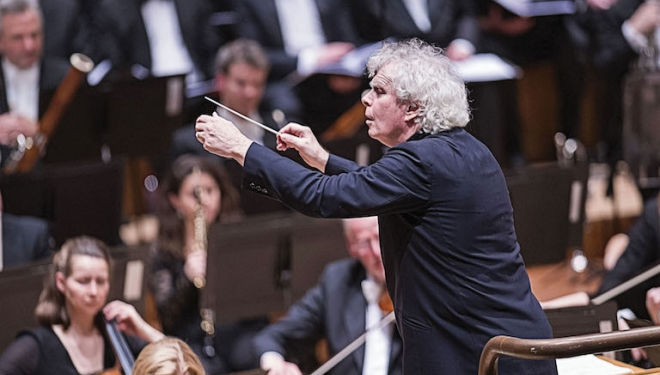
Wickedly idiomatic Carl Nielsen - Rattle, LSO Abrahamsen


Simon Rattle and the London Symphony Orchestra at the Barbican in Sibelius Symphony no 7, Hans Abrahamsen's Let Me Tell You (with Barbara Hannigan) and Carl Nielsen Symphony no 4 .  Rattle has conducted one of the finest Sibelius 7th's on record, and done it live numerous times, so no surprises expected : this was good, but the real fun was yet to come.
Rattle conducted Hans Abrahamsen's Let Me Tell You better than most of the many who have conducted the piece over the last few years, which is saying something, since it's been done so often and by so many.  Just as  Sibelius was cursed by the popularity of Valse triste at the expensen of his more substantial work, Let Me Tell You has become the curse of Abrahamsen.  Contemporary music for those who don't like contemporary music !  At roughly 35 minutes, it's longer than all the vocal music put together that Abrahamsen has written in his long and productive career.  It's good enough but not typical of his greatest work.   Let Me Tell You was created as a vehicle for Barbara Hannigan, so it fits her voice so well that she could be singing it well into later years.  Not that there were any problems here : she's nailed it so perfectly that she hardly needs to do much more.  The fans have come for her,  and her persona.  Rattle, on the other hand, made the orchestra sing , revealing the beauty in the music itself. : shimmering, liquid lines that flow and circulate, wrapping round the voice.  this l;oveliness is poison : Ophelia kills herself by drowning, throwing herself into the vortex of a stream.  Syllables fragment and reform, like droplets of water reflected in light - wonderfully delicate textures created by harp, celeste, and percussion with tubular bells and tiny wooden objects scraped and beaten, making sounds like grasses blowing in the wind. Sounds of nature, too subtle and too elusive to identify, reminiscent of Abrahamsen's greatest works like Schnee and Wald, though Hannigan takes precedence.   "Music is pictures of music", Abrahamsen once said. "That is a strong underlying element in my world of ideas when I compose - as is the fictional aspect that one moves around in an imaginary space of music. What one hears is pictures - basically, music is already there."   In Let Me Tell You, Abrahamsen collaborated with Paul Griffiths, the author and music historian, whose books on modern music are still, after 30 years, the best informed. In comparison, The Rest is Noise is Reader's Digest.
The revelation of the evening was Rattle's appoach to Carl Nielsen's Symphony no 4 op 29, The "Unextinguishable"  (Det Uudslukkelige). This, too, is a staple in Rattle's repertoire, but this performance was inspired.   The sharp attack in the opening bars contrasted with the lyrical first theme, zig zag chords introducing a more vigorous theme, produced here with a swagger, followed by quieter figures, like prancing footsteps. Sassy, expansive figures against moodier passages, exuberance underlined by percussion, winds and brass.  I thought of the series of photographs Nielsen was so proud of, where he grins and grimaces and hams up for the camera (see more here).  The Four (and more) Temperaments ! Just when we're getting into Nielsen's zany vibe, he slips into an elusive mood.   If the symphony deals with the concept of life inextinguishable, it is presented in infinite variety, though the same basic ideas evolve and proliferate, like units in Mandelbrot diagrams,  Nielsen anticipating later composers, even Boulez. The third movement, marked poco adagio quasi andante, wasn't a leisurely stroll, but purposeful.  Woodwinds called, and the strings sprang back to life.  Rattle drew forth an almost bluesy quality from the orchestra which was prescient, given that, even in wartime, one might sense a future where new influences might enliven the mix.  For a moment dark forces emerged :  percussion like gunfire, brass screaming tension, but gradually these gave way to joyous conclusion.  Nothing sentimental or escapist about this despite the vaguely MGM drum rolls. That wasn't Nielsen's style, quirky and defiant as he was. Wonderful, precise playing from the LSO who respond to Rattle better than they do for nearly anyone else.

Tuesday, 8 January 2019

Why walls don't work


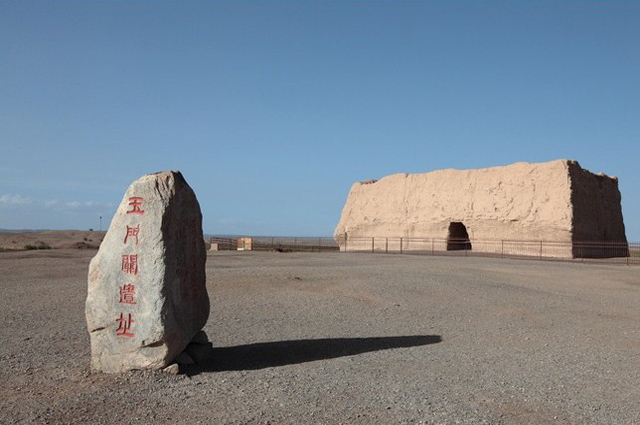
 What's left of the Jade Gate Pass on the Great Wall of China

Photo by Raki Man 2011

Sunday, 6 January 2019

Brain-free Smetana Die Verkaufte Braut - Bayerische Staatsoper


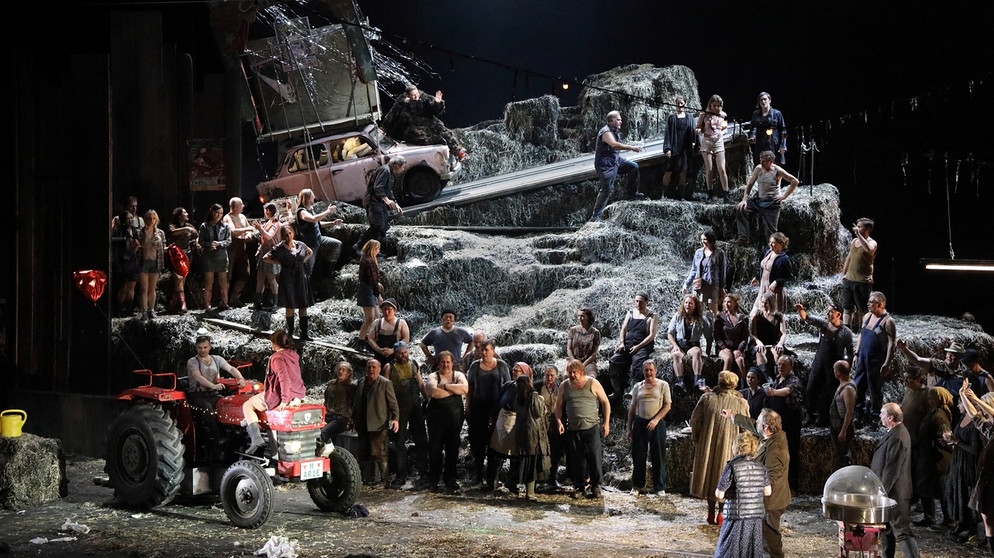
Bedřich Smetana Die verkaufte Braut (the Bartered Bride) livestreamed by the Bayerische Staatsoper.   German language versions of this opera have been around for over 100 years, andd some have been very good indeed.  So no reason to dismiss this on language grounds.  With a strong cast headed by Pavol Breslik, Günther Groissböck, Selene Zanetti and Wolfgang Ablinger-Sperrhacke this should have been a treat !  Deprived of real music during the Christmas-New Year season, I was so looking forward to this.  The singing was fine, especially the principals, and Tomáš Hanus is a good conductor.  But this was disappointing because of the production, directed by David Bösch.  This is the sort of vision-free mishmash that happens with the new fashion for performance that doesn't make us listen or think.  But it would give pleasure to those who take delight in knocking all productions on principle, without really engaging with what a production might have to say about the music. So we end up with the worst of worlds, a production that doesn't stimulate thought but reinforces non-thought. 
Nothing wrong with setting the scene in an industrial farm : that's the premise behind the opera, that people can be sold and bred like animals.  Those who think in such terms have ugly minds, so if the set was prettied up, it would only weaken the drama.  The key, I think, is to take the cue from the music - listen to that Overture ! Of course Smetana uses speech patterns and roughly "folk" allusion, but what makes the music work with the drama is its energy and vigour.  Farmers grow crops, they live in tune with Nature or they don't survive. Fertility means renewal : people get married to propagate.  Marie's love for Hans is natural genetic selection.  Hans, an outsider, represents hybrid vigour, while Wenzel's probably inbred.   Love and fidelity do matter, but   no smart farmer can ignore practical things. Hans turns out to be rich after all.  And fertility, in humans, means sex. hence the thrusting, spiky rhythms in the music and its bouncy liveliness.  Making the erotic elements in the opera more explicit would not bea mistake  , even if modern audiences aren't grown enough anymore to deal with it.  A really strong orchestral performance can create the right atmsphere. Hanus is good enough but wasn't really on fire.  I enjoyed listening to the main singers - Breslik's naturally sexy, Groissböck a born actor and Ablinger-Sperrhacke one of the finest character singers in the business.   But something is wrong when you get distracted by the live pig snuffling about in the background, presumably gobbling treats hidden in the clutter on stage.  Or maybe that's a metaphor for fashionable taste. 

Friday, 4 January 2019

Britten Hymn to St Cecilia and love that dares speak its name : RIAS Kammerchor

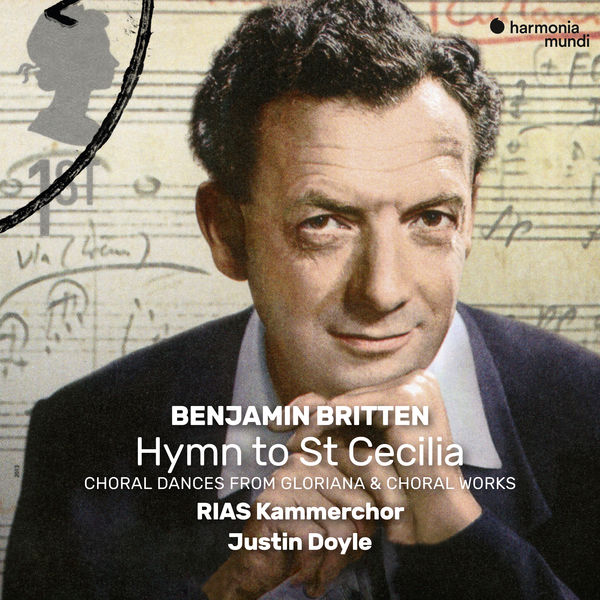
Benjamin Britten Choral Songs from RIAS Kammerchor, from Harmonia mundi, in their first recording with new Chief Conductor Justin Doyle, featuring the Hymn to St. Cecilia, A Hymn to the Virgin, the Choral Dances from Gloriana, the Five Flower Songs op 47 and  Ad majorem Dei gloriam op 17. This new release extends RIAS Kammerchor's engagement with British repertoire, established when  they recorded Britten's Sacred and Profane together with songs by Elgar, Ralph Vaughan Williams and Charles Stanford, with former Chief Marcus Creed in 2013.  This new collection is particularly valuable   because it focuses on works Britten wrote at a formative period in his  career which even now is relatively unexplored. 

Britten's Hymn to St Cecilia op 27  is one of the classics of modern choral repertoire. It's not an "easy sing", lines and parts interwoven in inticate patterns.  This hymn had great personal significance for Britten, who was born on St. Cecilia's Day.  It is relevant that this was while he lived abroad : its connections to English polyphonic tradition show where his heart truly remained. St Cecilia was a singer who was matryred for her faith, hence the symbolism implicit in the text, by W H Auden.

"Blessed Cecilia, appear in visions/
To all musicians, appear and inspire/
Translated Daughter, come down and startle/
Composing mortals with immortal fire.
"

This refrain repeats through the three sections of the piece, and are sung in unison, underlining its meaning.  Auden extends the imagery to include Aphrodite, rising full-formed from the sea, and a more obscure reference (possibly from Dante), "around the wicked in Hell's abysses/The huge flame flickered and eased their pain."  Britten picks up on this for the scherzo section, where bright, short phrases flicker, like flames, in quick succession.  The hymn is as much for all artists in times of persecution as it is for the saint, given that Britten was acutely aware of the impact of Nazism on composers and others in the Europe he'd thought he'd left behind. The final section is characterized by "o" sounds and vowels, which resonate, like bells, an aural image emphasized by the sudden descent into solo parts, evoking sacred form.  The RIAS Kammerchor perform Britten's Hymn to St Cecilia so it flows fluidly, the parts so well balanced that they blend without losing clarity.

Britten wrote his Hymn to the Virgin at the age of sixteen, revising it in his early years at the Royal College of Music. Nonetheless it is not juvenilia, but a sophisticated use of double chorus, one singing in  English, the other responding in Latin, creating an echo effect as if the past were resurfacing in the present. In the final verse, the parts divide, singing the text together.

This recording is also valuable because it features the Choral Dances from Britten's Gloriana. The opera is sadly still  misunderstood, and the dances in the Second Act come in for criticism, so hearing them  on their own as a sequence shows their merits. This also demonstrates their role in the opera, which is not to further the obvious drama between Eliuzabeth and Essex but to focus on the Queen and her subjects, and the national interests that made her give up Essex for England. The good folk of Norwich are a symbol of the nation, and their loyalty is genuine. This fits in, too, with Britten's core beliefs in the value of local community : at Aldeburgh, he did more for community music theatre than anyone since the Renaissance.  In contrast, the courtiers who surround the Queen are sycophants and hypocrites.  The courtiers may sneer at the peasants, but the Queen recognizes sincerity. Presumably the new Queen Elizabeth got the message. She was personally fond of Britten  and gave him her support, much to the chagrin of those who thought him an outsider.

In the opera, the Choral Dances also underline the fundamental role of English tradition in Britten's music.  This structure is reminiscent of earlier form, and shows Britten's understanding of style.  The first three dances are a masque within a masque. "Time", "Concord" and "Time and Concord", moving from liveliness to serenity to joy.  The women's voices of the RIA Kammerchor sing "The Country Girls", while the men sing "Rustics and Fishermen", and come together again for the "Final Dance of Homage", here beautifully parted.

Britten's Five Flower Songs op 47 (1950) sets poems by Robert Herrick, George Crabbe, John Clare and an anonymous folk song.  Britten creates a bouquet, bringing together colours in varied combinations. "To Daffodils"  is swift, for daffodils don't linger, while "The Ballad of Green Broom" alternates doughty rhythms with longer, lighter lines, men's voices for the wood, womens for leaves, so to speak, the song ending with a witty flourish.  In "The Succession of the Four Sweet Months" (Herrick) the parts define each month. The parts combine in "Marsh Flowers", strong colours spread along lines that end in a sudden upbeat, and in "The Evening Primrose" stretch the lines so they descend slowly into slumber.

With Ad majorem Dei gloriam (AMDG) we return to Britten from roughly the same period as Ballad of Heroes op 14, the Violin Concerto op 14 and Young Apollo op15, all of which did not receive much attention until later years.  In the case of the Violin Concerto, now regarded by many as a masterpiece, the reason may be that it expressed despair so intense that Britten could not yet process.  The reason for the suppression of AMDG may have more to do with the fact that the solo SATB version can't achieve the colour  a larger ensemble can bring to it.  But there are deeper undercurrents here, too. The texts are by Gerald Manley Hopkins. What drew Britten to these poems of extreme mystical devotion ?  Since Catholic Emancipation wasn't achieved until 1829, and the order itself was suppressed until around that same time,  Jesuit principles of intellect and independence threatened more conservative minds.  Furthermore, Hopkins' poetry was not published until after his death, a sign of humility before God.  Hopkins may have been, for Britten, the quintessential artist as outsider, who endured suppression for the greater glory of his Art.

These songs are difficult to perform, but RIAS Kammerchor carry them off extremely well.  Again, the fine balance between voices creates a lustrous sheen which enhances a mystical sense of rapture. In "Prayer I" ("Jesu that dost in Mary dwell") the voices unite for the last line "To the greater glory of Thy Son : Amen", the last word extended, like a prayer.  Even more beautiful is "Rosa Mystica", where the male voices chant, as if at Mass, the women's voices dancing above the steady pulse of prayer.  The women's voices take up the chant with greater elaboration.  Britten sets "God's Grandeur" with brisk pulsating rthyms from which outbursts of energy emerge, like shouts of joy.   With "Prayer II", a hushed, contemplative mood returns,  the flow of the lines illustrating the image of a fountain linking God and Man. When the men sing "I repent of what I did", the line stands out, emphasizing humility. "O Deus, ego amo te" is a tender love song ; for Hopkins, the object being God, for Britten, perhaps someone human, The word Amen stresses the first syllable so it explodes like a shout.  The Jesuit order was founded by soldiers, and organized on quasi-military lines.  Hopkins writes unorthodox marching rhythms into his poem "The Soldier", which Britten respects, starting with the ejaculatory "YES!" (in capitals in the original poem) For Hopkins, the poem is a celebration of vigour in imitation of Christ.  But Britten, and readers of A E Housman, may read other connotations in the line ".....séeing somewhére some mán do all that man can do,
For love he leans forth, needs his neck must fall on, kiss, And cry ‘O Christ-done deed!".


If man is the image of God, kissing a man cannot be a sin.  In this context, the final song "Heaven-haven" may be a love song, too, and to someone quite specific.  The text is simple and direect, Britten's setting calm, with no fear of the "Love that dare not speak its name" in the words of Lord Alfred Douglas.  Imagine the rage of homophobes and those jealous of Britten and Pears in an era when homosexuality was illegal.  Britten may not have published the songs, but he didn't destroy them, aware that some day they would be understood as a testament.

Wednesday, 2 January 2019

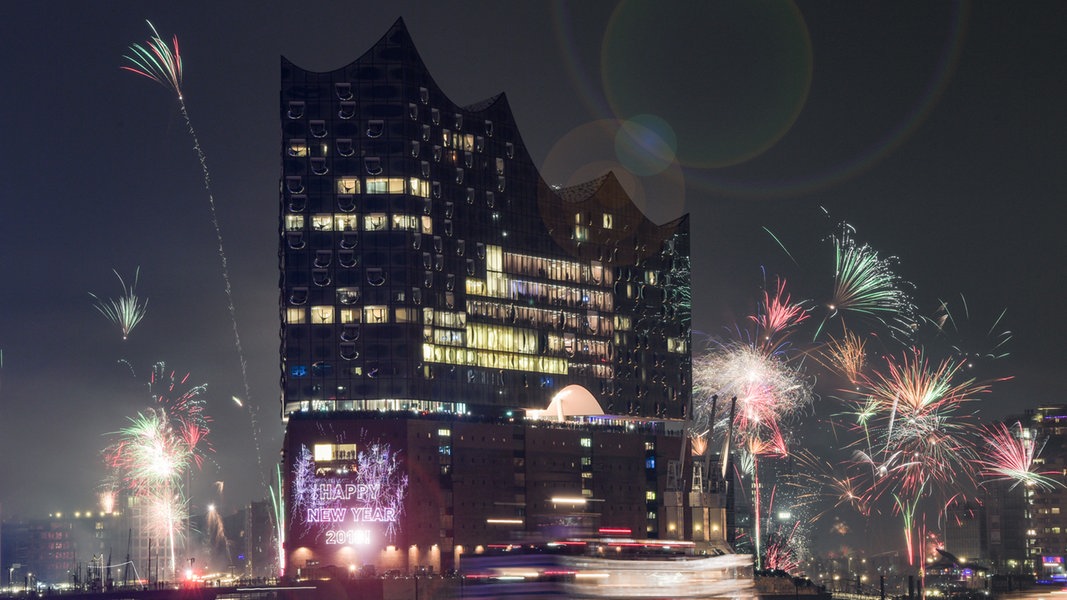
New Year in Vienna and the Elbphilharmonie Fledermaus


On New Year's Day, Johann Strauss Die Fledermaus live from the Elbphilharmonie, Hamburg, Manfred Honeck conducting the NDR Elbphilharmonie Ochestra, in a stylish semi-staging  by Michael Struminger and Renate Martin.  This is what good semi staging should be, making the most of resources to hand, creating a unique perspective.  The acoustic patterns on the vertical surfaces are replicated in the patterns on the costumes.  The hall at the Elbphilharmonie  rises in multi layers around the main platform, with smaller areas where singers can move between, depending on the action,and can be heard without getting muffled.  The hall "transforms" seamlessly from boudoir to party to prison, a concept which is pretty much central to the meaning of the opera.  Swift changes of scene are of the essence. Think about it - everyone's scamming, pretending to be what they're not. They're locked into farce but they get out, just as quick. Alcohol muddles the mind but releases the unconscious.  Die Fledermaus is satire, and savage satire at that, by no means Schlagobers schmaltz. 

Honeck keeps the music zipping along, too. The last thing you want in Die Fledermaus is ponderous Sitzfleisch ! Honeck also brings out the punch beneath the surface fluff, keeping tempi tight.  The dialogue was snappy - quickfire puns and cracks, visual jokes, switching from German to French and to English, too, for the occasion.  The cast included Bo Skovhus (Gabriel von Eisenstein), Michael Nagy (Dr Falke), Astrid Kesssler (Rosalinde),  Katharina Konradi (Adele), Adrian Angelico as Prince Orlovsky, - singers who can speak and act as well as sing.

This broadcast was the third performance, the second on New Years Eve when so much else was going on - Berlin, Munich, Leipzig, Venice - and of course fireworks and parties in the real world outside.  Not much that I know of in Dresden because the boss man there was in Vienna, conducting the Vienna New Year Gala.  That has never been a concert in the normal sense, but a party. Complaining that it's not sober enough is to miss the whole point, and to complain that Christian Thielemann was too sober on top of that is just plain nuts.  The Gala follows the Opernball : waltzes, polkas, and czardas are dances, and dances (and marches) are for fairly large groups of people who need to keep more or less together so the ensemble doesn't collapse in chaos.  Again, a metaphor for society and for Viennese society in particular.  Dance "is" discipline, you can't flop about and be fuzzy.  All the better that Christian Thielemann understood the music and its background and kept things punchy, not floppy.

Monday, 31 December 2018

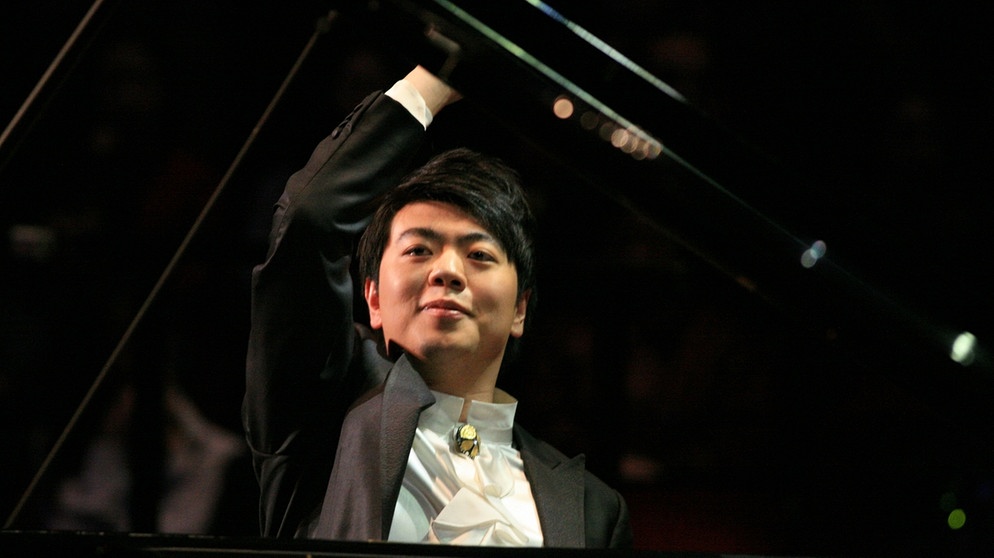
Fun New Years Eve concert - Lang Lang, Mariss Jansons


New Years Eve, enjoying the Silversterkonzert from Munich, with Mariss Jansons and Lang Lang and the Symphonieorchester des Bayerischen Rundfunks.   I should've been listening to Daniel Barenboim's all-Ravel concert with the Berliner Philharmoniker , like my pals did,  but it's New Year's Eve ! Not the time to be safe and sober.  What is wrong about having fun ? Some of us put enough into music year-round, that we can afford to party !  Like most New Year concerts, the programme was wide ranging and light hearted, a buffet with popular treats asnd more exotic fare.
The kick-off started, appropriately, with Leonard Bernstein Candide overture,  but Jansons and the BRSO showed their true mettle in Debussy's Clair de Lune, in the arrangement by Leopold Stokowski. Big, full bodied yet classy and stylish. Aha, a piano piece for large orchestra on a programme with a megastar pianist ! Witty good humour. Then a bit of Elgar, gentler, more personal  Elgar, closer to the composer's soul than public blockbusters.  Elgar's Wand of Youth Suite no 2 is marked op. 1b though it was completed for publication long after Enigma, Gerontius and Pomp and Circunstance.  The suites are compilations of some of Elgar's earliest works, some written to entertain children, but anyone, including adults can respond to the magic that is "the wand of youth".  Here we heard "The Wild Bears", a jolly piece which dances with vivacious freedom.  A joyous performance ! Sibelius, too, in the form of Kuolema from Valse Triste op 44, and Antonín Dvořák Slavonic Dance op 72/15. 
Xian Xing Hai, (middle) in Paris with Nie Er and other compsoers
Lang Lang joined Jansons and the orchestra for the andante to Mozart Concerto for Piano and Orchestra No. 21  KV 467.  The Herkulessaal in Munich is a tiny hall and Lang Lang usually plays very big halls indeed.  It might be fashionable in some circles to sneer at him because he's successful, but he learned his music the hard way, working his way up. So here we heard the "real" Lang Lang to some extent, playing for pleasure, adapting for the small hall and the more intimate vibe.  Without a pause, Jansons segued into Xian Xing Hai's Yellow River Concerto, the section "Ode to the Yellow River".  In the west, people just don't understand the role of Western classical music in China.  Interest was established fairly early on in China, enough so that it could support conservatories in Shangahi and Beijing from the early years of the 20th century.   Even now, it's normal for middle class kids to play piano and know the basics of classical  music, both western and Chinese.  Xian Xing Hai (冼星海, 905 -1945) was a virtuoso pianist but also studied composition and Chinese classsical music. Like so many Chinese intellectuals and modernizers he gravitated to Paris when it was the place to be in creative terms.  Japan invaded China in 1931, occupying much of North China. By the time Xian returned to Shanghai, the country was in turmoil.  Xian wrote the soundtrack for Ma-Xu Weibang's film A Song at Midnight (夜半歌聲) which is marketed as "The first Chinese horror movie" but much more sophisticated than a horror movie, with pointed references to the social and political situation and also to western classical music, to Beethoven and to Freedom.  Please read more about it HERE. When civil war broke out Xian headed to Yenan, following the Communists. There he wrote the original Yellow River Cantata,  (黄河大合唱) for orchestra, chorus and soloists.  Please read more about it here - it is a very good piece "more" than just music, it's a kind of expression of the soul of Chinese history, symbolized by the Huangho River, the cradle of Chinese civilization.   The Yellow River Concerto suite was created decades after Xian's death.  It's not nearly as good as the full cantata, but it is a vehicle for piano and orchestra, which is why Lang Lang played it here.  It's new to Jansons and the BRSO, so they didn't do it justice. 
 More mainstream was the Chopin Grande valse brillante op. 18, closer to what Jansons, the orchestra and Lang Lang usually do. It's not fair to sneer at Lang Lang because he's so famous. Pianists (and violinists) have always been "pop stars". Think Chopin and Liszt or Paganini.  Or Bernstein and Gergiev.  Lang Lang has inspired millions of ordinary Chinese to take up western classical music : imagine the same happening in other countries where people seem to take pride in despising "elitist" art forms.  Jansons has recorded Yūzō Toyama
(b 1931) Yugen, a suite for ballet, and here we heard the Men's Dance . Its use of percussion provides a strong foundation for the keening string legato  and flashes of brass : you can almost visualize these ideas translated for dance.
Back to more standard New Year's Eve party fare with Pietro Mascagni Cavalleria rusticana. Intermezzo, Johannes Brahms,  Hungarian Dance No 5 and the Prelude to  La Revoltosa by Ruperto Chapi (1851-1909) a bit of "Spanish" colour  to continue the "international" theme.  To conclude, the Finale to György Ligeti's Romanian Concerto, sneaking in a dose of modern for audiences who assume they might be averse to the avant garde. 

Sunday, 30 December 2018

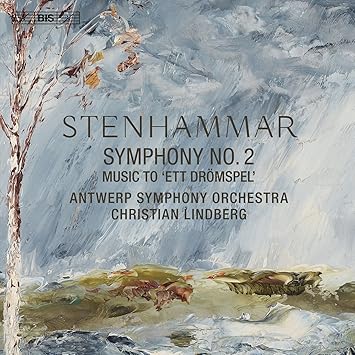
Wilhelm Stenhammar Symphony no 2 - Blomstedt and Lindberg, BIS

Two new recordings of Wilhelm Stenhammar Symphony no 2 in G minor op 34 (1911-15) one with Herbert Blomstedt and the Gothenberg Symphony, the other with Christian Lindberg and the Antwerp Symphony Orchestra.   Why two recordings from the same label, BIS, specialists in Scandinavian repertoire ? Even the booklet notes are identical.  BIS know their market, and know that two very different approaches will appeal to a more sophisticated audience than to those who still think Stenhammar is "unknown",  Neeme Järvi's recordings, from the1980's established the composer on an international level, followed by many others. So it's not at all a question of Blomstedt or Lindberg, but why.  For many,  Stig Westerberg's recording with the Stockholm Philharmonic Orchestra, from the late 1970's, is the benchmark against which all other performances of Stenhammar’s Symphony no 2 needs to be heard.

Like Järvi, Blomstedt has been conducting Stenhammar most of his career, so any recording he makes is a snapshot of the many performances he's given over the years, and this live recording, from Decemeber 2013, is well worth hearing. When the symphony premiered in 1916, Stenhammar wrote that he had wanted to write "sober and honest music without showing off", a statement that deliberately places a distance between him and the excesses of  post-Wagnerian Romanticism, and sets him in the context of Sibelius and the aesthetic of "Northern Light" which revitalized Scandinavian art, literature and culture. Sibelius expressed the same spirit when he wrote of his Symphony no 6 in 1923, that he did not engage in "manufacturing cocktails of every hue (but) I offer the public pure cold water". Significantly, he dedicated that symphony to Stenhammar.

Blomstedt's approach to Stenhammar reflects these Sibelius connections.  While Blomstadt approaches the  principal theme of the first movement with relative restraint, placing more emphasis on what evolves later, Lindberg defines it with greater vigour, emphasisng its crucial role. In this way, Lindberg is closer to the marking "allegro energetico" and to Stig Westerberg who showed how the the motif is broken into component parts, then redeveloped, each variation prefaced by different instrument (woodwinds, horns and woodwinds). Though this motif resembles the folk song "Row, row to the fishing inlet", what might meant more to Stenhammar was the sense of forward thrust, not the folk melody per se. Westerberg and Lindberg capture the ever-changing moods of the movement with stronger definition, so the variations surge, like the ocean, sometimes ebullient, somtimes with more stillness.  Blomstedt  suggests smoother passage, the strings of the Gothenberg Symphony rich and full, like Sibelius in full flow.  Though the Antwerp Symphony Orchestra doesn't have the Scandinavian pedigree of Gothenberg, who premiered the symphony in 1916 and have had it in their repertoire ever since, they respond well to the innate personality of the music.

In the second movement, an andante, the significance of the quieter moments in the first movement are revealed.  Though the mood is subdued, much happens "beneath the surface", so to speak. This movement proceeds as a series of developments, as did the first. Westerberg observes this so perceptively that each variation has character, giving context to the reiteration of the central motif which re-asserts itself as the movement ends with an almost Beethovenian sense of purpose.  Blomstedt is particularly good here, the classiness of the Gothenbergers' playing comes to the fore. Stenhammar   called the scherzo movement "a gentle and sympathetic piece", where the trio dances in triple time. Blomstedt is more refined but Westerberg captures the gaiety and good humour, and Lindberg's players enter into the spirit. Lindberg, incidentally, has recorded Stenhammar Serenade and Excelsior! , also for BIS, which was well received. It doesn't matter what nationality the players are, if they have a conductor who is enthusiastic and understands the music.

The finale begins with a theme which is not so much slow as sostenuto, sustained, not still, which ascends to joyous outburst, from which the original theme in the first movement returns, gently but with authority, the themes alternating in double fugue.  Each of the sections has character.Stenhammar   called the cantilena in the middle "The heart's song brimming over".  Nontheless it is balanced by the lively vivace sections around it and a tranquillo. The movement ends not with bombast but with equanamity.  Structure matters, and balance, and a sense of musicality, not overwrought excess.  Virtues we need all the more in these times of ignorance.  A while back there was a campaign on the internet predicting an end to performances of Carl Nielsen, of all people! Notice the carefully shaped pizzicato in Blomstedt, restrained percussion giving way to expansive strings.  Lindberg overall is brighter and livelier though he takes a whole minute longer - never trust timings alone - and has a rather good violin leader, and warm-sounding brass. (Lindberg also works as a trombone soloist.)  Westerberg takes the prize, though, for depth of interpretation, particularly in the finale, where some inexpressible emotional depth comes through, past structural quality and fine playing.

So, Blomstedt or Lindberg ?  The answer is both, since each one offers a distinctive and valid approach.  Blomstedt might seem the safe answer but Lindberg is closer to Westerberg, and  is an interpreter to listen out for.  Unsurprisngly his recording is something of a hit in some Stenhammar circles. BIS pairs Blomstedt with Serenade in F major op 31 and Lindberg with Stenhammar's Musik till August Strindberg's "Ett Drömspell".written for a performance in 1916 which did not take place. Here it is heard in a concert version from 1970 by Hilding Rosenberg (1892-1985), another great Swedish composer. It is an atmospheric work, strings reverberating in extended legato above the low rumbling of percussion winds and brass. An ascending figure introduces a new scene, where textures are brighter, but this is cut suddenly short by strident chords.  The figure returns, yet is confronted yet again by dominant chords which develop in a melody that evokes march or hymn.  Whizzing strings, whirring like wind, introduce the dramatic final section. A wall of sound (strings, brass, woodwinds) looms up suggesting a vast panorama before the final theme (led by harps and horns) suggests something mysterious and open ended.  Stenhammar's Symphony no 2 is so well known that it obscures much of Stenhammar's other music, which is also significant. I learned my Stenhammar from his many songs.  Again, it makes a difference to approach Stenhammar in the context of Scandinavian lietrature, art and culture. Please see HERE for my piece on Stenhammar's opera Gillet på Solhaug. 1893, one of the earliest Swedish operas, based on Henrik Ibsen's play Gildet paa Solhaug .  

Thursday, 27 December 2018

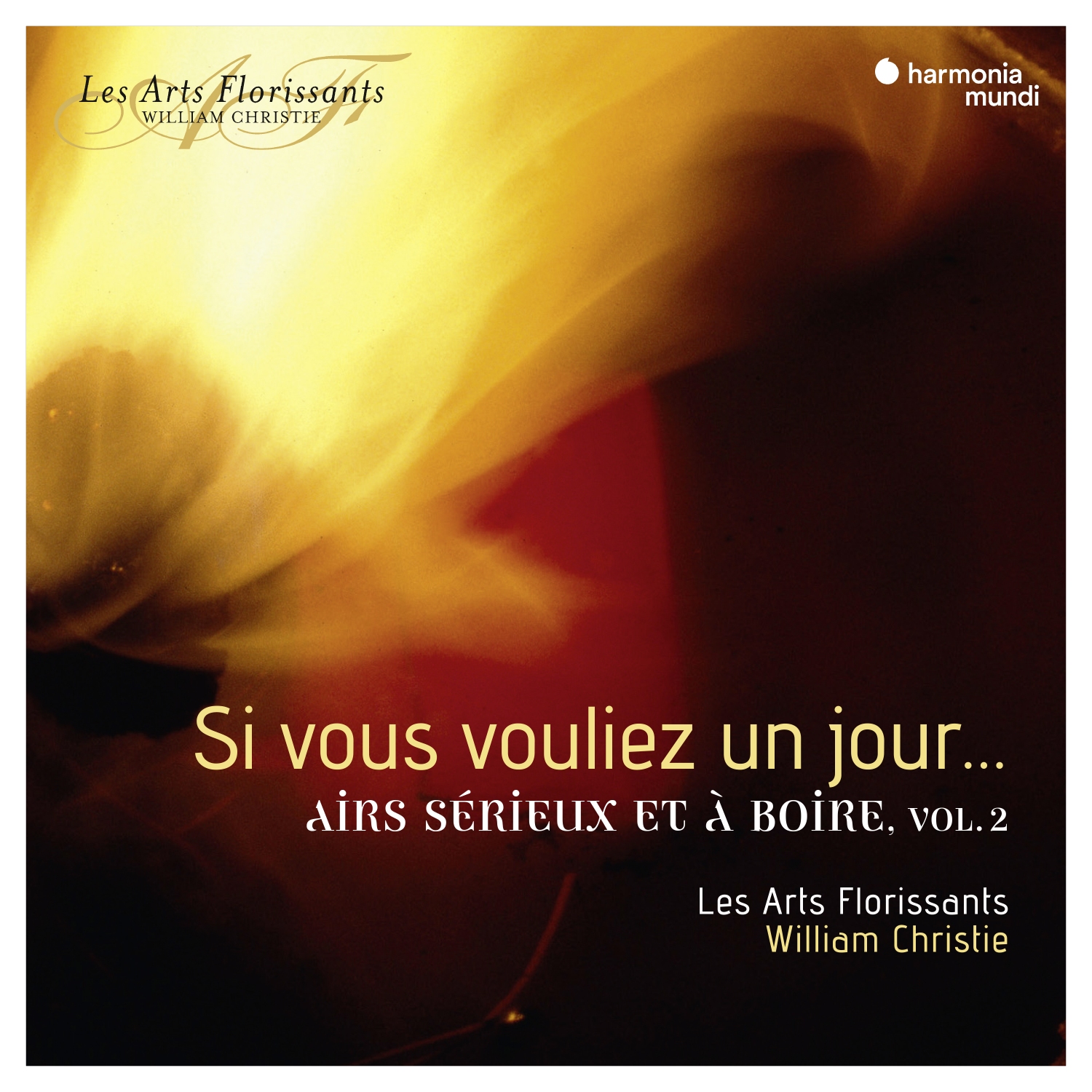
Si vous vouliez William Christie : Airs Sérieux et à boire vol 2

"Si vous vouliez un jour..." Volume II of the series Airs Sérieux et à boire, with Sir William Christie and Les Arts Florissants, from Harmonia Mundi, following on from  the highly acclaimed "Bien que l'amour"  Volume I. Recorded live at the Philharmonie de Paris in April 2016, this new release is as vivacious and enchanting as the first. Christie and Les Arts Florissants are already working on Vol III, and will be giving a recital at the Wigmore Hall in London on 29th January.  "Si vous vouliez un jour..." brings together airs de cour by Marc-Antoine Charpentier,  Étienne Moulinié, Michel Lambert and Sébastien Le Camus, "Having displaced the polyphony of the Renaissance chanson in the musical landscape of the day, the air de cour, with its clear melodic lines, simple form, and expressive possibilities, soon became an indispensable component of aristocratic entertainment and served as a musical platform for much of the poetry of the day, which ranged from courtly songs (air galant) covering the gamut of amorous states, to air de ballet (often framed as formal expressions of praise), by way of drinking songs (air à boire), devotional songs (air spirituel), and so on." writes Thomas Leconte in his programme notes.  The air de cour thus contributed to the rise of a sophisticated socio-literary culture which prized the musical equivalent of the art of conversation (bien dire), seen at its apogée during the reign of Louis XIII. With its vivid expressiveness, the genre was an important link in the chain of events leading up to the creation of French-language opera,. "The first attempts at setting French plays integrally to music" he continues,"– be they of courtly or pastoral inspiration, such as Les Amours d’Apollon et Daphné by Charles Dassoucy (1650), Le Triomphe de l’Amour by Marin de La Guerre (1654), and La Pastorale d’Issy by Pierre Perrin (1659) – consisted chiefly of juxtaposing several airs, loosely connected together by what would, in the skillful hands of Lully, become the recitative". 

This collection begins with the Petite pastorale H. 479 by Charpentier from around 1676, which is partly created by assembling pre-existing musical fragments, notably those taken from the prologue to Molière's Le Malade imaginaire (1673), interspersed with airs sérieux, and extended by instrumental ritornellos.  In this Petite pastorale, Alcidon and Lysander, (Reinaud Van Mechelen and Cyril Auvity) joust by exquisite singing, accompanied by harpsichord (William Christie). Hardly the weapons of "real" shepherds !  Pan (Lisandro Abadie) - the god of merriment -  unites them and they sing in unison "Laissez, laissez là sa gloire ! Ne songez qu’à ses plaisirs !"  Also included in this collection are all five scenes from his pastoraletta Amor vince ogni cosa, H. 492 for five voices which shows the impact of Italian cantata.

Étienne Moulinié (1599-1676) was an early master of the courtly air, inheriting older traditions, as evidenced by two airs de boire, Amis, enivrons-nous du vin d'Espagne en France, a cheerful part song for male and female voices and Guillot est mon ami (1639) where polyphonic style is adapted for decidedly non-religious purposes. It ends with gleeful laughter, a nod to its folk song origins. Moulinié's  Enfin la beauté que j'adore, (1624) is an air de cour reflecting troubadour style.  By the mid 17th century, the genre developed in different directions. The air galant became more personal,  morphing into the air sérieux, the art song of literary salons, where, as Leconte notes,  "the art of conversation was practiced according to the new codes of behaviour and courteousness which appealed both to the heart and the mind". The air sérieux favoured simple, strophic structure, almost ballad form, but much more refined and elegant : songs of love, longing and  emotional poise.  Vos mépris chaque jour me causent mille alarmes, by Michel Lambert (1610-1696) epitomises the style. A tender accompniment (violins, viola da gamba and theorbo) cradles the singer, the counter tenor Cyril Auvity) who sings expressively but without excess. Sans murmurer  from 1689, is a part song for three male voices, while Amour, je me suis plaint cent fois and J’aimerais mieux souffrir la mort  also include the female singers Emmanuelle Negri and Anna Reinhold, demonstrating the flexibility of the form. Laissez durer la nuit, impatiente aurore, (Anna Reinhold) and Oh ! que vous êtes heureux (Emmanuelle Negri) are airs by Sébastien Le Camus (c. 1610-1677), proving that, in 17th century artistic circles, lighter female voices filled a worthy role.

It's Elf !


Monday, 24 December 2018

UNIQUE Christmas greeting from Uncle Nick


Utterly unique - a Christmas card drawn in the Prisoner of War Camp in Sham Shui Po, during the Japanese occupation of Hong Kong, sent to some of his family. The artist is Nick Jaffer,  Private, Service number 3177, in the Hong Kong Volunteer Defence Corps, seeing action in Wong Nei Chong Gap, where 60% of some units were wounded or killed, including his brother-in-law, William Markham.  In 1943, he was shipped to Japan with many other prisoners and worked in a coal mine in Sendai.  He was born in Shanghai on 29th October 1908 to Abdul Hamoned Jaffer and Kulsoom Jaffer, who were"Chinese Parsees", Parsis who had been settled in China for many generations.  In the POW records held by the Commonwealth War Graves Commission, he's listed as "Persian". This proved to be an advantage as the Japanese considered him technically Indian and gave his wife Indian rations, which were more generous than for Chinese people. Since she didn't eat Indian food, she swapped ghee and spices for extra rice.  His father died before the war and his mother died in the Red Cross Rosary Hill Camp for dependents of HKVDC POWs, during the occupation.  But at least she saw her grandson, born in 1942.  Prewar, he'd worked for Thomas De La Rue (security printers) and after the war worked for NCR in Singapore, when they still made cash registers.  He was a dashing man, very debonair and creative. That's why he was a Camp artist, constantly drawing, painting, and taking part in the social activities the prisoners organised to keep up their spirits.  The drawing above looks just like him ! He accumulated a huge cache of drawings, which were borrowed by someone in the 1960's and never retuned, which almost broke his heart.  He loved travelling, well into later life, and died in his 90's.