Monday, 11 June 2012

Britten Year, Aldeburgh 2013

"My music has its roots, in where I live and where I work," said Benjamin Britten. Aldeburgh Music marks Benjamin Britten's centenary with a year-long celebration. Aldeburgh is "Britten territory" Britten was shaped by Suffolk and its coast, not by London or the Cotswolds. The North Sea and its changing moods, the endless, opaque horizons, ruined churches and anciernt hamlets, all evoke aspects of Britten's music. While there will be Britten celebrations everywhere (Gloriana at ROH), the Suffolk coast is where you really channel Britten, in winter  as well as summer.

To mark Britten's birth in November, Death of Venice is directed by Yoshi Oida. This is part of Opera North's four-opera Britten season next year, so it's not clear where it will take place. But I hope it's at Snape, because Oida  connects to the deepest levels of the opera, and incorporates into the very fabric of the theatre at the Maltings. It's as if Britten's spirit inhabits the very walls, and the water imagery that meant so much to him enters the building itself. Not comfortable or pretty. But then, neither was Britten. I wrote about the 2007 Aldeburgh premiere and will do more later. Recommendation : hear Curlew River on DVD, directed by Oida. .

BBC Radio 3 dedicates the weekend of 22-24th November to Britten. This will be good. Keynote concert conducted by Oliver Knussen, the string quartets (The Belcea Quartet), Noyes Fludde (performed live in Lowestoft - rare experience), a recreation of the first-ever Aldeburgh Music Festival, a special series of choral works, and many other favourites. No-one could top the BBC Schubert week (Britten's not "that" prolific) but if they stick to high-quality commentary, this will be good.

This year's Aldeburgh Music Festival has just started but some details of next year are out already. TWO Peter Grimes, one a concert performance at the Maltings with Alan Oke (who's also singing Eschenbach) and one actually on the beach directed by Tim Albery, and a separate Grimes Journey through the town, by Punchdrunk. This isn't as odd as it sounds because nearly every year they do open-air music and theatre at Aldeburgh, and they tend to know what they're doing. How are they going to "kill" the kid? How will Peter G sink his boat? Since it's Peter Grimes no-one can complain if they get wet or cold. Indeed, it might be better if the weather's inclement. Ice creams and colourful buckets somehow won't seem right.

Speaking of Ellen Orford, if you nip down to Orford Church in June next year you can hear a special staging of all three Britten short works for music theatre - Curlew River, The Burning Fiey Furnace and The Prodigal Son, all staged by Mahogany Opera. Since the church is tiny, and parking is almost non-existent,  it's good to know it will be broadcast on BBC Radio 3.

Britten  never intended that the Aldeburgh Festival should be about his own music. He actively supported new work, so next year's Aldeburgh Festival will pair Britten works with newly commissioned works by Harrison Birtwistle, Wolfgang Rihm, Magnus Lindberg and others. Top-rank professionals, superb performances. Yet that other aspect of Britten's legacy won't be forgotten. Throughout the year local community celebrations, including A Ceremony of Carols at Christmas, children's choirs, semi-amateur Albert Herrings (and of course the Lowestoft Noyes Fludde mentioned above).For Britten, music was meant to be experienced as a living art.

Definitely a year to become a Friend of Aldeburgh Music!


Sunday, 10 June 2012

Cream Teas I have known

 Cream Teas are Great British Tradition, the sign of an English Summer (rain and cold notwithstanding). These scones look particularly nice, and the jam has fruits in it.  You can imagine that they're fresh baked, and still warm. Prerhaps this jam smelled like strawberries. It must have been a memorable treat. Many thanks to Ibán Yarza for this wonderful photo, much appreciated.

When cream teas are good, they're very, very good, but when they're bad they are horrible. So the eternal quest for a perfect cream tea. Perhaps closest to ideal are the cream teas at Glyndebourne (Leiths). They're firm on the outside, but the texture inside is moist and not too crumbly. Almost as creamy as the cream!  In theory, you should be able to taste the flour and butter used in the mix. Good scones should not be sweet, so they don't mask the flavour of the cream or jam. Needless to say, the cream should be clotted, and  the jam more fruit than sugar, ideally made in small batches by someone who cares.The one in the photo looks like it's made with less solidifiers than commercial products would be. That's the sign of a good jam, where you can taste natural freshness instead of assitives (and sugar).

Today I found another good cream tea at the Cragg Sisters' Tea Room, 110 High Street Aldeburgh. (opposite Salters Family Butchers, of whom more here). It's a few metres from Crag House,where Benjamin Britten lived from 1947. In fact, you can exit the shop through the garden straight onto Crabbe Street. This tiny nook of Aldeburgh is true Britten territory. Peter Grimes was written in the upstairs seafront room in Crag House, which faces the open seas. The first Aldeburgh Music Festivals centred around Jubilee Hall, where some events still happen (like last summer's retro Albert Herring). Cragg Sisters Tea Shop was founded in 1949, though the current management is new, so chances are Britten knew the original shop.

Cragg Sisters bake their own scones and cakes, which is why they're so nice. The shop is very pretty, floral tablecloths, crochet doileys, antiques and crockery that doesn't match, which is much more stylish than fake retro. Parts of Aldeburgh are becoming Sloane Square-by-Sea, or Essex North, but this area is still original and unique. Make this part of any Britten pilgrimage. See The Cragg Sisters' website, which is as pretty and individual as the shop. They're doing good savouries too, and special events like a local produce feast on 30 June. Dining out in Aldeburgh can be disappointing unless you eat only seafood and like to spend ostentatiously, so I.m going back to Cragg Sisters for lunches, too.
TOMORROW : Oliver Knussen's operas Where the Wild Things Are and Higgelty Pigglety Pop.. and his excellent concert with the Scottish Chamber Orchestra.

Saturday, 9 June 2012

Janáček - The Cunning Little Vixen on film

The Glyndebourne production of Janáček's The Cunning Little Vixen can be seen in cinemas and on the Guardian website on Sunday 10th. Janáček was inspired by cartoon illustrations, but the opera is by no means a cartoon opera. It's gloriously happy, but happiness does not preclude irony, or even much darker thoughts. The Vixen is captured and mistreated. She fights back and tears the Cock to pieces. She's red of tooth and claw, and "Red" in the political sense, too, because she tells the hen protelariat to revolt. In nature, animals are free, not institutionalized like hens in a coop.  There's nothing cute or infantilized about Janáček's Cunning Little Vixen.

Perhaps it's best not to know the opera when watching the Melly Still production, so it can be enjoyed on its own terms. But those who care about the opera, and about the composer, might want to delve a bit more deeply. Nobody needs to know an opera to enjoy it, but making judgements involves a bit more. Hearing the opera in Czech is essential, because Janáček's entire idiom derives from the Czech language, and its unusual stresses and sibilants. In English the music is castrated, and translations often try to be funny and soften the impact. Read the libretto carefully and hear how the edgy, angular music works against sentimentality. When the Fox courts the Vixen, he fancies her because she's a "Modern Woman, my ideal". He hopes she smokes! Definitely advanced for the era. "Foxy" in the modern sense, not a fox from nature. We know she won't survive because foxes don't and the trap is laid before our eyes. Then, when the Vixen dies, she's dead. The music rises again, triumphantly, when the Forester dies, because he's free now of stifling convention, at one at last with some greater cycle of nature. Whoever sings the Forester doesn't need a luxuriously Romantic voice: much better a singer with character and wit, because the Forester is a gruff, unfussy man. A lot like Janáček himself. Read John Tyrell's biography. It's long but genuinely erudite and perceptive, the essential Janáček tool.  

The Cunning Little Vixen is hard to stage because the characters are animals and act as animals do, but speak for humanity. In theory, dressing them as animnals is no big deal since it's plainly obvious that they are singing, and animals don't sing. By far more important is to understand what they are singing about. Each animal has a purpose. The Vixen grabs "Uncle" Badger's lair (itself an oblique allusion to several things). The Dog is sexually frustrated and denatured, just like the Schoolmaster and possibly the Priest. Sharp characterization above all, I think, so the fundamental grittiness of this plot and its music don't get lost behind the charm. Good filming probably helps too, because it narrows focus onto the personality of the characters, and cuts away irrelevant busyness.

Highly recommnded is the DVD of the Opéra Bastille, Paris production from 2008, directed by Don Kent. (get it here). Read Jim Sohre's review in Opera Today.  The animals are costumed as simply as possible, so they look like animals but not in a gimmicky way.The chickens in this production are dressed in colours like white hens, fluffed up and fussied. In the Paris production, the hens are surreal, because they are "un"natural. Watch how sharp their movements are, and how savagely the Vixen kills the Cock (even though we see no blood). The farmyard's a bit like a prison yard, which is how it feels for the Vixen. The passage of time and seasons is harmonized by a railway track which moves from the Forester's home out into woods and meadows.  One of the most memorable images of this production are the vistas of sunflowers, as perky and unreal as in a cartoon, but suggesting wide, open spaces, sunshine and endless horizons. Later, winter comes and the set turns white. The fox cubs prance about but look vulnerable against the stark horizon, a reminder of how easily they can be killed. Singing and orchestral playing good, too. So the more we listen and watch, the better we understand how the opera works. (Please see my many other posts on Janáček and on The Cunning Little Vixen)

photos© Opéra national de Paris/ Christian Leiber

Friday, 8 June 2012

The Platters - radicals of Rock

Herb Reed, who founded The Platters, has died, aged 83. The Platters? Even the name sounds antique. Modern audiences don't know LPs and probably wouldn't know the word "platter" if it hadn't been revived in  restaurant-speak. But the Platters were one of the biggest names in popular music in the 50's and 60's. Those were the days before the concept of "teenager" even existed, and everyone listened whatever their age or culture. The Platters were radical because they were part of the Rock and Roll Revolution, though they were more crooners than R'n'B. They were also radical because they were black musicians who crossed race boundaries. Movies made black people visible.

Below is a clip from Rock Around The Clock, the 1956 film that created teenagers in the media. Nice, sheltered whitebread kids throw a party and dance to bands that don't wear tuxes or croon. Bill Haley and the Comets star. Plaid shirts, duck tail quiffs instead of GI  haircuts. When Elvis came along, Haley seemed so tame. But in 1956, this movie created shock waves. The Platters featured, a black band given star treatment next to whites. The front man is tenor Tony Williams. Hear the trademark crack in his voice!  Get the full movie if you can, as it's well made, full of pithy quotes. (If you like this, enjoy The Secret History of Louie, Louie)

Les Roses d'Ispahan

Pierre de Ronsard this rose is named, after the poet. It's a hybrid from the French nursery Meilland, who've been breeding roses for over 100 years.  Leconte de Lisle's poem inspired Gabriel Fauré to write Les roses d'Ispahan, such a beautiful song that one could swoon, intoxicated by its scent. But beware!

Les roses d'Ispahan dans leur gaîne de mousse, Les jasmins de Mossoul, les fleurs de l'oranger, Ont un parfum moins frais, ont une odeur moins douce, Ô blanche Léïlah! que ton souffle léger. 

Mais le subtile odeur des roses dans leur mousse, La brise qui se joue autour de l'oranger Et l'eau vive qui flue avec sa plainte douce Ont un charme plus sûr que ton amour léger! 

Ô Leïlah! depuis que de leur vol léger Tous les baisers ont fui de ta lèvre si douce Il n'est plus de parfum dans le pâle oranger, Ni de céleste arome aux roses dans leur mousse.

Oh! que ton jeune amour, ce papillon léger, Revienne vers mon coeur d'une aile prompte et douce. Et qu'il parfume encor la fleur de l'oranger, Les roses d'Ispahan dans leur gaîne de mousse. 

Full text on Emily Ezust's wonderful Lieder and Song Texts site) Photo: Manfred Heyde.

Thursday, 7 June 2012

Spitalfields Summer Music Festival starts tomorrow

Despite rain and cold, it's summer! The Spitalfields Summer Music Festival starts Friday. Spitalfields Music Festivals have always been an eclectic mix of early music, baroque and up to the minute contemporary. Sturdy foundations, like Christ Church itself, a Hawksmoor structure that's survived despite travails. Good solid period music, done without affectation in simple but dignified surroundings. Modern music sounds good here too, benefitting from the clear, unfussy lines.

Tomorrow,  Ton Koopman and the Amsterdam Baroque Orchestra in an all Bach programme, (incl cantatas) which should be glorious. Interesting to realize that these works were written at the same time that Christ Church was being built. Get there early and hear the new Howard Skempton work for church bells. It's called Five Rings Triples, which might express what it sounds like.

Even bigger highlight on Monday 18th, when John Eliot Gardiner and the Monteverdi Choir do an a Capella Pilgrimage.  Tallis, White, Tomkins and Byrd. Sold out ages ago - returns only. This weekend, though, Harry Christophers and The Sixteen do an all-English selection - Tallis, Tippett, Byrd, Britten.

Next Tuesday 12th, Henry Purcell's The Fairy Queen.  Don't miss The Fairy Queen at Glyndebourne because it's an amazing theatrical experience, (possibly less so on film). But get to Spitalfields for this concert performance because it should be musically rewarding. Paul McCreesh conducts the Gabrieli Consort. Good soloists including Sophie Bevan (currently Donna Elvira at Garsington Opera) and Ashley Riches (a favourite from the Guildhall School of Music and Drama). More baroque and the Stravinsky Mass with the Gabrieli Consort, On Thursday and Friday 14th/15th, La Nuova Musica presents two oratorios, (Charpentier, Carissimi,)  in a staging by Vignette Productions. 

Wednesday brings a Harrison Birtwistle rarity, Bow Down. This is an early experimental piece where musicians (members of the London Sinfonietta) and actors combine to act out a story of love and murder. Primeval saga in tight, intimate form. Very Birtwistle. It's staged by The Opera Group, under their new director Frederic Wake-Walker. The Group has always been innovative and communal, so even without John Fulljames, they should be very interesting.  I can't make it, but anyone who can, please let me know. Two performances, early and late on 13th. It should be interesting heard with Samuel Beckett's Old Earth, with music by Alec Roth, which includes a chorale for The Sixteen. It's a world premiere, staged, with actor Alan Howard. Four performances, 15th and 16th, La Nuova Musica (new music of the 16th century) presents "a staging of two trailblazing oratorios" (Charpentier and Carissimi) with Vignette Productions. Imagine "immersive sound installations".

Melvyn Tan, Matthew Barley, John Tavener's The Protecting Veil, the Heath Quartet (Nicola LeFanu premiere) and  the Schubert Ensemble premiering a new piano quartet by Huw Watkins.  My old favourites Exaudi, singing John Cage, intrducing Cage as "a creator of ravishingly beautiful, mysterious music, from a spatial performance of Four² to the “plain harmony” of Hymns and Variations. Thursday 21st.

You can have the London Handel Players play Tafelmusik while you dine at The English Restaurant. This sold out fast, but you can go to the restaurant at any time, without music. Fantastic menu, which might convert even me to English food. "In a world seemingly in love with novelty and fads and gimicry, we aim to offer simple integrity, in never purchasing ready-made, in cooking always and only from fresh ingredients, and in rediscovering the noble and rich traditions of the English kitchen.", they say, which fits in well with the spirit of Spitalfields Music Festivals.

Wednesday, 6 June 2012

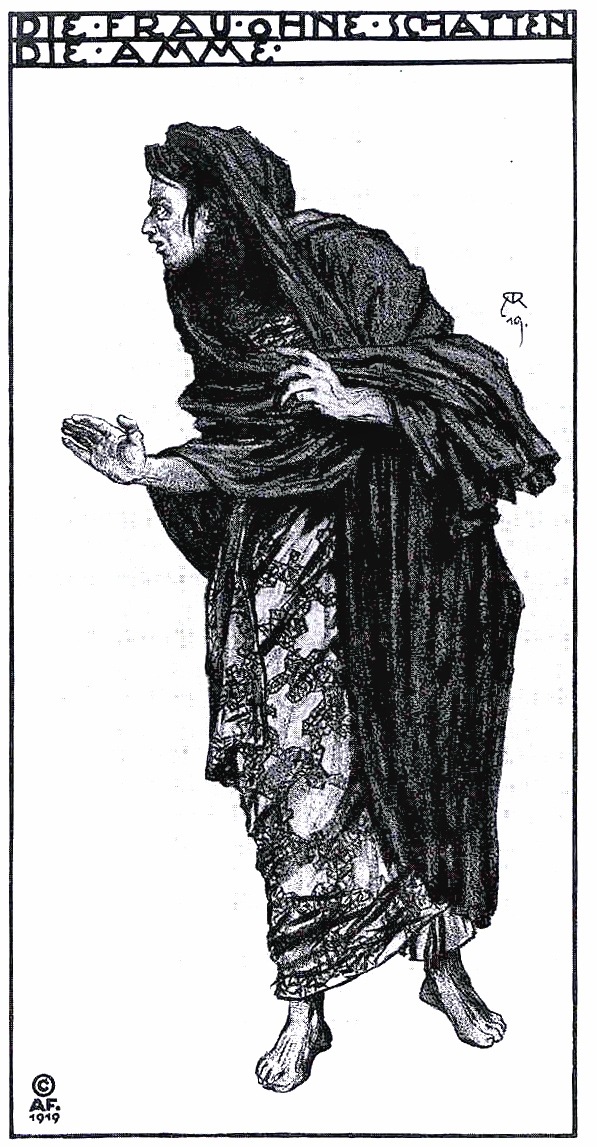
Die Frau ohne Schatten - Salzburg - broadcast

Complete broadcast of the Salzburg Strauss Die Frau ohne Schatten on BBC Radio 3 Thursday and Friday. Available for a week online!

The picture is one of Alfred Roller's designs for the original production. 

Perish the fad for hearing other composers in whatever you listen to. I keep thinking Schreker and Korngold in Strauss. Not wise.

Strauss Salomé - Royal Opera House review

Perceptive review of Richard Strauss Salomé by Claire Seymour HERE in Opera Today.  Read in full, it's extremely well written. Here are some quotes :

"This is a Salome who is less interested in the bodily pleasures offered by the pure masculinity of Jokanaan than in the narcissistic celebration of her own vicious carnality. And, Angela Denoke is just the singer-actress to convey the princess’s escalating self-awareness and indulgence in emotional extremities"  Denoke "may not have had the requisite consistent sheen at the top, and indeed may have struggled at times to hit the uppermost notes truly and securely — who wouldn’t given the unalleviated high tessitura? — but she possesses an emotional sincerity, communicated through an infinite variety of colours, shades and shadows, which wins the hearts and minds of the audience. Slightly tense at the start, she went from strength to strength: the final statement of her insistent demand, “Give me the head of Jokanaan”, was truly chilling in its honest exposure of human egoism; and in the final scene, as she cradled the bloodied head of the prophet, at times tender, then terrifyingly solipsistic, she communicated powerfully the destructive yet vulnerable self-regard of the eponymous anti-heroine before her thankfully inevitable death."

"Andris Nelsons conducted the orchestra of the Royal Opera House in a thrilling, precise yet disquieting rendition of Strauss’s provocatively extrovert score. Solo lines emerged effortlessly from the luxuriant orchestral canvas. The seductive harmonies which foreshadow Rosenkavier — employed therein to depict exuberant sexual freedom, piquant desire and joyful satisfaction — were here bitterly destabilized by disconcerting instrumental colours textures and extremity of register, which Nelsons exploited to perfection. The conductor perfectly balanced measure and excess, liberation and control. His ability to restrain his naturally exuberant forces until precise moments of erotic release was nowhere more evident than in the Dance of the Seven Veils."

Don Giovanni - Garsington Opera at Wormsley

FULL REVIEW with photos in Opera Today . Garsington Opera at Wormsley is stunningly beautiful. Just being there is an experience, which is why the social aspect is so rewarding. But regular patrons can do bland, corporate affairs any time. They come to Wormsley because they care about opera. This new production of Mozart's Don Giovanni has a lot to offer to those who pay attention.

The Wormsley Pavilion is a wonder of translucent glass and  gleaming metal.  It inspires the set design by Leslie Travers.  Simple, clean-cut lines, stylish elegance. If Don Giovanni were alive today, he'd live in  designer surroundings like this.  He fits life into compartments, which the "boxes" in this set reflect. But as we know, things go awry. Under this surface glamour lurks something very nasty. Don Giovanni (Grant Doyle)  and Donna Anna (Natasha Jouhl) act out bondage games. Naturally, she doesn't want her father to know. She cuts Don Giovanni from his handcuffs, and he stabs the Commendatore (Christophoros Stamboglis).  It's not a conventional reading but valid. Don Giovanni gets his kicks from seduction, not rape in the modern sense, and those around him are complicit. Besides, Donna Anna's feelings are conflicted. Her Don Ottavio (Jesús León) is rather alluring  and comes over as a real match for her. When they masquerade, she wears dominatrix, he dresses as muzzled dog, which expresses much about their relationship.

Because Garsington Opera uses relatively young singers, the production is energetic. Boyle's Don Giovanni is quick on his feet (as is the character). Joshua Bloom's Leporello  radiates physical presence. Interesting voice, with good colour and range - definitely a future Don Giovanni. When Bloom sings the catalogue aria, he snaps out statistics rapid fire. He prints off a speadsheet, and reams of paper fill the stage. Donna Elvira (Sophie Bevan) is dumbstruck.

While Natasha Jouhl's Donna Anna is svelte and sung with richly controilled poise, Bevan's Donna Elvira  is more earthy, even endearing. This brings out the social commentary in the opera. Donna Anna's posher, but far more trapped by her position in soctey. She has too much to lose. Donna Elvira on the other hand, seems to be able to roam freely in pursuit of Don Giovanni and declare her feelings openly. Zerlina (Mary Bevan) is "a bit of rough"  Her wedding dress is more showgirl than country virgin, because she she has aspirations. Think footballers' wives weddings. She wants more than the underclass which Masetto (Callum Thorpe) represents, but she puts up with his violence because she has no option. Or perhaps, like a dirtier version of Donna Anna, because something in her draws her to the dark side Don Giovanni offers. Massetto and the villagers sing and move well. You can sense that this lot could riot and wreck Don Giovanni's spotless cocoon of a penthouse, if they had a chance.

But retribution comes when the Stone Guest comes to dinner. A corpse resembling the Commendatore is wheeled in on a hospital table. This looks much more like a marble statue than some depictions, and close to text. The inscription is written on a tag. While Don Giovanni and Leporello examine the corpse, a voice booms out from high above the stage, as Stamboglis sings. They can't see him, but we can. Wonderfully surreal. We don't need to see Don Giovanni literally dragged down to hell. He drops dead and falls into the same wheelchair with which the Commendatore's body was removed at the start of the opera.  Perfect symmetry. More controversially, Donna Anna caresses Don Giovanni's corpse. Her emotions are complex. This implies more than a simple happy ending. The Edition used in this production is Barenreiter-Kassel, edited by Wolfgang Plath and Wolfgang Rehm.
.
A full review with cast list soon in Opera Today. 


Monday, 4 June 2012

The Mighty Fontonfrom

From my friendly West African music buff reader here is a clip of The Mighty Fontonfrom - large drums used by royal courts in Akan-speaking Ghana. This clip shows the funeral of an important king.You might also like King Bruce welcoming Queen Elizabeth to Ghana in 1959, Adventures with a balafon and Ewe drumming.

50 million British go gay

Clever product marketing in 1953. See the Guards in bearskin hats? In fact the boy in front wants candy more than the parade. Will he go gay with a sugar rush? That expression "go gay"conveys so much more than "be happy". It's wonderful, and would be nice to revive. The other, more modern meaning is OK too.

Sunday, 3 June 2012

5 million Ghanaians will go gay

"This is the day, 5 million Ghanaians will go gay. Queen Elizabeth and Prince Philip will be here that special day. We'll drink and dance the whole day and put on kente fine [Ghanaian woven cloth] on that Thursday 12th November 1959."

Chorus : "May God bless this fine Thursday, when all Ghana will go gay. Elizabeth we love you, akwaba wa wa too [Ashanti welcome] "

"Seven long years we waited since Co-ro-na-tion, to Canada and then Nigeria, she brought jubilation. Now hear the drummers thumping on the mighty fontonfrom, the Queen has come at last to Ghana from United Kingdom,"

"With one accord we welcome you to Ghana. The people are rejoicing, from  Axim to Bolgatanga. From our leader Dr Nkrumah to the lowest in the land We all join this song of love, we know you'll understand. "

The song is by King Bruce and The Black Beats, a big Ghanaian highlife band. King Bruce (1922-98) was well educated and spent several years in London, returning to Ghana where he became a senior civil servant. John Collins, an authority on West African music (who also plays in highlife bands) interviewed King Bruce about his dual careers.

"At first the opposition from my employers came in hints. Then in 1967 the opposition came in black and white as a result of a letter I received from the government. It was from the head of the Administrative Civil Service and they told me that I had now got to the stage where I was due for promotion from assistant to full principal secretary and that the only thing that stood in my way was my dance band playing. So I had to decide whether to continue playing or accept promotion. I replied that I had commitments to play up to Easter 1968, but that from April and thereafter I would comply with the undertaking and wouldn't play in public anymore. .....I was very much annoyed because I had always believed that it was the actual playing in a band that sharpens your faculties and brings new ideas. When you sit down doing nothing you don't create new music. So the ban on my playing hurt me very much as I had to sacrifice a lot to play music and had always wanted to pursue it and make something out of it." 


COLOUR Coronation film 1953

More rare footage of the Queen's Coronation, 2nd June 1953  in Hong Kong. This time it's COLOUR.  See the procession assemble on the race course at Happy Valley, floats, stilt walkers, heavenly maidens and the giant dragon dance in colour (albeit faded after 60 years).  The film was made by the Hong Kong Amateur Cine Club, but the quality is way above any home movie. No expense was spared, and much preparation work was done to set up shots, arrange permissions etc. Extremely professional results. Perhaps not so surprisng given how well-connected the men who made this film were. It's interesting to compare this with the Cantonese movie with Coronation footage that I wrote about earlier. (see here). This time the film is anglocentric, reflecting the film makers' position in society. So you see the trappings of colonial power, which in the Chinese film is largely irrelevant (though they're having a wonderful time). Many, many thanks to Michael Rogge, who made dozens of films like this from 1949. Because he's Dutch, his perspective was unique. He saw Hong Kong without the filter of British rule. His films are a wonderful archive of Hong Kong as it was, filmed with respect and humanity. His films of the boat people are extremely valuable, since they all migrated on land, fifty years ago.

Friday, 1 June 2012

Tristan und Isolde - WNO

Robert Hugill went to Cardiff to catch the revival of Yannis Kokkos's Tristan und Isolde, which first saw light 20 years ago. Has it stood the test of time? How was the singing? (Heppner/Ann Petersen/Susan Bickley) Read the full review here in Opera Today. This is the one that's being heard at the Edinburgh Festival later this summer.  For those who can't afford Edinburgh, it's on in Birmingham on 16/6.