Tuesday, 10 June 2014

Offenbach Vert-Vert : Garsington Opera at Wormsley


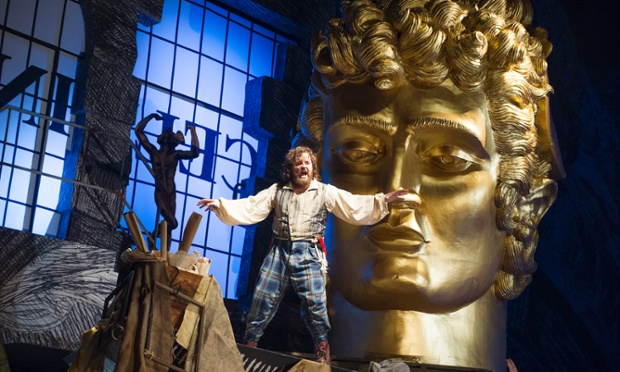
"Monty Python meets the Belles of St Trinians? Sacré bleu !"Jacques Offenbach's Vert-Vert at Garsington Opera at Wormsley  features a girl’s school in collective mourning for a dead parrot".

"The plot, suitably Pythonesque given the dead parrot, is more or less impossible to précis. Suffice it to say we are in a girls convent school in mourning for its dead parrot, Vert-Vert. Cue general lamentations. The girls choose an innocent young man, Valentin, as a substitute parrot....."Rather like a demented Brian Rix farce, mayhem ensues. All is happily resolved in the rousing final chorus (“A slurp of wine”) but in between there are some notably tender and affecting moments. This may be comic but it is comedy with a heart."

Read more HERE in Opera Today reviewed by Douglas Cooksey

"The production - a fine demonstration of ‘more is less’ but nonetheless with several coups de théâtre as when the back of the stage opens wide and the school/chateau is wheeled to the open space beyond with Garsington’s woods as a backdrop or another occasion when the rear of the stage opens to admit the barge named Hortense which bears Valentin away - was an object lesson in pointful economy. .......Most importantly - and this is probably why the genre has never really caught on in Britain - in David Parry we had a conductor who, like Beecham, has the idiom at his fingertips, exuding panache, élan and élegance in equal measure (only French words will do). Beecham once talked of combining the maximum delicacy with the maximum virility, a comment which might well have applied to the Garsington orchestra on this occasion with its polished strings, an excellent first clarinet (Peter Sparks) in his several solos and a notably secure horn section. The score absolutely fizzed along.

Sunday, 8 June 2014

CRINGE worst orchestra EVER

Ear wincingly awful ! Brought tears to my eyes ! Strauss Also sprach Zarathustra . But someone's stuffed things into the brass, who emit horrendous wails.  OTOH, the kids were trying, and the parenst must have been rolling with agony (and laughter). This is what you call, "learning by mistakes". Click HERE to hear the world's worst Strauss performance ever !!!

Saturday, 7 June 2014

Sajid Javid's Big Statement

Sajid Javid MP has made his first public statement since becoming Secretary of State for Culture, Media and Sports. Even before he started, Javid was attacked in terms that bordered on racist. No  party has a monopoly on virtue. In any case, traditional political stereotypes have been toast for forty years. So it's important to read what Javid actually says, as opposed to what others think he says. The most detailed verbatim report is HERE.  Perhaps it says much about the level of arts coverage in this country that the best analysis comes from a political correspondent, not an arts luvvie. Better a Minister for Culture who is honest than one who pretends to be artsy.

"For a bus driver's son, the idea of popping along to the Donmar Warehouse – or even the Bristol Old Vic – to take in a cutting-edge new production was simply not on the agenda. It wasn't what people like me, people from my background did," said Javid, who has elaborated on his thinking in an interview with Mark Lawson for the Guardian. "As a youngster, the closest I ever came to the creative industries was when the careers adviser at Downend comprehensive told me I should work in television – repairing them at Radio Rentals." 

"And while 14% of the UK's population is non-white, BME applicants were awarded just 5.5% of Grants for the Arts awards last year. Why is this? Are BME people simply less artistic, less talented? Of course not." Javid said this mattered because culture was more than a privilege: "If you are not engaged with our cultural life, you're not engaged with our national life. Too many Britons are culturally disenfranchised."

It would be wrong, I think, to cut funding from classical music to fund, say, grime or hiphop, just to be politically correct. Some genres thrive because they're alternative, and free of government interference.  Similarly, it's a mistake to dumb down classical music to make it somehow more accessible. Dumbing down implies that the audiences being targetted are inferior, incapable of being civilized.  Read my article "End the Missionary Position in Classical Music"

The root of the problem lies in society, not in the arts. In countries like China, South Korea and Japan the arts are honoured because they are intangible assets.. In ancient China, peasants might not be able to read, but they knew that the pursuit of knowledge was worthwhile. The arts cannot be valued in simple terms of mass appeal. They represent the ideals and dreams that drive civilization. Of course terrible things happen, even in civilized societies. A society that derides culture descends into barbarism. Goebbels (who invented modern mass media) supposedly said, "When I hear the word Kultur, I reach for my gun".

Unfortunately we do live in a world where people are judged by the colour of their skin and by how much money they have to spend. It's hard enough to break past barriers like that without having to deal with white middle class assumptions of superiority. All people have the potential to make something of their lives whichever way they want to. There's no reason why ethnic minorities or people without money (not necessarily the same thing) shouldn't listen to classical music. But neither should they "have" to.  Everyone in Britain is part of a wider artistic culture, since the western classical music tradition reaches the world over. In hard-headed business terms. supporting that tradition is good for Britain, and for Britons whoever they are.

The Gay Shoe Clerk


Pretty racy for 1903 !

Friday, 6 June 2014

ENO Benvenuto Cellini - no groupthink !


Berlioz Benvenuto Cellini at the ENO reviewed by Mark Berry in Opera Today (read the whole piece here)

"First, a sigh of relief: in almost every respect, this new ENO staging of Benvenuto Cellini marks a significant improvement upon Terry Gilliam’s ‘Springtime for Hitler’ Damnation of Faust. If that sounds like faint praise, for beating a ‘Holocaust as entertainment’ travesty is perhaps setting the bar unreasonably low, then such is not entirely the intention. Gilliam’s Cellini has its virtues, though for me they are considerably fewer than they seemed to be for the audience at large. It is far from unreasonable to depict anarchy and ribaldry in the Carnival, and indeed during the ‘carnival’ overture — though Gilliam’s reported remark that ten minutes of music are ‘too long for the audience to sit through waiting for the show to begin’ are unworthy of anyone working in opera. There is nothing wrong in principle with ‘staging’ an overture, but the reason should be better than that; if the results are a little over the top, they are certainly superior to the justification."

Thursday, 5 June 2014

Rafael Frühbeck de Burgos, Mahler Symphony no 1

Rafael Frühbeck de Burgos is to retire, with immediate effect. "After meeting with my doctors I have come to the following conclusion: I have to recognize publicly that I have cancer and that in this state of health and with deep sorrow I am not able to conduct at my standards and the moment to quit professional matters has come.” What a dignified and honest statement. That is the measure of a man, I think. I'm greatly moved.

Although Frühbeck de Burgos was a regular fixture in London in the late 60's early 70's, in later years his appearances here were relatively rare. I came to "know" him from his recordings with the "New Philharmonia" as it was called then. His recording of Die Meistersinger von Nürnberg (Deutsche Oper Berlin, 1995) is another milestone. Wolfgang Brendel's Hans Sachs is uncommonly wise and warm - a lot like I imagine the conductor himself is. Frühbeck de Burgos didn't record Mahler, but his way with the composer was highly regarded. He was awarded the Gold Medal of the International Gustav Mahler Society in 1996, when such things meant a lot. So when he returned to London after a long hiatus to conduct Mahler Symphony no 1, my friends and I were there.

In this symphony Mahler sets out his calling card, so to speak, so the way a conductor approaches it shows how deeply he's absorbed the composer's idiom. There are brash, vulgar Mahler 1's, perfectly valid in some ways, if you think of Mahler as a wild young man punching his way Titan-like into the world.  Then there are Mahler 1's conducted like Frühbeck de Burgos, where you feel you're hearing  a wise older man looking back fondly on a tempestuous young man's audacious dreams, knowing how the composer will grow and mature.

"This performance placed the First Symphony firmly in the context of Mahler’s early influences", I wrote then. "The imagery of dark, nocturnal forests is central to Germanic folklore, and to the sensibility of the Romantic period. It’s natural, then, that Mahler, so aware of the position of music in connection with other arts, would choose to start the first movement with what are effectively “forest murmurs”, evoking panoply of images pregnant with meaning for his time. Indeed, Siegfried was a kind of “Titan” individual who, like Mahler, had to make his own way in the world. Tentatively, the clarinet and flute break through the murmurs: the clarinet’s kuckuck a direct reference to the cuckoo heralding Spring who will appear in other songs and symphonies. The music then wells up to an unequivocally lyrical transposition of Ging heut’ Morgen übers Feld. Frühbeck de Burgos beamed with happiness, for this is exhilaratingly happy music, especially when separate from the other, darker songs in the cycle. It is, after all, about an idealised “Schöne Welt”. At the crescendo, the whole orchestra seems to explode with enthusiasm, horns and big brass in full fanfare, but Frühbeck de Burgos keeps the textures clear and distinct. It is exciting because it is so breathtakingly pure."
 
" In the second movement, the references to Ländler and folk dance are emphasized. Frühbeck de Burgos had the orchestra play the swaying, swaggering theme with panache, the lovely clarinet embellishments played with instruments held high. The heady, swirling figures in the theme later used in the Second Symphony and Des Antonius von Padua Fischpredigt came across confidently, for this conductor understands Mahler’s quirky sense of humour, which is never far from the surface. It’s not simply that this conductor’s personal geniality brings out the humour: Mahler’s sense of the ludicrous is far more deeply ingrained in his work than is often appreciated. Hence the “funeral march” in the third movement, inspired by a picture in which animals escort a hunter in his cortège This image frightened the composer when he was a child, for it addresses the idea of transience, a world overturned, and a reversal of order. It’s a theme later to be explored in the Dionysian deconstruction in the Third Symphony. In the First Symphony, though, it’s still relatively undeveloped. A well modulated roll of the massed kettledrums announces a colder mood. The slow march here was supported by a surprisingly gentle clash of cymbals, whose reverberations seemed to float on, highlighted by two bursts of sound from the double basses, a simple but telling detail. Then the orchestra reignites in full crescendo. In contrast with the rounded, warm lyricism that had gone before, the “inferno” sequence was wildly angular, trombones, trumpets and tuba in full fanfare. Yet as the conductor raised his hand, in an instant the powerful surge subsided into a recapitulation of the balmier “summer” theme.

"Frühbeck de Burgos uses volume to accentuate the colours and contrasts in the score: it works well because this orchestra is so good they respond immediately, as one. There’s no room for muddy playing in this approach. Thus the final movement really was Stürmisch bewegt, a tsunami of sound relentlessly, powerfully surging forward. It was both beautiful and terrifying at the same time. Yet at no point did the individual strands get lost in the tumult. Highly disciplined and accurate musicianship kept the colours clear and vibrant. Amazingly, the horns sounded almost like bells tolling, the bigger brass providing a deeper undercurrent. Sudden bursts of colour, such as from the flute and clarinet, lit up the curtain of sound created by the rumbling roll of percussion and the extremely well balanced strings. And so this symphony ended in a truly jubilant mood. Just as there were quotes from Lieder to provide subconscious commentary, the quotes now were from Handel “King of Kings, Lord of Lords, and he shall reign forever and ever”. It is, unmistakably, a triumphant ending, bursting with hope, life and vitality. Frühbeck de Burgos has the horns stand up to play in a splendidly theatrical gesture, which fits the exuberant spirit of this music. A complete Mahler cycle tracing the composer’s development, symphony to symphony, from this conductor and an orchestra of this standard would be a wonder to behold."

Garsington Opera's 25th Anniversary : past unites with future


Garsington Opera's 25th anniversary season starts Friday - some seats still available,. But there's a lot more to the season than the three operas on offer. Douglas Boyd, Artistic Director, speaks about this year's programme and about thrilling new developments that could launch Garsington Opera into the next 25 years at the forefront of British country house opera. Read the interview HERE IN Opera Today for more.  

 The late Leonard Ingrams founded Garsington Opera in 1989 in his own home, Garsington Manor. In 2011, the festival moved to Wormsley Park, Mark Getty's estate in the Chiltern Hills. The larger and even more spectacular setting has great potential. The award winning pavilion is now permanent, and its backstage area has been expanded. Garsington Opera's own orchesstra will continue to produce chamber-scale specialist work - Garsington Opera is the foremost house for Rossini rarities  in the UK - but the facilities now cater fro larger scale orchestras and a wider repertoire.

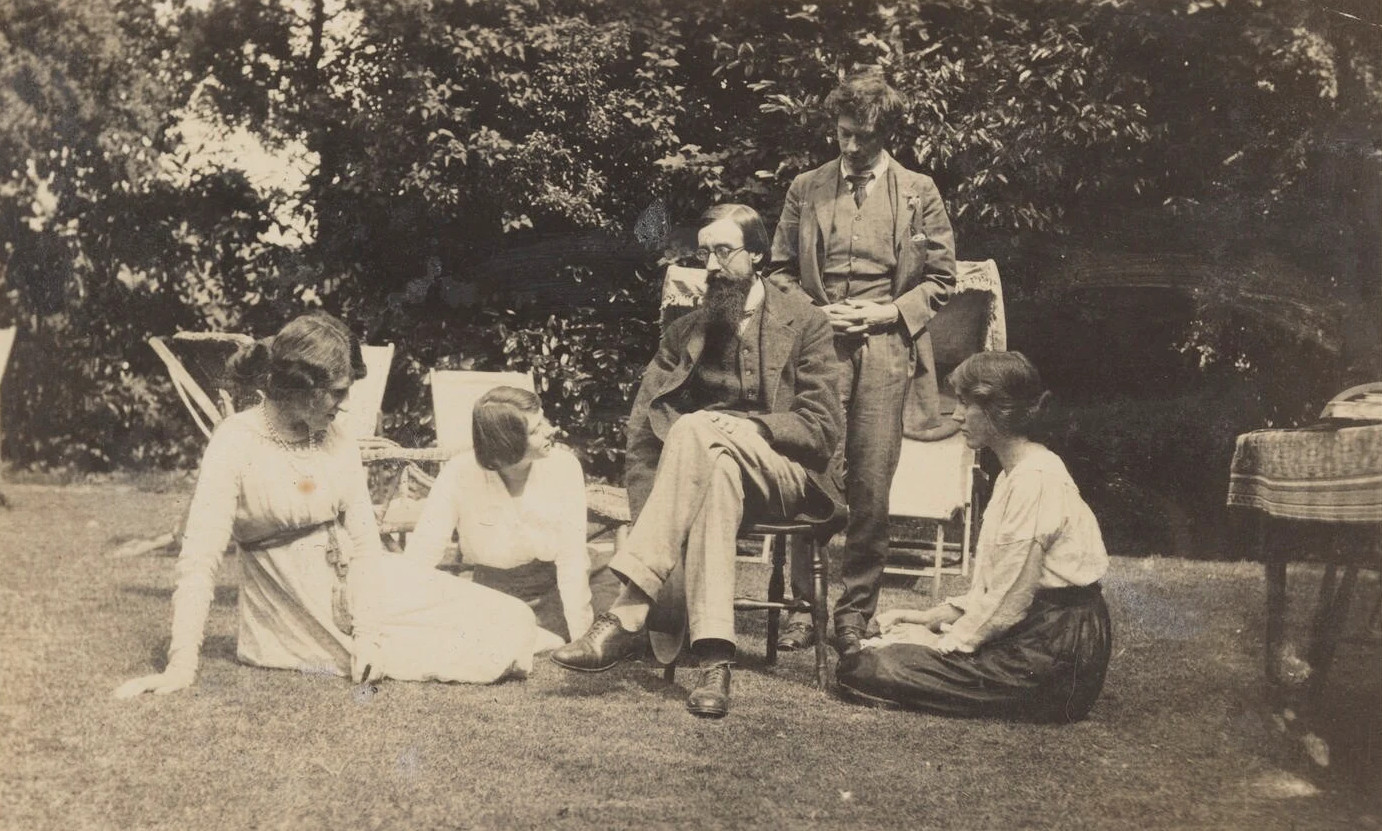
Furthermore, Garsington Opera will be able to create a new niche through which opera, chamber and orchestral music can be heard together with literature and discussions on broader issues. In 1915, Lady Ottoline Morell bought Garsington Manor as a retreat from her estate at Morrell Park in Oxford. Her salon attracted the more adventurous artistic minds of her era - she knew TS Eliot, Virginia Woolf, Bertrand Russell and many others.  At right a photo showing her on the lawn at Garsington with Aldous Huxley, Lytton Strachey, Duncan Grant and Vanessa Bell. Siegfried Sassoon, the war poet, stayed at Garsington Manor while recuperating from the Somme.

This year, Garsington Opera is holding a weekend "Peace in our time?" (note the question mark). Discussions, concert performances, chamber music, masterclasses, cricket matches and poetry readings. By remarkable coincidence, two previously unpublished poems by Siegfried Sassoon will be read in public for the first time. One poem, "Atrocities", was suppressed during war time, but the other is an ode to Beethoven: the composer who perhaps more than others deals with ideas of oppression, war, resistance and hope through brotherhood. Celebrated in a poem by Siegfried Sassoon, who knew war and injustice, and whose poetry stimulated a whole new artistic aesthetic. (Ivor Gurney lived in High Wycombe down the road from Wormsley, and Wilfred Owen lived near Henley-on-Thames)  Perfect dovetail : Garsington Opera's past and its future.

photo of the Garsington Opera Pavilion at Wormlsey by Christopher Jonas

Wednesday, 4 June 2014

Tiananmen Square massacres 25 years on


Twenty five years ago today, the protests at Tiananmen square in Beijing were crushed. The protests seemed to suggest a new era, like the May 4th movement in 1919 which was a watershed in Chinese history (leading among other things to the foundation of the Communist party). So it was traumatic when the protests were ended. Everyone remembers what they were doing when the news came through, also what others were saying and doing. François Bisson was there, in Beijing, right in the heart of the action. He made this film using footage he and a cameramen he knew shot at the time. It's very direct, first person, watch it and "be there" again.

Has anything changed? Yes, a great deal. Although the Party and Army still control the government and the media (my site is banned in China), things are infinitely better. The "Capitalist Roaders" the Red Guards used to rail against have won, sort of. Throughout history, change has happened when ordinary people have opportunities to better themselves. So much for Marxist theory. To some extent it's fortunate that strong central economic control persists, because the Chinese banking system didn't collapse when disaster struck everywhere else. At the top, three powerful and idealistic women bankers who don't believe in Gordon Gecko selfishness. But an economy that size, growing at that rate... Nothing is easy or simple in a nation that size.

But may June 4th 1989 NEVER be forgotten! The subject is still taboo. A whole generation has grown up, hardly knowing what happened. All the more reason that we who can should remember this day and what it means. Twenty-five years ago, my brother was enraged when my elderly father did not condemn the young soldiers who killed the students.  Father was right. From the perspective of country boys from remote provinces, joining the army was an escape from extreme hardship. They couldn't comprehend why educated city folks would reject the regime. So the way forward is not hate but reform, which cannot take place without remembrance. Twenty-five years ago, my little son wore a black armband to his English infant school. No-one knew what it meant. The teachers must have thought I'd indoctrinated the kid. But my son has grown up with a social conscience and good values. I'm so proud of him.

Monday, 2 June 2014

Rattle conducts Poulenc Dialogues des Carmélites, Royal Opera House

Claire Seymour's review of Poulenc, Dialogues des Carmélites, at the Royal Opera House. London. Read the whole piece HERE in Opera Today.

"A black bare stage heaving with a rebellious revolutionary throng; they stare with still hostility directly at the audience, stark light streaming from above. A scene from Boublil’s and Schönberg’s Les Misérables? No. The opening moments of Robert Carsen’s much-acclaimed production of Poulenc’s opera of courage, cruelty and redemption."


"Rattle clearly knows and loves this score: the brass play with purity and restraint in the chorale-like passages, and Rattle creates an iridescent sound-world in which glistening harps ripple and luscious strings surge in rapture, coloured by silky woodwind slithers, but one which is also ominously punctuated by shuddering, jagged rhythmic bursts of terror and brutality. The percussive slashes of the final march to the scaffold reveal the full unleashed force of the Royal Opera House Orchestra. Yet, despite Rattle’s care and attention - and Carsen’s imaginative faithfulness to the composer’s reputed preference for stagings which adopt a monastic austerity - there is no getting away from the fact that the score is dominated by an ever-repeating two-bar progression, in various harmonic inversions and timbral colourings, an infinite chain which becomes increasingly more wearisome and which makes it difficult to establish and sustain any driving musico-dramatic direction. Typical of the nature of Poulenc’s idiom is the terrifyingly moving final scene, which is underpinned by a rocking minor third; it is the raw rip of the slicing guillotine which provides the drama, rather than any harmonic conflict."

My piece on Olivier Py's 2013  production from Paris with Pétibon, Piau,, Koch, Gens, Lehtipuu etc is HERE


photos: Stephen Cummiskey 2014 courtesy Royal Opera House

Sunday, 1 June 2014

Poulenc Dialogues des Carmélites


Francis Poulenc Dialogues des Carmélites at the Royal Opera House. Review HERE, but first a consideration of interpretation. Interpretation is  paramount to assessing any production. Criticism often latches onto things like sets and costumes because these are easy to isolate. But they're absolutely secondary to interpretation. Dialogues des Carmélites is interesting because it's austere; its meaning and methods not easy to penetrate.

The Carmelites take vows of silence, they don't fritter their lives away on frivolity. That's why Blanche chooses such a strict order. She lives in times of danger, when violence can overwhelm even the rich and protected.  Her mother was killed in shocking circumstances. Neurosis is implicit in her music which wavers tremulously up and down the scale. "C'est physiquement que je n'en puis supporter le bruit, l'agitation". In a convent, everyone wears the same uniform, but you can't escape into anonymity. Hence Poulenc defines the main characters through their music and their personalities.

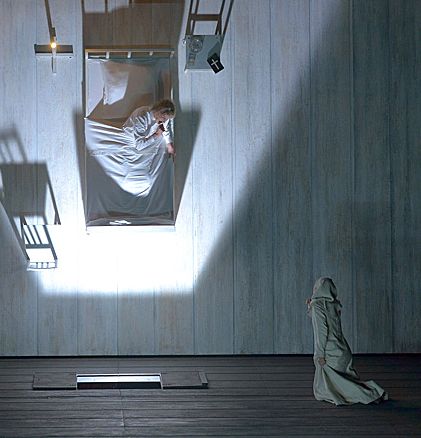
Robert Carsen's Dialogues des Carmelites at the ROH was first seen nearly 20 years ago.  Last in December 2013, Olivier Py created a superb but different  approach at the Théâtre des Champs-Elysées.  Py's style is colourful, and often humorous but it brings out the  beauty in the opera. When Blanche is accepted as a novice, Patricia Pétibon is transfigured, lit with silvery light. Dialogues des Carmelites, because it unfolds as a series of disconnected tableaux, is like the Stations of the Cross. This structure is significant, for Poulenc is connecting the nun's journey to the guillotine to Christ's journey to the cross. He further emphasizes the non-linear progression by writing expressive interludes which are as much part of the narrative as the text. Woodwinds sing, bells toll, and a "window" opens above the stage, the outline of trees, also lit in silver. Religious paintings often showed the Infant Jesus with a tree in the background, which will someday become his cross. When Madame de Croissy lies dying, Rosalind Plowright is shown in a bed hanging from the wall, so we can hear her voice project into the auditorium. It's also an image of Christ on the Cross. The Philharmonia Orchestra, conducted by Jérémie Rhorer, play savage, stabbing dissonances. The dying woman thinks God has forsaken her, her perception as distorted as the perspective of her bed on the wall.

Py's use of delicate, subtle colours emphasizes spiritual purity, Sister Constance (Sandrine Piau, one of the "whitest" voices around) positively glows. At this point, Blanche can't understand the miracle of simplicity. The singing in this production is exceptional. This cast includes the finest French repertoire specialists around : Pétibon, Piau, Véronique Gens (Madam Lidoine), Sophie Koch (Mère Marie de l'Incarnation). [Indeed, the interaction between the singers is electric - the sisters "feel" like sisters, Pétibon and Piau in particular. The finest singing around at the moment, could hardly be bettered].  The male voices are just as good. They are lustrous. Topi Lehtipuu (the Chevalier de La Force) sings forcefully, but with refinement and with lustre, suggesting that Blanche will find similar inner strength when she faces her destiny.

As violence closes in, Poulenc's music takes on richer dignity. Pétibon is seen with her hair shorn, but defiantly ginger, while a chandelier glows with rich, golden light. The nuns are condemned to death. Dark, glowering chords in the music, strange angular lights grow maze-like from the floor of the stage. Brassy trumpets, pounding percussion. Yet the visual image is that of a stylized religious play, such as children might enact. At the moment of their death, the nuns are restored to innocence. "Salve Regina", they sing, lined across the stage. As each is killed, there's a thud and a singer leaves the stage. Can something as gruesome as the guillotine be shown with such beauty?  Yes, for Blanche and her sisters have found a greater truth, which those without their faith cannot comprehend. Blanche is seen, arms spread wide like Christ on the cross. Her face is beatific, as she sways in a circle against a backdrop of stars.


photos : Georges Bernanos

Friday, 30 May 2014

Birtwistle - Yan Tan Tethera, Barbican


Latest in the Barbican's Birtwistle at 80 celebration, Harrison Birtwistle's Yan Tan Tethera, from 1984. For a change titles like "A Mechanical Pastoral"  add to meaning. The piece is "pastoral", a rumination on folk traditions which date from before Christian times. Whatever period these shepherds may live in, they connect intimately with an ancient landscape. Yet Birtwistle's music is constructed with mathematical precision. Perhaps he's suggesting clocks, as he has done elsewhere, alluding to Time itself, operating on many different levels at once.  Geological layers, layers of language, repetitive layers and interconnections in the score.  Yan Tan Tethera is a maze in music, like the mysteries that might lie beneath the sarsen stones and prehistoric burial mounds.

The narrative is extremely simple. Just as in a medieval mystery play the characters are symbols, not characters in themselves but links to cosmic truths. In theatre history, the idea of psychological character development is very recent indeed.  Alan (Roderick Williams) comes from the northlands, Caleb Raven is a Wiltshire man, who pokes the ground, looking for buried treasure. "I wave to him but he never waves back" sings Williams. Caleb Raven (Omar Ebrahim) doesn't like immigrants. His name itself hints at Cain and Abel, his surname sinister and his abode the mound of Adam. Alan came south against his will, driven by the sound of an invisible piper who is also the Bad 'Un, ie, a Satanic figure (Daniel Norman). Alan starts off with two sheep, who multiply to a large flock: Alan's wife Hannah (Claire Booth) gives birth to twins who mysteriously multiply while Alan is imprisoned under the earth by Caleb Raven, jealous of his good fortune.

Mathematical puzzles in the music, too - diabolic triads and triplet, repeated patterns that vary in sequence.  Baldur Brönnimann, a new-music specialist, conducts with unsentimental lucidity. Waffle isn't Birtwistle's thing. (Shame about the poor unsigned programme notes.) The very title "Yan Tan Tethera" refers to archaic methods of counting and measurement. so accuracy is of the essence.The Britten Sinfonia and the Britten Sinfonia Voices responded well to Brönnimann's tight phrasing. "Pastoral" in Birtwistle's case doesn't mean dreamy, but earthy and gritty. John Lloyd Davies' semi-staging. employed the image of sarsens, standing on flat plains. Now they stand immobile, but once they were transported from far away. In a piece like this, "singing" doesn't mean elaborate coloratura, but solid pitch and down to earth diction. Roderick Williams is perhaps the best baritone in English repertoire in this country, and Omar Ebrahim the best for avant garde (though Williams sings a lot of new music). Together the pair were ideal counterparts, two opposing poles, like the landscape they occupy in the score. .More on Birtwistle on this site than most anywhere. please explore.
Photo (top): Roger Thomas

Opera HD - myths and facts

Audiences for opera broadcasts in the cinema are old. That's news? The survey has gone viral. But here's where genuine local knowledge comes in. The survey  was done by the Guildhall School of Music and Drama. Excellent music and drama students but not necessarily sophisticated pollsters. It was commissioned by English Touring Opera. ETO is a wonderful, innovative company but its business is touring, reaching places outside London, where people might not otherwise experience live opera at all. The ETO is unique, and serves an important public purpose.  But one can understand why they'd be interested in the impact of HD, when anyone can watch the Met, ROH, Salzburg and Munich. Personally I think ETO has a special place !

The story, however, has gone international, raising a lot of questions that don't have much to do with the survey at all. Some have even blamed the  Met's problems on HD. So it's a good time to separate fact from fabrication.  Opera has been filmed almost as early as the technology has been available. In the 1970's Rolf Liebermann at Hamburg pioneered the idea of opera created for film, which resulted in works of genius like Wozzeck and Die Freischütz which combined musical astuteness with visual imagination. Opera films were often broadcast on TV, some even written for TV, like Britten's Owen Wingrave. So why should HD be any different?

Watching live streams is fun, but fundamentally not all that different from watching a DVD. The art itself does not change. Directing an opera is completely different from directing a film: the skills are not usually compatible.  An opera director works through character and motivations: a film director chooses angles which best bring out the intention behind the production. In a good production live, there's often so much to take in at once that it's often easier to watch something through the eyes of a film director. Real opera devotees often catch both the live and filmed broadcast, because the slight shift of perspective adds to knowledge and thus to enjoyment.

Millions of people can watch filmed opera in cinemas and online, who might never otherwise be able to attend in person. What's so wrong with that? People get old and immobile but they should not be written off as human beings. Millions grew up with audio recordings and DVDs. Of course their experience counts, every bit as much as those lucky enough to be in the right place at the right time. Being in a house is exciting, even when you attend many times a week, but the primary aim is opera as music and as art, not the frills, the popcorn or fancy new stilettos. As I've said many times before, there are numerous different audiences, each with different interests. So there's a case for tolerance and inclusivity.

Filming opera is expensive, so it's not a universal panacea, however tempting it might seem. Some smaller houses have been burned. However,the reality is that the potential market for opera is infinitely bigger than house capacity. The Royal Opera House enjoys 95% occupancy, so there's little room for growth in those terms.  Film is an essential part of the business model. In 2013, 675,000 people watched 415 performances in house. Since 2012, over three million have watched a much smaller number of operas in cinemas and online. Go figure. Glyndebourne is a much smaller house - usually packed out - but it's so good that it can do deals with newspapers to broadcast online.  Statistically it just doesn't add up that film bleeds live. Online audiences may not rush out for live tickets, but so what? They are paying attention.

The game changes all over again with digital broadcasting. On 20 May the ROH broadcast La Traviata live on its own youtube channel.  In cost terms, this is more effective than sharing profits with a cinema chain. In Europe, there are online channels that broadcast recent productions as well as old. Siemens pioneered digital screening technology and paid for 3 years of screenings from  Bayreuth.  How do companies make money? Some charge, which is fair enough. If we care for the arts we should be mature enough to realize you can't expect good things for free. But the returns are simply the amount raised by subscription.  The size of the online market shows that the demand for opera is greater than seat sales alone.  There's a huge potential audience out there who are interested enough to care and to learn. Much better such audiences than the kind of boors who think they "know" opera because they can shell out for pricey tickets. Gimmicks like fast food eateries don't help sales,. The South Bank shows how artistic purpose is lost when artistic vision is compromised.  Online and HD grow the audience through education.  When  the Berliner Philharmoniker began its digital concert hall, it became the world's "home" orchestra,. Competition can be good or bad, but raising standards is good for everyone.

LOTS more on film and opera on this site, please explore

Wednesday, 28 May 2014

Ian Bostridge, Wigmore Hall, Schubert

"In this Schubert Liederabende — the second in Ian Bostridge and Julius Drake’s planned series of four recitals at the Wigmore Hall — dark, sombre worlds evoking the romantic turbulence of Death and the Maiden were only briefly alleviated by radiance and light."   Claire Seymour reviews  Ian Bostridge and Julius Drake's Schubert recital at the Wigmore Hall in Opera Today.  

Please take the time to read this - extremely erudite yet sensitive and perceptive writing :

"This haunting intimation of mortality at eventide was followed by just a single verse of the intimate ‘Ins stille Land’ (To the land of rest) which perfectly expressed the Sehnsucht that Schubert instructs. ‘Totengräbers Heimweh’ (Gravedigger’s longing) brought the first half to a close. Nicolaus Craigher de Jachelutta’s somewhat melodramatic poem describes a gravedigger increasingly seduced by the lure of the burial places he digs for others. But, while there was force and anger in Bostridge’s frustrated cries at the start, there was no undue exaggeration in the performer’s depiction of mental distress and decline. The weaving semiquavers of the second stanza were skilfully controlled, the mood first elegiac then more restless and exposed. Drake’s transition to the slower third stanza was eerie, an apt prelude to the mysterious, mournful unison which follows, the latter disturbed by the piano’s rustling ornaments. As the gravedigger’s energy gradually dissipated, Bostridge increasingly withdrew: indeed, so introspective was his longing for release — ‘O Heimat des Friedens,/ Der Seligen Land!’ (O homeland of peace, land of the blessed!) — that there was a rare rhythmic error which Drake subtly resolved. A remarkably hushed sense of heavenly yearning infused the arcing lines, the piano’s diminished harmonies suggesting an unearthly transmutation. Bostridge’s final cries had an uncanny, sweet lightness; the extreme registral contrasts of the piano postlude evoked the expanse between man and celestial realms."

"

Broadcast Alerts - May, June

Thanks again to Andrzej !

31 May 2014 Die Soldaten Bavarian State Opera, Munich Internet video streaming

1 June 2014 14.30 Les Contes d'Hoffmann Vienna Internet http://www.staatsoperlive.com/

3 June 2014 Ballet : Balanchine / Millepied Paris Cinema live

3 June 2014 Matisse Live from Tate Modern Tate Modern Cinema live

 6 June 2014 19.00 Donizetti Gala Genova Internet http://www.streamingcarlofelice.com/la-stagione.html

 8 June 2014 16.30 Der Rosenkavalier Glyndebourne Cinema live

11 June 2014 19.15 Galakonzert der Semperoper Dresden (Harteros, Nylund, Stemme) Dresden TV Arte TV

12 June 2014 Così fan tutte Bologna Cinema live 12 June 2014 A Small Family Business NT Live Cinema live

14 June 2014 19.00 Il Barbiere di Siviglia Genova Internet http://www.streamingcarlofelice.com/la-stagione.html

 17 June 2014 Benvenuto Cellini ENO Cinema live

17 June 2014 Traviata Paris Cinema live

24 June Manon Lescaut ROH

18 June 2013 18.30 Berlin Phil (Rattle) Berlin Cinema live

18 June 2013 19.00 Henry IV Part 2 RSC Cinema live

Tuesday, 27 May 2014

Thrilling 2015, 2016 - Garsington Opera at Wormsley


Thrilling 2015 and 2016 for Garsington Opera at Wormsley, showing how it's maturing, and developing a unique niche in the British opera world. As the curtain goes up on Garsington Opera’s 25th anniversary season, Douglas Boyd, artistic director, has announced two major developments - partnerships with The Royal Shakespeare Company Theatre, Stratford, and the Philharmonia Orchestra, London.:.

For the first time Garsington Opera is working on a joint project with the RSC with performances at both Wormsley and the Royal Shakespeare Theatre, Stratford. It will be a rare opportunity to see an abridged version of Shakespeare’s A Midsummer Night’s Dream performed by members of the Royal Shakespeare Company, under the creative guidance of Gregory Doran, Artistic Director of the Royal Shakespeare Company, illuminated with Mendelssohn’s enchanting incidental music, played and sung by the Garsington Opera Company and Orchestra, conducted by Douglas Boyd. RSC Artistic Director Gregory Doran said "A Midsummer Night's Dream is one of my favourite Shakespeare plays, so I am delighted to be able to stage this bespoke version incorporating speeches from the play along with Mendelssohn's gorgeous score. It was one of the first pieces of music I heard in childhood and inspired my lifelong love of Shakespeare. This is a very exciting new collaboration with Garsington Opera, and I hope will appeal to lovers of theatre and music alike."

Garsington Opera will  also form a partnership with one of the world’s great symphony orchestras, the Philharmonia Orchestra, initially for five years, which will enhance the artistic quality and reputation of the company. Garsington Opera is also committed to the Garsington Opera Orchestra, which will focus on baroque, classical, Italian and chamber works, whilst the Philharmonia Orchestra will enable larger-scale works to be performed. David Whelton, Philharmonia Orchestra Managing Director said: “Creative partnership is at the beating heart of the Philharmonia's artistic approach, and the opportunity for us to collaborate with one of the most forward-thinking opera festivals in the UK is tremendously exciting. We are absolutely delighted to be a part of Garsington Opera's future, and look forward immensely to working together with Douglas Boyd and the Garsington creative team to bring extraordinary new productions of the larger scale 19th and early 20th century repertoire to audiences at Wormsley."

This year's season starts with Fidelio on 6/6, Offenbach Vert-Vert on 7/6 and Janáček Cunning Little Vixen on 22/6. Almost sold out! So look ahead :

In 2015  Mozart’s Così fan tutti  conducted by Douglas Boyd and directed by John Fulljames, Britten’s Death in Venice conducted by Steuart Bedford, who conducted the world premiere in 1973,  directed by Paul Curran, and Strauss’ Intermezzo conductor Jac van Steen, director Bruno Ravella.

 In 2016, Douglas Boyd will conduct a new production of Tchaikovsky’s Eugene Onegin directed by Sir Michael Boyd, David Parry conducts Rossini’s L’Italiana in Algeri directed by William Tuckett,  and Tobias Ringborn conducts Mozart’s Idomeneo with Tim Albery directing.

Garsington Opera at Wormsley fills an important niche. It's Britain's foremost Rossini house, having presented 12  Rossini opera since 1995.  Read about the ground-breaking new Rossini Maometto Secondo commemorative CD (new edition) here.  It's also an elegant Mozart house. The new developments suggest thrilling new possibilities. The season at Wormsley, includes a weekend commemorating the First World War with a celebrity recital by Steven Isserlis, masterclass with Ann Murray, tours of the world-famous Getty Library and a symposium Peace in our Time? led by James Naughtie with Oxford historian Professor Margaret MacMillan, writer Miranda Carter and Jeremy Paxman .

photo: Mike Hoban