Thursday, 18 April 2013

Biggest and best City of London Festival 2013


The City of London Festival starts in June but book now because most of it will sell out fast. This is the biggest and best CoLF in ages - more events, more venues and an extremely well planned programme that brings together many different aspects of London's cultural and historical heritage. It's so good that it's worth edging aside some of the more popular arts calender. It's also not at all "tourist" London although it takes in important sites. It's a great way to really get to kmow parts of London not normally open to the public.

The Festival starts, appropriately, in St Paul's Cathedral on 23/6 with two free concerts. These will be spectacular. Ralph Vaughan Williams The song of the Tree of Life needs a huge performance space like a cathedral, and this one comes with one of the finest cathedral choirs in the country. It will be paired with Jean Langlais' Messe solonnelle, with one of the country's finest organs. Andrew Carwood conducts.

St Paul's Cathedral will also host a major concert on 25/6 with the City of Birmingham Symphony Orchestra, who don't come that often to London. Edward Gardner, of the ENO is Principal Guest Conductor of the CBSO, so it will make a change for Londoners  to hear him conduct an orchestra that specializes in non-operatic music. The CBSO will be joined by the Choir of St Paul's Cathedral and Toby Spence, Russell Braun and Albina Shagimuratova. There will be many Britten War Requiems this year and next, but this could prove to be one of the better ones..

Two concerts on 27th, both with interesting programmes. The BBC Singers are singing Kodaly, Ireland, and an extract from Clément Jannequin La Bataille de Marignan - La guerre at St Giles Cripplegate. Leg it over to Mansion House .if you can for Huw Watkins and Nicholas Daniel and the Britten Sinfonia. They're doing Stravinsky's The Birth of Apollo and Britten's Young Apollo.

At Aldeburgh, Britten's Church Parables (Curlew River, The Prodigal Son and The Burning Fiery Furnace) have sold out ages ago because Orford Church, for which they were written, is so small. But don't miss out because the City of London Festival is bringing the exact same production to  Southwark Cathedral from 3rd July. The Church Parables really need to be experienced in the right reverential atmosphere, so don't miss the opportunity to see this important production and excellent cast (including James Gilchrist). I'm planning to go to both Orford and Southwark. (Read more about this production here.) 

The City of London Festival has good relations with Dutch musicians, reflecting the maritime traditions of both countries. On 4th July, Toonkunstkoor Utrecht will combine with the English Chamber Orchestra, under conductor Jos Vermunt for Handel, Te Deum  and Jubilate for the Peace of Utrecht. They will also be doing  The Idea of Peace, a new work by Adrian Williams, a British composer whose music has featured regularly in the Netherlands and has also been performeed by ensembles like I Fagiolini, The BBC Singers and Gillian Keith (who will be a soloist). In the Draper's Hall on 24th, a specially commissioned song cycle that links the eight ‘walled’ cities of Derry, London, Utrecht, Berlin, Vienna, Dubrovnik, Nicosia and Jerusalem, each section written by a composer from each city. Lore Lixenberg sings with the Brodsky Quartet.

By now it should be clear that war is one of the many themes in this year's CoLF. Apart from the keynote Britten War Requiem, Jannequin, and the Handel Utrecht pieces, we'll be able to hear Messiaen (a friend of Langlais) Quartet for the End of Time and other new commissions, attend a two-day conference Worlds in Collision Conference – Music and the Trauma of War which will conclude with a concert of settings of Gurney and Butterworth with the Royal Artillery Band. Read more here about the conference which looks a cut above average. Although this is a busy period for me, and it's very expensive,  I am hoping to make time for this because it's so interesting.  To quote "This two-day conference brings together musicians, music therapists, arts practitioners, psychiatrists, neuroscientists, historians and soldiers to address important questions. What is the relationship between art and war? What have been the responses of artists to post-traumatic stress disorder? Is human creativity itself therapeutic?"

And then, there are trees. Although the City of London seems completely urbanized, there are pockets of ancient greenery, like trees in graveyards that date back hundreds of years. Even today there are seven sites which are part of the ancient woodland which once covered the city we know now. Throughout the CoLF, there'll be an exhibition about "The Forest of London", There will also be talks and something called The Lord Mayor's Tree Party, an evening of arts, crafts, refreshments and songs about trees. You could also enjoy "An evening of culinary creativity and musical magic on the theme of birds, bees, flowers and trees" in what was once the Ballroom of the historic Great Eastern Hotel in Liverpool Street. Look at the photos: the place is gorgeous.

For more information, see the CoLF site here.
photo : Mike Quinn

Wednesday, 17 April 2013

Welsh National Opera 2013-2014 analysis + touring

The Welsh National Opera 2013-2014 booklet has arrived. All operas can be heard at the Millennium Centre in Cardiff (pictured here, photo courtesy Thomas Deusing, San Antonio).  Although Cardiff is easily reached by train or road, many WNO productions tour, and the booklet's invaluable in tracking down what's on where.

The three Donizetti Tudor operas are being presented together : Anna Bolena, Maria Stuarda and Roberto Devereux. Each is interesting in its own right but hearing them together as a trilogy will enhance their impact. It's a brilliant idea!  It would be pointless for Wales to upstage London in Britten year, someone at WNO deserves great praise. It's much more satisfying, I think, to immerse in depth like this. Besides, the Tudors were originally Welsh, so WNO is connecting to Welsh history even if it's through the ears of an Italian. Tosca is on, too, around the same time, for contrast. The series starts in September in Cardiff, running through October. The Donizetti triology is also touring to Swansea, Oxford, Liverpool, Bristol, Birmingham, Llandudno and Southampton.  It's not coming near London, so Londoners might want to study the Cardiff dates.

In Spring 2014, a series on "Fallen Women" :  Manon Lescaut, La Traviata and much more unusual Hans Werner Henze's Boulevard Solitude. Lothar Koenigs, Music Director at WNO, says "Alongside Britten, Henze is surely the most important representative of opera in the 20th century". Boulevard Solitude (1951) was last heard in the UK at ROH some ten years ago, though it's heard frequently in Germany. There's at least one DVD. The WNO production will, of course, be new. The director is Mariusz Trelinski. Boulevard Soiltude connects to Manon Lescaut because it's a re-telling of the Abbé Prévost story. Henze had grown up during the Third Reich when "modern" music and jazz were banned. Still only in his mid 20's, Henze used the story to explore what to him were still "new" forms. Henze's music is fairly accessible, so even conservative audfiences won't find Boulevard Solitude too difficult. The "fallen women" series travels to Birmingham, Milton Keynes, Southampton, Plymouth, Llandudno,  and Bristol.

Then WNO mounts a real challenge: Arnold Schoenberg's Moses und Aron, in Cardiff from 24th  May 2014, in Birmingham on 7 June and at the Royal Opera House, London, from 25th July. This will be the staging by Jossi Weiler and Sergio Morabito, first heard in Stuttgart ten years ago.  There's an audio recording of a later production. Moses und Aron is being paired with Verdi's Nabucco. The production was first seen in Stuttgart in January 2013, and ended its run last week. The director is Rudolf Frey. It's astute of WNO to pair the two operas because Nabucco is not, as some London critics think, a hymn to false gods and graven images but a statement of faith in an austere, enduring God. Follow this link to more information and production photos. There's a gaudy golden backcloth for those who need glitz. 

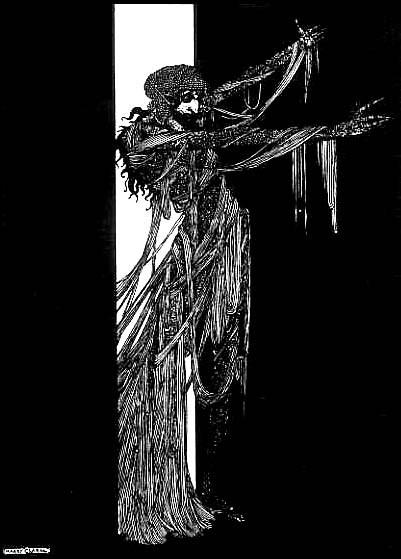
Also intriguing will be the Edgar Allan Poe double bill directed by David Pountney in 2014. Claude Debussy’s unfinished one-act opera The Fall of the House of Usher has been orchestrated by Robert Orledge, using additional material from sketches left by Debussy. It will be heard with Gordon Getty’s Usher House. Both will be presented in San Francisco in 2015. The picture right is Harry Clarke's illustration from an early French edition of Poe's poem. David Pountney directs.

Mark Anthony Turnage's Greek returns in the 2011 Music Theatre Wales production, which will also be heard in London.  In Summer 2013, before the full formal season, the WNO Youth Opera will be doing Britten's Paul Bunyan. This isn't touring for obvious reasons.

Tuesday, 16 April 2013

Nabucco with Plácido Domingo - Royal Opera House

Plácido Domingo's London debut as Nabucco at the Royal Opera House was received with rapture. Domingo's position in opera is immense. His very presence comes over so well that any performance feels like a historic event. He is a marvel. If Domingo was singing Plácido Domingo rather than Nabucco, it hardly mattered.  He delivered the big areas well, and was particularly impressive in the typically Verdian dialogues between father and daughter. Domingo isn't a singer who needs Personenregie. He is simply himself and that's enough.

Earlier in the run, the role was taken by Leo Nucci. Domingo and Nucci are almost exactly the same age, but Nucci has been singing Nabucco most of his career. Domingo's voice may be more rounded, but Nucci understand the extremes in the part, and how to express the darker sides of character. Domingo sang Nabucco. Nucci "was" Nabucco, carrying the whole performance by the sheer depth and conviction of his portrayal.

The fire in this performance came from Liudmyla Monastyrska. She an impressively forceful Abigaille on the first night, but as the run  has progressed, her approach  has developed, and her voice has taken on intense new colours. She isn't the most physically demonstrative of singers, so n amount of direction would animate her stage presence. Instead her reserve becomes part of the characterization. Abigaille isn't lovable. She's ruthless, using power as revenge. Monastyrska uses the fundamental dignity in her voice to create an Abigaille as unyielding as the stone pillars and marble walls around her. When she lights the ring of fire, she gives a glimpse of another Abigaille, made vulnerable by passion. Thus, in the finale, her abject humiliation is truly tragic.  When the ensemble stand together and sing, Monastryka makes us feel that Abigaille has found redemption.

This production, directed by Daniele Abbado, has been criticized because it's too modern. But what is Nabucco really about ? The temple has been destroyed, and the people of Judah are taken as captives into foreign exile. As Zaccaria (an excellent Vitalij Kowaljow) remeinds is, it's not the first name the nation has been threatened with annihilation. Moses came out of exile from Egypt. We don't need reminding about the horrors of the 20th century, and Abbado makes no explicit references at all. There's no need to be specific. The bodies that are laid on the ground in Act IV rise again, for they are not dead.

In Nabucco the primary struggle is between the God of Judah and the multiple idols of Babylon. The God of the Jews is so sacred that he's invisible. He is invincible because he is austere and lives in the hearts of his people. This is the absolute crux of the whole story. Gaudy golden idols are false. Men cannot become gods, as Nabucco learns the hard way.

 "Gli arredi festivi giù cadano infranti, Il popol di Giuda di lutto s’ammanti!" In Catholic Italy, religion is a kind of public theatre, hence the performing tradition. But Abbado takes his cue from the ytrue meaning of the opera, and from a source that long predates Christianity. If audiences and critics can't cope with an absence of graven idols, that's their problem. To please such folk, Verdi should have rewritten Nabucco in favour of the gods of Baal.

Abbado's visual images are austere. There are suggestions of marble towers, the plain plains of a frozen desert at night, monoliths strewn across the stage suggesting multiple ideas : marble plinths, gravestones, the shards of the shattered temple, relics of civilizations long forgotten. Visual literacy is like emotional intelligence : you have to be sensitive to all nuances. For me the abstraction underlined the spiritual nature of the story. Once the eyes are cleansed of gaudy images, one can focus on the subtlety of this staging. The colours may be muted but carefully observed they reveal delicate gradations of colour : washes of pale green and blue over multiple shades of black, white and grey.  This is entirely valid, for the text is full of references to starlight, mists and "tepide e molli
l'aure dolci del suolo natal!"

Music moves.Abbado expresses this constant movement in the score obliquely through projections that are shown behind the singers, instead of submerging them in busy stage action.  Thus the stately, dignified pulse of the central drama unfolds without fuss. The choruses are very precisely directed, the voices particularly well blended..They move and part several times, reflecting the shifts in balance in the music. Verdi was quite specific about the conquerors appearing in disguise. His music reflects this confusion and anguish. It may not work so well on stage (Verdi was only 30 when he wrote Nabucco) but Abbado is not to be faulted for respecting the composer's intention.,

This is also an extraordinarily musically-informed production. One of the dirty little secrets of the opera world is that audiences don't really listen to the music. Abbado, whose background is more musical than most, deliberately shifts attention to Verdi's music. The Overture is played against a simple backdrops, so we can focus on how it shifts from theme to theme, highlighted by unobtrusive changes in  light and colour. Just as the god of Judah is invisible, Verdi's orchestral writing is abstract, but inherently dramatic. That the Royal Opera House Orchestra plays superbly is a given. For conductor Nicola Luisotti, they rose to even greater heights than usual. Abbado's restraint lets the music shine forth. At last, we are hearing Verdi as symphonist, and as a musician.

Please see the review in Opera Today of the first performance in this run, which mentions the exqusite choruses.


Royal Opera House tribute to Sir Colin Davis

Tonight the first performance this season of Mozart's Die Zauberflöte will be dedicated to the memory of Sir Colin Davis. He was very closely associated with this opera, and indeed with this production. Poignantly, it was before a performance in 2011 that he collapsed with a heart condition. No doubt an announcement will be made, but even in the unlikely event it isn't, there won't be a soul in the house who won't be remembering him.

The Royal Opera House has released an extensive tribute. Many people at the ROH now and in the past worked with the conductor and knew him well, so the tributes are personal and sincere, much more moving than the normal bland press obits.

Antonio Pappano says "His passing represents an end of an era, where grit, toil, vision and energy  were the defining elements of a leading international opera house.. He was a giant. A very sad moment for British music".  Kaspar Holten says ".his influence over the this company is profound and special".

Sir Colin's first appearances in Covent Garden were with the Royal Ballet, where he conducted from 1960.  Dame Monica Mason, former Director of the Royal Ballet, says "I first met Colin Davis when he conducted the opening performances of The Rite of Spring in 1962.  I was the Chosen Maiden and he was the most wonderfully encouraging conductor..Fifty years ago he was a young man of 35, and he went on to make an enormous international career...   I am very sad to think I won't see him in the Royal Opera House again".

Colin Davis's first performance at the Royal Opera House was conducting Le nozze de Figaro in 1965. Sir John Tooley, who was General Administrator from 1970 to 1988 remembers "He arrived as Music Director of the Royal Opera House in 1971 with the reputation of being something of a firebrand. There was little evidence of that, but Colin knew what he wanted orchestral musicians and singers to give in terms of a performance...... Colin was no slouch, and took on a repertory at ROH much of which was not familar to him at the time but which he wanted to explore". 

"Colin's early days as Music Director at ROH were not easy for him,  as they had not been for his predecessor. There were some doubts that he could deliver and that he could begin to match some of the world's greatest conductors...the doubters were proved wrong". ...One of his biggest challenges was Der Ring des Nibelungen from 1973 to 1976, in which he collaborated with Götz Friedrich. Not an easy relationship, but one which nevertheless flourished .... as I look back over Colin's life and particularly his 15 years at the ROH, he seemed to be on a journey through music, constantly re-examining and developing his intepretations"

David Syrus, Head of Music for the ROH adds "On the day Colin started as Musical Director here I started as a fledgling ,répétiteur. He was my first and most stimulating professional teacher - singing bel canto in every language, using text as the driving force (in the first Freidrich Ring, Götz talked music, Colin text!), discovering the rhetoric in accompanied recitative (not to mention the first two chords of the Eroica!)....the modesty and humanity of the man irradiated his music"

Monday, 15 April 2013

ENO Sunken Garden Michel van der Aa

Michel van der Aa's Sunken Garden had its world premiere at the Barbican Theatre, under the auspices of the ENO.  Van der Aa is a well-respected artist, closely associated with the Nederlandse Opera.  His Up Close, presented together with Pierre Audi's Liebestod in 2011, won a Gravemeyer award. Sunken Garden is a huge leap ahead from Up Close, and also from the earlier After Life (reviewed here), also presented at the Barbican and in Amsterdam. Sunken Garden is altogether more ambitious, and successfully achieves van der Aa's dreams of linking different art forms to create a Gesammstkunstwerk for the age of technology.  It will divide opinion, however, as anything truly experimental usually does.

Much will be made of its technological inventiveness, but don't be distracted. At heart, Sunken Garden is a true opera in the deepest sense.  It's about people and how they communicate, or don't communicate. As human beings we don't communicate in any one way, but on multiple levels, consciously or unconsciously. We absorb data from all sources.  What matters is how we process that information.  Thus van der Aa, his librettist David Mitchell and his visual effects team create a multi-level, multi-dimensional whole from which we take as much as we can. 

We could remain on the surface, like Portia Jacquemain (what a name!). She runs an art gallery but is not an artist. She spouts babble because she can't cope with real communication. We can stop there and snigger. But van der Aa is making a wry joke. Jacquemain ( played by Caroline Jay) is shallow. She's estranged from her daughter Amber who seems to make a mess of her life but engages with the world around her, and with the artist Toby Kramer, admirably played by Roderick Williams. Kramer composes with video, in much the way that a composer assembles notes to make music. Like Amber, he cares about people, and wants to find out what's happened to his subject Simon Vines (Jonathan McGovern).  Significantly, Zenna Briggs (Katherine Manley) morphs from persona to persona. She starts off as a wealthy patron of the arts, but drops Kramer when he starts getting too close to the truth. It turns out that she's not a patron of the arts at all but a sinister figure who, vampire-like, lives off the psyches of people who think and feel for themselves.
Don't be distracted by the complex plot. Think of Lewis Carroll's Alice in Wonderland. Nothing seems to make sense, yet there's a crazy sense of momentum, such as one finds in dreams. Like Alice, Kramer descends into a sunken garden hidden below the flyover. Suddenly everything glows in surreal, unnatural colour. The 3D effects aren't a gimmick but an intelligent theatrical commentary. We're in a psychedelic dream where everything is more real and more false. You can escape by taking off the 3D glasses, but how flat things seem in comparison. Even if you can't follow the narrative, seeing the water from the "vertical pond" implode and explode is great theatre. Some of the most effective scenes are fairly straightforward, such as the shots of Roderick Williams against a flat background with diagonal beams.

The technological special effects are themselves a comment on the way we communicate. Kramer films. Amber texts. Jaquemain chatters. In After Life, van der Aa used clips of real people talking and spliced them with scripted film.  In Sunken Garden, he uses actors whose speech is peppered with inconsequentials. But that's exactly how "real" people speak. The ums and ahs of conversation are part of the process of communication, and of formulating ideas. If we look more closely to these "people" we begin to notice that they, too, are as unnatural as the 3D scenery in the garden. Toby Kramer clearly isn't American, despite his talk of Omaha. Sadaqat Dastani (Stephen Henry) is also a caricature. Mental hospitals aren't that luxurious.  And since when did landladies like Rita Wales (Alwyne Taylor) dress in cashmere and pearls and live in National Trust gardens? Sadaqat is supposed to be insane but he identifies Amber's drawings of the sunken garden and points Kramer to Iris Marinus, the "doctor". It's a gorgeous role for Claron McFadden, who, like Roderick Williams, helped create After Life. She's good at being over the top. He's good at being matter of fact.

Zenna Briggs morphs from persona to persona, til her true malevolent nature is exposed. Katherine Manley sings the difficult part well. Amber (Kate Miller-Heidke) is in real life an indie star who can sing though not with Manley's range. She's not what she seems either. Her hair, make-up and clothes are so unnatural that they're playing roles as well.

Van  der Aa's music is very expressive, much more direct and visceral than, say, George Benjamin's Written on Skin (reviewed here). He worked with Louis Andriessen, for whom communication was paramount. Andriessen, for example, was involved with political music theatre where he tried to challenge the normal hierarchy of performance. The sung and spoken text is often unclear. There are no subtitles. You have to struggle to -ollow what's happening in Sunken Garden, but  that's the whole point. As in real life, nothing is clear cut. You have to listen to the music, and assemble all the information in this opera in your own mind. It helps a lot that the conductor  was André de Ridder, one of the best new music specialists in Europe, who understands the multi dimensional levels in this tightly constructed score.  

Van der Aa's Sunken Garden is so different that it would be a miracle if everyone could respond to it in the same way. But perhaps the secret is to enter its strange world on its own terms.In the real world, we communicate in many different ways other than through words alone. We listen to all kinds of verbal and non-verbal signals, and we use visual and subconscious images. Sunken Garden is good opera because it transports us into an artist's vision and makes us engage with our feelings. Or not, if we prefer. 

Full review in Opera Today.

Saturday, 13 April 2013

Rossini Maometto Secondo Garsington Opera Talk Oxford

Garsington Opera is staging Gioachino Rossini's Maometto Secondo at Wormsley from 8th June. This will be an event because Maometto Secondo is a very good opera, which deserves the interest it's been getting in the last few years. As background, Richard Osborne, the Rossini specialist, will be giving a talk on Wednesday 17th April at North Wall in Oxford (directions here). The talk will be repeated before the 16/6 performance. More details HERE including sound clip and synopsis. Public bookings start Monday 15th.

"Two supreme interpreters of Rossini’s music lead the company; conductor David Parry and tenor Paul Nilon, with bass-baritone Darren Jeffery in the title role. This is the eagerly awaited British premiere of an opera described in the New York Times in July 2012 as ‘a Rossini masterwork ahead of its time’. This performance, using a new edition, reinstates Rossini’s vitality, grandeur and freshness of inspiration."

Rossini's Maometto secondo is a wonderful work., and surprisingly trenchant for its time and our own. The real life Maometto secondo, or Mehmet II (1432-1481) was Fatih Sultan of the Ottomans. He conquered Constantinople, and ended the Byzantine Empire. His next  plan was to invade western Europe, and take on the Holy Roman Empire, thus linking Europe and Asia under Islam. Mega geopolitics. This Turk was no buffo. Venice was in the front line because Venetians traded throughout the Eastern Mediterranean. For Venetians, Turks posed the biggest ever threat to their survival.

Rossini doesn't, however, portray Maometto as a villain. Perhaps that's why Rossini's Maometto Secondo flopped in Naples in 1820 but was a hit in Venice in 1822. Although the opera fell out of the repertoire, it's come back into favour now that European and Islamic nations reassess their relationship.  Rossini with political depth? Surprisingly, yes, for he treats his characters as individuals rather than cardboard stereotypes. Paolo Erisso is chief of the Venetian outpost at Negroponte in Greece. It's besieged and finally taken by the Turks. Oddly enough, Erisso's daughter, Anna, has a secret lover whose identity she doesn't know. Guess who? Maometto, himself, whom she recognizes when the defeated Venetians are rounded up. Maometto loves Anna so much that he pardons Erisso and gives Anna his official seal to keep her safe when he has to go back into battle. Anna is torn between love and duty. He father chides her and she obeys by marrying Calbo, a Venetian nobleman, and uses the safe conduct pass to let the Venetians escape. News comes that Maometto's lost the second battle, and Erisso's saved the city, but somehow Maometto appears in her chambers, and she kills herself.

Order is restored, but in the process we glimpse another type of Turk. In real life, the Ottomans consolidated their Empire by intermarriage - Maometto was part-Greek - so at the time, theirs was a more sophisticated authority model.  For 19th century audiences, Turks were supposed to be the enemy, so the idea of Maometto as lover must have caused a frisson.

There are quite a number of recordings. The version with June Anderson and Sam Ramey (conductor Claudio Scimone) is probably the best, given the singers. I've reviewed the DVD of the 2005 production at the Teatro La Fenice di Venezia, also conducted by Scimone, but the singing isn't quite so good.

Friday, 12 April 2013

Graham Johnson Tribute Wigmore Hall

Saturday is a special day. At the Wigmore Hall, John Gilhooly will present Graham Johnson with the Wigmore Hall Medal in recognition of his unstinting championing of Song and his extraordinary achievements on the concert platform and in the recording studio.

The presentation will be made on stage following a gala concert which celebrates the launch of Graham’s three-volume encyclopaedia Franz Schubert: The Complete Songs (published by Yale University Press). “Graham founded the Songmakers’ Almanac in 1976 to explore neglected areas of piano - accompanied vocal music and to provide an alternative to the conventional song recital and has continued to illuminate this area of music with passion and erudition. His fine programme and sleeve notes have greatly added to the wider understanding and interest in Song over the last 30 years and a wonderful discography includes outstanding recordings of the complete songs of both Schubert and Schumann for Hyperion. I can think of no other figure in the international music world who has done so much for the promotion of Lieder,” said John Gilhooly.

Graham Johnson is like a father figure to me, although we're almost the same age. He has been a fixture at the Wigmore Hall for what seems like forever, creating imaginative programmes that highlight the art song in different contexts. Songs are often mixed with well-chosen readings. A Graham Johnson concert is never boring. This recital will be typical. The programme is all Schubert, but focuses on settings of Shakespeare, Walter Scott and Ossian, plus less well known British poets like  Colley Cibber and Abraham Cowley, This shows how well read German Romantic intellectuals were. Would English composers have set so much German poetry (even in translation)?. Oh, I forgot! What English composers in this period. Haha! Even a song recital can tell us something about our heritage.

 photo : Clive Barda, Askonas Holt

Thursday, 11 April 2013

Pabst Freud Weimar - Secrets of a Soul

G W Pabst's film Secrets of a Soul (Geheimnisse einer Seele) (1926) is the story of Martin,  a wealthy Berlin scientist, who is crippled by anxiety. He develops a phobia of knives, terrified that he might kill his wife. Pabst worked closely with two noted psychologists, Karl Abraham and Hanns Sachs, so the film is often approached as a window into psychiatric practice in the 1920's, lovingly dissected by psychoanalysts, who see it was a vindication of their profession. But is it? Seen from other perspectives, it's actually quite damning.

Martin is shaving with a cut-throat razor, removing the hairs that testosterone makes men grow. He looks at the nape of his wife's neck and experiences horrible feelings. A woman is murdered nearby. The killer escapes to Munich, but Martin is gripped by fear and guilt.  He is intimate with his wife,  The couple haven't been able to have a child. Even the family dog has puppies, but Martin's house is empty.  Eventually a woman - almost certainly not his mother, but a mother figure, suggests he should see a doctor who will cure him. "After many months of hard work" the intertitles tell us, Martin recalls a childhood event which forms the basis of all his adult anguish. Instantly, he's "cured". An epilogue shows Martin fishing in an idyllic mountain setting. He looks up towards a chalet to see his wife embracing a child. Martin skips along a path like a happy child. Then you notice that the banks of the stream are unnaturally straight and uneven.  He drops the whole bucket of fish he's caught. Is this a happy ending, or is Pabst undermining the very idea of resolution? Perhaps this is just another dream sequence. Wish fulfilment but not reality.

Central to the drama is a long dream  sequence, filmed with the full artillery of modernist techniques of the time.  Multiple exposures superimposed on each other suggest the hidden layers of Martin's soul. A tree is shot in white against a black background, A whole village of cardboard buildings pop out, and a tower shaped explicitly like a penis drills it way to the surface as if emerging from the subconscious. The cupola on the tower is shaped like the pith helmet Martin's wife's cousin wears in the tropics. The cousin has sent Martin and his wife gifts from exotic lands - a sheathed knife and very well carved soapstone idol.  Since many educated Europeans at the time were fairly aware oif theosophy and orientalist ideas (they read Tagore, for example), it's quite possible that Pabst and at least some of his audience recognized the idol as Kuanyin, the Goddess of Mercy, whom some traditions describe as hermaphrodite.

Freud intepreted dreams. So have shamans in all cultures. But visual images are also the stock in trade of film makers and theatre directors. Coming to Secrets of a Soul from an opera staging perspective reveals a lot more than conventional Freudian analysis might suggest. Visual images, by their very nature, are open to multiple interpretation. Two people looking at the same object from different angles will see it differently. Seeing is a process which involves emotional input , dependent on the sensitivity of the viewer and his/her ability to think from perspectives other than their own. Thus there's so much resistance to opera stagings : audiences forget that all performances involve interpretation. There's no fixed formula. Visual literacy is like emotional intelligence. The art is in making connections, and in making connections that ring true, supported by other connections.

Because we're now so accustomed to Freudian imagery, many aspects of Secrets of a Soul are easy to identify, such as the phallic tower and the pop-gun the man in the helmet fires at Martin from the tree. Much has been made of Martin's supposed impotence or homosexuality because we're used to reading those signs. But Pabst was an artist. He wasn't confined to simple, literal images. Commentators largely ignore the women in the film, but anyone familiar with Pabst's other films (Pandora's Box, Die Dreigroschenoper etc)  will be alert to his ideas of female power.  Martin works in a lab where his assistants are women, and they're strong minded.  A little girl visits, and Martin is clearly delighted. Does that suggest his love for children is tainted?  In the absence of other clues, we can't assume. The images of dogs, the household, the meal, Kuanyin, all connect to the idea of childhood and fertility. Martin dreams of his wife in an exotic harem, clearly enjoying herself.  Martin fiddles with a key because he can't enter his house. But perhaps the key missing in a straightforward Freudian analysis is the simple fact that Martin  has married a woman with whom he grew up as a sister? No wonder he can love her but can't get her pregnant.

Martin has a flashback to a childhood Christmas when he, his wife and her cousin were playing together. We see toy trains and remember the phallic trains in his big dream. We see Martin shown a new baby, while the girl who will be his wife hands a toy doll to her cousin. Aha! Insight! The psychoanalyst helps Martin make the connection. But why should an innocent gesture like that mature into murderous anxiety? If all psychiatric problems were that easy to solve, life would be so simple. Because this is a silent film, intertitles are sparse: people watched, rather than reading words. Nonetheless the psychoanalyst has more to say than anyone else and he speaks in jargon. Perhaps Pabst is making a point by casting Werner Krauss as Martin. Krauss was the mad doctor in The Cabinet of Dr Caligari (1921) where the doctor/patient/relationship is upside down. Pabst shows Martin in his lab, mixing potions. Perhaps he's suggesting that science and pseudo science aren't that far apart? Artists interpreted dreams and visual images long before psychoanalysis came into the frame. Reading images is not a science, but a creative art in itself.

Wednesday, 10 April 2013

Michael Van der Aa Barbican

New ENO production at the Barbican of Michael Van der Aa's Sunken Garden on Friday. Sunken Garden tells a "multi-layered story of a missing person and those who are searching for him. What connects the disappearance of a software engineer, a neurotic film-maker and a gullible patroness of the arts? This new film-opera explores hoax and dark truth, with a libretto from Cloud Atlas novelist David Mitchell."  If opera is a fusing of music, acting, text and visuals, then why not add film to the mix ? Film opens up dimensions that can't otherwise be easily expressed.

In Van der Aa's Up Close (at the Barbican in 2011) a cellist played live, interacting with a film of an actress. At first actress and cellist look alike, but when the actress turns round, close ups show  her face is haggard and etched. It feels like she's carrying the "madness" of ages.  Van de Aa's music murmurs and wails, like the forest the actress is seen wandering through. A modern day Ewartung? The actress acts out mechanical, compulsive routines, like copying out what looks like a periodic table in chemistry, and operates a strange machine whose purpose is unclear. A symbol not so much of mad science but the kind of emotional alchemy which some people need to do to give order to their lives. 

Much more ambitious and conceptual was Van der Aa's After Life in 2010. Several people meet in a waiting room. They’ve just died, but they must examine their lives, and pick one memory to take with them before they can journey on. One memory to summarize a whole lifetime? It’s not easy. Effectively, they’re pondering what their lives might have meant. It’s a powerful psychological concept, strikingly adapted as theatre. van der Aa mixes live orchestra with electronica, live performers with ordinary people captured on film. That’s not specially innovative in itself, but van der Aa takes the concept further, blending art and reality.

Singers and musicians perform a score, while ordinary people speak spontaneously. Van der Aa abandoned the idea of script altogether: people simply turned up at his studio, and talked spontaneously. Ordinary people, but extraordinary lives. Perhaps that’s part of After Life’s message too. More emotionally articulate people have more insight into what makes them what they are, but even the most mundane life has meaning. READ MORE HERE.

Tuesday, 9 April 2013

Chaliapin Don Quixote Pabst movie download

Feodor Chaliapin, the great Russian bass, starring in a comedy made by G W Pabst ? Yes! In 1933, even the biggest names in opera had no hang-ups about crossing genres. In this film, Chaliapin hams with great gusto. The voice that sings immortal Gudonovs, Mefistofeles and Volga Boatmen sings "I, Don Quixote". He did sing Massenet's Don Quixote, but this is different.

The song is utter tosh, but Chaliapin revels in the corny text, camping up the flourishes, striking exaggerated operatic poses, his arms akimbo. Later, he sings "This castle mine", delighting in the mock Spanishisms in the music. His accent is atrocious, so you can't hear most of the words, but it hardly matters. Chaliapin "is" Don Quixote par excellence, capturing the craziness in the role. Look how his beard sticks out horizontally ! Even his tall, gangly frame lends itself to strange angles which Pabst films with great style.  Cervantes meets Expressionism!

Sancho Panza is played by George Robey, a British music hall entertainer, who is a perfect foil for Chaliapin's Don Quixote. Robey sings Sancho Panza's songs with an accent as Cockney as Chaliapin's is Russian. Pabst plays with body form throughout the film, employing a large number of dwarves, and using costumes designed to suggest geometric shapes. Dulcinéé appears in the film as love interest. She's movie star pretty but wears a skirt that looks like a barrel. Spoken dialogue is also delivered with histrionic exaggeration. The scene where Don Quixote charges at the windmill is delightfully shot - crazy diagonals and spinning circles. Chaliapin was too precious to risk falling from the sails of the windmill. They must have used a stuntman. Listen out for the very final song, "Sancho, my friend". Chaliapin strings out the words, and his vibrato wobbles madly off the  scale. His voice switches from rumbling bass to a sudden bizarre high note you'd hardly believe he had, then he reverts to a growl which becomes a howl. He is an artist, but one who can send himself up.

Three of the songs were written by Maurice Ravel and the incidental music is by Jacques Ibert. There's a fanfare where mock medieval trumpets blare wilfully out of tune.  Apparently, Ravel, de Falla, Delannoy and Darius Milhaud were also commissioned to write scores, but I don't know what happened to their music. Lots more on Weimar era film, more on Pabst and more downloads. Please search this site, there's plenty here.HERE is a link to "Forbidden Music", another rare film with Richard Tauber and Jimmy Durante, of all people. It's kitsch, but with darker undercurrents.


Sunday, 7 April 2013

George Benjamin Day Into the Little Hill Wigmore Hall

The Wigmore Hall's George Benjamin Day followed on from the success of Benjamin's Written on Skin at the Royal Opera House. It was a wonderful opportunity to reassess Benjamin's first, ground-breaking opera Into the Little Hill.  

The world of Into the Little Hill is deliberately mysterious and confusing. Two singers  (last night Hilary Summers and Susanna Andersson) present different parts, They use indirect speech, so phrases like "...said the man" carry as much weight as the words themselves. This unusual device, which Benjamin also uses in Written on Skin thus has an almost ritualistic significance. Perhaps Benjamin is creating distance between narrative and audience, redirecting attention onto the drama in the music?  As pure music, both Into the Little Hill and Written on Skin are fascinating. Images and forms emerge and dissipate. The big, dramatic chords in Written on Skin operate like the cinematic "curtains" between scenes in Berg's Lulu. There are less big moments in Into the Little Hill but a concert performance gives us a chance to hear the close-ups in stronger focus. 

At the Wigmore Hall, the Birmingham Contemporary Music Group gave an account which showed the intricacy of Benjamin's construction. Martin Crimp's narrative may be confusing, but that's the whole point. It is poetry, not prose.  In the strange world of Into the Little Hill, all the normal signposts we use to navigate a plot are hidden. We have to be alert and listen  acutely. As rats do. That in itself is disturbing, for the Rat is sinister. But is he any more sinister than the Minister?

"I followed the sound, said the man with no ears". The Pied Piper led the children of Hamelin from their homes into the bowels of the earth. Given the repressive nature of the Minister's regime, perhaps the Way of the Rat might be oddly liberating.  What are Benjamin and Crimp hinting at when they use the image of music?  The  minister tries to sanitize the extermination, but the man witrh no ears keeps asking "and music", the word shining with lyrical beauty, illuminating the murkiness around the lies. The narrative is not linear but progresses in stages, with tunes. In the final section, the children burrow under the earth, "into the little hill". Yet the music becomes transparent, like "particles of light".  "Our home is under the earth", both singers intone together. "With the Angel under the earth, and the deeper we burrow the brighter his music burns". 

In Written on Skin, the Boy is a painter, but the Woman, with her child-like innocence, intuits that art can represent a higher level of truth.  In Into the Little Hill, music, an intangible form of art, leads us away from the poisoned double-think of the minister's regime. In both operas, the purity of Benjamin's music rises upwards, leading us out of  nightmarish tangles. Instead of conventional plot resolution, the "answers" are indirect. In Written on Skin, the woman becomes Agnès, no longer anonymous but a person with purpose. She becomes a figure who transcends time and place, suspended forever in the painted illumination.  Please read my review of Benjamin's Written on Skin HERE and of Into the Little Hill HERE.

The impact of Into the Little Hill was reinforced by being heard with David Sawer's Rumplestiltskin Suite (2011) and Francesco Antonioni's Ballata (2008); both also inspired by folk tales. Anyone who still believes that "fairy tales" are not grim probably believes in fairies, or rather the kind of vacuous mindless fairy of cartoon stereotype. Antonioni says of Ballata that "the iambic rhythm that flows throughb the piece is commonly associated with the narration, the conversation, the litanies of women in churches, the gradual revelation of a secret".

Much more revealing for me was David Sawer's Rumplestiltkin Suite. because it was more concise, the intensity concentrated into a brief, sharp shock. Rumplestiltskin's psychotic rage is violently dramatic, but the music that describes the miller is even more intriguing. The miller plays mind games. He's dishonest and cruel. Like the Rat in Into the Little Hill, Rumplestiltskin isn't necessarily the villain. Sawer's Rumplestitlskin Suite is very good indeed. I liked the "straw and gold" of the original opera (see review here), so hearing the Suite makes me hope that we''ll be able to see Sawer's Rumplestiltskin again soon.


Saturday, 6 April 2013

George Benjamin Day Wigmore Hall

Benjamin  is next year's Wigmore Hall composer-in-residence, so the Wigmore Hall is doing a Benjamin series culminating in George Benjamin Day on April 6th. HERE IS MY REVIEW.The Birmingham Contemporary Music Group will be doing Benjamin's first opera, Into the Lttle Hill, this time in concert performance with Hilary Summers and Susanna Andersson singing. This was a watershed for Benjamin, previously known for his painstakingly meticulous working methods.  Working with Martin Crimp, the librettist, challenged Benjamin, who worked at what was, for him, breakneck speed. Taking risks makes for highly charged drama. Into the Little Hill is a tightly focussed chamber opera, whose depths reveal themselves obliquely. I love Into the Little Hill. I've written about it extensively. Read my piece on the performance at the Linbury  HERE.

The programme will also feature Francesco Antonioni's Ballata and David Sawer's Rumpelstiltskin Suite, based on Sawer's opera Rumpelstiltskin, another BCMG speciality. Read my article "Gold and Straw" HERE about the full opera when it wass staged at the Spitalfields Music Festival. The concert will be preceded by a talk with John Gilhooly.

Friday, 5 April 2013

O wär ich doch ein Vöglein nur


"Still sitz' ich an des Hügels Hang, Der Himmel ist so klar, Das Lüftchen spielt im grünen Tal". Blissful springtime beauty. Then the punchline : "Wo ich beim ersten Frühlingsstrahl Einst, ach so glücklich war".  Schubert's setting is delightful, but the poet is Ernst Konrad Freidrich Schulze. So beware. Schulze developed an obsession for a young lady called Cäcilie Tychsen, for whom he wrote his epic Cäcilie: Ein Romantisches Gedicht in 20 Gesängen. When she died, he transferred his obsession to her sister. So consider the sadness lurking behind.

Wo ich an ihrer Seite ging So traulich und so nah, Und tief im dunklen Felsenquell Den schönen Himmel blau und hell Und sie im Himmel sah. 

Sieh, wie der bunte Frühling schon Aus Knosp' und Blüte blickt! Nicht alle Blüten sind mir gleich, Am liebsten pflückt ich von dem Zweig, Von welchem sie gepflückt. 

Denn alles ist wie damals noch, Die Blumen, das Gefild; Die Sonne scheint nicht minder hell, Nicht minder freundlich schwimmt im Quell Das blaue Himmelsbild.

Es wandeln nur sich Will und Wahn, Es wechseln Lust und Streit, Vorüber flieht der Liebe Glück, Und nur die Liebe bleibt zurück, Die Lieb und ach, das Leid! 

O wär ich doch ein Vöglein nur Dort an dem Wiesenhang Dann blieb ich auf den Zweigen hier, Und säng ein süßes Lied von ihr, Den ganzen Sommer lang.

Thursday, 4 April 2013

Seven Dwarves in Auschwitz

"In our hearts, we were giants"  Seven members of the Ovitz family were dwarves who defied the odds. Because they were talented entertainers, they turned their stature into an advantage. Born in a rural area in Transylvania, they found fame and relative fortune travelling around Eastern Europe in the 1930's, as The "Liliput Troupe".  But being Jewish, they were rounded up and sent to Auschwitz. Had they been standard sized, they would have perished. Ironically, they were saved because they were dwarves. Josef Mengele collected human curiosities, inflicting insane "medical" studies upon them.
 
Society treats those who are different with a curious mix of titillation and humiliation.  The Ovitz family made a good living as musicians. Perhaps audiences stayed because the family was good at what they did, but chances are, the initial draw was that they were dwarves. Disadvantaged people were exploited in freak shows., but for some it was a way of making a living. Whatever motivated Mengele, we shall never know, or want to know, but he was intrigued enough to keep them alive.

Yehuda Koren and Eilat Negev have written a book about the Orvitz family, "In Our Hearts we were giants : the remarkable story of the Liliput Troupe"

Read about the book HERE and watch the documentary (presented by Warwick Davis) here.  Perla Ovitz, the youngest and last survivor tells the camera why she wears so much lipstick in her old age. "So people can see the smile, but not the tears". A philosophy we can all learn from.