"Tradition ist nicht die Anbetung der Asche, sondern die Bewahrung und das Weiterreichen des Feuers" - Gustav Mahler
Sunday, 18 January 2015
Saturday, 17 January 2015
Overwhelmed by riches - the Philharmonie de Paris and more
Overwhelmed by the riches to watch and listen to, all at once, this week. Some have been so good you need to enjoy them more than once. 24/7 listening if possible. Absolutely the crowning glory is the inauguration of the Philhamonie de Paris. Twenty years in the making, this is, most certainly, the biggest new venture on the European arts scene in decades, eclipsing even the new Mariinsky. Even those who don't actually like music should watch: the building is spectacular, so beautiful and so innovative it's a work of art - massive multi-dimensional sculpture. The filming is surprisngly tactile: the cameras linger lovingly over different vistas and angles, as if they were exploring the body of a beloved. Utterly sensual.
The performances are excellent, the performers electrified by the glorious sense of occasion and place. The grand opening gala overran live but it was worth watching anyway: this was a historic moment, particularly in the wake of last week's murders and the bigotry that's surfaced since. Paavo Järvi, sometimes uneven, led the Orchestre de Paris in a truly great rendition of a patriotic (but artistic) programme of Dutilleux, Ravel and Fauré. William Christie, in the third concert, positively glowed with happiness. He's looking old and frail, so any opportunity to see him should be treasured. Les Arts Florissants did a familiar programme well, but my eyes were riveted on Christie, who was clearly enjoying the moment, the fulfilment of the dreams of a lifetime. Les Art Florissants now have a glorious, permanent home in Paris itself, much higher profile than their former base at the Théâtre de Caen. Les Arts Flo are more than an orchestra, they've helped transform the status of French baroque.
Last night I watched Tito Ceccherini conducting Ensemble Intercontemporain. Wonderful performance, even by the high standards of this orchestra, founded in 1976 by Pierre Boulez. Their home, the Cité de la Musique, has been renamed Philharmonie II, integrating contemporary music and IRCAM in the mainstream, as it should be, for it's one of France's great contributions to European culture. Excellent programme, with great classics like Varèse Intégrales, Ligeti Concerto for piano and orchestra, and Magnus Lindberg's Related Rocks. Throughout history, innovation has been resisted, but without renewal, there's no life. Boulez, incidentally, collects Paul Klee.
On now, Carl Orff Carmina Burana, which I'll watch later, and tonight, Laurence Equilbey conducts Max Bruch Die Loreley a rarity recently revived, which I've written about HERE (Max Bruch Die Loreley - non-Wagnerian Wagner
On Sunday, clash of the Titans !
Boulez's Birthday Bash in Baden Baden, where he began conducting in 1957 on the recommendation of Hans Rosbaud.
Live streaming from the Wiener Staatsoper of Wagner Tristan und Isolde, the old McVicar production .
The Jerusalem Quartet live from the Wigmore Hall on BBC Radio 3
A new opera by Régis Campo on BR Klassik
Plus a documentary on the making of the Philharmonie de Paris, and still have to catch up on Don Giovanni from La Monnaie, the Second Gala of the Phiharmonie de Paris (Lang Lang), photographed above by Beaucardet, and La Clemenza de Tito Plus, CDs, DVDs, books etc etc
Friday, 16 January 2015
Boulez Birthday Bash Baden Baden
Pierre Boulez turns 90 on 26th March. On Sunday 18th January, a special concert will be broadcast on arte.tv.
François-Xavier Roth conducts the SWR Sinfonieorchester Baden-Baden und Freiburg with Pierre-Laurent Aimard. It was with this orchestra that Boulez began the major part of his conducting career, on the recommendation of Hans Rosbaud. He still lives in the vicinity, so perhaps he will be in the audience. The photo shows Rosbaud and Boulez in October 1958 at the Donaueschingen Musiktage in October 1958. Photo : Willy Pragher, Landesarchive Baden-Württemberg
The programme :
"... explosante - fixe ..."
pour flûte soliste, deux flûtes, ensemble et électronique
Première sonate pour piano
Avec Pierre-Laurent Aimard au piano
Dérive 1
Douze Notations pour piano
Notations I à IV et VII pour orchestre
Wednesday, 14 January 2015
Paris Philharmonie Grand Opening Galas - links
The Philharmonie de Paris opens today. It's a huge project, many years in evolution, designed to give Paris a world-class cultural centre, like the Philharmonie in Berlin, or the South Bank in London (as was). The former Cité de la musique will be updated as "Philharmonie 2". The new main auditorium (pictured above), which seats 2400, resembles the design of the Berlin Philharmonie. Like the South Bank, the new centre will cater to different types of music, though mainstream (and moden) classical music will be its base. The resident orchestras are the Orchestre de Paris and Ensemble Intercontemporain. Read more on the Philharmonie de Paris website HERE
Like many big projects, the new Philharminie doesn't come without controversy. Read more HERE and HERE. The South Bank is still controversial after 60 years, At least the new Philharmonie isn't in the heart of town, where it would have had to cater for the kind of non-musical uses which have worn down the South Bank. Meanwhile, Boris Johnson's pet project, the £141 million Olympic complex gets underway with hardly a mention in the British media. So it's going to house branches of the V&A, Sadler's Wells, two university campuses and links with American universities, but is it actually an arts venture? Or is it a new branch line for the Olympics gravy train At a time when the arts in London are seriously threatened by a government that puts politics above the arts, it's pretty cockeyed. There's a sound business case for keeping London as an international arts powerhouse, but some politicians are more interested in votes than business sense.
So let's consider the new Philharmonie de Paris on its musical offerings. The first Gala Opening concert features Dutilleux, Fauré, Ravel, and Thierry Escaich. Paavo Järvi .conducts the Orchestre de Paris with soloists Renaud Capuçon, Sabine Devieilhe, Matthias Goerne and Hélène Grimaud. Arte.tv is screening the concert live, even in the UK.
The second opening gala, on 15th at 2030 (Thursday) features Lang Lang in a programme of Borodin, Tchaikovsky and Berlioz. On arte tv HERE.
On Friday 16tth, William Christie conducts Les Arts Florissants in motets from Mondonville and Charpentier together with parts of Rameau Les Indes galantes. Tito Ceccherini conducts Ensemble Intercontemporain in an interesting programme: Varèse Intégrales, Ligeti Concerto for piano and orchestra, Magnus Lindberg's Related Rocks and two pieces by Yan Maresz HERE
On Saturday 18th, Laurence Equilbey conducts Max Bruch Die Loreley a rarity recently revived, which I've written about HERE (Max Bruich Die Loreley - non-Wagnerian Wagner On the same evening, Lionel Sow conducts Carl Orff Carmina Burana. And on Sunday there's a documentary about the Philharmonie, a "Musical Dream" HERE.
For a complete list of forthcoming concerts, see HERE
Monday, 12 January 2015
Schumann Das Paradies und die Peri, Rattle, LSO Barbican
Is Robert Schumann's Das Paradies und die Peri an oratorio or an experiment towards a new form of music theatre? Simon Rattle and the LSO at the Barbican, London, confirmed its rightful place in the repertoire. It's a wonderful piece which, like all truly original work, defies pigeonholes.
The Peri is a half-human, half-demon Mischling who has to die to be redeemed. The original poem, Lallah Rookh, by Thomas Moore, titillated 19th century readers because its exoticism confounded comfortable, Christian concepts.Perhaps that's exactly why Schumann chose to set it. References to Bach flow through the piece so frequently that it's clear that Schumann is making a statement. Yet the subject might have appalled Bach's more devout listeners. There are references, too, to Mendelssohn's oratorios, like Elijah, and to his songs, particularly Auf Flügeln des Gesangs, with its images of flying across night skies to the Ganges, to palm trees, to lotus blooms (read my piece on it here) What secret message is Schumann sending? The late John Daverio called Schumann "the Herald of a New Poetic Age" Would Schumann, had he lived, heralded a new musical age ? By 1843, he'd proved his mastery of Lieder. Might he not have turned his attention to experiment with new forms of music drama as an outgrowth from his immersion in the literature and music of his time? There are references to Weber, for example, as there are in Schumann's opera Genoveva (read more HERE). Das Paradies und die Peri is a sophisticated approach to music drama, not a throwback to a time before Wagner changed the whole game plan.
Rattle has
conducted Das Paradies und die Peri with the Berliner Philharmoniker and has conducted it in London before, with the Orchestra of the Age of Enlightenment. This LSO performance was warmly received, but not quite in the same league. In the first part, textures and tempi weren't as sharp as they might have been, though things picked up immeasurably in the second half. Go to the Berlin Philharmonic Digital Concert Hall for a really definitive performance. We love the LSO. our home band, but they aren't quite in the same league. The female soloists are the same. In London, we had Mark Padmore whose extensive experience in Bach oratorios helps make the Bach connection more obvious, especially to new audiences. We also had Florian Boesch whose 'Jetzt sank des Abends goldner Schein" was extraordinarily moving. The part isn't big yet the passage and its partner "Mit ihren Schwester" are critical, so it really needs the authoritative, clear definition which Boesch brought to it. The connection between the bass and the fluttery quartet of Peris was wonderful. The biggest part, however, falls to the Peri. Sally Matthews's diction-free billowing sound was certainly enthusiastic, though there's much more depth to the Peri than she got here. Bernarda Fink has been singing Das Paradies und die Peri longer than anyone else. In 1999 she sang the Angel for John Eliot Gardiner, whose concerts and recording transformed the fortunes of this work. It's still the benchmark, I think, though Harnoncourt with the Bayerischen Rundfunks Orchester (which also features Bernarda Fink) is also good. She also sang for Rattle with the OAE, when she stood among the chorus, and her voice shone forth, like an angel. Bernarda Fink deserves some kind of award for services to Schumann.
This Rattle/LSO concert was recorded for the LSO's own label. Worth hearing for Padmore and Boesch, but to be honest, Gardiner, Harnoncourt and Rattle/Berlin are the ones to go for.
The Peri is a half-human, half-demon Mischling who has to die to be redeemed. The original poem, Lallah Rookh, by Thomas Moore, titillated 19th century readers because its exoticism confounded comfortable, Christian concepts.Perhaps that's exactly why Schumann chose to set it. References to Bach flow through the piece so frequently that it's clear that Schumann is making a statement. Yet the subject might have appalled Bach's more devout listeners. There are references, too, to Mendelssohn's oratorios, like Elijah, and to his songs, particularly Auf Flügeln des Gesangs, with its images of flying across night skies to the Ganges, to palm trees, to lotus blooms (read my piece on it here) What secret message is Schumann sending? The late John Daverio called Schumann "the Herald of a New Poetic Age" Would Schumann, had he lived, heralded a new musical age ? By 1843, he'd proved his mastery of Lieder. Might he not have turned his attention to experiment with new forms of music drama as an outgrowth from his immersion in the literature and music of his time? There are references to Weber, for example, as there are in Schumann's opera Genoveva (read more HERE). Das Paradies und die Peri is a sophisticated approach to music drama, not a throwback to a time before Wagner changed the whole game plan.
This Rattle/LSO concert was recorded for the LSO's own label. Worth hearing for Padmore and Boesch, but to be honest, Gardiner, Harnoncourt and Rattle/Berlin are the ones to go for.
Saturday, 10 January 2015
Ian Bostridge - Schubert's Winter Journey : Anatomy of an Obsession
Schubert's Winter Journey: Anatomy of an Obsession, by Ian Bostridge, isn't yet another book about Winterreise. Like the cycle, it is a journey of exploration. charting Bostridge's lifelong saga into the heart of the music, and into the world from which it came. Goethe may have been more of a classicist than a true Romantic, but his never ending search for knowledge defined his era and remains an inspiration for our own. In an era of instant expertise, this spirit of eternal discovery seems to have been replaced by fast-food thinking, instant expertise and Tea Party Intellectuals. We need books that don't leap to conclusions but focus, instead, on the process of learning itself.
Questions are far more important than answers. This book is a Rückblick on a never-ending journey, whose goal lies not in conclusion but in the search that goes into understanding. It's a journey that takes courage and integrity. There used to be a body of opinion that the protagonist in Winterreise must have been mad, and must die in the end because he doesn't conform. But the protagonist, poet and composer deserve more respect. In each chapter, Bostridge engages with the background to the ideas in the cycle, and with the wider social and artistic context. "Winterreise is a historical artefact", he writes, ""made in history, and transmitted through and by it". The poet, Wilhelm Müller, was a soldier who served in the wars against Napoléon in Russia, a "winter journey" if ever there was one. The chapter Der Lindenbaum opens up a panorama of ideas, which range from the symbolism of the Linden tree and its associations in folk magic, to a particularly thoughtful essay on Thomas Mann and the winter journey in The Magic Mountain. Bostridge then proceeds to a technical discussion of triplet assimilation, then forwards to geology and the physical phenomena that are so much part of the cycle. Many interesting observations. "To write on ice is an image of ambivalence, like writing on water but not quite letting go,.....Freezing feeling is....both to preserve and to anaesthetize it". Utterly relevant to interpretation of meaning.
Bostridge's sensitivity picks up on details like "eine Köhlers engem Haus" in Rast. Why such a specific reference, and not something more generic? Bostridge discusses charcoal burning and its economic context. Obviously we don't "need" to know this to enjoy the song, but the knowledge opens up new vistas which deepen our appreciation, and exposes the political undercurrents in Schubert's world. Incidentally, charcoal-burners were men who worked alone in the wilds. Is the charcoal burner an invisible precursor of Der Leiermann? Or another expression of the lonely mission the protagonist is driven to undertake? Or a metaphor for artist and intellectuals and their role in society? These questions matter, if we really care about the cycle and its deeper meanings. Schubie doobie doo Schubert and Mahlerkügeln may be more popular with the masses, but as has been observed , the
"m" in "masses" might be silent. Lieder is an art form of the intellect, a voyage into emotional depth, which all can undertake if they so wish. For this reason, Bostridge's book, with its wealth of ideas on art, literature and history, informs and stimulates. Had Bostridge stayed in academia, he might have been one of those truly good teachers who teach students how to think rather than what to think.
He also writes in a clear, elegant style with little of the logorrhea too many writers use to hide the fact that they aren't really saying much. His translations are simple yet emotionally direct. Although he digresses, he always returns to the music and to the point. Physically, this is a beautiful book, with thick, satiny paper and relatively few words per page, and extremely well-produced illustrations. It is a throwback to the time when reading was a sensual pleasure, to be savoured without rush. In some ways. it's like poetry, to which one can return to again and again and find more inspiration. Schubert's Winter Journey: Anatomy of an obsession might enrage those who expect confirmation of what they already believe, but for me, and, I think, many others, it's a springboard for ever greater engagement with the miracle that is Winterreise.
Questions are far more important than answers. This book is a Rückblick on a never-ending journey, whose goal lies not in conclusion but in the search that goes into understanding. It's a journey that takes courage and integrity. There used to be a body of opinion that the protagonist in Winterreise must have been mad, and must die in the end because he doesn't conform. But the protagonist, poet and composer deserve more respect. In each chapter, Bostridge engages with the background to the ideas in the cycle, and with the wider social and artistic context. "Winterreise is a historical artefact", he writes, ""made in history, and transmitted through and by it". The poet, Wilhelm Müller, was a soldier who served in the wars against Napoléon in Russia, a "winter journey" if ever there was one. The chapter Der Lindenbaum opens up a panorama of ideas, which range from the symbolism of the Linden tree and its associations in folk magic, to a particularly thoughtful essay on Thomas Mann and the winter journey in The Magic Mountain. Bostridge then proceeds to a technical discussion of triplet assimilation, then forwards to geology and the physical phenomena that are so much part of the cycle. Many interesting observations. "To write on ice is an image of ambivalence, like writing on water but not quite letting go,.....Freezing feeling is....both to preserve and to anaesthetize it". Utterly relevant to interpretation of meaning.
Bostridge's sensitivity picks up on details like "eine Köhlers engem Haus" in Rast. Why such a specific reference, and not something more generic? Bostridge discusses charcoal burning and its economic context. Obviously we don't "need" to know this to enjoy the song, but the knowledge opens up new vistas which deepen our appreciation, and exposes the political undercurrents in Schubert's world. Incidentally, charcoal-burners were men who worked alone in the wilds. Is the charcoal burner an invisible precursor of Der Leiermann? Or another expression of the lonely mission the protagonist is driven to undertake? Or a metaphor for artist and intellectuals and their role in society? These questions matter, if we really care about the cycle and its deeper meanings. Schubie doobie doo Schubert and Mahlerkügeln may be more popular with the masses, but as has been observed , the
"m" in "masses" might be silent. Lieder is an art form of the intellect, a voyage into emotional depth, which all can undertake if they so wish. For this reason, Bostridge's book, with its wealth of ideas on art, literature and history, informs and stimulates. Had Bostridge stayed in academia, he might have been one of those truly good teachers who teach students how to think rather than what to think.
He also writes in a clear, elegant style with little of the logorrhea too many writers use to hide the fact that they aren't really saying much. His translations are simple yet emotionally direct. Although he digresses, he always returns to the music and to the point. Physically, this is a beautiful book, with thick, satiny paper and relatively few words per page, and extremely well-produced illustrations. It is a throwback to the time when reading was a sensual pleasure, to be savoured without rush. In some ways. it's like poetry, to which one can return to again and again and find more inspiration. Schubert's Winter Journey: Anatomy of an obsession might enrage those who expect confirmation of what they already believe, but for me, and, I think, many others, it's a springboard for ever greater engagement with the miracle that is Winterreise.
Friday, 9 January 2015
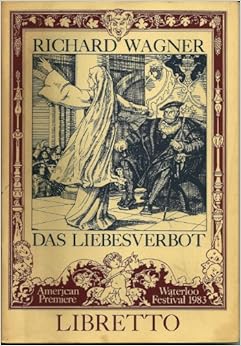
Wagner Das Liebesverbot Trieste, Lohengrin Amsterdam
Wagner Das Liebesverbot at the Teatro Verdi, Trieste reviewed HERE in Opera Today
"Aron Stiehl’s production of this rare early Wagner opera cheerfully brings commedia dell’arte to La Cage aux Folles.At the outset it should be said that as Das Liebesverbot has so seldom been staged since its disastrous premiere in Magdeburg nearly 180 years ago, this was more a case of re-birth than resurrection. Reportedly after word had got around that the opera was echt Abfall, only three people turned up to the second performance and Richard Wagner (who was 23 at the time) virtually disowned his own composition and insisted that it must never be performed in the sacred Bayreuth Festspielhaus" MORE HERE
Lohengrin in Amsterdam - Juliane Banse, Nikolai Schukoff MORE HERE IN OPERA TODAY
"Aron Stiehl’s production of this rare early Wagner opera cheerfully brings commedia dell’arte to La Cage aux Folles.At the outset it should be said that as Das Liebesverbot has so seldom been staged since its disastrous premiere in Magdeburg nearly 180 years ago, this was more a case of re-birth than resurrection. Reportedly after word had got around that the opera was echt Abfall, only three people turned up to the second performance and Richard Wagner (who was 23 at the time) virtually disowned his own composition and insisted that it must never be performed in the sacred Bayreuth Festspielhaus" MORE HERE
Lohengrin in Amsterdam - Juliane Banse, Nikolai Schukoff MORE HERE IN OPERA TODAY
Sanglots
Sanglots - Guillaume Apollinaire
Notre amour est réglé par les calmes étoiles
Or nous savons qu'en nous beaucoup d'homme respirent
Qui vinrent de très loin et sont un sous nos fronts
C'est la chanson des rêveurs
Qui s'étaient arraché le coeur
Et le portaient dans la main droit
Souviens-t'en cher orgueil de tous ces souvenirs
Des marins qui chantaient comme des conquérants
Des gouffres de Thulé, des tendres cieux d'Ophir
Des malades maudits, de ceux qui fuient leur ombre
Et du retour joyeux des heureux émigrants.
De ce coeur il coulait du sang
Et le rêveur allait pensant
À sa blessure délicate
Tu ne briseras pas la chaîne de ces causes
Et douloureuse et nous disait
Qui sont les effets d'autres causes
Mon pauvre coeur, mon coeur brisé
Pareil au coeur de tous les hommes
Voici nos mains que la vie fit esclaves
Est mort d'amour ou c'est tout comme
Est mort d'amour et le voici
Ainsi vont toutes choses
Arrachez donc le vôtre aussi
Et rien ne sera libre jusqu'à la fin des temps
Laissons tout aux morts
Et cachons nos sanglots
----------------------------------------
Our love is ruled by calm stars
we only know that around us that many sentient (breathing) people
who would have come from far away and are now inside our heads.
It's the song of the dreamers
whose hearts have been torn out of their chests,
carried aloft in the right hand.
Remember that in the fierce pride of all these memories.
Sailors who would have sung like conquerors
of the Gulfs of Thule and the tender skies of Ophir
of cursed sick, of those fleeing their shadows
and of the joyous return of happy emigrants.
And of this heart where the blood curdles
and the dreamer thinks of his wound.
You will not break the chain of these causes
and sufferings and say to us,:
who are the effects of other causes.
My poor heart, my broken heart,
equally like the hearts of all mankind.
Here are our hands which life has enslaved.
It's the death of love which
becomes the death of everything
Ripped out from everyone else, too.
Nothing will be free until the End of Time
Leave everything to the dead
and hide our sobs (image of blood)
Notre amour est réglé par les calmes étoiles
Or nous savons qu'en nous beaucoup d'homme respirent
Qui vinrent de très loin et sont un sous nos fronts
C'est la chanson des rêveurs
Qui s'étaient arraché le coeur
Et le portaient dans la main droit
Souviens-t'en cher orgueil de tous ces souvenirs
Des marins qui chantaient comme des conquérants
Des gouffres de Thulé, des tendres cieux d'Ophir
Des malades maudits, de ceux qui fuient leur ombre
Et du retour joyeux des heureux émigrants.
De ce coeur il coulait du sang
Et le rêveur allait pensant
À sa blessure délicate
Tu ne briseras pas la chaîne de ces causes
Et douloureuse et nous disait
Qui sont les effets d'autres causes
Mon pauvre coeur, mon coeur brisé
Pareil au coeur de tous les hommes
Voici nos mains que la vie fit esclaves
Est mort d'amour ou c'est tout comme
Est mort d'amour et le voici
Ainsi vont toutes choses
Arrachez donc le vôtre aussi
Et rien ne sera libre jusqu'à la fin des temps
Laissons tout aux morts
Et cachons nos sanglots
----------------------------------------
Our love is ruled by calm stars
we only know that around us that many sentient (breathing) people
who would have come from far away and are now inside our heads.
It's the song of the dreamers
whose hearts have been torn out of their chests,
carried aloft in the right hand.
Remember that in the fierce pride of all these memories.
Sailors who would have sung like conquerors
of the Gulfs of Thule and the tender skies of Ophir
of cursed sick, of those fleeing their shadows
and of the joyous return of happy emigrants.
And of this heart where the blood curdles
and the dreamer thinks of his wound.
You will not break the chain of these causes
and sufferings and say to us,:
who are the effects of other causes.
My poor heart, my broken heart,
equally like the hearts of all mankind.
Here are our hands which life has enslaved.
It's the death of love which
becomes the death of everything
Ripped out from everyone else, too.
Nothing will be free until the End of Time
Leave everything to the dead
and hide our sobs (image of blood)
Thursday, 8 January 2015
Why I love the ROH Un ballo in maschera
"At last" said a man in the audience at Verdi Un ballo in maschera at the Royal Opera House, "a production there's nothing to boo about" though, pf course, some sections of the audience like getting incandesant with hate, and would feel cheated if they didn't get that rush of livid adrenaline. Most of us, however, go to opera because we might learn something about art itself. At first, I could hardly believe my eyes, seeing 19th century stagecraft and semaphore acting to match. The man sitting beside me fell asleep. I wanted to join him. Then it dawned on me that that was exactly the intention.
Katharina Thoma got slammed for her Glyndebourne Ariadne auf Naxos because it was too demanding. "We British don't like intellectuals,"someone said at the time. So this time, she gave the audience the bog standard they claim to love. Or did she, really?
This production appeals to those who think opera must be as literal as possible. But what if art exists to stimulate our minds, and to make us think and feel more deeply about life? Is art a commodity that can be consumed, like fast food, or does it exist for its own sake? Throughout history, true artists have often been innovators. Now, mass audiences hold sway: people don't want truth but the confirmation that their version of truth cannot be challenged. So, on the surface, this Un ballo gave a large part of the audience just what they wanted – no ideas, no perspective. Conversely, an even larger part of the audience was numbed into disbelief. Could anything outside the Met be quite that mindless? While seeming to pander to the anti-intellectual wing of the opera world, Thoma makes a good case for opera with ideas.
A good director once told me, always think of characters, how they came to be where they are and why they feel as they do. The libretto and score, in this case, give precious little to go on, though a lot could be made of the relationship between Riccardo and Renato. And why is Oscar a trouser role ? Maybe the old production with revealing yellow skin-tight pants was saying something significant! Why do supposedly rational people need to consult soothsayers? Many questions. Dramatic interpretation gives clues to answers. But oh, no, we don't like ideas and, above all, not German ideas. So in this Un ballo, we get a supposedly ideas-free experience.
As I watched, I enjoyed seeing the dynamic between Joseph Calleja and Dmitri Hvorostovsky They were singing the right words, but were playing themselves, not their roles. There's a difference. Both are perfectly capable of inhabiting characters but here they were being stage personalities having a good time interacting with each other. Art about the making of art! So the staging with its archaic painted screens was making a statement: this is drama, not realism. At least this production had nice colours unlike the last one, which Rupert Christiansen rightly called "ugly and obtuse". At least we didn't have the horror of blackface extras pretending to be voodoo slaves, which has been done in the past. Whatever the synopsis says, the opera isn't about Boston, even long ago.
Thoma's Un ballo in maschera connects to theatre traditions of the past, not just in the physical sets and park-and-bark acting, but in its references to French grand opera, which still dominated Europe at the time Verdi was writing. The libretto is an adaptation of a score written by Eugene Scribe for Daniel d'Auber only 25 years before. Hence the Gothic Camp of the midnight scene, which references the taste of the time for crypts, funerary marble and dancing corpses. Thoma didn't invent the soothsayer, who is in the libretto, and looks like a witch in most productions, including the one by Calixto Bieito, where she looks exactly like Rebekah Brooks, though the staging precedes the News International scandal). Oscar appears in a costume from the "wrong" period, another link to stagings of the past. As I've mentioned, a very odd character indeed.Small photo shows Pavarotti and an Oscar of his time.
There are two more performances to come at the Royal Opera House. This is such refined satire that I wish I could manage to go again. Please read my review of the premiere of the ROH Un ballo in maschera HERE. "Tales from the Crypt"
Photo of Joseph Calleja, copyright C. Ashmore 2014, courtesy Royal Opera House
Katharina Thoma got slammed for her Glyndebourne Ariadne auf Naxos because it was too demanding. "We British don't like intellectuals,"someone said at the time. So this time, she gave the audience the bog standard they claim to love. Or did she, really?
This production appeals to those who think opera must be as literal as possible. But what if art exists to stimulate our minds, and to make us think and feel more deeply about life? Is art a commodity that can be consumed, like fast food, or does it exist for its own sake? Throughout history, true artists have often been innovators. Now, mass audiences hold sway: people don't want truth but the confirmation that their version of truth cannot be challenged. So, on the surface, this Un ballo gave a large part of the audience just what they wanted – no ideas, no perspective. Conversely, an even larger part of the audience was numbed into disbelief. Could anything outside the Met be quite that mindless? While seeming to pander to the anti-intellectual wing of the opera world, Thoma makes a good case for opera with ideas.
A good director once told me, always think of characters, how they came to be where they are and why they feel as they do. The libretto and score, in this case, give precious little to go on, though a lot could be made of the relationship between Riccardo and Renato. And why is Oscar a trouser role ? Maybe the old production with revealing yellow skin-tight pants was saying something significant! Why do supposedly rational people need to consult soothsayers? Many questions. Dramatic interpretation gives clues to answers. But oh, no, we don't like ideas and, above all, not German ideas. So in this Un ballo, we get a supposedly ideas-free experience.
As I watched, I enjoyed seeing the dynamic between Joseph Calleja and Dmitri Hvorostovsky They were singing the right words, but were playing themselves, not their roles. There's a difference. Both are perfectly capable of inhabiting characters but here they were being stage personalities having a good time interacting with each other. Art about the making of art! So the staging with its archaic painted screens was making a statement: this is drama, not realism. At least this production had nice colours unlike the last one, which Rupert Christiansen rightly called "ugly and obtuse". At least we didn't have the horror of blackface extras pretending to be voodoo slaves, which has been done in the past. Whatever the synopsis says, the opera isn't about Boston, even long ago.
Thoma's Un ballo in maschera connects to theatre traditions of the past, not just in the physical sets and park-and-bark acting, but in its references to French grand opera, which still dominated Europe at the time Verdi was writing. The libretto is an adaptation of a score written by Eugene Scribe for Daniel d'Auber only 25 years before. Hence the Gothic Camp of the midnight scene, which references the taste of the time for crypts, funerary marble and dancing corpses. Thoma didn't invent the soothsayer, who is in the libretto, and looks like a witch in most productions, including the one by Calixto Bieito, where she looks exactly like Rebekah Brooks, though the staging precedes the News International scandal). Oscar appears in a costume from the "wrong" period, another link to stagings of the past. As I've mentioned, a very odd character indeed.Small photo shows Pavarotti and an Oscar of his time.
There are two more performances to come at the Royal Opera House. This is such refined satire that I wish I could manage to go again. Please read my review of the premiere of the ROH Un ballo in maschera HERE. "Tales from the Crypt"
Photo of Joseph Calleja, copyright C. Ashmore 2014, courtesy Royal Opera House
Wednesday, 7 January 2015
Monday, 5 January 2015
Sparkling La Chauve-souris Opéra-Comique
Now online on France Musique (show starts at 51 minutes) , a sparkling new production Johan Strauss II La chauve-souris (Die Fledermaus) from L'Opéra Comique in Paris. Conducted by Marc Minkowski, musically it's effervescent and sparkling, with the depth of genuinely vintage champagne. Headed by the inimitable Stéphane Degout, the singing is sharp, sophisticated and pungent. When the hiccups, "drunken" slides and woozy laughter take hold, they're even more pointed. In vino, veritas ! This isn't a superficial opera, except to those who like superficial. Decades of Otto Schenk have trained audiences to think of the opera in terms of costumes, rather than drama or even music. Hence the leaden, self-conscious performance we've suffered in recent years. Wit lies in the mind, satire in the imagination ! Thankfully, the acting here is as spirited as the singing, dialogue delivered with such panache that non-native speakers can catch the excitement. Luckily, there are many good recordings (Kleiber, Karajan etc) to listen to as music, blanking out the Schenk staging. Imagination, as always - listening should be a form of creativity.
Robert Schumann Kerner Lieder op 35
At the Wigmore Hall last night, Jonas Kaufmann sang four songs from Robert Schumann's Kerner Lieder op 35 (1840). The full twelve songs comprise a true "song cycle" of which there are relatively few in the whole repertoire. This is a very tightly structured cycle, sometimes compared to Beethoven's An die ferne Geliebte,
to Mahler's Kindertotenlieder, or even to a miniature symphony. This indicates that perhaps Schumann heard greater possibilities
in them than a straightforward textual study might indicate. Themes recur, with unifying effect, creating a kind of flowing, subterranean logic. This matters in terms of meaning, for the songs are marked by a strange, otherworldly aesthetic, as if each were a vignette into another dimension of consciousness. The cohesiveness of this cycle also makes me think of Schumann's interest in puzzles and arcane patterns. Nonetheless, some of the songs are outstanding on their own terms, which is why they are frequently performed as individual stand-alones.
Justinus Kerner (1785-1852) was a Swabian medical doctor, interested in the wilder shores of therapy in his time, when ideas like magnetism, mesmerism and the occult weren't excluded. Imagine how he and his contemporaries would have embraced psychology! Perhaps Schumann responded to Kerner's morbid imagination, just as Hugo Wolf was to respond to the poetry of Eduard Mörike, a generation later.
The cycle begins with the violent Lust der Strumnacht, invoking storm, winds and heavy rain, through which a mysterious traveller makes his way. Listen to the savage "s" sibilants whipping the song forward to its adamant one-chord conclusion. Somewhere trapped inside the second strophe is the image of lovers snatching a golden moment - indoors - who want the storm never to end. "Bäumt euch, Wälder, braus, o Welle,
Mich umfängt des Himmels Helle!"
Already Schumann creates the almost schizoid extremes of mood that characterize the cycle. This turbulence gives way to Stirb' Lieb’ und Freud”! in which a man observes a woman transfixed by religious ecstasy. She's young but wants to renounce the world, to become one with the Virgin Mary. Beautiful as the image is, it's unnatural to the man, who now can never speak of his love. The tessitura suddenly peaks so high than some singers scrape into falsetto, which is why the Kerner Lieder are more safely performed by tenors who can do the sudden tour de force transition with relative ease. Peter Schreier mixes purity with ardent protest - wonderful. It's more of a strain for baritones. Fischer-Dieskau recorded it only once, as did Hermann Prey.. However, when Matthias Goerne, with an even lower timbre, sang it he showed how the contrast between dark and light is integral to meaning. The high pitch isn't merely a way of imitating the young girl's voice, but a cry of pain from a man in the shadows, seeing the girl illuminated by rays from a Heaven he can never attain.
As the last notes fade, Schumann throws us back into the maelstrom.. In 'Wanderlied', the protagonist enjoys golden wine (a recurring symbol in this cycle) but this moment of rest is soon blown away by the dynamic opening line, "Wohlauf! noch getrunken den funkelnden Wein!" Wherever he might find himself, he doesn't belong. Again, the minor key of 'Du junges Grün, du frisches Gras!' throws us out of kilter. The protagonist admires fresh shoot of grass, but he'd rather be under them than alive. The lyricism in the piano part is deceptive. Similarly, the rolling, circular figures in 'Wär' ich nie aus euch gegangen' belie the intense regret in the text. These two songs function like a prelude to the magnificent ;'Auf das Trinkglas
eines verstorbenes Freundes'. The canon-like melody has a grandeur that raises it above a mere drinking song. It has an elegaic quality, suggesting an organ in a cathedral – linking back again to the mood of Stirb' Lieb’ und Freud”. Its long lines demand exceptional skill in phrasing, for it ponders the mystery
of the relationship between the living and the dead, and along the way
reflects the composer’s love of “Gold der deutschen Reben!”– at these lines there is a touching modulation which is
sustained through the grandeur of “Auf diesen Glauben, Glas so hold!” A spider has wound its web round the long dead man's wineglass. Again, Schumann forces the singer's voice way up his register. suggesting heights and distances the living cannot reach. The very spookiness in this song elevates it to another plane. This song doesn't come at mid point in the cycle for nothing.
For a moment, Schumann retreats into the relatively conventional Wanderung, and the delicacy of Stille Liebe , but notice how the soft, rolling figures from 'Wär' ich nie aus euch gegangen' should keep us from being lulled. Thus, Frage emerges like a prayer: a miniature whose quiet tone disguises its key position in the cycle. The protagonist is now the one who is mediating on the stillness which the young nun and the departed friend have achieved. With "Noch" the pace slows deliberately, so the last phrase "in arger Zeit ein Herz mit Lust?" shines upwards.
The final "movement" in the Kerner Lieder begins with Stille Tränen. It's not unlike Stille Liebe, but much richer and more assertive. The voice opens out, the piano part is firm and resonant. The sleeper has woken from a night of tears, to a morning of heavenly blue skies. Is the protagonist starting to wonder Dass du so krank geworden? The final song is, to me, one of the finest in the repertoire. It is marked “noch langsamer und leiser” (than the previous song)., rising barely above a mellifluous, perfectly controlled half -voice, so one has to pay attention to every syllable. The poet rejects the comfort offered by nature, and affirms that only death will release him “…aus dem Traum, dem bangen, Weckt mich ein Engel nur.” The quiet lines, with the lovely slight pressure on “Engel”suggesting a caress. The invisible wings of an angel? Whatever the source of this mystery it offers kindness and the hope of ultimate release. Has the protagonist at last found that elusive inner repose Listen to the contemplative pace of the piano, each note separated by silence, like a heartbeat. What a contrast with the turbulent Lust der Strumnacht, ! The cycle has come, ouch! full cycle.
Justinus Kerner (1785-1852) was a Swabian medical doctor, interested in the wilder shores of therapy in his time, when ideas like magnetism, mesmerism and the occult weren't excluded. Imagine how he and his contemporaries would have embraced psychology! Perhaps Schumann responded to Kerner's morbid imagination, just as Hugo Wolf was to respond to the poetry of Eduard Mörike, a generation later.
For a moment, Schumann retreats into the relatively conventional Wanderung, and the delicacy of Stille Liebe , but notice how the soft, rolling figures from 'Wär' ich nie aus euch gegangen' should keep us from being lulled. Thus, Frage emerges like a prayer: a miniature whose quiet tone disguises its key position in the cycle. The protagonist is now the one who is mediating on the stillness which the young nun and the departed friend have achieved. With "Noch" the pace slows deliberately, so the last phrase "in arger Zeit ein Herz mit Lust?" shines upwards.
The final "movement" in the Kerner Lieder begins with Stille Tränen. It's not unlike Stille Liebe, but much richer and more assertive. The voice opens out, the piano part is firm and resonant. The sleeper has woken from a night of tears, to a morning of heavenly blue skies. Is the protagonist starting to wonder Dass du so krank geworden? The final song is, to me, one of the finest in the repertoire. It is marked “noch langsamer und leiser” (than the previous song)., rising barely above a mellifluous, perfectly controlled half -voice, so one has to pay attention to every syllable. The poet rejects the comfort offered by nature, and affirms that only death will release him “…aus dem Traum, dem bangen, Weckt mich ein Engel nur.” The quiet lines, with the lovely slight pressure on “Engel”suggesting a caress. The invisible wings of an angel? Whatever the source of this mystery it offers kindness and the hope of ultimate release. Has the protagonist at last found that elusive inner repose Listen to the contemplative pace of the piano, each note separated by silence, like a heartbeat. What a contrast with the turbulent Lust der Strumnacht, ! The cycle has come, ouch! full cycle.
Sunday, 4 January 2015
Berlin at the Barbican, London
Berlin comes to the Barbican and Royal Festival Hall, London, this season For my review of Simon Rattle Schumann LSO Barbican Das Paradies und die Peri see HERE. The Berliner Philharmoniker give concerts at the Barbican on 10th , 11th, 12th February , traversing the complete Sibelius symphonies, with Mahler Symphony no 2 as an encore at the RFH on 14th and 15th February. The series has been sold out for ages, but returns do pop up. Keep checking, as Sibelius has long been a speciality with both the orchestra (remember Karajan) and conductor. Rattle's approach is very different to Karajan's but still very idiomatic.
Two more Simon Rattle concerts at the Barbican, with the London Symphony Orchestra: Schumann Des Paradies und die Peri on 11th January, and for contrast Webern, Berg, Ligeti and Stravinsky The Rite of Spring on 15th January. Barbara Hannigan is singing the excerpts from Wozzeck, which she's done with Rattle in Berlin. The Schumann concert's significant too because it's one of Rattle's favourites. When I first heard it, in a new edition, premiered by John Eliot Gardiner live as the Royal Festival Hall in 1999, I didn't get it at all. Now, however, I think it's an underrated milestone in music theatre. If I have time, I'll write more before the concert. There have been lots of recordings since JEG's landmark, but Rattle is very good, and idiomatic. He last conducted it in London in 2007.You can also hear his Berlin performance with the Berliner Philharmoniker HERE, with a similar cast to what we'll hear next week. Highly recommnded. The Barbican concert will be broadcast live on BBC Radio 3.
Also worth going to: Ian Bostrdge, Schubert Winterreise with Thomas Adès at the Barbican Hall on 12th January and the UK premiere of Wolfgang Rihm's Tutuguri on 31st January. Kent Nagano's conducting the BBC Symphony Orchestra. "Scatological and anti-religious words are used in a musical texture that ranges from hypnotic haze, to raw blasts of noise, to slow-motion Stravinsky. In the second half of the piece, ten percussionists pummel out an intense, shimmering and at times deafening rhythmic ritual."
Friday, 2 January 2015
Looking ahead - Wigmore Hall January
So much to look forward to in the New Year!
At the Wigmore Hall: Jonas Kaufmann in recital on Sunday, sold out for months, with ticket prices three times more than usual. Much as I love JK in opera, I'll leave that for the fashionable crowd. But start the year with Amore e Morte dell'amore, a very well planned recital of baroque chamber pieces with Sonia Prina, Roberta Invernizzi and Ensemble Claudiana on Saturday 3rd. Andras Schiff plays Schubert on Friday 9th. He's also giving one of his inimitable post-concert talks, usually very special. He's playing Beethoven on 13/1 and accompanying Mark Padmore in recital on 15/1. Less famous, but good: Barnabas Keleman at 11.30 on 11/1, a young but very promising violinist. Also very worth booking, the JACK Quartet premiering Simon Holt and G F Haas on 19/1.
The REALLY big news is Mozart 250 – A Retrospective, the Wigmore Hall's series marking the 250th anniversary of Mozart’s childhood sojourn in London. It launches with a retrospective of the year 1765, featuring music written in London, Paris, Vienna, Eisenstadt and in Italy, complete with Mozart’s first symphony and concert arias. Classical Opera, conducted by Ian Page, with Anna Devin, Sarah Fox and John Mark Ainsley. Mozart back-to-back, pretty much, for the rest of the month.
But for me, the highlight will be Ernst Krenek's Reisebuch aus den österreichischen Alpen on 29/1 with Florian Boesch and Malcolm Martineau. The cycle is panoramic in every sense and rewards thoughtful understanding – much more than seven humorous songs, as it was once described. There are in fact 20 songs, some of them very dark indeed, including perhaps the only Lied to deal withn the rise of the Nazi Party on the other side of the Alps.
Fresh from his success in Vienna with Jonny spielt auf, Krenek went on a spiritual retreat to the Salzkammergut. This background is extremely important context. In 1928, the centenary of Schubert's death. Schubert wasn't quite as ubiquitous as he is today, so Krenek was paying homage, as a modern Austrian composer, to the most iconic song composer of all time. Again, this matters, since Austria lost the war of 1914-18 and became a dismembered rump of a formerly glorious empire. Krenek was engaging with Schubert, and also with the reinvention of Austrian identity. Life in the Salzkammergut was tough, but the people were as resilient as mountain goats. I've been writing about Krenek's Reisebuch aus den österreichischen Alpen for more than 15 years yet still find fascinating new aspects. It's such an unconventional work that it would be worth reading what I've written before about it, for example HERE. Boesch should be brilliant, since he's Austrian and understands the background.
Thursday, 1 January 2015
TWO great New Year's Galas - Vienna and Venice
Also available :
The Dresden Staatskapelle gala wth Thielemann, Netrebko, J D Florez and Pavol Breslik HERE. It's wonderful. very spontaneous and lively.
The Berliner Philharmoniker gala with Simon Rattle HERE
And an antidote to the brainless Vienna Staatsoper Die Fledermaus, a link to the 1943 film version, which puts the satire back into the opera. Good "Regie" deals with the meaning of an opera. Otto Schenk, is "Bad Regie" because he castrates meaning.
.
Subscribe to:
Posts (Atom)

%2BROH.%2BPHOTOGRAPHER%2BCATHERINE%2BASHMORE.jpg)