Sunday, 7 January 2018

Oramo and Komsi - Sibelius 2, 7 and Luonnotar Barbican


Perhaps the most intriguing programme in the whole Sibelius series with Sakari Oramo and the BBC SO at the Barbican, London. Three stylistic breakthroughs - Sibelius Symphony no 2 and Symphony no 7  and Luonnotar, with coloratura assoluta Anu Komsi, whose range and vocal flexibility is well suited to the piece. Luonnotar is always a tour de force,  but Komsi topped it off with Aare Merikanto's Ekho, yet another vocal challenge. Pairing Luonnotar with Ekho was daring indeed. Though the two pieces complement each other well, they are tricky to programme together, given the technical difficulties in the voice parts. But this conductor, orchestra and soloist have worked together so often in this repertoire that they can pull the feat off, and well, too.  They have been busy in recent weeks, with the Sibelius series (see below for links to my reviews of other concerts), with  Soumi 100 and with the Esa-Pekka Salonen Total Immersion at the Barbican which coincided with Finnish Independence week, in which the Komsi twins sang Salonen's Wing to Wing.  A lot to take on board at one time! Luckily, the Salonen Total Immersion is being broadcast on BBC Radio 3 this week.  More about Salonen to come.

So hearing Oramo conduct the BBC SO  in early Sibelius (Symphony no 2), early middle Sibelius (Luonnotar) and late Sibelius (Symphony no 7) brings out the connections between them and throws into higher focus the overall traverse of Sibelius output.The year after Luonnotar, Sibelius was to explore ocean imagery again in The Oceanides, whose Finnish title is Aallottaret, or "Spirit of the Waves", just as Luonnotar was the Spirit of Nature, tossed by waves.  Luonnotar also marks a rebirth of a kind for Sibelius after the difficult period from which came the dark Symphony no 4. Mahler's works form a huge, coherent whole, but so too do the works of Sibelius when presented with the intelligence that Oramo has brought to this series. 

Luonnotar was the Spirit of Nature, Mother of the Seas, who existed before creation, floating alone in the universe before the worlds were made "in a solitude of ether". Descending to earth she swam in its primordial ocean for 700 years. Then a storm blows up and, in torment, she calls to the god Ukko for help. Out of the Void, a duck flies, looking for a place to nest. Luonnotar takes pity and raises her knee above the waters so the duck can nest and lay her eggs. But when the eggs hatch they emit great heat and Luonnotar flinches. The eggs are flown upwards and shatter, but the fragments become the skies, the yolk sunlight, the egg-white the moon, the mottled bits the stars.

The orchestra may play modern instruments and the soprano may wear an evening gown, but ideally they should convey the power of ancient, shamanistic incantation, as if by recreating by sound they are performing a ritual to release some kind of creative force. The Kalevala was sung in a unique metre, which shaped the runes and gave them character, so even if the words shifted from singer to singer, the impact would be similar. Sibelius does not replicate the metre though his phrases follow a peculiar, rhythmic phrasing that reflects runic chant. Instead we have Sibelius’s unique pulse. In my jogging days, I’d run listening to Night Ride and Sunrise, finding the swift, "driving" passages uncommonly close to heart and breathing rhythms. It felt very organic, as if the music sprang from deep within the body. This pulse underpins Luonnotar too, giving it a dynamism that propels it along. They contrast with the big swirling crescendos, walls of sonority, sometimes with glorious harp passages that evoke the swirling oceans.

But it is the voice part which is astounding. Technically this piece is a killer – there are leaps and drops of almost an octave within a single word. When Luonnotar calls out for help, her words are scored like strange, sudden swoops of unworldly sounds supposed to resound across the eternal emptiness. These hint at the wailing, keening style that Karelian singers used. This cannot be sung with any trace of conservatoire-trained artifice: the sounds are supposed to spring from primeval forces. After the duck approaches in a quite delightful passage of dancing notes, the goddess expresses agony for its predicament. Those cries of "Ei! Ei!" – and their echo – sound avant-garde even by modern standards. The breath control required for this must be formidable. Singing over the cataclysmic orchestral climax that builds up from "Tuuli kaatavi, tuuli kaatavi!" must be quite some challenge. The sonorous wall of sound Sibelius creates is like the tsunami described in the text, and the soprano is riding on its crest.

Luonnotar is a complex creature, godlike and childlike at the same time, strong enough to survive eons of floating in ravaged seas, yet gentle enough to cradle a hapless duck. The singer needs to convey that raw primal energy, yet also somehow show the kindness and humour. The sheer physical stamina of singing this tour de force probably accounts for its relative rarity on the concert platform. Luonnotar swam underwater for centuries, so a soprano attempting this must pray for "swimmer's lungs". The last passages in the piece are brooding, strangely shaped phrases which again seem to reflect runic chanting, as if the magical incantation is building up to fulfillment. And indeed, when the creation of the stars is revealed, the orchestra explodes in a burst of ecstasy. The singer recounts the wonder, with joy and amazement: "Tähiksi taivaale, ne tähiksi taivaale". ("They became the stars in the heavens!"). I can just imagine a singer eyes shining with excitement at this point - and with relief, too, that she’s survived! As Erik Tawaststjerna said, "the soprano line is built on the contrast between … the epic and narrative and the atmospheric and magical".

In his minimalist text, Sibelius doesn’t tell us that  in the Kalevala, Luonnotar goes on to carve out the oceans, bays and inlets and create the earth as we know it, or tell us that she became pregnant by the storm and gave birth later to the first man. But understanding this piece helps to understand Sibelius’s work and personality. Like the goddess, he was struggling with creative challenges and beset by self-doubt and worry. Perhaps through exploring the ancient symbolism of the Kalevala, he was able in some way to work out some ideas: in Luonnotar, you can hear echoes of the great blocks of sound and movement in the equally concise seventh symphony

In each concert in this Oramo/BBCSO Barbican series, other composers have been included for comparison and contrast.  Now, at the end of the run we're looking ahead to the future. Aare Merikanto (1893-1956) was the son of  Oscar Merikanto (1868-1924), also a composer and a contemporary of Sibelius.  Please read more HERE about mid 20th century Finnish music (Susanna Mälkki/Helsinki Philharmonic in December).  Oramo conducted Aare Merikanto's Ekho (1922), and Komsi sang.  But enough for now, I'm knackered.  I'll write about that tommorow .when I have more time. And here is my bit on Merikanto's Ekho, as promised !

Other concerts in the Oramo Sibelius series with the BBC SO at the Barbican:

Finland Awakes ! Finnish centenary celebration

Sibelius 4 and 6, Anders Hillborg

Sibelius 3 Ravel Franck and Schmitt

Apples and Pears


And why not ? A family of traditional instrument makers somewhere in Germany around the turn of the century. 

Friday, 5 January 2018

Bohuslav Martinů - The Epic of Gilgamesh

New recording of the English version of Bohuslav Martinů's The Epic of Gilgamesh, from Supraphon, the Czech Philharmonic Orchestra conducted by Manfred Honeck.  This is the world  premiere recording of the text in English. Martinů, wrote the original based on an English language translation which he disliked, for pragmatic purposes. "Nowhere would they sing my piece in Czech", he told his family in 1955.  He need not have worried.  Soon after, a Czech translation became available, which, to this date has been the standard version used in performance, with several fine recordings.  The piece is recognized as one of Martinů's key works and a part of Czech core repertoire. So what's it like hearing it in English ?

The opening erupts in the cry "Gilgamesh!" chorus alternating between soloist. group against individual.  Gilgamesh was all-powerful, but an oppressor  Martinů, who spoke good English,  was right about the clumsiness of the translation.  "To the appeal of their waiting, Goddess Aruru gave ear. She fingered out of clay......Enkidu made she, a warrior"  Jan Martiník sings the bass part. He's the only native Czech speaker in this cast, and possibly the youngest soloist. Because the text is so archaic, his (very) slight accent works well, since it emphasizes the stylized non-realism central to the work, and indeed to its origins. Yet Martiník also manages to nuance his singing with emotion. As he describes Enkidu, the wild man, finding human solace, his voice softens.  The music changes, flurries on harp suggest the flowing of water, the bringing of life to the desert from which Enkidu came.  The choral part (Prague Philharmonic Choir) is lit by searching lines in the orchestra.  The soloists don't portray individuals : the flow between choir, orchestra and individual voices progresses the piece structurally. Gilgamesh and Enkiddu end up in epic struggle, the choral lines moving back and forth until the dramatic breakthrough.           
Andrew Staples sings the tenor part, demonstrating the unique artistic qualities of the English Tenor voice type. He makes the awkward, jerky text curl and bristle with sinister tension. "When  I entered the House of the Dead, the Queen of the Underworld, she saw me, she lifted her head, she saw me...."  Although the other soloists (Lucy Crowe and Derek Welton) are good, the "personality" of the voice type hints at extra levels of meaning, making this English version worth listening to.  Enkidu lies dying, and Gilgamesh, now his friend, grieves. Welton's last lines are followed by tiny broken fragments in the orchestra. The choir comments, male and female lines crossing and combining with the fluidity of waters in a river.
The final section, the Invocation, begins with vaguely "Babylonian" rhythms. An unearthly, high pitched "O!" wails from time to time (Lucy Crowe), her cry linking the disparate segments.  Tension builds. Gilgamesh enters the Temple of Enlil searching for the dead Enkidu. The orchestra pulsates savage ostinato, developing into a tumult of windswept frenzy.  Suddenly, the sound of single bells. For a brief moment, the two interact, as if in embrace. The baritone (Welton) asks about the afterlife. The bass (Martiník)  can only say "I saw, I saw", expressed with great feeling.
The Epic of Gilgamesh has come down to us in broken fragments : we don't know the whole story and cannot understand the full cultural context.  It's enough that we can glimpse it through the archaic symbolism of Martinů's music. The quality of singing in this performance (particularly the English tenor) makes it worth hearing, though the narration (Simon Callow), while suitably theatrical overpowers the purity of the music.  Thus I'd dare say that the Czech text should remain  unchallenged.  Whether it's better than the English translation or not, I do not know, but the richness and depth of Czech language recordings is far more rewarding, in particular the recording by Belohlavek, also with the Prague Symphony Orchestra and also for Supraphon, nearly 20 years ago.  In marketing terms, some might assume you need an "international" style, but quite frankly,  the pungency of Czech is unique, and brings out the true punch in Martinů.  


Tuesday, 2 January 2018

Thielemann swings ! Silvesterkonzert Dresden


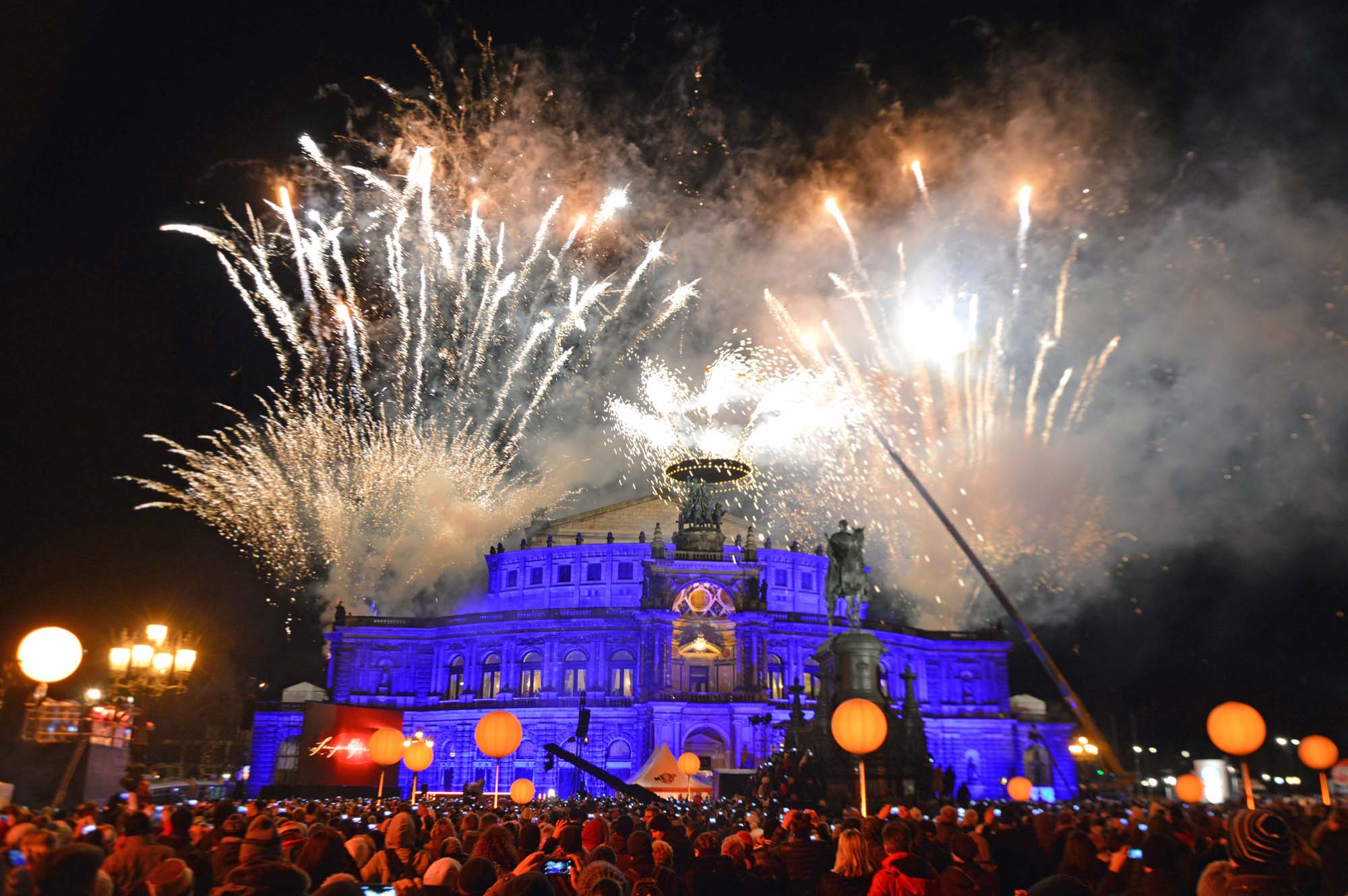
The Vienna Philharmonic Orchestra has named Christian Thielemann as conductior of the 2019 Vienna New Years Concert.  All the more reason Thielemann's Silvesterkonzert with the Dresden Staatskapelle.  He's done similar repertoire at the Dresden New Year's Eve concerts for years. Come 2018/2019 he'll be nipping back and forth, but one thing for sure, he'll be interesting.  Dresden Silvesterkonzerts don't always follow the same formula.  This year's concert marked the centenary of  UFA GmbH, the conglomerate behind the German film industry.  Yet the concert was more than music from the movies. Outside Germany, UFA is associated with the Nazis, who took it over in 1933. With the rise of Far Right extremism all round the world, it might be safer to steer clear. But it's far braver to confront the past, warts and all.  If we don't learn from the past, we'll make the same mistakes. 
With some trepidation, I approached the programme. But the UFA situation is far more complex than simple black and white. Deliberate pun on the technology behind Weimar film. For UFA was associated with some of the finest art movies ever made, and with directors like Fritz Lang and F W Murnau.  Goebbels wasn't the first to realize that film could be used for mind control.  Witness the wave of Soviet films like October (more here) which are works of art but also propaganda.  When the Nazis came to power, the studios churned out stuff like Jud Süß which I confess I haven't been able to watch for more than a few minutes. And hundreds of Africans and Roma were forced to work in slave conditions.  But  UFA made over 1000 films in this period and not all can be condemned.  The gradation between art and the abuse of art is a dilemma we need to confront, if we are to learn. 
Thielemann began with Erich Korngold's main theme and love scene from Captain Blood.  Korngold  didn't work at UFA but his music epitomizes what we'd now call "Hollywood Style" but like so many in Hollywood, he was European. Chances are he would have followed Max Reinhardt to the US whatever the circumstances, but by remembering him we also honour those who did not have a choice  Theo Mackeben remained in Germany, writing operettas and film scores, but  he knew Brecht and Weill, having conducted the premiere of Die Dreigroschenoper.  Angela Denoke sang his song Frauen sind keine Engel, not as politcial as Weill but certainly racy.   Hans May went into exile, but to Britain, not Hollywood, where he was part of the then-thriving British film industry.   Daniel Behle sang May's Heut ist der schönste Tag.  The show stopper, though, was Ich bin von Kopf bis Fuß auf Liebe eingestellt made famous by Marlene Dietrich. Elisabeth Kulman looked the part in a silvery gown, but vocally she's a lot stronger than Dietrich and could sing the "cadenza" arrangement.  The song comes from Josef von Sternberg's The Blue Angel  (1930) starring Marlene Dietrich.  The real star of that film was Emil Jannings, who'd established a career in Hollywood silent film.  He "reverse migrated" back to Germany. After 1933 he made movies for UFA on historical subjects, which in the circumstances had political overtones. Was he nationalist or Nazi ? Does nationalism necessarily lead to evil things ?
The Dresden Staatskapelle musicians morphed into dance band for fox trots, setting the mood for songs by Werner Richard Heymann, two from Die Drei von der Tankstelle (1930). The songs have an almost Schlager-like gaiety.   Saxophones and guitars turned the Staatskapelle into jazzband, with Daniel Behle hamming up stylishly in top hat and tails.  A moment for contemplation, though, with melancholy torch songs by Michael Jary, sensitively sung by Elisabeth Kullman.  Jary was a jazz musician, a genre the Nazis despised, but managed to scrape a living writing film scores for UFA. More songs by Mackeben , Friedrich Hollaender and Robert Stolz, "the luckiest man in the world" who made and lost several fortunes in the theatre. Winding up old, penniless and stateless in Paris, he was about to be imprisoned as an enemy alien, when he was saved by a beautiful 19-year-old heiress,who fell in love with him at first sight and became his (I think) sixth wife. They went to Hollywood where he made another fortune in movie music before returning to Dahlem and then Vienna (read more here).
Altogether a delicious concert,  played with total conviction, the material treated as serious music, not just "movie music".  One of the finest classical,orchestras in the world, letting their hair down without dropping a note.  When Christian Thielemann swings, he swings like a natural!  Thielemann and the orchestra had much more substantial music to work with in Georg Haentzschel's Große Suite in sechs Sätzen zu Münchhausen from one of the most extravagant movies UFA ever made, József Baky's Münchhausen (1943).  Goebbels gave UFA an unlimited budget. The Grand Canal in Venice, no less,  was closed off for the filming.  Thousands of extras were employed, including, alas, African prisoners of war and German-born men from former colonies in West Africa.  Münchhausen travels to the palace of the Grand Sultan, where the Turks are comic and the eunuchs camp. That's fairly benign by the standards of the time and not only in Nazi Germany, one should emphasize.  The Black men are dressed in silks, as slaves.  One wonders what was going on in their heads ?  At least they were - relatively - safe and many survived.  This is such an amazing movie that I'll write more in depth later.  Like the Wizard of Oz, it's fantasy but with quietly subversive political undercurrents,. The script was by Erich Kästner, definitely not a Nazi.

Monday, 1 January 2018

Why the Vienna New Year Concert matters


The Wiener Neujahrskonzert, the Vienna New Year's Concert 2018 with the Wiener Philharmoniker conducted by Riccardo Muti, for the fifth time - he's much older now than when the photo above was taken, but you're only as old as you want to be.  Muti was on good form, clearly enjoying himself.  Spontaneity is the spirit !  Like champagne, the Vienna formula works best when it's served fresh with wit and gaiety. Some years, it's fallen flat, and you think "not again" and then, like this year, it sparkles again.  The Wiener Philharmoniker parties, too. All year round, they play "serious" repertoire, but on New Year's Day, they make merry with Strauss (Johann I and II, not Richard !), with marches, waltzes and ventures in operetta.  But Vienna is "more" than music, it's the world's biggest New Year's Eve Party.

All over the world, millions join in the festivities.  When the concerts started, Vienna was the capital of an Empire.  Now it commands a new position as flagship of classical music for many who wouldn't otherwise listen at all.  Not by any stretch of the imagination is it typical concert fare and it does not represent what happens the rest of the year. But so what if some of those listening think all concerts are like this ?  The Vienna New Year's Concert fascinates because it's a symbol. It presents western culture as something glorious, thrilling and fun, which all can enjoy. The spirit of Empire, reprised : nothing wrong with that since it's not backed by military might.  So why not celebrate Vienna itself, and its heritage ?  Now the world's sinking into small-minded reductionism, it's a good idea to remember that the idea of nation state isn't compulsory.  Can we dream of a world without borders, where all can participate as they wish ? As long as it’s not enforced by the barrel of a gun, physical or mental. Remember what happened to the Hapsburgs in 1918.

Since the New Year's Concert is not an ordinary concert by any means, it's perfectly valid to present it on an extraordinary scale.  Music, especially music like this, is communal, meant to be heard live, involving all the senses. The audience might not dance, but they know about the New Year’s Ball, and about the waltz tradition.  They dress up to enhance the sense of occasion.   Hence the flowers, bringing scent and countryside into the city in mid-winter.  New Year means hope and renewal, and the return of summer. Miss that and you miss the whole darn point of the New Year Concert !
The Neujahrskonzert represents much more than music. Vienna itself  (and Austria) is the star !  Thus the shots of the city in its splendour.  This year, we get to see architectural treasure, in greater close up than we could walking round as tourists. As we hear the Tales from the Vienna Woods, we see them, briefly, and see close-ups of the zither being played, an important detail for those keen on how music is made.  Music doesn't exist in isolation. It's the product of many influences, and, as we listen, we (in theory anyway) might be opening our minds to the richness of human endeavour.  Vienna brings to millions all over the world, the experience of live music "in the round", in its true context. For that, we should celebrate.

Please also see Thielemann Swings !  Christian Theielemann's Silvesterkonzert in Dresden, which matters because he's doing Vienna next year

Prosit Neujahr 1918


Saturday, 30 December 2017

The Sun King Dances - Le Ballet Royal de la Nuit

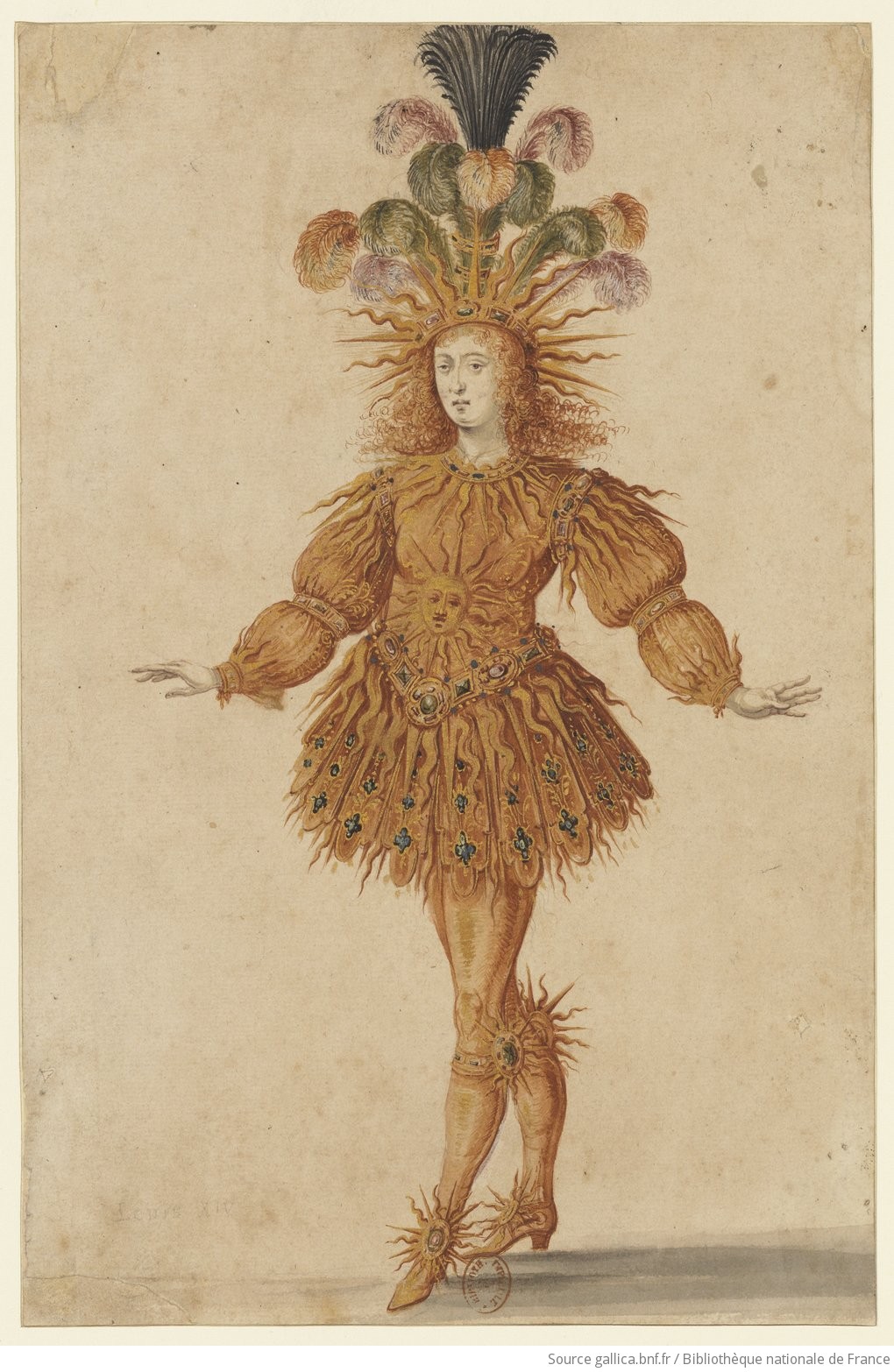
Le Ballet Royal de la Nuit, performed at Caen last month, broadcast on France Musique HERE, with Sébastien Daucé and Ensemble Correspondances who recreated the spectacle for modern audiences,  preserved in their recording for Harmonia Mundi in 2015. The original was performed only once, on 23rd February 1653, in the palace of Petit-Bourbon in Paris : an extravaganza where the star was its subject : Louis XIV, the King of France. No way could the original be matched today.  It ran for 13 hours solid,  from darkness to dawn, dawn being, of course the return of the sun. Thus Louis revealed himself as the Sun King, his countenance bringing light to the nation.  He appeared, in the costume pictured right,  dressed as the sun, the centre of the solar system, the bringer of light and growth.   An audacious statement, so dazzling that the court was stunned into submission.  And he was only 14 years old.  Though Louis wasn't formally crowned until the following year, Le Ballet Royal de la Nuit marked the beginning of his reign of glory.

Le Ballet Royal de la Nuit also marks the beginning of modern music, opera and ballet.  It comprised music from several composers, (Jean de Cambefort, Antoine Boësset, Louis Constantin, Michel Lambert — Lully's father-in-law, Francesco Cavalli, Luigi Rossi),  secular as well as religious. It evolves in four parts, comprising numerous scena and interludes, depicting the known and unknown world. Gods and Symbolic Dieties mix with mortals and (glorified)  peasants, represented the multitudes whom Louis would rule over, in fact as well as in allegory.  Musicians, singers, dancers, acrobats, jugglers : the plethora of styles and skills reflected the diversity of the Empire and the scale of Louis's ambition, the abundance of human experience elegantly ordered into artistic form.  Later, Louis's minions would create the gardens of Versailles,  "civilizing" nature in formal parterres, preserving the forests beyond, for hunting.  In the Grand Ballet with which the spectacle ends, Louis danced - not folk dance by any means, but a form of pageant derived from courtly disciplines like gymnastics. Fencing was aristocrat physical fitness, but also good training for minds that had to keep alert and wary,  keeping counsel but acting swiftly and decisively when need. arose.  Medieval jousting, adapted for more sophisticated intrigue.  Dance was a principal foundation of French Opéra, but also influenced the development of French music in a wider sense,where  the virtues of clarity, lucidity and intelligence prevail. Passion is no less intense in a cultivated mind, it's just more focused.

Le Ballet Royal de la Nuit is a metaphor for French style.  Its audacity lies in its extravagant imagination, elegance restraining excess, technical achievement balanced by refinement, agility and energy.  When Sébastien Daucé and Ensemble Correspondances made their recording for Harmonia Mundi, the release was audio only, though the performance was partly staged.  Yet this first great Gesammstkunstwerk was meant to be seen as well as to be heard.  Perhaps one day, who knows? Til then, there are clips and stills to stimulate the mind.  Read more about the original HERE and enjoy the videos in THIS LINK.

Tuesday, 26 December 2017

Amsterdam Kerstmatinee 2017 Bach Mass


The Royal Concertgebouw Orchestra Amsterdam’s Kerstmatinee (Christmas Matinee) is legendary. This year, we can all take part , as the live concert is streamned on the RCOA website.  For the first time in forty-five years, the orchestra is performing Johann Sebastian Bach’s B minor Mass, BWV 232. The RCOA is joined by Collegioum Vocale Gent, conducted by Philippe Herreweghe with soloists Dorothee Mields, Hana Blažíková, Alex Potter, Robin Tritschler and Krešimir Stražanac.  An exceptionally rich performance, enhanced by the sense of occasion. This is a Kertmatinee to remember ! I've listened more oir less back to back three time.  Herrweghe is of course one of the great interpreters of this piece, and the RCOA sound sublime.  Enjoy the performance HERE for a limited time. 

Friday, 22 December 2017

Christmas? not! Braunfels Verkündigung medieval mystery for modern times

Christmas music ? Not ! Walter Braunfels  Verkündigung op 50 a medieval mystery play for modern times.  Angels, stars, snow, happy peasants and quaintly volkisch sounds. But no tinsel here, and no false sentiment. Braunfels was writing during the Third Reich.  Hitler loved kitsch medievalism, so Braunfels quietly turned it against him.  Braunfels's Verkündigung is subversion, the composer a resistance fighter in Gothic guise.  A miracle happens at Christmas but this is not religious music.  In this Nativity, the baby is stillborn, brought back from the dead by a mortal woman. God doesn't figure directly and the message isn't redemption.

The text is a loose adaptation of a play by Paul Claudel, an ultra-conservative Catholic and nationalist whose sympathies weren't far off from the Nazis.  Claudel was writing about a period before the emergence of Joan of Arc.  As an icon, Joan is as political as she is saintly. She's a saviour who gets martyred. Braunfels, who was radicalized by his experiences in the First World War, was passionately anti-war and despised dictators and charlatans.  Later, as Europe was again on the verge of war, Braunfels began to write Jeanne d'Arc, Szenen aus dem Leben der Heiligen Johanna . Please read more about that HERESo don't assume Braunfels didn't know what he was doing.   Verkündigung is an allegory which makes many potent points. 
Peter von Ulm is an architect who raises money from believers to build cathedrals, symbols of power and unquestioning faith.  Hitler wanted to build whole cities to glorify his 1000 year Reich, seducing architects like Albert Speer.  Although Claudel's translator - not Braunfels himself -  shifted the action in the play from France to the early medieval German city of Speyer, the irony wasn't lost on the composer. Speyer = Speer, and Peter the rock on which grand Churches are built,  Peter von Ulm has a secret: he's a leper and he's infectious.  An angelus rings from Marienberg Tower.  Inspired by the idea of sacrifice, thinking that God will protect her, Violane kisses Peter to comfort him, and contracts his disease.  Violane's family and her fiancé, Jakobäus, think she's been unchaste and throw her out.

Years pass. It's Christmas Eve in Rothestein.  A cathedral is being built.  It's snowing and the peasants are celebrating the coming of the King, in every sense.  Braunfels’s writing is vivid.  Robust mock medieval instrumentation and jolly peasant dance, fuelled  by too much Pfälzerwein. "Weihnacht, tralla, Weihnacht tralla...... der Starmetz friert, brrrr, brrrr, brrrr!". Meanwhile, Violane is a hermit, having caught leprosy from Peter, and blind.  Her sister Mara's baby is dead.  Though Mara had betrayed Violane years before, now she wants Violaneto resurrect   the corpse.  Though Violane doesn't have supernatural powers, she hears the sounds of Christmas bells, though her sister can't.   Braunfels writes Violane’s part so the voice shimmers, as if the woman were being beatified by the orchestra around her. Fascinating music, pulsating with obssessive rhythms, the trumpets swathed by a celestial choir. Violane's voice soars upwards, in ecstasy, the choirs swirling round her.  Magnificent! 

A miracle happens. But the dead child is reborn with blue eyes like Violane, not brown eyes like Mara !  So Mara throws Violane down a cliff, where she dies.  Peter von Ulm carries her body: Having been cured by Violane's kiss, he is now immune to catching the disease again. Violane is returned to her father's home, but that's not much help, since she's dead herself.  Nobody gets out of this well, except perhaps Peter von Ulm, who has learned by Violane's selfless example. Although parallels are often drawn between Verkündigung and Hindemith Mathis der Maler,  (artists and architects) there are also parallels with Parsifal . "Durch Mitglied wissen...."   Is Violane an artist, too, her art the art of self-transcending compassion ? 

The recording to get is the one made for BR Klassik, with Ulf Schirmer conducting the Münchner Rundfunksorkester. Juliane Banse sings a rapturous Violane. I've been listening to her for years, and this is outstanding. Janina Baenchle sings Mara, Matthias Klink sings Peter von Ulm and Robert Holl sings Andreas Gradherz.  When this BR Klassik performance was mooted, the long-deleted recording from 1992. conducted by Russell Davies in Cologne, was re-issued. Though the singers on that are good, orchestrally it's less focused, the sound quality isn't conducive to concentrated listening. Schirmer and his forces bring out so much depth that their recording is the one to go for. 


Please read my many other posts on Walter Braunfels and composers of this period.

Wednesday, 20 December 2017

Posthumous Christmas : Samuel Coleridge-Taylor


Samuel Coleridge-Taylor Christmas Overture is "posthumous", in the sense that the present form in which it's known was made thirteen years after the composer’s death by a popular arranger, Sydney Barnes.  Colerdge-Taylor's original music was more extensive, being incidental music for a children's play, The Forest of Wild Thyme, in 1910.  There must be dozens of Christmas compilations but this is robust and rather jolly. One wonders what remains of the original manuscript. There's a good recording by the BBC Concert Orchestra conducted by Barry Wordsworth.

While still a student at the Royal College of Music, Coleridge-Taylor came to the attention of August Jaeger and Edward Elgar who arranged a commission for him at the 1897 Three Choirs Festival.    Hiawatha's Wedding Feast followed soon after, then the full Song of Hiawatha. By the age of 25, Coleridge-Taylor was a resounding success.   Hiawatha was a hit because it suited the taste of the time for grand excess, but it's actually a more more sophisticated work than its reputation might suggest.  Even in Hiawatha, Coleridge-Taylor experiments with non-western form, following Longfellow's attempts to recreate Native American chant and the use of exotc speech rhythm. 


Although he never knew his father and was brought up in an entirely English  environment, being half Black might have shaped his sense of identity, though his interest in the possibilities of "new world" music might also have been sparked by Dvořák and German and French composers of the era. Imagine if he had lived to know Ravel or Starvinsky, or to experience the Jazz Age and the innovations of the 1920's!  Understanding Coleridge-Taylor means understanding the social context in which he was operating, and very specifically the black and non-western culture  of his time.  


Thus I cannot recommend highly enough the book Samuel Coleridge -Taylor: a Musical Life by Jeffrey Green (Pickering & Chatto, 2011, 296pp). This is the kind of proper examination that Coleridge-Taylor deserves. Green is a meticulous researcher, with an encylopedic knowledge of Black society in Britain in Coleridge-Taylor's time.  Green's research is meticulous, drawing on sources rarely explored, and is presented with intelligent analysis. It's absolutely essential for anyone interested in multi-cultural Britain. But he's also superb on the social context of Victorian  and Edwardian Britain: a lesson for anyone really interested in knowing what life might have been like in crowded terrace houses and large extended families. Indeed, anyone interested in modern Britain needs to know Green's work.  


The first books on Coleridge-Taylor were written in the early years of the 20th century, before most could even conceive the subtleties of race and class politics. Thus the early books were a sanitized mix of myth and wishful thinking.  The tag "The Black Mahler" for example which has nothing to do with Coleridge-Taylor as a man and his music. It was coined in reference to Coleridge-Taylor’s celebrity when he arrived  in the United States, the reference being to the celebrity as a conductor accorded to Mahler when he visited America in the same period.  Nowadays anything with the word "Mahler" in it sells, so the temptation is to exploit the term for money value even though it's highly misleading.

Tuesday, 19 December 2017

Festive season concerts/opera

What's on this festive season ?  Plan ahead

NOW

J S Bach Christmas Cantata

Philippe Herreweghe Collegium Vocale Gent, Saint Roch, Paris  recorded 2015  Only available til  24/12 !

Vienna New Years Ball, from Paris ! Operettas, Johan Strauss, marches etc but with the Orchestre de Paris, coinducted by Thomas Hengelbrorock, only to 24/12. A LOT classsier than Vienna. 

Rossini Barber of Seville Théâtre des Champs-Élysées

 conducted by  Jérémie Rhorer, directed by Laurent Pelly,  Florian Sempey, Michele Angelini, Catherine Trottmann et Robert Gleadow

Verdi Don Carlos  Opéra de Paris 

Philippe Jordan, Jonas Kaufmann, Sonya Yoncheva, Elina Garanca directed Krzyxtof Warlikowski til 8/3/18

Friday 22nd

Elgar The Dream of Gerontius in FRENCH

Daniel Harding, Orchestre de Paris  Magdalena Kožená, Andrew Staples and Jihn Relyea

Humperdinck Hansel and Gretel from Budapest

Saturday 23rd

Puccini Il Trittico Bayerisches Staatsoper  1800 GMT

Kirill Petrenko ;
Wolfgang Koch, Eva-Maria Westbroek, Yonghoon Lee, Pavol Breslik,
Ermonela Jaho, Michaela Schuster, Ambrogio Maestri, Rosa Feola  Diurectir Lotte de Beer
Der aufgezeichnete Stream ist von So, 24. Dezember 2017, 11.00 Uhr bis Mo, 25. Dezember 2017, 10.59 Uhr abrufbar.


Wagner Twilight of the Gods Opera North

25th December

Christmas in Vienna from Vienna 

ORF Radio Symphonie Orchester Wien, Vienna Boys Choir etc etc