Monday, 15 July 2013

Roth rocks baroque : Different Rite of Spring Les Siècles BBC Prom 4

Le sacre du Printemps (the Rite of Spring) but not as we know it! At BBC Prom 4, François-Xavier Roth conducted a unique version created with French-Canadian musicologist Louis Cyr. It's a recreation of how the music was heard at its first performance in 1913. Stravinsky revised the work several times and we know it from the definitive 1967 version. But the "original" intrigues.

Roth says "By rewriting the score to make it easier for players, Stravinsky removed many sound textures and colours that were there in 1913. In the original version of the ‘Sacrificial Dance’, for example, he included subtle variations in the texture to bring out the rhythm, alternating pizzicato and bowed strings..... Ansermet wrote to Stravinsky in 1922 and asked if he might reintroduce this alternation. Orchestras are not ready for it, Stravinsky replied, but maybe they will be in sixty years!"

Hearing the "first" Le sacre du Printemps shows how carefully Stravinsky structured the work. The music sounds primitive but it's not barbarian.  The maiden's sacrifice stems from deeply-held animist beliefs. The violence in this piece is meticulously channelled. The stylization reflects the ritual the Bear People have enacted for millennia. Roth's clear, lucid textures accentuate the underlying logic. The controlled silences twitch with tension, so the explosive outbursts have maximum impact. Roth's approach highlights the sense of fragility and wonder. Spring will come after a hard winter : tender plants will shoot from the hard ground. The maiden's death is part of a cycle of rebirth and renewal. 

Les Siècles is a period ensemble but it's not the instruments they use that count. When they play Stravinsky, they apply the aesthetic of French form so we can hear the intelligence in Stravinsky's creation.

Historically-informed performance is often misunderstood. As Nicholas Harnoncourt has said , it was a movement away from the bland and homogenized to something more human..The Baroque was a period of expansion: Europe was discovering the world, embracing change and discovery. The Baroque aesthetic was confident, brash and exuberant.  Les Siècles, founded by Roth in 2002, approaches the baroque in this spirit.  Rameau's Les Indes galantes typifies the style, with its  tableaux of exotic aliens: Turks, Incas, Persians, Red Indians (in this case PC doesn't count. These "indians" aren't real). Extravagant visuals and music to stimulate the imagination. Nothing timid!

Le Bourgeois gentilhomme was a robust satire by Molière, poking fun at pretension. The music moves as if in ceremonial procession.  Molière is sending everyone up, even the Court. Like Lully himself, Roth conducts with a staff. It's not affectation. It's a percussion instrument, meant to be heard. Music for dance needs a pulse. Even though we can't see dancers we can hear them as an invisible presence in this rhythmic structure. Listen for the marching drum and small beaten bells. They are portable instruments, evoking open-air, sunshine and a spirit of freedom.

Baroque music was also visual. Lully employs Turkish bells, a huge, golden instrument shaped like a mobile pagoda with bells on. You're fascinated, waiting in anticipation. The percussionist stamps it on the ground like the conductor's staff, and the bells ring wildly. Music "was" theatre. The origins of modern music theatre go back even beyond courtly displays to Church ceremonial and military display.

Roth and Les Siècles followed Lully with Rameau, a suite from Les Indes galantes.. It was a telling choice, because it emphasized the formal structure of the piece rather than its flamboyance. Just as in Lully, the orchestra is balanced visually as well as aurally: four trumpets, four basses, four flutes and Lully's staff and Turkish bells. But Rameau sounds new and different. Roth's pacing makes the music fly, so when the formal rhythm returns it feels so jaunty that you want to dance along. The petite percussionist threw herself so forcefully into her playing that she bounced up and down. Delightful detail!

Combining Rameau and Stravinsky was an inspired choice. Both pieces depict "savages" who aren't savage. Le sacre du Printemps stems from a very long tradition in French music and dance.

From a ballet with a libretto to an opera with ballet : Délibes Coppélia and  Massenet Le Cid. Again, the choices in this Prom were instructive. Roth and Les Siècles approached them with the same free, exuberant spirit that informed their Lully and Rameau. The Waltz from Coppélia sparkled: period instruments suggest lightness and irreverence. Beneath the comedy, there's a fragile wistfulness in the story, which responds better to Roth's approach than a more heavy-handed literal interpretation. Hearing the ballet excerpts from Le Cid without the opera made me realize how this Prom brought us full circle from the baroque to Stravinsky and Diaghilev.

This programme was devised for Les Flâneries de Reims and Radio France's Montpellier Festival. But at the BBC Proms it gets the high profile, international coverage it deserves. It was being filmed for broadcast on BBC TV 4 on 21st July. Hear it audio only here for 7 days and here until next Wednesday

Sunday, 14 July 2013

Gergiev explodes - Le Sacre du printemps full video


Tonight at the BBC Proms,  François-Xavier Roth conducts Stravinsky Le scare du Printemps (the Rite of Spring). It's going to be different! Roth's leading Les Siècles, the innovative period instrument ensemble. The logic is, I think, to connect Le sacre with the long tradition of French music for dance. Music for dance is physical: it needs to support movement. Roth's hero Jean-Baptiste Lully, who conducted with a stave, adding percussion effects, got so involved with the music that he rammed the stave into his foot, got gangrene and died. We can hear "modern" Rites of Spring anytime, but it will be good to hear it expressed with the vigour and brashness of the baroque.

Above is a very good, lively and physical Rite of Spring.  This time we have Valery Gergiev, with the Mariinsky Ballet and Orchestra. Fantastic performance - vivid, spirited, barbaric. Violence is exactly what we need to hear. Diaghilev and Stravinsky were shaking up everything comfortable society expected.

Look at the dancers : their bodies contort in strange, stylized twitches. They prance on tiptoe for long periods - how painful their calf muscles must feel!. When they rest, their hips are turned 45 degrees, their feet turned sideways. They are making a sacrifice, just as the Chosen Maiden is doing. The Mariinsky dancers move with superb precision,  The gestures look simple but they're not, and they're executed with such commitment that you know there's more to this ballet than dance. It is a ritual, a shamanistic ceremony. connecting to ancient mysteries of fertility and rebirth. 

Gergiev is in his element. Forcefulness finessed with discipline.  The narrative is savage, but not barbaric. Gergiev directs with utter precision: every note, every gesture feels right, executed with conviction.  He makes the Rite of Spring explode, but it's a controlled explosion, all the more impressive because it's done with high professional standards. Listening to this feels like a work-out, physically and emotionally. Which is what it's all about.  This time I thought of dense geological layers, relentless forces of nature. The Bear People respond with the only resources they really have: their bodies. Hence the Sacrifice and thus renewal. The Rite of Spring could never be an opera.

This performance, at the Champs-Élysées. uses a reconstruction of the original choreography and designs. That's been done before, but this time, Gergiev reinvigorates the piece. He's not reverential or polite. We're not listening to a museum display. He makes The Rite of Spring explode, as shocking and fresh as it might have sounded in 1913.

Saturday, 13 July 2013

Ermonela Jaho Magda, La Rondine ROH

Ermonela Jaho, who sang the wonderful Suor Angelica at the Royal Opera House, returns to sing Magda in Puccini's La Rondine. 

"Magda knows that she can’t be the kind of woman Ruggero needs. So she tells the truth. In those moments, you can see Ruggero’s face change with disappointment and shock. He is losing his dream, too. But he is young, he might have a different future. So she sings tenderly, like a mother soothing a child. ‘Quando sarai guarito, te ne ricorderai. Ti ritorni alla casa tua serena, io reprendo il mio volo e la mia pena”......

"Magda a truly noble soul. She is strong because she could make that choice. She will be empty, a long, slow sadness in her life, but she also knows that Ruggero will be happy. That is the proof of her love. She doesn’t have a physical death, she doesn’t have a catharsis. But her pain makes her stronger and more mature.”

“Every time I sing this role, even in rehearsal, it takes a lot out of me. I need to be totally honest with my emotions. When I sing those last lines, I feel my heart and vocal cords pulling. If we are human beings, it’s impossible to become detached. Puccini closes the opera with pianissimo, but for me that is not a beautiful sound. It is the sound of Magda’s heart screaming from deep inside her soul.”

Read the full interview here in Opera Today

Friday, 12 July 2013

First Night of the BBC Proms 2013

The First Night of the BBC Proms 2013 marks the start of summer. At the Royal Albert Hall, Sakari Oramo, new Chief Conductor of the BBCSO, captured the sense of anticipation. Seldom does Benjamin Britten's Four Sea Interludes get a performance as vivacious as this.  And why not? We all know the piece and its origins in Peter Grimes. So it's good to hear it as a stand-alone celebration of the sea, of wide open horizons : freedom, exhilaration,  adventure. Of course we know what happens to Peter Grimes and his boys, and that the opera is grim. But for a moment we can think ourselves back to 1948 and feel the excitement. Peter Grimes was the "dawn" of modern British opera, and Oramo's bright, optimistic "Dawn" movement sparkled with hope and light. The high violins and flutes suggested soaring seagulls, and the lower strings and brass evoked the swell of the tides. The distinctive clarinet danced, like phosphoresence on waves. Then, woodwinds and brass suggested, well, "wind", stirring, heralding change. Grimes dies, but the sea renews itself with every wave and tide.

"In ceaseless motion comes and goes the tide Flowing it fills the channel broad and wide Then back to sea with strong majestic sweep It rolls in ebb yet terrible and deep".

Stephen Hough was the soloist in Rachmaninov's Variations on a Theme of Paginini. Hough is a Proms regular. I like the maturity of his playing, and his sense of assertiveness, qualities we value on an occasion like The First Night of the Proms. Hearing Rachmaninov after The Four Sea Interludes made me think of the many, fleeting moods of the sea. Hough's hands flew across they keyboard . In my imagination, images of change, energy and renewal. And perhaps, even the image of Paganini, the violinist, remade by Rachmaninov the pianist, and yet again by Witold Lutoslawski the composer. Lutoslawski's Variations  were new to me and thrilling. The familair basics are there,  but this time rejuvenated with a quirky, irreverent flamboyance. Paganini, who sold his soul to the Devil? Hough had been confident before : now he was almost demonic, pulling the orchestra in his wake.

For Ralph Vaughan Williams, A Sea Symphony marked more than a first symphony. (Note it's title "A" symphony, anticipating one of many). RVW lived in London and The Home Counties, unlike Britten who lived literally on the beach at Crag House in Aldeburgh. For RVW, the idea of the seas may have stimulated ideas of voyages of the imagination,  an expanded "Songs of Travel" for nearly 500 voices. It spurred – to use a bad pun – a sea change in his writing. He was making a transition from the safe world of Parry and Stanford into the great unknown. “Behold, the sea itself” could be an allegory for a young composer launching himself into uncharted waters.

RVW's  A Sea Symphony is an extravagant spectacular, ideally suited to the grand treatment it can get at the BBC Proms. A rousing, powerful performance. Roderick Williams sang the baritone part to perfection. His style is direct, almost conversational, yet carries thrust and authority without "period" ponderousness. If anything, he was even better in the quiet second movement "Alone on the Beach" than in the fairly truculent "public" first movement with its reference to imperial power. Even in the cavernous Royal Albert Hall, Williams could convey intimacy and colour. In the turbulent third movement, "The Waves", choirs came to the fore. Oramo's not a specially demonstrative conductor, but he could get the orchestra to deliver on a magnificent scale. You can hear why he was so popular with the CBSO in Birmingham during the Elgar centenary.

Oddly, the mystical final movement "The Explorers" evokes Elgar at his most spiritual. Solo violin, solo viola, solo horn, and Roderick Williams singing at the top of his register, quietly and with hushed reverence, awed by the power of God and of Nature. "O farther sail", Williams, the choirs and Sally Matthews the soprano repeat. The last chords of the orchestra fade slowly, suggesting distance and movement. We are on the way "Toward an Unknown Region".

As so often on The First Night of the Proms, the Prom opened with an extract from a larger work in progress by a leading British composer. This year, Julian Anderson's Harmony, a four minute choral work which may prove interesting on further hearing.

Here's a link to my Proms overview. Usually I listen to and write about 30- 40 Proms a season, so please come back for more.
And look at the SECRET TWINS - Roderick Williams and Benjamin Britten !
 photo:  Yuichi from Morioka, Japan

Thursday, 11 July 2013

Revelatory and rare - Britten Canticles Bostridge Linbury ROH

Revelatory and Rare! Britten's Canticles, though individually well-known, are seldom performed together because the forces they require are so diverse. But they need to be heard together so their significance can be truly appreciated. Although written separately over thirty years, they "embody a musical journey" as Roger Vignoles has written. "Not quite the Seven Stages of Man, but at the very least Five Stages of Britten".

This was an astonishing performance, led by Ian Bostridge, the most perceptive Britten interpreter of our time.  Britten was never "cosy". Bostridge's voice curls and quavers, imparting dark secrets, drawing out the bitter savour behind extended syllables, then suddenly turns pristine and oddly elegant. If he records this for posterity, it will be a performance to be studied note by note. Bostridge is more mature - and more daring - than he was on the 2002 recording. There's no comparison. We need modern interpretations. When Peter Pears was singing, times were more buttoned up and repressed. Fortunately, we can now cope with the more dangerous, disturbing aspects of this music.

In 1947, homosexuality was illegal and careers could be destroyed if any whiff  of scandal became public. Canticle One, My beloved is mine and I am his is a shockingly bold statement of The Love That Dare Not Speak Its Name.  "I give him songs, he gives me the length of days". The text is Biblical, and refers - we assume - to the relationship between God and man. The piano introduction is tender, almost lullaby-like. Perhaps it is a morning after, as this Jones staging suggests. The juxtaposition between religious text and homosexual love is audacious. This Canticle could still shock the pants off Middle England and the Choral Evensong culture.

Abraham and Isaac, the second Canticle (1952), takes its cue from medieval mystery plays, but revitalizes them with Britten's characteristic asperity. A dominant God, for which one might read authority, society and patriarchal values, demands that Abraham sacrifice his beloved son. Exquisitely beautiful cadences, gruesomely horrible meanings. Iestyn Davies is a much better Isaac than David Daniels was eleven years ago. Davies's voice is purer, stronger, less roccoco and much more idiomatic. Isaac agrees to being sacrificed, which suggests that he's more than a typical "innocent". Like the Boy in Curlew River, (another key work in which Britten explores stylized symbolism), Isaac's death has redemptive power. This time it's God who is moved and relents. Britten's Innocents are not as passive as one might think.

Still Falls the Rain (1955), based on Edith Sitwell's poem about the Blitz, is even more equivocal. A horn drones (Richard Watkins). It evokes the sound of an air raid siren, the drone of a bomber's engine, the sound of vast mechanical processes grinding away, mindless and impersonal. The staging was particularly evocative. We saw the white cliffs of Dover, as pale as the bodies of innocents, then shots of munitions factories churning out missiles - pointedly phallic. The gloom is punctuated by staccato piano,  making the connection between bombs and the hundreds of nails in the Holy Cross, and in Christ's body. Julius Drake played with adamant ferocity. This isn't pretty music, even when the horn leaps into a jaunty march. Bostridge sings the long arching lines so they ache and tantalize. Wails of agony or something more?  The poem is a curious blend of religion and the horror of war. Britten suggests that there might be even stranger, possibly erotic elements. Consider Isaac's sacrifice, and ultimately the surreal imagery in Canticle Five, written when Britten himself was confronting death.

Bostridge, Davies and Drake are joined by baritone Benedict Nelson for the fourth Canticle.  The Journey of the Magi (1971) may seem oddly quaint after the drama of Still Falls the Rain  The Three Kings speak in matter-of-fact conversation. They're preoccupied with the coldness of the night and the physical difficulties of travel. The birth of the child at Bethlehem seems almost an afterthought. Yet listen to the curious blending of the three voices. This isn't a chorale.

In 1974, Britten was so ill that he could not play the piano. The Death of St. Narcissus is thus scored for harp (Sally Pryce). The harp gives this last Canticle a curiously ethereal quality. Its strings seem to shimmer, evoking light and frragility. But is this light the natural light we'd expect from the modern equivalent of an arcadian lute?  At first, we're lured into the shadow of a rock, lured by "something different". The poem, by T S Eliot, blends references from classical antiquity with the image of St Sebastien, pierced by arrows, dying for one he loved. Quite probably, Britten didn't read Yukio Mishima on St Sebastien, but he must have understood that the symbolism wasn't strictly Catholic. that implies.  Someone, perhaps a tree, a girl, or a fish, has been ravished and corrupted. But the poem continues. "because his flesh was in love with the burning arrows, he danced on the hot sand until the arrows came. As he embraced them, his white skin surrendered itself to the redness of blood and satisfied him". How does one read this image?  One thinks of Tadzio, dancing on the beach in Venice, watched by dry, doomed Aschenbach. Perhaps Britten is contemplating beauty, fragility and the nature of creative life.

The stagings, by Neil Bartlett and Paule Constable, respect the individual character of each Canticle, while also suggesting ideas in common. This balance is important because the songs weren''t written as a unit, even if they can be interpreted as a cohesive whole. In any case, the staging is so minimalist that it doesn't distract. Mysterious figures move in the darkness, always elusive.  Dancers appear in Abraham and Isaac, connecting to the idea of the medieval "Holy Fool". They function as a silent chorus, their hands reeplicating the falling diminuendos. The significance  of dance is revealed in the final canticle, with the image of a lone dancer, spotlit in the darkness.

Claire Seymour, author of The Operas of Benjamin Britten will be reviewing this for Opera Today.If you like this, please read about Curlew River and the Church Parables. and Gloriana.  There's more on Britten here than any other non specialist site.

Macbeth, Blackheath Halls

Macbeth on the Heath, Blackheath Halls, that is. Blackheath is a shining example of how good community-based opera can be when it's done well. It helps that this local community includes professional musicians and singers, whose expectations are higher than elsewhere.  Many community operas are written to involve the community and children in particular : a noble ideal, which grows the long term audience. Blackheath, though, can tackle operas written for more sophisticated resources. The secret, I think, is to understand the core essentials in a work and do it well.  ".....electing for a ‘Gothic minimalist’ approach to the staging allowed the well-known story - played in the round - to unfold directly and without distraction."

The emphasis then is on the singers. A few really good leads (Miriam Murphy, Matthew Rose,
 Quentin Hayes) and a well-led cast, and there you go !  Claire Seymour was at Blackheath Halls for Verdi's Macbeth. She write about it in Opera Today (click link for full review and cast) 

She adds "This community project was launched and is driven by the passion and invention of General Manager, Keith Murray. In this ‘age of austerity’, such ventures are undoubtedly a long way down funding bodies’ list of priorities, and it takes considerable energy and commitment to get a project like this off the ground, let alone to attain such tremendous standards of professionalism year upon year. For the members of the adult and children’s choruses, the experience will have been immensely edifying and invigorating, and perhaps for some, life-changing."

Wednesday, 10 July 2013

Oxford Lieder Festival 2013

The 2013 Oxford Lieder Festival starts in October, but make your bookings now - some things sell out fast. Each year, the Festival grows and this year's no exception.

John Mark Ainsley and Brigid Steinberger (with Julius Drake) open this year's series of recitals in the Holywell Music Room on 11/10 with a concert built round Schumann's complete Myrthen. The first Festival weekend focuses on Goethe. A Goethe Study Day at the Jacqueline du Pré Music Building examines Goethe's poetry and Schubert's interpretations. Two concerts, two talks/discussions. On Monday, Christine Rice, Roderick Willaims, Adrian Thompson, Louise Alder and Sholto Kynoch sing Goethe settings by Wolf, Schubert, Zelter and Loewe. "Lesser-known gems" the programme promises. That's why Oxford Lieder is so impoortant. There's always something stimulating.Sir Willard White sings Brahms Vier ernste Lieder at St John the Evangelist on Tuesday 13th. Go early for the pre concert talk by Natasha Loges who is always interesting.

 Roderick Willliams pairs Schumann Dichterliebe with a world premiere : Robert Saxton's Time and the Seasons. Oxford Lieder actively champions new work, and this is its most substantial commission.

"Frozen Landscapes and Winter Journeys" on Friday 18th should prove fascinating. In 1897, Swedish explorer Solomon Andrée tried to fly to the North Pole in a balloon. Thirty years later, his photographs and diaries were discovered in the remains of his final camp in the frozen wastes. Like Amundsen and Scott in the Antarctic, it's a story of courage against the adversities of nature. American composer Dominick Argento set words from Andrée's diaries to music. Mark Stone and Sholto Kynoch will perform the piece in an atmospheric late night concert in the New College Ante Chapel. This is one of the "lost" photos showing a photo of the site where Andrée's balloon crashed. All the men were doomed. It's amazing that the photos and diaries survived. Oxford Lieder has organized an afternoon at The Pitt Rivers Museum so we can learn more about the expedition and the region in which it took place..

The second Oxford Lieder Festival weekend is themed around Benjamin Britten. James Bowman will be giving  a masterclass on Saturday afternoon, and is singing the keynote concert on Sunday 20th.  Britten was one of the first modern composers to appreciate the counter tenor voice. This is an aspect of Britten's work that';s rarely given the recognition it deserves : Bowman is in an ideal position since he knew Britten and sang the first Voice of Apollo in Death in Venice. This will be unique, from a historic and scholarly point of view. Lots more very unusual Britten this weekend, including Britten's work for two pianos, the Colin McPhee arrangements of Balinese gamelan. There'll also be a mid week screening of Tony Palmer's Nocturne,  a new film on Benjamin Britten (reviewed here).

Wolfgang Holzmair has been a patron of Oxford Lieder for many years. He's much loved and appreciated in return. Holzmair is unusually erudite, even for a Lieder specialist. As a young man he said he could never sing Lieder with a non-native-speaking pianist. Then he met Imogen Cooper, and a legendary team was born. Cooper's Schubert is exceptional : she understands the spirit and the words as if by instinct. Moreover, they're doing Schubert's Mayrhofer settings, some of which are so beautiful that they make Mayrhofer sound (almost) as wonderful as Goethe.

Toby Spence, Kate Royal and Christoph Prégardien are giving important recitals. I'll be at Prégardien, for sure! But fundamental to the Oxford Lieder ethos is the idea of practical perfomance. Singing is an interactive experience.. Hence the numerous masterclasses and opportunities to sing and develop. Oxford Lieder has helped launch many careers, and enhanced appreciation of the art of song.  Fifteen years ago, Lieder had a relatively low profile in this country, except for top level, high profile events in the Wigmore Hall. Oxford Lieder changed things, dramatically. Young British and European singers and pianists now have greater opportunities to learn and to share. Audiences, too, have grown to cherish Lieder and art song as a genre with unique delights and values. I am honoured and privileged to have supported Oxford Lieder almost from the start.

For more information see the Oxford Lieder site
photo of Holytwell Music Room : By Ny Björn

Tuesday, 9 July 2013

The Cheat 1915 - hypocrisy and dishonesty


Oriental Villain burns brand onto White Woman! Even today the subject would be sensitive. Racial prejudice, violence. Exotic, erotic aliens. The Cheat (1915) is shockingly prescient even now, a hundred years after the film was made. Modern audiences can't hide behind the illusion that things have really changed.

"Haka Arakau, a Burmese Ivory King to whom the Long Island smart-set is paying social tribute" is played by Sessue Hayakawa, (1889-1973) the first non-white to have a major film career. That in itself is telling. Not until Bruce Lee did Asians get to play important dramatic leads that didn't pander to stereotype. Arakau is seen using a Chinese incense burner to heat a branding tool to burn his seal onto ivory idols: the alien making his mark, in every sense. Because he's immensely wealthy, he doesn't get sidelined like nearly every other non-white in a era where race laws nullified reinforced prejudice. Arakau can switch from "oriental" to sophisticated western gentleman in elegant dinner jacket. He's threatening because he doesn't conform to stereotype.

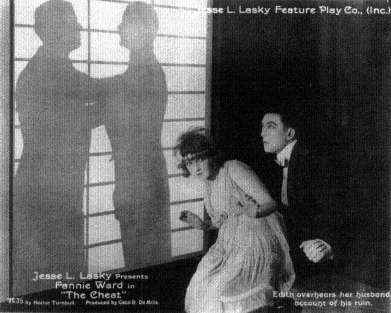
Edith, a socialite, flirts with Arakau, even though inter-racial relations were illegal, and she's married as well. Not a nice lady. Her husband Richard teeters on the edge of bankruptcy but she can't stop spending wildly and showing off. She steals money from a Red Cross fund raiser to help her husband on a money making venture. Edith borrows from Arakau to cover the misappropriation, with the implication that she'll sleep with him in return.  She slips into the inner rooms of Arakau's home. There's a struggle. He coat slips off, revealing her naked shoulders. It's not very clear what's happening until Arakau grabs his branding iron and pushes it into her flesh. She falls to the ground: even then it's not completely clear how she feels. She doesn't scream, but gasps ambiguously. Then she picks up a gun and shoots him, also in his shoulder. Branding iron and gun: both symbols of sexual penetration.

Richard tells the police that he shot Arakau. The truth is too dangerous. The grid of the shoji screen is now reflected in the shadow of the bars in a prison cell. Edith, hardly in fear of being raped or attacked, goes to Arakau. He's reclining in bed, and she leans close to him. Note the hands that don't quite touch. She wants to bribe him to drop the case. "You can't cheat me twice", he says. "It's in the hands of the law". But he concurs with Richard's story. At last Edith is spurred to tell the truth. She rips her clothes off in front of the courtroom and displays her scar. This scene alone is quite shocking, given the proprieties of the time. Mayhem. The crowd attacks Arakau and Richard is freed. It's not very clear but Arakau seems to be arrested by the police. Better than than get lynched by the mob, I guess. Despite her duplicity, Edith is a "heroine". Who are the "cheats" here?

Apart from Hayakawa's dignified performance, the acting in this film is exaggerated, even by the standards of the time. Perhaps the direction is a further clue to meaning. Edith is the fake, Arakau has integrity even though he assumed she would sleep with him if she couldn't repay the loan. The director was Cecil B De Mille. Four years later, D W Griffiths made Broken Blossoms, on a similar theme of dishonesty, sexuality and racism, (read more here). Significantly, Griffiths used a white actor in yellowface for his later movie, defusing some of the impact.  De Mille couldn't confront racism head-on, but disguised it under a story audiences then - and now - take at face value. How modern audiences read The Cheat tells us a loit about racism today. Some will assume that Arakau gets what he deserves, since he's a foreigner and doesn't "know his place". Others will read the film as something much more disturbing and brutally honest.

Sunday, 7 July 2013

New role for Cecilia Bartoli ?

Is there no end to her many talents ? "Brilliant Bartoli romps to Wimbledon Title". If she can transform into a marble statue,  winning at tennis should be easy. Plus, I think Marion B is cute !

Saturday, 6 July 2013

Gheorghiu vindicated - La Rondine Royal Opera House

La Rondine isn't Puccini's finest moment. As drama it's a retread of La Bohème. The music resembles out-takes from Madama Butterfly. What holds it together is Magda. So when an artist like Angela Gheorghiu revives the role, she brings a much-needed extra dimension to the opera. This is the role that helped propel her to stardom together with Roberto Alagna. Now they're having a bitter divorce, fanned by media sensationalism.

Art imitates life. Ironically, that human background adds poignancy to what is essentially, a fluffy vacuum of an opera, despite its surface charm. Magda sings of her first love, and the kiss that sealed their passion. When she sang this with Alagna the extra-musical frisson must have been intense.It must take incredible courage to revisit this role now, when every note tears open old wounds.  For that alone, Gheorghiu deserves respect. So what if her voice isn't at its resplendent peak? She creates a far more accurate Magda because she accesses the underlying pain that animates the character. Gheorghiu shows that there is more to Magda than her fawning, false friends realize. Pretty and superficial might apply to them. but not to her. When Gheorghiu sings the long sequence "Ore dolci et divine" the strain isn't vocal, but emotional. She breaks off the last lines a little abruptly, rather than letting them linger. But that's far truer to Magda's true personality.

Some might prefer mechanical songbirds, who churn out mindless perfection, but for me a true artist has emotional intelligence. Artists are not gladiators in an arena. They exist for their art, not for the mob. Some singers attract nastiness that goes far beyond artistic criticism, and descends into vicious personal abuse. Perhaps that's how some people get their kicks. If they saw someone leaning over a parapet, they'd scream "Jump!", then righteously tut tut when the body hits the ground. It's a form of bullying, and usually the abuse of women, worse than anything Alagna may or may not have done. . If opera is based on human feelings, sensitivity is essential. If we care about opera as art, we should respect the human beings who sing and create it. The last thing they need is to go on stage, knowing that the media has fanned the flames of frenzy against them. Gheorghiu is in a difficult position at the moment, so it's all the more to her credit that she went on at all.

For an intelligent and humane discussion of cancellitis please read this, written by a serious opera fan and singer.

Having braved the personal demons Act One would have awakened, Gheorghiu settled into the role ever more comfortably as the opera continued. Her Ruggero, Charles Castelnovo, supported her well. If his voice isn't quite as lovely as many who have done the part before, he compensated by being a solid foil to Gheorghiu. Perhaps the all-important kiss worked its magic, for Gheorghiu's Magda blossomed again, like the roses in the song. Castelnovo seems genuinely nice, so Magda's eventual renunciation seems quite natural.  Magda has come to terms with her past and doesn't need illusions of youth and love. Gheorghiu seems to find strength in Magda's maturity. For once the ending convinces, even though it's not written with the depth Puccini might have given to his other heroines.

.Sabina Puertolas sing Lisette, Magda's maid.  The rapport between Gheorghiu and Puertolas seems genuinely affectionate: they bounce off one another merrily, singing with palpable warmth. The dynamic lifts the opera , defusing the mood. Some of the wittiest musical passages illustrate Prunier's attempt to turn Lisette into what she can never be. Edgaras Montvidas sang a very good Prunier. He made us hear the "Poet" who thinks in terms of dreams, not reality, casually changing names and identities.  Ultimately, La Rondine is a warm-hearted, humane opera where pretensions are overturned. Lisette goes back to being a maid, and Magda (presumably) goes back to being Rambaldo's good friend.  Good nature prevails over delusion.

Marco Armiliato conducted. The production is the Nicholas Joël perennial, as flashy as the life Magda and her friends seem to live. It's telling that when Magda and Ruggero share their brief happiness that the backdrop shows fake flowers. The real beauty in La Rondine lies in the portrayal of Magda as a human personality. As such, Angela Georghiu is truly vindicated.

A full review and cast list will appear shortly in Opera Today.
photo by Catherine Ashmore, courtesy Royal Opera House

Friday, 5 July 2013

Silent Wagner 1913 wryly intuitive biopic

Is that Richard Wagner conducting? "Silent Wagner" is a remastering of a 1913 film made to celebrate Wagner's centenary.

A hundred years on, it's even more fascinating because the actor, Guiseppe Becce, is a dead ringer for Wagner himself. He's short and scrawny but moves with nervous energy. Perhaps Wagner, who had massive chips on his shoulders, moved with that punchy combativeness. In the scenes where Becce's Wagner squares up to the enormously tall Ludwig II (Ernst Reicher) we can sense something of the unspoken personal dynamic between them. Wagner's a chancer, getting his own at the aristocratic Big Guy. No historian can ever quite suggest this, but Becce has the intuition of a true method actor.

Becce (1877-1973) was also a musician and composer, who worked with  Arthur Nikisch and Ferruccio Busoni. He was a big name in German cinema. Before sound, he conducted live orchestras  who played during screenings. He was involved with The Cabinet of Dr Caligari (1920). For the Wagner biopic, he wrote an original score. When sound movies came in, Becce did very well. He wrote and conducted the music for Pabst's Geheimnisse der Seele, Reifenstahl Das blaue Licht, Ekstase, numerous classic Bergfilme. Becce was extremely important in the evolution of German cinema. It's unfair that the remastering calls the film "Silent Wagner" because it obliterates Becce's contribution. He must have written the music with wry humour: scenes from the operas pop up throughout the film with hilarious effect.

The script's a bit dodgy, lingering too long on Wagner's youth, leaving the Cosima years to the last 20 minutes. Cosima was alive and still truculent when the film was made, so perhaps the director, Carl Froelich (a huge presence in later in German cinema), was diplomatic to shy away from detail. "Cosima" appears in  brief shot, holding a suitcase, gesturing that she's come to serve her Master. Minna is excoriated. "Wagner" throws her out, suggesting that he was single before he met Cosima. All we see of their relationship is a flashback to a shot of Siegfried awakening Brünnhilde on her rock. Somehow I don't think Wagner would have exclaimed "Das ist keine Mnn !" This film is more tongue in cheek than meets the untutored eye. Ooops, wrong choice of metaphors.

But the period detail is breath-taking. Elaboate sets, suggesting how over-stuffed and claustrophobic period interiors might have been.  There are scenes with tiny, cramped theatres. The actors move stiffly in "actorly" poses. Yet even this tells us something. Was Wagner moving away from the stylized kitsch of the past? Cosima would not have liked that. Nor would she have liked seeing Meyerbeer who appears, tall and confident. Cosima would, however, have liked the scene where she's presented to Ludwig II surrounded by children who have mysteriously appeared. The boy who plays Siegfried Wagner sports a blond bouffant - must be a wig!
 
The composer sits at his desk, or plays a lumpy antique piano. "Ghosts" appear : Beckmesser, Eva and then Hans Sachs. Presto! Opera complete! Ludwig II visits Wagner in Switzerland, arriving in a boat, preceded by a swan. Wagner reads his Nibelung poems to polite Swiss burghers. Mathilde Wesendonck falls decorously for the artist, with a chaste kiss. Getting a shot of Bayreuth must have been easy enough, but the film uses state of the art technology (for 1913) to show Wagner on his deathbed in Venice. He's visited by apparaitions : Parsifal, Brünnhilde, Sachs, Walter with his harp. If this film is approached in modern cinematic terms, it's hard  to take. But appreciate it for its wry insights and provocative humour, and delight in the way it revises the Wagner story. There';s a scene where Becce plays Wagner in a bathtub, which is fair enough. But the film lingers lovingly on his naked body, discreetly lit from behind a screen.  When he emerges the towel he's wearing keeps threatening to slip off. That's a clue that this isn't reverent hommage, but "Wagner revealed".

 It's also important as a record of the evolution of German film, given that those who made it were to become leading figures in the business. And it also suggests the links between opera and film. Cinema was another form of "high art", treated with respect.


Thursday, 4 July 2013

Picnic time at the opera

At last it's summer ! At last picnics at country house operas will be fun - warmth, sunshine, glorious gardens.  It's Regatta week and Wimbledon, too. This year I treated myself to new picnic plates at the shop at Garsington Opera Wormsley and of course used them at Glyndebourne, too. These one are proper enamel, not plastic, designed by Emma Bridgewater. They're sturdy, but surprisingly easy to carry. They "feel" like real plates but should last ages. And only £6 each, about the same price as decent melamine. At Glyndebourne, there's a £500 golf caddy which must be nice to push on grass, but the plates and glasses inside are very basic clear plastic. But it's a great talking point !

I don't do clear plastic except for glasses. Waitrose does an excellent  range, wineglasses of different sizes, champagne flutes, hi ball glasses usw. which feel classy and look like the real thing. Coloured plastic is not my scene even as post modern irony, though I have a wonderful 50's glass tumbler that screams "Gold Coast, Queensland". It's so kitsch it's a treasure. After years of feeding small children, I don't do fussy food. But I do like "civilized" picnic ware that's not pretentious. With nice, light plates and glasses, you can use real cutlery without having to lug a bivouac. There's no substitute for real cutlery! Though you could do all-sushi with decent chopsticks.


More Band Aid or Surgery ? National Theatre slams South Bank redevelopment

The National Theatre has lodged a long, detailed and strongly worded objection to the South Bank's proposed redevelopment. Since the National Theatre is an integral part of the South Bank, this objection carries much more weight than most. Read the full objection HERE. The piece is a model of professional, informed analysis, backed by proper architectural and legal input. The project has such huge significance, not only for London, but for the whole country. It needs to be approached in a serious way. The South Bank site gives only a limited, biased account, which is fair enough - they want it to go through without too much scrutiny. Most of us don't have the professional expertise to comment in the way the National Theatre does, which is all the more reason we should pay heed.

"There is a common fallacy reflected in the above paragraphs: that Southbank, the brand, is synonymous with South Bank, the area. Over emphatic boundary-marking is inappropriate to the audience that comes to the arts buildings and moves easily between them, and those who simply come to the Queen's Walk to enjoy the river views and the overspills of animation".  

"In summary, we consider that the proposed development, in particular the Liner building, by virtue of its siting and scale contravenes relevant national, regional and local planning policies relating to the setting of the National Theatre, a grade II* structure; that the proposed building will abrogate the public perception of a unified cultural quarter; and that the wall effect it creates will undermine the amenity value of the National's largest public open spaces."

Under the the terms of consultation process, the National Theatre can only comment as far as the proposals pertain to itself, but the rest of us should be thinking in terms of how the proposals might work out in wider terms. The South Bank will be closed for another three years, only six years after the re-opening of the Royal Festival Hall. This time, the disruption will be even greater, possibly long term. The area has grown piecemeal, without any long term strategy or vision.

"Band Aid or Surgery?"  Cosmetic patches won't solve the problems of the South Bank. The basic problem is that it is a huge, nationally important enterprise squashed into an area hardly big enough to fit a local arts centre. 

Architects design buildings, they don't design cultural policy. The responsibility for that lies not only with South Bank management but with the Arts Council. Where is the vision ? Where is the leadership?  How do piecemeal patches fit in with a wider overall strategy for the arts ?

A much more comprehensive solution to the South Bank's problems might be to diversify and decentralize. Even the Barbican is expanding to new premises and areas.  Notice that the Barbican retains core facilities like the Barbican Hall while outsourcing services that can be housed elsewhere.. The beauty of the Barbican approach is that they go into the community, rather than expecting the community to come to them.  There is no sacred rule that different facilities have to be housed in the same place.

Big scale facilities like the Royal Festival Hall can't be relocated, because they cost so much and are so specialized. But things like poetry workshops can happen anywhere. If the South Bank were decentralized, other parts of South London would benefit it things were spread around a bit. Think of LSO St Lukes rejuvenating Old Street.  It's infinitely better to do a few things extremely well than cram too much together.  There's no reason why the South Bank should become a bazaar. An arts centre should aim at excellence, rather than watering down its main purpose to look trendy. Because the riverfront space is so limited - and so unique - it should be used for prime, high-profile activities that have maximum impact. Rehearsal rooms and offices, and similar activities can be housed elsewhere and at less expense. As the National Theatre says "over emphatic boundary marking is inappropriate".

photo : Matt Brown, London

Tuesday, 2 July 2013

Mahler Alert - London Sunday

Sybille Werner, the Mahler scholar who assists Prof. Henry-Louis de La Grange, conducts Mahler Symphony no 1 in the rarely heard 1893 Hamburg edition this Sunday, Mahler's 103rd birthday. It's an honour to be a friend of Sybille's, she "understands Mahler from within".

Monday, 1 July 2013

Glyndebourne Hippolyte et Aricie Rameau revitalized

Glyndebourne revitalizes Rameau's Hippolyte et Aricie. Baroque tastes were extravagant. Louis XIV, Le Roi Soleil, and his successor Louis XV,  epitomized the aesthetic: audacity, not gentility, vigour, not timidity. When Hippolyte et Aricie was premiered in 1733, it was considered radically inventive. So it's appropriate that Glyndebourne should present Rameau with the same spirit of adventure. William Christie has shown many times before that baroque thrives on daring and panache.

So the Prologue starts with a shock calculated to shake things up. Diana, the Goddess is in a refrigerator. But she's the Goddess of frigidity. Why not show her in a Frigidaire?  She has a frigid, rigid mindset. . For her, feelings should be sealed in air-tight compartments. So Diana comes out of the freezer cabinet. Her colours are those of frost, and the "pale sterile moon". Nature, though, is having nothing of artificial cool. In the egg compartment, Cupid is breaking out of a shell, challenging Diana with bright colours and joyously lively song.

Hippolyte, the son of Theseus is in love with Aricie, who has dedicated herself to the service of Diana, the Virgin Queen. Hippolyte's stepmother, Phaedra, lusts after him. Ironically, her husband Theseus is off saving a friend who has committed adultery with the wife of Pluto, Lord of the Underworld. We enter l'Enfer, where hell fire reigns: the reverse of the refrigerator, where overheated workings splutter in darkness and dirt. Is death more colourful than Diana's sterile temple? The denizens of the Underworld have merrier dances. A group of Flies.with elaborate wings, pirouette gleefully. Decay is part of the cycle of Nature. Without it, no rebirth. Theseus calls on his father, Neptune, for help and escapes. The Parques (The Fates) warn "Tu sors de l’infernal Empire, pour trouver les Enfers chez toi."

Rameau writes a Tempest into his music, which even now, when we're used to extreme theatre, is strikingly dramatic. At Glyndebourne, we get strobe lights, Rameau's audiences, who loved mechanical special effects, would have been thrilled by electricity. Neptune is the God of the Ocean, so his minions are "matelots".  At Glyndebourne, they appear as a chorus of French sailors. This is perfectly in keeping with the music. Rameau adapts a hornpipe jig. It's meant to be gay (in the old sense of the word) "Tous les cœurs sont matelots ; On quitte le repos : On vole sur les flots;"

Theseus blames his son for his wife's infidelity. Hippolyte follows Aricie into Diana's world. A dead stag hangs from the rafters.  Diana, despite her disdain for passion, is also the Goddess of the Hunt, and an agent of death  Aricie is initiated into the cult by being blooded. It's not gruesome, though, for Rameau's sense of elegance precludes overt barbarism. At Glyndebourne, Diana's followers are seen in hunting reds, the men's wigs oddly peaked as if they were foxes. Hippolyte disappears in a puff of smoke, presumably dead. Phaedra dies, too. This time, the Underworld is depicted as a morgue, pointedly designed like Diana's chilled-out Temple. But Hippolyte is no more dead than Theseus was when he went into hell. The lovers are reunited happily ever after. In this production, the ghost of Phaedra appears to observe proceedings. It's a nice touch, which fits in with the mood of healing and kindness. No grand showpiece arias here. Instead, the exquisite "Rossignols amoureux" a delicate air for soprano accompanied only by flute, exceptionally beautifully played by a soloist in the Orchestra of the Age of Enlightenment

Ed Lyon sang Hippolyte, fresh and youthful but no ingénue. Lyon's voice is assertive, suggesting strength in the character beyond the restraints of the text. That's perceptive. With his genes, Hippolyte is no wimp. Christiane Karg sang Aricie with charm and energy. Katharine Watson sang Diana, and Ana Quintans sang a vivacious Cupid.  Quintands also sang the crucial Nightingale Song, in the guise of a shepherdess. So Cupid has triumphed ! François Lis was a magnificently characterful Pluto/Jupiter, well supported by Loïc Felix's Tisiphone. Sarah Connolly (Phaedra) and Stéphane Degout (Theseus) were exceptional, wonderfully assured singing and stage presence.

Together with Lis, Connolly and Degout (one of the finest French singers of his generation) sang their parts in the Paris production last year with Emmanuelle Haïm, where the set was a reconstruction of what the opera might have looked like in 1733. That was important because it clearly showed the cast in costumes that were "modern" at the time. Rameau wasn't depicting Greeks or Greek Gods but archetypes in a setting his own audiences could relate to.  So much for the notion of period specificity. True period authenticity is fascinating, for me, anyway. But it doesn't necessarily do much for modern audiences, who might find the succession of dances less easy to take. The Glyndebourne production, directed by Jonathan Kent, with designs by Paul Brown, doesn't actually "update", to use the much misused term, but treats the opera as something fresh and exciting, as it might have seemed to audiences nearly 300 years ago  Like the cycle of Nature, life goes on when things renew. The humour is entirely appropriate, and the dances are brightly characterized. One other good moment: when Sarah Connolly descends off the stage as Phaedra preparing to die, the auditorium goes completely dark for much longer than usual. She's such a big star that audiences expect an exit as dramatic as that. She doesn't get to sing anymore, but the memory lingers on.

Most credit, however, to William Christie. What animated, vivid playing he draws from the  Orchestra of the Age of Enlightenment. How the singers seem inspired by his enthusiasm! He's visionary. He understand the baroque and its aesthetic so well that he can teach us a great deal about the idiom. His Rameau Les Indes Galantes (recorded on DVD) is an education. Christie brings out the vivacious, almost anarchic vigour that is at the heart of French baroque. He's worked with Jonathan Kent before (Purcell Fairy Quuen, Glyndebourne). My companion said "If this is good enough for Bill Christie, it's good enough for me". By sheer coicidence we bumped into Christie himself a few minutes later, and told him. He beamed. "That's the sort of feedback I like to hear!". I hope it helped to make his day. Certainly, with this performance, he made mine.

Complete review and cast list in Opera Today
Photos c. Bill Cooper, courtesy Glyndebourne Festival