Friday, 20 July 2012
Esa-Pekka Salonen Torchbearer no 40


Thursday, 19 July 2012
Christie Charpentier David et Jonathas Aix

Musically this is divine, the intricate correspondances done with exquiste clarity and delicacy. In David et Jonathas, this freedom of spirit is very much part of what the opera is about. David is a hero, who has killed Goliath, but the times he lives in are turbulent. War, intrigue, bluff and counter-bluff, the sordid stuff of politics. Although David is loyal to King Saul, he's forced to flee to the Philistines who welcome him. Despite negotiations for peace, war breaks out again, Briefly David and Jonathas are reunited, but Jonathas is killed. Saul dies, heartbroken. David becomes King.
We know the plot from the Old Testament, but Charpentier fleshes it out with wonderful music. The parts for David and Jonathas are beautiful: theirs is a love story as much as a symbol of purity against a background of sordid violence. Christie chooses his singers well. Pascal Charbonneau, who sings David, frequently reaches countertenor territory. The part was written for alto, to contrast with the very low baritone of Saul, (Neal Davis) and the bass of Achis (Frédéric Caton). Ana Quintans sings Jonathas. It's a trouser part because a high. bright voice shows how young and beautiful Jonathas was, beloved by all.
The interplay between voices and orchestra is superb, the formal patterns of baroque art expressed in music. Brightness and depth, constant weaving of textures - political intrigue woven into the very fabric of the form. Christie's precision keeps the layers bright : no room for approximation in this score.
Thus Andreas Hoimoki's staging worked extremely well with the clarity of Christie's approach, and with Charpentier's idiom. The set (Paul Zoller) is as simple, throwing focus on the singers, yet a pine panelling background lit as luminously as this evokes the golden glow of baroque paintings and indeed the instruments in the orchestra.
Intelligent use of space and boxed space to create the flow of exterior and crowd scenes, and interior, private intensity. The long non-vocal passages might once have been filled with formal masques. Here, they're used to hint at background. Jonathas, as a young boy, stands before the bier of his dead mother. The young David enters and comforts him, but Saul's disturbed to see them embrace. He in turn embraces the portrait of his late wife which mesmerized hius son. Costumes are timeless, sufficiently middle eastern to remind us of Biblical times.
The Israelites and Philistines are distinguished by their music rather than by costume (some of the Philistines wear a red fez), but again this is true to plot. For thouands of years before 1948, there was conflict in these lands. Charpentier and his audiences weren't in the least bothered about historical accuracy, so neither should we be. Indeed, seeing Jonathas clothed in short pants (not robe) is a subtle reminder that David and Jonathan relationships have happened throughout history. Homoki doesn't over-emphasize, but Charpentier and his audiences weren't naive. Chorus scenes are well blocked, almost like choreography: I kept thinking of 17th century paintings, utterly approrpriate to Charpentier's period.
(photo : Pascal Victor)
The Fricka of Country Music - It wasn't God who made Honky Tonk Angels

More than ten years before Betty Friedan and women's Lib, Kitty Wells was a pioneer when there weren't many roles for women in Country music, or indeed the whole social milieu of Country music, dominated as it was by Bible Belt patriarchy, which even men didn't know how to question. Alcoholism was the angst of the misfit in the Country scene. Kitty wasn't the first female Country or Cajun singer, but she was different from nice girls like the Carter family who knew their place. Kitty was happily married for 74 years, almost certainly not leftist. You bet she never burned her bra or flag. But she stood up to things. "Will your lawyer talk to God and plead your case on high?" "Making believe, you're somebody's love, never mine".. "Have I lost you to a woman half my age?" Without Kitty Wells, perhaps no Patsy Cline, Tammy Wynette or Dolly Parton. And thousands of nice girls in white cardigans and aprons started to think, why should we take things lying down? Real change happens when the non-urban, non-intellectual proletariat are roused. Kitty Wells, with her Southern belle gentility, deserves a place in the Valhalla of modern womanhood.
Kitty became famous almost by accident, after recording a riposte to Hank Thompson's The Wild Side of Life which blamed womern and alcohol for leading him astray. No, sang Kitty, using the same tune. "It wasn't God who made Honky Tonk Angels,.... Many a time married men think they're still single, that has caused many a good girl to go wrong. It's a shame that all the blame is on us woman, ....from the start most every heart that's ever broken was because there always was a man to blame". It's overstatement of course, but understandable given the heirachical situation at the time. Women (and men) aren't born bad, they're made bad. So even if Kitty Wells, the Fricka of Country Music, upholds marriage and good behaviour, she's not judging those who fall.
Ultimately, feminism liberates men as well as women because it shows that there are other ways to be. Again and again, in Country music people are destroyed by this either/or dilemma between perfection and dissolution. Britney Spears went off the rails because she couldn't cope. Many times I hoped she'd learn not to blame herself but the crazy world around her. Singing, she doesn't need to learn from Kitty Wells, but how to stand up for herself.
Lots on this site about Country and Cajun music, feminsism, fesity women and Lieder. Please read here how the Lieder and Country Music traditions ironically connect.
Wednesday, 18 July 2012
Strauss Sibelius Saariaho Juanjo Mena Prom 5
 Juanjo Mena made his Proms debut last year before he officially became Chief Conductor of the BBC Philharmonic. This year's Prom gave him much higher profile, and a more challenging programme with which to show what he can do. Strauss Also sprach Zarathrustra and Sibelius 7th Symphony are huge pillars of the repertoire, almost guaranteed to shock and awe. The Willis organ with its 9997 pipes was designed for big statements like Zarathustra. It's almost impossible not to respond, especially given the sense of
occasion that amplifies any performance in the Royal Albert Hall. Mena's Sibelius 7th had grandeur, though there's more to this most unusual piece that rips apart the very notion of symphony in just twenty minutes. Still, Mena has what it takes to wow and that's what we got.
Juanjo Mena made his Proms debut last year before he officially became Chief Conductor of the BBC Philharmonic. This year's Prom gave him much higher profile, and a more challenging programme with which to show what he can do. Strauss Also sprach Zarathrustra and Sibelius 7th Symphony are huge pillars of the repertoire, almost guaranteed to shock and awe. The Willis organ with its 9997 pipes was designed for big statements like Zarathustra. It's almost impossible not to respond, especially given the sense of
occasion that amplifies any performance in the Royal Albert Hall. Mena's Sibelius 7th had grandeur, though there's more to this most unusual piece that rips apart the very notion of symphony in just twenty minutes. Still, Mena has what it takes to wow and that's what we got.Kaija Saariaho's Laterna magica was inspired by Ingmar Bergman. It evokes the mood of those aspects of Bergman's films where brief, unspoken glances carry great portent. Bergman didn't need grand gestures to make a point. In that sense, Saariaho captures the essence of the director's style, whose black and white starkness is so different to her own multi coloured washes of sound. Saariaho refers to the "magic lantern", the first film machine that used light to capture movement on film. "While I was working with different tempi, rhythms with different characters became a major part of the piece's identity. A fiery dance thythm inspired by the flamenco, a shifting, asymmetrical rhythm provided by speech, and an acceleratingn ostinato that ultimately loses its rhythmic character and becomes a texture" writes Saaiaho, in the programme notes. Saariaho's more usual voice emerges "music without a clear rhythm or pulse ... dominated by strongly sensed colourful planes and airy textures, such as the unified colour of six horns".
It was clear that Anne Schwanewilms was indisposed. Normally she'd have sailed graciously through Struass' Vier letzte Lieder, making them the high point of the evening. Singers are not machines, they can't be expected to do perfection at all times. I'm not going to blame her. In any case, she's good enough to realize that she should have cancelled even at the last moment. Better this than singers who aren't even aware that the songs are beyond their abilities. We heard a shockingly awful Four Last Songs a few years ago which left many aghast at its demented nerve. Schwanenewilms can sing Strauss, so let's forgive her.
Listen online here for 7 days, and to the TV broadcast on 19th July.
photo : Sussie Ahlberg
Verdi Otello, Royal Opera House,
Perceptive analysis of Verdi Otello at the Royal Opera House. Another example of good music writing, knowledgeable, thoughtful, and constructive. The production is ancient, but Claire Seymour finds something new to say about it, and the singing. (Harteros, Antonenko) Read the whole piece in Opera Today.
"The Christian iconography of the lush, Veronese-inspired Renaissance backdrops may be stretching the ‘tragic hero’ notion a little too far, especially given that the excision of most of Shakespeare’s first Act reduces the racial and religious antagonisms of the drama; moreover, the absence of Othello’s final ‘redeeming’ Act 5 monologue, which renders his suicide a restitution of nobility and an act of selfless service to the state, means that we feel pity but perhaps not catharsis at the end of the opera. But, the Crucifixion allusions do add to the timeless quality of the whole.
"The Christian iconography of the lush, Veronese-inspired Renaissance backdrops may be stretching the ‘tragic hero’ notion a little too far, especially given that the excision of most of Shakespeare’s first Act reduces the racial and religious antagonisms of the drama; moreover, the absence of Othello’s final ‘redeeming’ Act 5 monologue, which renders his suicide a restitution of nobility and an act of selfless service to the state, means that we feel pity but perhaps not catharsis at the end of the opera. But, the Crucifixion allusions do add to the timeless quality of the whole.
More George Benjamin Written on Skin (Aix)
HERE is my review of the London premiere of George Benjamin's Written on Skin. Last week I wrote about George Benjamin's Written on Skin at the Aix Festival and gave links to two reviews, one quite detailed, from Michael Milenski in Opera Today (with photos). It's now a great pleasure to present another well written review from Liam Cagney in the Telegraph. It's good that there are writers around who think analytically. I like reading reviews to learn how a performance fulfils the music, so appreciate writers who care. Benjamin's Written on the Skin is an extremely important piece, innovative in many ways. Although I've listened to it several times, I still can't do it justice in a few brief lines. Today I've been listening to Into The Little Hill and reading the score of Luke Bedford's Seven Angels which was way above the heads of most London critics, who couldn't get past the idea of role-playing angels acting out scenarios. Now perhaps they can. All three operas, Into the Little Hill, Seven Angels and Written on Skin predicate on the concept of multi level, stylized narrative. Benjamin's Written on Skin is amazing, and the more you put into it the more you get.
More Proms Pelléas et Mélisande JE Gardiner
"There will be plenty of hyperbole, bombast and bravado during this
‘Olympic’ Promenade season; but, on this evening Eliot Gardiner reminded
us of the genuine potency of refined understatement."
Please read this review of BBC Prom 3 Debussy Pelléas et Mélisande here in Opera Today by Claire Seymour. Reviews in themselves mean nothing. What counts is what the reviewer has put into the analysis. This is good!
"Eliot Gardiner demonstrated a masterly appreciation of the way the subdued sonorities and gentle articulation of period instruments could perfectly convey the shadowy elusiveness and obscurities of Debussy’s score. The instrumental fabric was beautifully blended: orchestral motifs — such as the oboe’s opening arabesques depicting Mélisande’s elusive diffidence — were gracefully etched; delicate, half-whispered gestures, bloomed into swelling torrents of sound. The combination of control and flexibility was impressive as the shifting tonal colours, floating modulations, rhythmic elasticity, half-cadences and flowing, interweaving inner parts conjured a darkly brooding restlessness. The short scenes never seemed fragmented; instead, an air of timelessness was created as we moved from dark forest to enchanted well to gloomy castle. The transition from the second to third scenes in Act 3, as we rose from the subterranean castle vaults to the glaring daylight of the castle terrace was exhilarating."
Please read this review of BBC Prom 3 Debussy Pelléas et Mélisande here in Opera Today by Claire Seymour. Reviews in themselves mean nothing. What counts is what the reviewer has put into the analysis. This is good!
"Eliot Gardiner demonstrated a masterly appreciation of the way the subdued sonorities and gentle articulation of period instruments could perfectly convey the shadowy elusiveness and obscurities of Debussy’s score. The instrumental fabric was beautifully blended: orchestral motifs — such as the oboe’s opening arabesques depicting Mélisande’s elusive diffidence — were gracefully etched; delicate, half-whispered gestures, bloomed into swelling torrents of sound. The combination of control and flexibility was impressive as the shifting tonal colours, floating modulations, rhythmic elasticity, half-cadences and flowing, interweaving inner parts conjured a darkly brooding restlessness. The short scenes never seemed fragmented; instead, an air of timelessness was created as we moved from dark forest to enchanted well to gloomy castle. The transition from the second to third scenes in Act 3, as we rose from the subterranean castle vaults to the glaring daylight of the castle terrace was exhilarating."
Tuesday, 17 July 2012
Tour London in music

So enjoy In London Town : A musical tour of the historic sights of London, a new release from independent label SOMM records. Visit the Tower, Rotten Row, the Royal Thames and take in the Blitz, too. Visualize!
1. Concert Overture: Me And My Girl (The Lambeth Walk) Noel Gay, arr.Iain
Sutherland
2 Knightsbridge March (The Household Brigade & Harrods) Eric Coates
3 Westminster Waltz (Big Ben & Westminster Bridge) Robert Farnon
4 Rotten Row (Hyde Park) Wally Stott
5 Covent Garden (The Historic Flower Market) Eric Coates
6 Overture: Yeomen of The Guard (The Tower of London) Sir Arthur Sullivan
7 London Fantasia (The London Blitz) Clive Richardson
8 Get Me To The Church On Time (My Fair Lady - Theatre Royal, Drury Lane)
Lerner & Loewe
9 Greensleeves (Hampton Court Palace) Arr. Ralph Vaughan Williams
10 Four Dances: Merrie England (At the Court of Queen Elizabeth I) Sir
Edward German
11 London Bridge is Falling Down (Tower Bridge) Alan Abbott
12 Elizabethan Serenade (Buckingham Palace) Ronald Binge
13 Prelude: Water Music (Diamond Jubilee Pageant on The River Thames) G.F.
Handel
14 Three English Dances (The Historic Mayfair) Roger Quilter
15 The Sea Hawk (Main Title) (Greenwich: Cutty Sark & The Maritime Museum)
Erich Korngold
Monday, 16 July 2012
Pelléas et Mélisande Proms Debussy

Pelléas et Mélisande can be interpreted in many ways, for its very nature is oblique. The Orchestre Révolutionnaire et Romantique have a very distinctive sound. It's not instrumentation so much as idiomatic style. Gardiner creates an almost luminous account that seems to shimmer with the light and haze so integral to the story. Heat lies heavily on this opera, suffocating the inhabitants of the castle into psychic stupor. It's high noon in the garden by the well where Mélisande teases Pelléas and throws her golden ring into the depths. Who is Mélisande, and what does she represent? As Gardiner conducts the interlude that leads into this scene, the orchestra creates Mélisande in sound - high, bright textures, limpid sonorities that suggest water, depth and danger. From this halo, Karen Vourc’h's voice emerged, exotic and elusive.
Gardiner, like Boulez before him, understands Debussy's extreme contrasts. Light and dark, oppressive heat, morbid dankness. Note the images : tower, well, caverns, linked by the symbol of Mélisande's long hair. Pelléas can't breathe underground. He's a creature of light, like Yniold, while Golaud inhabits depths. Laurent Naouri's Golaud was forceful, while hinting at Golaud's many inner fissures. He recognizes in Mélisande something he needs, but cannot comprehend why. In the forest scene, he faces away from her as if he's afraid of her power. In a fully staged production this makes sense, though less so in concert staging, where the voice is somewhat lost to the side of the hall. But Naouri is so good that he fills space with presence. Golaud as anti-hero: quite an achievement.
Phillip Addis sang an elegant Pelléas. very well attuned to Vourc'h's Mélisande. I can't forget Stéphane Degout's extraordinary Pelléas at the Opéra Bastille production in March 2012. When we assess performance, we're always influenced by factors other than the performance itself and need to make a concsious effort to appreciate the actual performance on its own terms, not on our own. Addis is good and it's not his fault, but mine, that I imprint Degout. When Addis sings with Naouri, their balance is excellent : that's praise indeed.
Nice cameos from Dima Bawab as Yniold, and from Elodie Méchain as Geneviève. But what can I say about John Tomlinson's Arkel? Granted the role is that of an elderly man, but even the most magisterial of singers can't do the part justice when they themselves grow old. Tomlinson still looks good, and acts well, and the audience exploded with applause.
Tallis Top of the Pops !
The Tallis Scholars' recording of Thomas Tallis's magnificent Spem in alium, for 40 unaccompanied voices, has today reached Number 1 on the UK's Official Classical Singles Chart, ending a 3 week run at the top of the chart for Luciano Pavarotti.
According to The Official Charts Company's sales data, the past two years have seen a surge in individual classical track download sales in the UK - up 46% in 2011 on 2010 (from 834,000 to 1.2 million). This trend has continued in 2012, and in the first quarter of this year, some 284,000 classical downloads were sold, a 34% increase on the 212,000 sold in the first three months of 2011.
The Official Charts Company's managing director, Martin Talbot, said: "It's fantastic to see Peter Phillips and The Tallis Scholars enjoying chart success off the back of the 50 Shades Of Grey publishing phenomenon, coming just months after the Military Wives became the first choir to top
the Official Singles Chart. It shows the changing ways in which classical fans are buying their music - track by track, as well as album by album." No problem about changing the way classical music is bought. But OTOH I'm really scared that someone in his position should think Military Wives is the way ahead for classical music. Long live the Tallis Scholars!
According to The Official Charts Company's sales data, the past two years have seen a surge in individual classical track download sales in the UK - up 46% in 2011 on 2010 (from 834,000 to 1.2 million). This trend has continued in 2012, and in the first quarter of this year, some 284,000 classical downloads were sold, a 34% increase on the 212,000 sold in the first three months of 2011.
The Official Charts Company's managing director, Martin Talbot, said: "It's fantastic to see Peter Phillips and The Tallis Scholars enjoying chart success off the back of the 50 Shades Of Grey publishing phenomenon, coming just months after the Military Wives became the first choir to top
the Official Singles Chart. It shows the changing ways in which classical fans are buying their music - track by track, as well as album by album." No problem about changing the way classical music is bought. But OTOH I'm really scared that someone in his position should think Military Wives is the way ahead for classical music. Long live the Tallis Scholars!
Sunday, 15 July 2012
Brilliant new Nixon in China - Paris
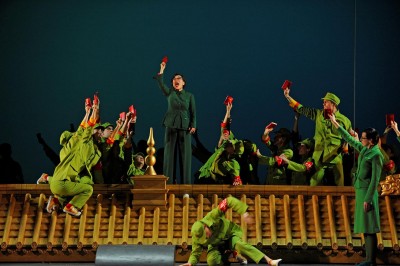
When Nixon arrived in China in 1972, he was entering completely alien territory. China was an unknown entity to the west. America, at the height of its empire, was confident of its place in the world. Then suddenly, Nixon and his entourage were rocketed into another empire, where American values had no place. They might as well have been time travellers in a sci fi situation. No stupid Air Force One prop here. Nixon and his team materialize in Beijing like visitors from another planet.
Forget what Sellars said, even though he was instrumental in the creation of the opera. John Adams Nixon in China is infinitely more nuanced, whether he or Sellars realized it or not. Perhaps Adams intuited the meaning of the opera more deeply than he realized. Chen Shi-zheng's production gets to the soul of the opera. No silly reproductions of newspaper photos, instead a set as stylized as the interaction between the two sets of politicans. They are playing a kind of psychological chess, sizing each other up in a formal game of greetings and entertainments.
Sellars steered well clear of meaning by focussing on decor. For Chen, meaning is the whole purpose. The set is simple, but exquisitely beautiful. Glowing gem-like colours which evoke the colours of China - blue greens, azure, red and gold. The two teams of protagonists stalk each other, probing emotionally. Mao himself reveals nothing. He conquered China by being devious: even Zhou Enlai has to watch his back. Nixon knows he's out of his depth, but that's a credit to him. No gunboat arrogance, no shouting at the natives. Compared with modern politcians, Nixon was "no crook". In Chen's production, Pat Nixon's role is very well developed. She's a sensitive soul who believes what she's told to believe. She's a perfect politician's wife, turned into an emotioinal Barbie Doll for display purposes. When she comes to China, her cultural bearings are lost and she responds as a human being to the ballet enacted in front of her. In the process of their China journey, Pat and Nixon learn something of themselves and of the wider world.
This brilliantly intelligent production lifts John Adams opera onto a greater level. Apart from being psychologically more astute than the Met production, this Paris production is infinitely more musically perceptive. Adams's series of repetitions and patterns replicate in the stage movements and choreography. When you watch the rows of uniforms intricately weaving and counter-weaving, it's like hearing the music come alive. Telling details, too, like the Little Red Book turning into streams of folded red paper as the cadres chant slogans.
Performances are good: indeed the fact that few of the performers are English speakers helps a lot to create atmosphere. Two more days to catch this amazing production on arte.liveweb. Don't miss it. Please also read my analysis of the Met production and also watch the original ballet on which the ballet in the opera is based. Full download of The Red Detachment of Women HERE. It does make a difference to know the original ballet, because it's a stylized telling of a very real story of the struggles Chinese people had to undergo. It sets Maoist China into context. It's also a ballet of women's liberation, to which Pat Nixon responds.
Saturday, 14 July 2012
Battle for the soul of classical music

It's pointless to knock Bocelli, Katherine Jenkins, Alfie Boe, Brightman, Garrett etc because they make thousands of people happy. They give people who otherwise would not listen to classical at all an alternative to pop. Why are people so threatened by anyone different to themselves? What does it prove? No-one is forced to listen. Throughout history, there always has been a mass market for crossover of many kinds. It's nothing new.
Better to offer "real" classical music, in the faith that the downtrodden masses can choose for themselves. They might start with Spem in Alium, and go onto other things. No doubt, many who came to Puccini from Nessun Dorma have expanded their listening choices. This is the market that goes for Hildegard of Bingen and Gorecki's Third. Taste goes both ways, too. Many years ago, a taxi driver asking what I do, scolded me for not liking Tavener's The Protecting Veil, his favourite song of all time. So I listened again but it still didn't grab me. But we both had a choice.
At last, the Tallis Scholars are entering the classical Hit Parade, and getting the attention they deserve. So promote The Tallis Scholars by getting Spem in alium on iTunes, Spotify etc. so they top the charts and capture the imagination of the public. Says a Tallis Scholars source: "This week's battle between The Tallis Scholars, the pre-eminent Specialists in Renaissance Choral Music, and two of the 21st Century's leading crooners has re-kindled the debate on what truly is great Classical music."
Maximum Impact First Night of the Proms 2012
What does being British mean, after all. Frederick Delius's UK connections were so tenuous that he'd fail the Immigration test questions. Born German, he left Bradford as soon as he could get away, fathered a child with a Florida black woman, partied in Paris and paid homage to Grieg in Norway, and wrote music that recalls Debussy. But "British" he became because the nation needed an icon. And when British music circles have heroes, they're fanatical about them. Delius Sea Drift is for me beautiful as abstract music, since I find the poem mawkish even though it's by Walt Whitman. Fortunately Bryn Terfel gives it vigorous, even gruff treatment which lifts it above sentimentality and gives it extraordinary power. Boyo Delius works well! Mark Elder conducted the BBC Symphony Orchestra and Chorus.
Elgar's Overture Cockaigne (In London Town) is a regular Proms perennial, but it was good to hear Roger Norrington's warm hearted, lively account, perfectly in tune with the good natured Coronation Ode. Martyn Brabbins conducted Michael Tippett's Suite for the Birthday of Prince Charles, which fitted the mood of optimism at the time the Prince was born. God Save the Queen, Long May She Reign! Even to age 116. Couldn't they have chosen something to praise a woman who has done more for the monarchy than anyone else? Including Princess Diana, who deserves much more attention than she's had this Jubilee year. Mark Anthony Turnage Canon Fever (note one "n", it's a pun) was a reminder thast British music is alive and well. Much quirkier and original than he's been for a while. Some First Night Fanfares disappear without a trace. This one will stay fresh.
Speaking of Britishness, the Olympics and British music, there was some discussion on the BBC Proms site, which I can't track down (might have been pulled). Someone objected to having Beethoven 9 at the Proms on the opening night of the Olympics, because Beethoven wasn't British. "Would the Germans have played British music at the 1936 Olympics opening?" someone asked. But Beethoven transcends national borders. Alle Menschen werden Bruder. That's the real spirit of the BBC Proms and should be of the Olympics, too.
Friday, 13 July 2012
Verdi Otello

Eleanor Vale, Wedmore Opera John Barber

Community opera is a genre in itself, with its own rationale and values. It brings communities together. All kind of people contribute : everyone gets a chance to enjoy and be creative. Even the big houses like Glyndebourne and the Royal Opera House have education programmes that reach out to new audiences. Britten was right : community opera has social purpose.
John Barber's Eleanor Vale at Wedmore Opera fills the brief. Large choruses and crowd scenes, so everyone gets to have a go. Big scenes for the children, who are clearly having a wonderful time and will treasure the experience for the rest of their lives, as will their families. Barber's music is lively and full of variety, filled with witty allusions. Part of the fun is picking up the witty allusions clothed in Phillip Glass-like sonorities. Modern music need not be scary! Nor does it have to be difficult to sing, an important consideration in these circumstances. The libretto, by Peter Cann, is droll, shiny as an apple, but sharp, which makes the rot at the core of the plot all the more potent.
The main role of Eleanor Vale holds the whole opera together and gives the opera distinctive character. Eleanor Vale rides into a Victorian Somerset village astride a man's bicycle. Barber can write much more demanding music for Eleanor. She stands out from the crowd in every way. It's a role for a professional with a strong personality, for it is the backbone that holds the entire opera together. Sarah Minns creates the part perfectly, indeed I think it was written for her. She has a clean, bright voice with enough depth to convey the more sinister side of Eleanor's personality. Sweet charm shields savage menace. Crows end up dead on the doorsteps of human carrion eaters. Dogs that chase Eleanor's bike end up dead. Eleanor wreaks havoc on the small-town small minds who destroyed her mother. Minns, who is a regular at Opera Holland Park, Grange Park Opera and elsewhere, has the voice, stamina and personality to keep this opera afloat (perhaps not the best choice of words given what happpens in the plot).
Nicholas Sharratt sings Matty the Mender, who's "travelled as far as Bristol". He fixes bikes and tries to fix Eleanor but she's beyond mending. The best writing in this opera focusses on Eleanor, but the dialogues between Matty and Eleanor give both singers a challenge which they meet well. Minns and Sharratt (I enjoyed his performance in Maconchy's The Sofa in 2007) both have solid experience and interesting voices. They're both in the photo above, with Adam Green as the Headmaster. He's a regular at the ENO and in concerts, both in the UK and abroad. He was good, but the role wasn't big.
Wedmore Opera, founded nearly 25 years ago, shows great foresight in commissioning this new opera. Barber's Eleanor Vale is "Somerset local interest", which is good, and places Somerset on the repertoire map. But it's an opera with basic human interest, which could transfer well nearly everywhere, Suffolk perhaps, and even London. The big crowd scenes can be cut down easily, when community participation isn't of the essence. The orchestra is small enough for Eleanor Vale to exist in chamber version. Indeed, it's almost like there are two operas here, one communal, another more concentrated version waiting to emerge. Perhaps they could co-exist? Tighter focus would overcome the natural difficulties that come with amateur performance. The punch in the libretto and score would hit harder if audiences could hear it more clearly. Ironically, away from the countryside, Eleanor Vale might blossom with the spark contemporary music specialists might give. Eleanor Vale shows that communuity opera can work when the basic concept is good. And the role of Eleanor Vale is a gift for a young, bright soprano, though it needs to be properly cast, as it was here. This is an opera that should be heard again.
Subscribe to:
Posts (Atom)