Friday, 9 September 2011
More French Freischütz
John Eliot Gardiner conducts the Berlioz French Freischütz tonight at Prom 70, but here is another version, conducted by Jean-Paul Penin.


Andris Nelsons in Berlin Sunday
Andris Nelsons is conducting the Berliner Philharmoniker on Sunday morning 1100 German time. Despite a horribly busy week, I'll be up early to catch it (I hope). Really interesting conductor, orchestra and programme. Rihm, Pfitzner, Kaminski and Richard Strauss - fantasies on different times and styles.READ ABOUT HEINRICH KAMINSLI DORISCHE MUSIK DORIAN MUSIC HERE.
Thursday, 8 September 2011
Ruhr Trienniale - Tristan und Isolde, Decker
Not being a special fan of Willy Decker, it was interesting to read about his staging of Wagner Tristan und Isolde at the Ruhr Trienniale. Here's a report by James Sohre, also not usually a fan of abstraction. "If reassurance is needed (and I fear it is, oh how it is) that a gifted creative team can not only brilliantly innovate, but also genuinely serve the composer’s intent, this production was proof positive. I am not sure the last time I was so captivated by a creation of modern art, as I was taken by the massive and utterly simple set design by Wolfgang Gussmann."
It helps a lot that the conduuctor is Kirill Petrenko. No megastar singers at Riuhr (it's not that kind of place) but if a production can convert this way, it can't be bad. Please read the full review in Opera Today. "Luminous", says Sohre.
It helps a lot that the conduuctor is Kirill Petrenko. No megastar singers at Riuhr (it's not that kind of place) but if a production can convert this way, it can't be bad. Please read the full review in Opera Today. "Luminous", says Sohre.
Prom 70 - what makes British music British ?
For a change, don't run off for coffee in the interval between the first and second parts of Prom 70 (Bridge, Birtwistle, Holst). Listen, instead to Anthony Payne, talking about British music. Payne is a fascinating person, an intellectual with emotional depth and a practical musician too. He's an authority on English music and made it possible for us to listen to what might have been Elgar's Third Symphony. Listen also to the programme that follows the Prom, where Tom Adès is interviewed by Tom Service. If Birtwistle were a talking man, he'd probably chime in too on the theme of What makes British Music British.
As Payne says, it's only in retrospect that we come to think of any piece as "British" because certain thing acquire a non-music identity from being used in ads, social music, movies etc. The music itself is intrinsically neutral. No composer worth anything doesn't write something original to himself or herself, based on what he absorbs from around him. Parry, Elgar, Bridge, Britten, RVW, all influenced by continental European music. So the idea of pushing composers into a ghetto of "Britishness" is a bit of a con.
Britten, especially, didn't relate to the "ghetto" though he was fascinated by Tudor and Stuart forms. Aldeburgh never was insular. Long before the Festival began, there was Britten, taking his Mum to Vienna, forcing his pals to listen to Mahler in the 1920's, hanging out with the Prince of Hesse and Hermann Scherchen (or rather his son), Scherchen, significantly, was closely associated with the avant garde of his time. Britten wasn't a little Englander. It was he who championed Shostakovich long before Shostakovich was famous in the west. Britten's support of Shostakovich, Rostropovich and Vishnevskaya was critical, for it protected them from the Soviet Regime. Similarly, Henze wouldn't be Henze without Aldeburgh, tnouugh he was too naive to realize that connecting to W H Auden in the 50's would mean exclusion from the Britten inner circle.
Harrison Birtwistle is as cow-pat free as it's possible to be. He's his own idiosyncratic self, and more power to him! I couldn't figure out his new Concerto for Violin and Orchestra, but that's why it's interesting. It's a new direction for the composer, still inventive post 75. It seems to lead to new paths, though I'm not sure where they head. But that's part of the challenge. So what makes British music British? We don't even know what makes Britain British, either.
As Payne says, it's only in retrospect that we come to think of any piece as "British" because certain thing acquire a non-music identity from being used in ads, social music, movies etc. The music itself is intrinsically neutral. No composer worth anything doesn't write something original to himself or herself, based on what he absorbs from around him. Parry, Elgar, Bridge, Britten, RVW, all influenced by continental European music. So the idea of pushing composers into a ghetto of "Britishness" is a bit of a con.
Britten, especially, didn't relate to the "ghetto" though he was fascinated by Tudor and Stuart forms. Aldeburgh never was insular. Long before the Festival began, there was Britten, taking his Mum to Vienna, forcing his pals to listen to Mahler in the 1920's, hanging out with the Prince of Hesse and Hermann Scherchen (or rather his son), Scherchen, significantly, was closely associated with the avant garde of his time. Britten wasn't a little Englander. It was he who championed Shostakovich long before Shostakovich was famous in the west. Britten's support of Shostakovich, Rostropovich and Vishnevskaya was critical, for it protected them from the Soviet Regime. Similarly, Henze wouldn't be Henze without Aldeburgh, tnouugh he was too naive to realize that connecting to W H Auden in the 50's would mean exclusion from the Britten inner circle.
Harrison Birtwistle is as cow-pat free as it's possible to be. He's his own idiosyncratic self, and more power to him! I couldn't figure out his new Concerto for Violin and Orchestra, but that's why it's interesting. It's a new direction for the composer, still inventive post 75. It seems to lead to new paths, though I'm not sure where they head. But that's part of the challenge. So what makes British music British? We don't even know what makes Britain British, either.
Wednesday, 7 September 2011
Warming up for Freischütz Prom 73
On Friday Prom 73, Weber's Der Freischütz turns into Berlioz's transcription thereof, en français. Before one screams sacrilege, remember that Berlioz is trying to figure out what made Weber and Mendelssohn tick (though he never really did). Furthermore, France isn't just Paris. There are hunting traditions in France, just as there were/are in Germany. So enjoy this choir Les Chanteurs Pyrénéens, who sound like they know about Chasseurs. And here is the original auf Deutsch
Was gleicht wohl auf Erden dem Jägervergnügen?
Wem sprudelt der Becher des Lebens so reich?
Beim Klange der Hörner im Grünen zu liegen,
Den Hirsch zu verfolgen durch Dickicht und Teich,
Ist fürstliche Freude, ist männlich Verlangen,
Erstarket die Glieder und würzet das Mahl.
Wenn Wälder und Felsen uns hallend umfangen,
Tönt freier und freud'ger der volle Pokal!
Jo, ho! Tralalalala!
Not all that different in spirit, though the band below is infinitely better and the singers have a more professional touch!
Prom 69 Rihm Mahler Pittsburgh Honeck

When Anne Sophie Mutter plays Wolfgang Rihm's Gesungene Zeit (Time Chant) she brings out its profound spirituality. Rihm wrote the piece for her 20 years ago, specifically attuned to her strengths and to the violin she prefers. It is one of her signature pieces. She's recorded it twice, first with Levine and more recently with Alan Gilbert (new release on DG here). In twenty years much has happened to Mutter - and to us - so hearing the piece again in this context is deeply moving. Mutter showed how music can lift us to emotional and spiritual levels which transcend the ordinary grind of life.
Knowing how high profile this Prom would be, Mutter seemed charged with supernatural intensity. The exceedingly high tessitura seemed to defy gravity, soaring into a stratosphere few dare explore. Her technique is so perfect that she can create pitch so high it's almost beyond the threshold of human hearing. This is the aria of an angel. No human voice could sustain legato that long and at that pitch. The music seems to float in the air, untrammelled by normal constraints. At times it swoops gently down towards the other instruments, lifting them upwards too. Two glorious tumults, when all seem to be singing together. Dark murmuring chorale (listen to the contrabassoona and low winds), col legno meeting tapping in the percussion. Mutter's line sweeps upwards and hovers. One last low-flying farewell to the orchestra and then back into the stratosphere, beyond mortal realm.
It would be tempting to draw parallels between Rihm's Gesungene Zeit and Mahler's Symphony no 5, but Manfred Honeck and the Pittsburgh Symphony Orchestra wisely stick to what's in the score. Mahler's views on the chamber-like nature of the piece are fairly clear. The Adagietto has acquired a lachrymose reputation through its use in movies and such things as Compilations for Valentine's Day and so on, but the symphony itself is much greater than popular myth. (There is a long story attached to how this developed, but I won't go into that here). Honeck respects the structural logic of the symphony, so this a fiull bodied, solid reading, satisfying though not specially spectacular.
But why start the Prom with the Prelude to Lohengrin Act 1? It's a grand opening, but listeners automatically go into Wagner-mode, thinking of what will follow in the opera. The days of "bleeding chunks" are long gone, since nowadays, we're more accustomed to more integrated and demanding programmes. Lohengrin always sounds wonderful, but it might have been better to concentrate on Rihm and Mahler.
Please read about Prom 68 where Honeck and the Pittsburgh Symphony played Beethoven Tchaikovsky but not Braunfels. There's more on Braunfels on this site than anywhere other than the Braunfels website itself. There's also plenty more about Wolfgang Rihm on this site. Like Braunfels, Rihm's not known to millions, but to tens of thousands, as he's probably one of the most important European composers of our time. Mutter is no fool artistically, she knows why she likes playing Rihm.
photo copyright : Harald Hoffmann
Tuesday, 6 September 2011
Prom 68 Braunfels Beethoven Tchaikovsky
"Music should disturb the comfortable and comfort the disturbed", a phrase coined by one of my friends. However, Prom 68, with Manfred Honeck and the Pittsburgh Symphony Orchestra proved somewhat the opposite. Nice, safe and unchallenging, guaranteed to confirm the comfortable in their comfort. The main relief was Hélène Grimaud's clear sighted intelligence, which lifted Beethoven Piano Concerto no 4 above the realm of feelgood. Pleasant, but interpretively undemanding Tchaikovsky no 5 thereafter. Lots of self-congratulatory chatter on the radio broadcast. Music as social lubricant.
As for music for music's sake? Walter Braunfels Phantastische Erscheinungen eines Themas von Hector Berlioz (Fantastic appearances on a theme from Berlioz) is a significant work by a significant composer. So what was the point of butchering it by two-thirds? Thius is artistic murder, but for what purpose? The work is based on a single theme from Berlioz's The Damnation of Faust, where Méphistophélès sings the song of the flea. It lasts but a few moments, but Braunfels examines it with such close forensic detail that he manages no fewer than 12 different variations and takes 50 minutes to do so. Pay attention! Braunfels is trying to tell us something! Instead, we got episodes from the middle sections of the piece, based around Ruhig, the slowest movement of all, which in the original is a transitional stage, not the main event.Ask yourself, is Méphistophélès being "restful"? Is Braunfels suggesting that Méphistophélès is there to comfort Faust? Of course not. Indeed, Braunfels is warning us to be alert.
So what was the musical logi ? What motivated Honeck, who does know his Braunfels, to authorize this rump? Braunfels's original is so tightly put together that there are hardly any pauses between segments, so it's not as if movements (or mini-movements) can simply be lifted out of context. The most interesting sections were left out. This wasn't Braunfels we were hearing, but a strange curtailment, as if someone, somewhere hates Braunfels so much they must cut out what makes him distinctive. Perhaps a rump of Braunfels is better than nothing at all, but this does the composer a disservice. Braunfels is by no means obscure, even if he's not mainstream. There is no excuse at all for anyone with an interest in this genre not to know who he is. There is a good recording of Phantastische Erscheinungen easily available, so anyone could look it up. (here it is on amazon).
Braunfels's Die Vögel received an ecstatic reception in 1995, when the Lothar Zagrosek recording was released, one of the highest points in the Decca Entartete Musik series. The very fact that LA Opera did a mega highprofile production last year means that Braunfels is not nobody. So why do we get fobbed off with a 15 minute summary ? A bit like playing a few bars from Mussorgsky's Song of the Flea.
I will write about the full Braunfels Fantastic Appearances later and about other Braunfels works like Die Vögel, the Te Deum and Honeck's new recording of Braunfels's major opera Jeanne d'Arc, with his regular European band, the Swedish Radio Symphony Orchestra. Braunfels was "suppressed" before. There's no reason he should be suppressed yet again. Please see my earlier post on the Fantastic Appearances HERE.
/div>
As for music for music's sake? Walter Braunfels Phantastische Erscheinungen eines Themas von Hector Berlioz (Fantastic appearances on a theme from Berlioz) is a significant work by a significant composer. So what was the point of butchering it by two-thirds? Thius is artistic murder, but for what purpose? The work is based on a single theme from Berlioz's The Damnation of Faust, where Méphistophélès sings the song of the flea. It lasts but a few moments, but Braunfels examines it with such close forensic detail that he manages no fewer than 12 different variations and takes 50 minutes to do so. Pay attention! Braunfels is trying to tell us something! Instead, we got episodes from the middle sections of the piece, based around Ruhig, the slowest movement of all, which in the original is a transitional stage, not the main event.Ask yourself, is Méphistophélès being "restful"? Is Braunfels suggesting that Méphistophélès is there to comfort Faust? Of course not. Indeed, Braunfels is warning us to be alert.
So what was the musical logi ? What motivated Honeck, who does know his Braunfels, to authorize this rump? Braunfels's original is so tightly put together that there are hardly any pauses between segments, so it's not as if movements (or mini-movements) can simply be lifted out of context. The most interesting sections were left out. This wasn't Braunfels we were hearing, but a strange curtailment, as if someone, somewhere hates Braunfels so much they must cut out what makes him distinctive. Perhaps a rump of Braunfels is better than nothing at all, but this does the composer a disservice. Braunfels is by no means obscure, even if he's not mainstream. There is no excuse at all for anyone with an interest in this genre not to know who he is. There is a good recording of Phantastische Erscheinungen easily available, so anyone could look it up. (here it is on amazon).
Braunfels's Die Vögel received an ecstatic reception in 1995, when the Lothar Zagrosek recording was released, one of the highest points in the Decca Entartete Musik series. The very fact that LA Opera did a mega highprofile production last year means that Braunfels is not nobody. So why do we get fobbed off with a 15 minute summary ? A bit like playing a few bars from Mussorgsky's Song of the Flea.
I will write about the full Braunfels Fantastic Appearances later and about other Braunfels works like Die Vögel, the Te Deum and Honeck's new recording of Braunfels's major opera Jeanne d'Arc, with his regular European band, the Swedish Radio Symphony Orchestra. Braunfels was "suppressed" before. There's no reason he should be suppressed yet again. Please see my earlier post on the Fantastic Appearances HERE.
/div>
Monday, 5 September 2011
Walter Braunfels - Fantastic appearances of a theme of Berlioz

The Berlioz theme Braunfels is referring to comes from Berlioz The Damnation of Faust. All year we're having one Faust inspired work after another, from Liszt's Faust Symphony, to Mephisto Waltz, to the revival of Gounod's Faust at the Royal Opera House, starting soon. Terry Gilliam's Faust in Jackboots ego trip doesn't count.
Braunfels specifically pinpoints the scene where Faust and Méphistophélès enter the Leipzig tavern. Both of them are out of their usual element, among "normal" people, so there's more to the scene than divertissement. Braunfels focuses on the song of the flea, which Méphistophélès sings to describe the way a mad king becomes obsessed with a flea, til his whole court are infested and suffer. Braunfels was writing during the 1914-18 war, although he was conscripted and fought in the western front. It was a traumatic period. He was injured and converted to Catholicism (from being Lutheran). Phantastische Erscheinungen eines Themas von Hector Berlioz develops the basic theme from different angles. We hear Méphistophélès cynical swagger, and a purer, more lyrical approach, which might be Faust. Images of hell, rising from low rumblings in the orchestra, diminuendos and rising passages, movements up and down. Smoke? Dreams? Tonight, after Prom 68, I will write much more, so please come back and bookmark/subscribe.
This week I've been listening again to Walter Braunfels Die Vögel (the Birds) which comes from the same period as the Fantastical variations. In Die Vögel, birds do what fleas do in Faust : the opera is altogether more complex and sophisticated. Indeed, Die Vögel and the Phantastische Erscheinungen need to be heard together for full impact. The opera is sumptuously beautiful, but with a kick.
There are two recordings of Die Vogel, the first being Lothar Zagrosek's 1996 recording for Decca. It is outstanding, the soprano Helen Kwon truly captures the surreal birdsong which Braunfels incorporates into the part. (Link here to Zagrosek's The Birds on amazon). I hate to say it, but avoid the 2010 LA Opera production which is on DVD. The conducting (Conlon) is leaden and deadening. It is not enough simply to do an opera because it's obscure. This approach is why composers like Braunfels don't get the respect they are due. Die Vögel is much more intelligent and sophisticated, and indeed more musically adventurous as the DVD would suggest. It's the curse of the myth that Schoenberg somehow "forced" anyone to be modern. Everyone was modern in their own ways. No-one was deliberately retrogressive. I'll write more about Die Vögel when I have time. Until then, please explore this site where there is a great deal in depth about other composers "suppressed" by changes in taste and politics. For more on Braunfels, HERE is a link to a very good German site about him (with English translation)
Don't forget, lots coming up, please explore this site and come back. (try searching Schreker, Korngold, Berg, Haas, Krasa, Theresienstadt, Ullmann, Eisler, Zemlinsky etc for more goodies)
Sunday, 4 September 2011
Prom 67 Beethoven Missa Solemnis Davis LSO
 So stunned by Prom 67, Beethoven Missa Solemnis, Colin Davis/LSO, that I'm staying up late to hear it again on TV details here). Gosh, this needs to be savoured ! This afternoon, I was listening again to the repeat of Prom 63, Mahler and Liszt, Ivan Fischer Budapest Festival Orchestra and liked that even more. (See my review "Trumpets and Demons" HERE and follow this link for repeat broadcast)
What characterizes both performances (Beethoven and Mahler) is intellectual rigour. Absolute faith in the music, total integrity. Edward Said said of Beethoven's late work, that old men don't need to sell themselves to please the public. Ergo, late work can free an artist from banal pressures. Maturity without compromise. This Prom won't knock Klemperer off the perch for me, but I was totally impressed by Davis's unfussy sense of conviction.
Performances like these need to be engaged with on a deep level. So I'm not going to reel off something shallow. So read this review of Prom 67 Beethoven Missa Solemnis, just in, from Mark Berry in Boulezian. Now this is good writing and perceptive !
Saturday, 3 September 2011
Trumpets and Demons - Prom 63 Mahler 1, Liszt Fischer

In Prom 63, Fischer's approach was coloured by Liszt, whose influence on Mahler is underestimated, though Liszt himself dismissed Mahler's Das klagende Lied in no uncertain terms. Mahler conducted the.Mephisto Waltz no 1 (Der Tanz in der Dorfschenke) several times and knew it well. Mefistofele grabs the violin from a village fiddler. Bucolic folk tune transformed by the Devil himself. Folk idiom juxtaposed with surreal, and macabre. Freund' Hein, who will appear in the sforzando section in Mahler's 2nd Symphony. Lizst's Faust Symphony (read more about this HERE) springs to mind, and Mahler's Eighth on the theme of Faust's redemption.
If anything Liszt's Totentanz connects even more strongly to Mahler's music. Listen to those savage, angular ostinatos transformed by magical flurries, and think of Mahler's relentless marches and the whips of bright sound that will come in Mahler. Although Mahler was himself a pianist, he wrote but one work for piano, and nothing concertante. His voice "was" the orchestra. Liszt's "voice" was the piano. Dejan Lazić played with assertive authority, easily a match for this orchestra. How full bodied this piano sounds here, imitating the sonority in the orchestra, breaking away with flourishes that defy containment. In Mahler's symphony, a vibrant new spirit emerges from struggle and breaks free. Mahler discarded the title "Titan" very early on, but it's not irrelevant, since in Jean Paul's Titan, a young hero becomes king.
Blumine is a serenade andante Mahler dropped after the Budapest premiere of the First Symphony in 1889. It's a fragment from the now-lost incidental music to Der Trompeter von Säkkingen, hence the prominent part for trumpet. Although the piece has charm,. its inclusion in performance is rarely successful, so Fischer respects the composer's second thoughts. By placing Blumine between Mephisto no 1 and Totentanz, Fischer bridges Liszt with Mahler imaginatively.
Fischer's Mahler 1 is audacious. Clear, pure trumpet calls, not quite a reveille. Fischer's players make the call sound searching, soaring. From the low rumblings that follow, emerges a melody one recognizes as Ging heut' morgen übers Feld, from Lieder eines fahrenden Gesellen. It's not accidental recycling. By incorporating song into the symphony, Mahler is adding an extra dimension to what the symphony might mean. "This moring I strode out across the fields". The poet, (Mahler himself) has been jilted but he leaves his sorrows behind. A bird calls out Ei du! Gelt?. "Isn't the world beautiful!". Is this reveille the awakening of Spring and creative energy ? These strings are certainly lush and verdant, evoking "alles Ton und Farbe". But Fischer makes sure that danger creeps in. Full-toned triumph, but undercut with sharp, chilling alarums. As in the song, the poet takes nothing for granted.

How full-bodied the orchestra sounds here, such depth and verve. Pounding circular figures, which repeat over and over. The march again in a new guise. Fischer and his orchestra get the bright, dizzying whips of sound particularly well, so there's no sense of stasis. The quiet passage has echoes of something nostalgic, a Ruckblick of some sort, the beautiful waltz theme remembered. Then suddenly trumpets and timpani explode, horns and trombones call ever upwards. A new theme appears tentaively, submerged into another explosive crescendo, which are created with great crispness and clarity. Then the theme takes over, trumpets and brass "marching" again. This three chord theme always reminds me of Handel's Hallelujah chorus "King of Kings ! Lord of Lords ! He shall reign forever and ever". Whether Mahler was deliberately quoting or not, the concept does fit the mood of the symphony. Fischer's reading isn't as violent as some, and the gentler passages that follow the outburst are elegantly shaped. Again the rolling circular "march" returns, whipped ahead by extremely bright trumpets, heralding the final glorious coda, which here sounded specially golden and vivid. Such a purposeful, determined and clear-headed. Mahler has arrived !
As a Mahler conductor, Ivan Fischer is much more idiomatic than Semyon Bychkov, whose Mahler 6th (Prom56) I admired so much. Fischer engages with Mahler on a much deeper level, bringing out the fundamental strong mindedness in Mahler's architecture, which underpins the spiritual searching. "Always, trajectory!" as Pierre Boulez used to say. For Fischer, too, trajectory is a key to meaning. There are many ways to conduct Mahler 1, but this one has me transfixed.
Harpa Hall, Iceland - decentralizing music venues

New photos in of Harpa Concert Hall in Reykjavík, Iceland, which offically opens on 8th September. Please see HERE. The hall was planned when Iceland's economy seemed to be blooming. Lots of countries do glamour projects like that - think Mandelsohn's vanity Dome which has fortunately been rescued, though it was a near thing. And think of the Olympics in London, on top of a war and the worst economic collapse the modern world has ever seen. So don't knock Iceland. Consider its situation on the furthest edge of Europe. The Harpa Concert Hall is an act of faith in the counrty's ability to revive. Harpa Hall is more than "just" a concert hall, for it provides the kind of civic facilities capital cities need. Many cities don't have the luxury of numerous specialist venues like we're blessed with in mainland Europe. In a country as northerly as Iceland, it's probably good for the community to have an all-weather focus place. Photo by Bára Kristinsdóttir
Harpa Hall might also put Iceland on the international music map and do for the country what the Canary Islands Music Festival does for the islands. And Iceland does have music - Vladimir Ashkenazy is a local resident and of course Jon Leifs the composer, who should be heard more often. Ilan Volkov is the Chief Conductor of the Iceland Symphony Orchestra (see HERE ) so maybe he'll develop a specialist profile. Ultimately, it's up to Icelanders, not outsiders, to decide what they want to do with the hall. So good luck to them ! Please also see my piece on Guangzhou's new Opera House, designed by Zaha Hadid. The future of classical music depends on places outside established centres of western music. Local customs, tastes and priorities must be respected. Places like Guangzhou (Canton) already have thriving regional cultures, so imposing from outside is a form of neo-colonialism. Guangzhou's opera house will be dwarfed by the even newer West Kowloon development in Hong Kong, of which I'll write more soon. Since the whole region between Guangzhou and Hong Kong is gradually becoming one huge conurbation of 50 million people, these venues serve a massive audience. In straitened times, thank goodness there are cities that invest in culture.
Thursday, 1 September 2011
NEWSFLASH Uproar at the BBC Proms
NEWSFLASH, uproar at BBC Prom 62, Zubin Mehta conducting the Israel Philharmonic. Extremely safe repertoire (which is why I wasn't listening) so the protestors are clearly using the concert for non-musical reasons. You can hear the first part of the uproar on the broadcast where people are shouting, then they cut to a recording. Was anyone there in person?
Latest I've heard : The people shouting Out! Out! are audience to protesters, not protestors to performers. The arena crowd are used to organizing themselves. It strikes me as counter-productive to annoy thousands of other people to promote a cause, regardless of what the cause might be.
Latest I've heard : The people shouting Out! Out! are audience to protesters, not protestors to performers. The arena crowd are used to organizing themselves. It strikes me as counter-productive to annoy thousands of other people to promote a cause, regardless of what the cause might be.
Bílá nemoc - Hugo and Pavel Haas
 A dictator stands on a balcony addressing the masses. "We are a great country, we need space to live" The crowds roar in hysterical approval. Might is Right, so it's OK to declare war on "small rotten countries" next door. Bílá nemoc, or The White Plague is a fascinating film because it was made in Czechoslovakia in 1937. The Czechs knew what a larger country meant by Lebensraum, but the rest of Europe wasn't listening. The script was written by Karel Čapek, who wrote the text for Janáček's The Makropulous Case and much radical social commentary. Čapek died of natural causes in 1938, thereby escaping the Nazis, who were after him. Watch this movie and see why.
This film is also interesting because it was directed by and starred Hugo Haas, brother of Pavel Haas, the composer who was murdered in Auschwitz in 1944. Hugo Haas was a big star in Czechoslovakia, working until at least 1940, starring in films with Lída Baarová, whom Goebbels made his mistress. Pavel, his elder brother, wrote film scores for sevearl of Hugo's movies. One I've heard (film: Mazlíček,The Pet) sounds more like Hanns Eisler at his most didactic than Haas's chamber music, but it fits the nature of the film. Pavel was sent to Theresienstadt and later Auschwitz. Hugo Haas manged to get to Hollywood, where by 1945, he starred in John Wayne movies and in King Solomon's Mines, and made his own B movies. [Since writing this, I've been able to see quite a few of Haas's American movies which are of an extremely high standrad]
 In Bílá nemoc,there's a sudden frame of a man in the howling mob outside the Dictator's palace (which is monumentalist Art Deco and filled with geormetric symbols) . It's Dr Galen (Hugo Haas). There's a mysterious plague in the country, which starts as white spots on the body and kills everyone it touches. Everyone's paranoid about contamination. Galen has a cure but he's not allowed to use it because his terms are too high. So he's only allowed to treat the destitute in Ward 13, who don't count. But those he treats, survive. Gradually the plague spreads, and the paranoia. The Dictator visits the research hospital but Galen isn't allowed near him. Galen is anti-war, and that's another form of plague. Eventually, Baron Krog, the second most powerful man in the land gets sick and is saved when he promises to respect Galen's ideas. Galen meets the dictator. Both of them fought in the Great War, but the Dictator believes war is a good thing and Galen thinks otherwise. Soon, the Dictator gets infected too, has a change of heart, signs ceasefire documents, and summons Galen. Galen tries to pass through the howling crowds, but they confront him when he talks anti-war and they beat him to death. No-one now to stop the plague, or the war.
PLENTY more on this site and in-depth too, on Czech and Weimar music and film, Entartete Musik, Theresienstadt composers, anti-war and non-violence. For me this subject is a principle of belief. Please explore
Beethoven Ninth, Fitkin Prom 61 Robertson
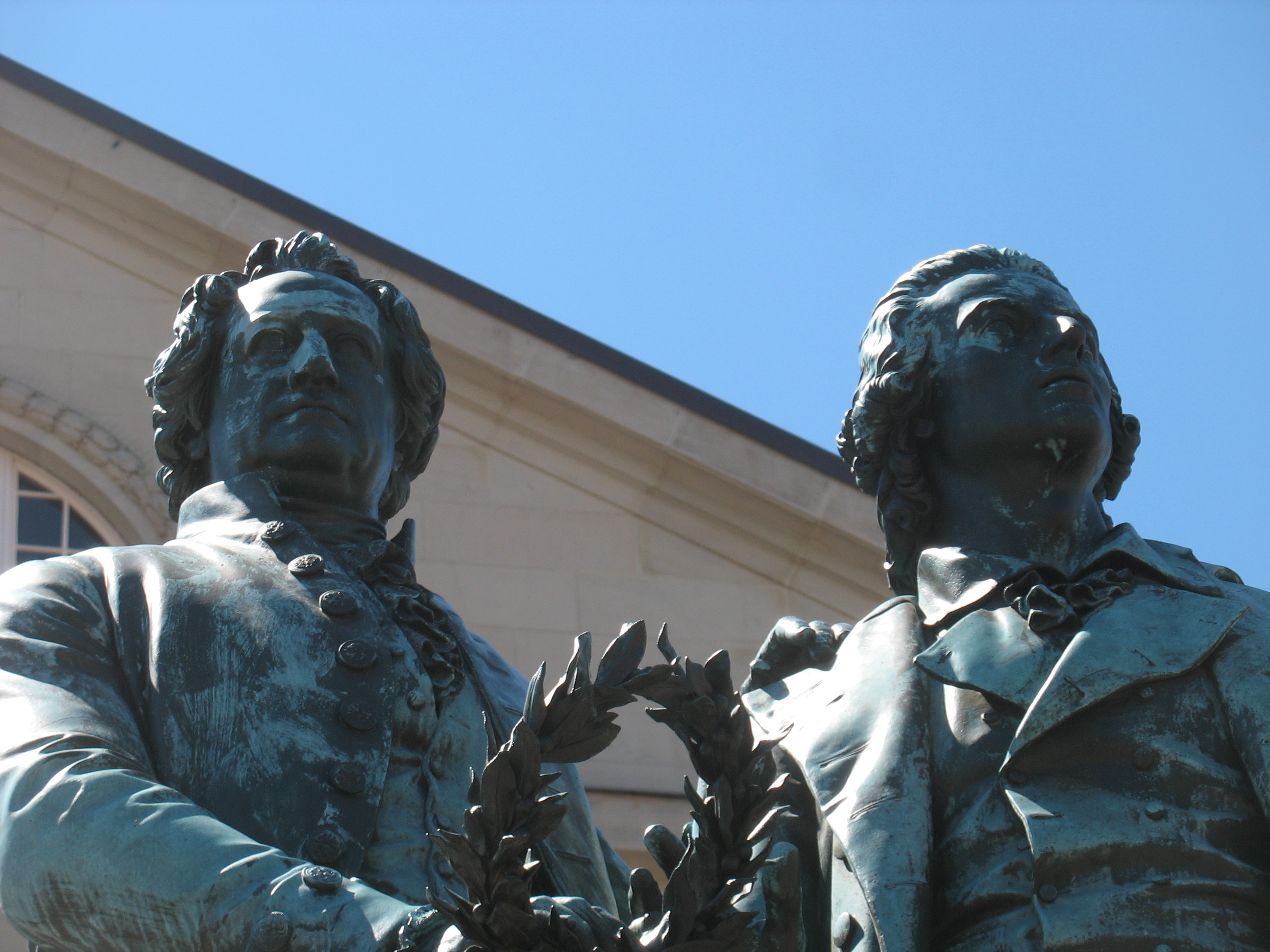
Which is why I've picked this photo to go with Prom 61 Beethoven Symphony no 9 (David Robertson, BBCSO) (copyright David Wen-Riccardi Zhu) It's the statue of Goethe and Schiller in Weimar. The photo is wonderful because they're shown against an open, blue sky, holding laurels. So we too should be inspired by idealism, altruism and basic human decency.
Beethoven's Ninth is the kind of music than can survive bad performance and still sound uplifting. Not that David Robertson and the BBCSO were bad at all. This performance zipped along smartly. Nice clean lines, confident, poised pacing. This was a reading true to the neo-classical spirit, unfussy but uplifting. Schiller's vision is sublime, rising above grubby concerns. This performance made me think of neo-classical architecture : structural balance and elegance. Female soloists on the shrill side, but Spence and Patterson were good. The wind and flute figures around Paterson's singing were very perky, so when the choir burst forth, it felt like light had filled the hall. Choruses very tight and bright.
David Robertson made his name in modern music, having conducted Ensemble Intercontemporain, no less. He's energetic both on and off the podium, and does interesting things. I enjoyed his Beethoven 5th, but even more his Beethoven 7th the year it was paired with an insufferably horrible piece moaning about automated phone systems. Obvioulsy conductors are contracted to do some works, but Robertson conducted that Beethoven with such vehemence it was clear what he thought.
In 2010, Beethoven 9 was played by the Ukelele Orchestra of Great Britain, which was hilariously funny for me, though Beethoven might have been glad he was deaf ! There have been some dull performances (Noseda, Proms 2009) and some truly overwhelming good ones (Chailly, Leipzig Gewandhaus New Year 2009). Read more about that one HERE. And of course Wilhelm Furtwängler! Now that's an example of music in value-added context. The Party Goons didn't get it, but Josef Goebbels squirmed, because he knew what Beethoven - and Furtwängler - were getting at. Please read about my discovery of papers in Furtwängler's Home Office file, when the BBC tried to get clearance for the conductor to come to London in 1946.
Having heard Graham Fitkin's L on Monday (Cadogan Hall Chamber Prom 3) with Kathryn Stott and Yo-Yo Ma, I wasn't expecting much from Fitkin's Cello Concerto, but it was altogether more stirring. This time Yo-Yo Ma seems to have written the piece as much as Fitkin did. This is a cellist's dream, the music building directly on what a cellist can do. Technique turned into art. Legato extended so long that it must be a challenge to bow as smoothly as this without breaking. Ma plays sensuously, using full range. It's like he's having a private conversation with the instrument he's known so intimately for many years. Again, it's pretty ty[pical; of Roberston tosprend much more time rehearsing pieces wer haven't heard before to give them best chance of success, and assume the rest will be OK.
Please read this carefully. It is a test in whether people read subtle or literal. Please read the comments on this post here to see why I'm doing this. Will people get this or will it be over most heads?
Is this cartoon racist ?
Is this cartoon racist ? It was made in 1930 and depicts San Francisco (note landmarks and islands) . But then, most white Americans had no real experience of Chinese and swallowed myths that hard working migrants all smoked opium and kidnapped white women for evil deeds. So it's much more frightening when blacks are depicted in this kind of cartoon because people were more exposed to blacks, so there's no excuse for some of the really degrading images of black people that were shown at the time. So I don't think this cartoon is racist, just misguided. Unfortunately in our more enlightened age, there's still a great deal of unthinking casual racism that still goes on. Because the world is dominated by the internet and the English language it's all too easy to forget that other races have value, too.
BTW "chop suey" simply means "miscellaneous left overs". Supposedly the term came around when non-Chinese gatecrashed Chinese kitchens after closing time and wanted to be fed,. So the cooks would rustle up whatever and serve it. "What's this dish called?" said the tavern folks. Perfectly honestly, the cooks said "miscellaneous leftovers". Apocryphal or not, there was an anecdote about tourists visiting Chinese restaurants in China demanding "Chop suey", completely confusing Chinese cooks, who could not figure why anyone would want scraps.
Subscribe to:
Posts (Atom)