Wednesday, 22 April 2015

ENO fights back - 2015/16 season announced


Under threat from punitive cuts by Arts Council England, English National Opera is fighting back with a bright new season for 2015/16.  Closing down the ENO would destroy a national asset that's taken decades to build up,. The ENO is unique, and part of its survival strategy should be to celebrate that uniqueness, and its  place in the wider network of the cultural life of this nation.

Last year, 201,361 people attended an ENO performnce live, up from 182, 242 in the same period the previous year, while an extra 51,000 heard broadcasts on radio and in the cinema. Popular marketing ideas like Secret Seat and Access All Arias did well. This year a new initiative: 23% of tickets for every performance will be sold at £20 or less. Thirty-five percent of first-time visitors via Opera Undressed have returned to catch another show. Capacity is up, though capacity figures are a crude measure of success. The ENO audience is slightly different from the ROH audience, which is supplemented by the international market, which the ENO hasn't even started to test, though it could exploit the niche market for operas written in English, as it has done with Philip Glass and Benjamin Britten. .

The Coliseum itself is an asset. Part of the fun of going to the ENO is the quirky, iconic Frank Matcham building, the biggest and most beautiful theatre in London. If crowds can come and enjoy Trafalgar Square and the West End, why not add art and architecture to the mix? Commercial developers might covet the site, but it doesn't make business sense for the ENO to move elsewhere. Negotiations for a foyer Benugo are well underway, but there are other opportunities to make profits from other parts of the building.  (I for one would miss those ornate wooden doors.) At the end of the day, though, people don't go for sandwich cafés, or even because tickets are cheap. Opera isn't cheap to produce and shouldn't be seen as cheap entertainment. Besides people often use cost as an excuse for not going, and happily spend much more on other things, eg football. .

Long term, people go to the opera for good music drama.  ENO productions are adventurous, attracting a livelier, more adventurous crowd, often with an interest in theatre as opposed to grand diva vocal display.  The ENO 2015/16 season offers a good range.  Six new productions, and five classic revivals

First, in September, the long-awaited  Shostakovich Lady Macbeth of Mtsensk. first seen in Düsseldorf in 2008, directed by Dmitri Tcherniakov. Patricia Racette, John Daszak and Peter Hoare sing the leads. Mark Wigglesworth, new ENO Music Director, conducts.  In November, a new production of Puccini La bohème directed by Benedict Andrews, who did the striking Monteverdi Return of Ulysses for the ENO at the Young Vic in 2011. 

Even more exciting, for lovers of rarer repertoire, Verdi's The Force of Destiny in a new production of Calixto Bieito, whose Carmen for |ENO , adapted for English sensibilities, has proved quite popular. Bieito may be shocking to some, but his ideas stem from a deep reading of text and music. His La Forza will be set in the Spanish Civil War. Don Alvaro would be perfectly at home.


The ENO's first ever Bellini Norma, in February, conducted by bel canto specialist Stephen Lord, directed by Christopher Alden with designs by Charles Edwards. This is a joint production with Opera North., giving the company a home in London.

Probably the mega-hit of the year, a new production of the legendary Philip Glass Akhnaten  by Improbable Theatre Company's Artistic Director, Phelim McDermott, who created the astonishing Glass Satyagraha (of which much on this site).  Expect spectacula !  Thirty years ago, Aknaten marked the beginning of the ENO's long relationship with Philip Glass.

Stuart Skelton, an ENO discovery, returns as Tristan in a new production, in English of Wagner Tristan und Isiolde. For Skelton, fans will turn out in droves, especially as Matthew Rose is singing Marke and and Edward Gardner is returning to conduct.  Sets are being designed by Anish Kapoor, as part of the ENO's new relationships with British visual arts. Director is Daniel Kramer, who did Duke Bluebeard's Castle in 2009.

Revivals incliude the perennial and much loved Anthony Minghella Puccini Madam Butterfly, David Alden's Janáček Jenůfa  and Mozart The Magic Flute, directed by Simon Burney of Complicité, who created the wonderful effects in the ENO's surprise hit A Dog's Heart.  When this Magic Flute premiered, it was met with incomprehension in London  but well received in Aix and in Amsterdam.  But Magic Flute is fantasy, and deals with the pursuit of wisdom through knowledge and trial. It doesn't "need" to be quaint. (Please see my review HERE)

The other two revivals are Jonathan Miller The Barber of Seville and The Mikado. That's what you get when a house is strapped for cash and can't take too many risks. Fun enough for some, but perhaps not healthy fare for those for whom opera is a living, thrilling form of art.. 


Tuesday, 21 April 2015

Barbican Boulez Rituel in memoriam Bruno Maderna


The Barbican Boulez at 90 tribute continues Thursday 23rd with a keynote concert, in which
Peter Eötvös conducts the London Symphony Orchestra (Boulez's old band) in Boulez Livre pour cordes, Stravinsky Rite of Spring and Boulez Rituel in memoriam Bruno Maderna, a particular favourite of mine. Above, Boulez, Maderna and Stockhausen in 1955, around the time Gruppen was written. Imagine, Gruppen now 60 years old ! Worth a birthday party. .

 Maderna (1927-73) and Boulez were particularly close, so Rituel is an extraordinarily personal work which brings together several different threads in Boulez and Maderna's musical life. Maderna was an associate of Hermann Scherchen, the champion of New Music, and began conducting Mahler at a very early stage. His Mahler 9 still remains one of the greats. Boulez's Rituel commemorates Maderna on many different planes.

On an obvious level, Rituel is a ritual procession, loosely referencing Mahler and even, possibly, the Catholic world in which they both grew up, even if they didn't practice the religion. The orchestra is divided into eight unequal parts, moving at different paces and in different ways, just as mourners follow a cortege, seemingly disparate but with common purpose. Solemn percussion evoking the image of a funeral, but also serving to measure time and its inevitable passing. This percussion functions like a heartbeat, often harshly hollow. Sudden  interruptions, flurries, changes and pauses that feel organic, like a brave heart that's failing but rallying despite the odds. Brass and string chords reach out into space, as if exploring distance and searching the unknown.  No wonder I'm thinking Gruppen, though they're so very different. Cymbal crashes echo, the sounds lingering after the act of playing has ceased.

Boulez's Rituel has been heard as a commentary on Maderna's own music and his place in music history, yet it's also psychologically intense, as if through the formality of the structure, Boulez is coping with extreme emotion.  Anyone who still swallows the myth that Boulez is cold needs to listen to Rituel.  Emotion does not need to be effusively heart-on-sleeve. Indeed, I think it's more sincere when tempered by intelligence. Significantly, solo clarinet functions prominently, weaving past the regulatory percussion, like a lone mourner wailing, bereft.  I've often imagined Rituel as if it were a chorus in a Greek tragedy, for it sounds primeval, throwing its deeply-felt spirit into high relief.

HERE is a link to extremely well written Programme notes by Philip Huscher for the Chicago Symphony Orchestra.

Monday, 20 April 2015

Friday, 17 April 2015

Not funny - Mahler Des Antonius von Padua Fischpredigt


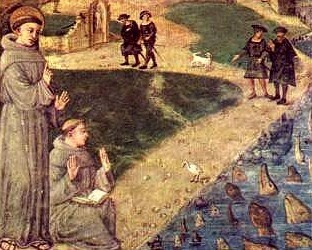
Is Mahler's song,  Des Antonius von Padua Fischpredigt,  from Des Knaben Wunderhorn,  meant to be funny ?  On the surface, it's droll, but as with so much good art, it's not a good idea to judge by surface appearances.  Saint Anthony of  Padua, a contemporary of St Francis of Assisi who preached to birds, was a famous orator, with phenomenal abilities to convert the heathen. In the poem from Des Knaben Wunderhorn, collected by Brentano and  von Arnim, the saint arrives at an empty church. So he goes down to the river and preaches to fish instead.  The fish leap and glisten, with excitement.  "Kein Predigt niemalen, den Karpfen so g'fallen"  Nothing like a juicy sermon, even if you can't speak.Latin.  Each verse describes a different type of fish, crabs and turtles, which wouldn't happen in nature.The stylized strophic refrains are a further clue that this isn't reality.

"Fisch große, Fisch kleine, Vornehm und gemeine,
Erheben die Köpfe, Wie verständge Geschöpfe:
Auf Gottes Begehren, Die Predigt anhören
."

To the devout, it's a kind of miracle, taken seriously. But, as so often, literalism is the enemy of art. Whoever crafted the poem subverts the pious image.  The minute the saint turns his back, the fish are back to their own ways.  "Spitzgoschete Hechte, die immerzu fechten" remain quarrelsome thieves. Note , too, the greedy carp, whose mouths are always open, swallowing anything they're fed,  A pointed warning for our  times when received wisdom replaces thought. . 

Mahler's setting of the poem reflects its mischief.  The markings indicate "with humour" on the piano part , its rolling rhythms suggesting that the saint's been too free with communion wine, although from what we know of the early Franciscan order, they were ascetic, not given to indulgence. It's a sly reference to Dionysius, a figure who pops up elsewhere in Mahler's work, specifically in Symphony no 3.  This humour is deceptive. "This piece is really as if nature were pulling faces and sticking its tongue out at you" (said Mahler)  "But it contains such a spine-chilling panic-like humour that one is overcome more by dismay than laughter". 

War, loss and death are recurring themes in the Wunderhorn saga. Thomas Hampson has called some of them "negative love songs" for they are neither optimistic nor sentimental. The regimentation of military life contrasts with individual freedom,  though these brief escapes through love and imagination are doomed. In death. troops of skeletons march through streets, and lovers meet, as ghosts. Des Antonius von Padua Fischpredigt isn't funny. It's a wail of despair, though the wit dulls the pain. 

 Think ahead to Wozzeck, where the anti-hero tries to do his best, but is destroyed by the cycle of madness around him. Can we hear in the cyclic traverses of Wozzeck, echoes of the marches in Des Knaben Wunderhorn and the repetitions in Des Antonius von Padua Fischpredigt ? Maybe, maybe not, but that should start you thinking. DKW and Georg Büchner's Woyzeck come from a similar vein in the Romantic Imagination. 

Furthermore, consider Des Antonius von Padua Fischpredigt in the context of Mahler's Symphony no 2. The long first movement may represent a funeral march, taken at a steady processional pace. From that the Ländler breezes serve a a Ruckblick on  a happy past, which will inevitably be left behind. In the third movement,  marked "In ruhig fließender Bewegung" come the references to the world of Des Knaben Wunderhorn.  The departed may be dead, physically, but Nature is working its miracles. The "Fischpredigt" passage begins with a  bang, the quirky woodwind melody leaping energetically, the strings surging with energized power.  The sermon is over, but that's not a negative thing. Now, we can move forward.  The music moves like the fish, disciples of the power of Nature to regenerate itself. Even at this point, we can think of Der Abschied, "Ewig, ewig.....".  In this context, the Des Antonius von Padua Fischpredigt represent transformational change, as well as the wilfulness of fish who don't change their ways. 

Hence the danger of interpreting this song too narrowly and too literally. Please also read my article "Why greedy kids in Mahler 4"  Understand and absorb the spirit of Des Knaben Wunderhorn : it's a key into Mahler's inner world.
 .

Thursday, 16 April 2015

Ambitious Royal Opera House 2015/2016 season


The Royal Opera House 2015/2016 season is one of the best for a long time. Eight new productions in the main auditorium alone, and a florescence of new work at the Linbury, before it closes for refurbishment.  An ambitious range from the baroque to the modern.   Juan Diego Flórez sings his first Orphée, and Bryn Terfel his first Boris Gudunov. Even some of the revivals are "new", like Tannhäuser and Il trittico, revived for the first time.  And even more intriguing, ROH is going musically in depth, enhancing appreciation of opera repertoire by developing themes which connect operas and by doing opera-related orchestral music. Even the revivals of more regular repertoire are given star treatment. Jonas Kaufmann and Bryan Hymel, no less. Joyce DiDonato and Vittorio Grigolo make their role debuts in Massenet's Werther.

ROH starts 2015/2016 in grand style, with Gluck's Orphée et Eurydice, in the 1762 French revision, conducted by John Eliot Gardiner with Juan Diego Flórez's Orphée and Lucy Crowe, and his own specialist musicians, the Monteverdi Choir and English Baroque Soloists. Hofesh Schechter, the acclaimed choreographer, will direct. An interesting fusion of period performance and modern dancing. An even earlier telling of the Orpheus legend will be Luigi Rossi's Orphée (1674), with Christian Curnyn conducting the orchestra of the Early Opera Company at Shakespeare's Globe, where ROH staged L'Ormindo: very different from the Roundhouse Monteverdi Orfeo (1607) .earlier this year. A hat trick of early Orpheus operas, which, when heard in close succession enrich and inform, so we get more from what we experience. This is intelligent, joined-up thinking! This summer, ROH is presenting Birtwistle's The Corridor, also based on the same story. Could we dare hope for a new production of  his The Mask of Orpheus? Above, Orpheus with his lute, in a 17th century painting by Benedetto Gennari.

Bryn Terfel makes his long-awaited role debut in Mussorgsky's Boris Gudunov.. Richard Jones directs, so expect surprises, but also very musically informed insights.  This production is based on the 1869 seven-scene version of the opera, dramatically more taut and tense. Antonio Pappano conducts. Terfel will clearly be the draw but Ain Anger will be singing Pimen: an interesting contrast of voices. Anger is highly regarded, so his Covent Garden debut will be something to look forward to.  John Tomlinson, so closely connected to the opera, will appear in the vignette role of Varlaam.  

In November, the world premiere of Georg Friedrich Haas's Morgen und Abend, a co-commision between ROH and Deutsche Oper Berlin. Haas's In Vain created a sensation when it was heard at the South Bank last year. Read my article Invisible Theatre : George Haas In Vain  to get an idea of what Haas's music is like. It's intensely dramatic. Morgen und Abends is based on a Norwegian novel about the life of a man from birth to death, morning to evening. Graham Vick directs, Michael Boder conducts. 
  
A new Cav and Pag for Christmas!  Eva-Maria Westbroek should be a superb Santuzza in Cavalleria Rusticana, to Aleksandrs Antonenko . He's also singing Canio in Pagliacci,, plus Dimitri Patanias.  Very solid casting. It will be directed by Damiano Micheletto, who's directing Rossini Guilliame Tell.this summer.

Donizetti Lucia di Lammermoor, with two different casts in April (Diana Damrau) and May (Alexandra Kurzak) 2016, directed by Katie Mitchell, who is approaching Lucia as a woman forced into madness..  

Georges Enescu's Oedipe (1936) continues ROH's exploration of 20th century opera, following on from Szymanowski's Król Roger.(1926).  This production, by Alex Ollé and Valentina Carrasco of La Fura dels Baus, was first heard in Brussels three years ago, with Leo Hussain, who will again be conducting. 

Stars for  Emmanuel Chabrier  L'etoile, a macabre comedy. Incidentally, Laurent Pelly directs this opera in Amsterdam in October. In London, we'll be hearing a completely different production directed by Mariane Clément, who'll be directing Donizetti's Poliuto at Glyndebourne next month.  In London, Christophe Mortagne will be singing King Ouf I.

Verdi Il trovatore next year, a co-production with  Frankfurt Alte Oper, directed by David Bõsch with Gianandrea Noseda making his ROH conducting debut.

Plenty of other interesting things, especially in the Linbury before its closure, after which performances will shift elsewhere, such as to the Lyric Hammersmith.   The now regular co-operation between ROH and Welsh National Operas  brings Iain Bell's In parenthesis, directed by David Pountney. Among the many British composers being presented is Philip Venables, with his 4.48 Psychosis,  about the playwright Sarah Kane, and Mark Simpson's Pleasure co-commissioned by ROH, Opera North and Aldeburgh. For more, peruse here.

Tuesday, 14 April 2015

X rated Mahler Wunderhorn Barbican


X rated Mahler on Wednesday  15/4  at the Barbican, London! Because there are scenes of nudity, it comes with an 18 plus advisory. And why not ?  Clemens Brentano and Achim von Arnim's Des Knaben Wumderhorn wasn't written for kids. This new Wunderhorn (not Des Knaben Wunderhorn) is creative re-imagining, in which live performance is blended into a film by Clara Pons who "visualizes Mahler’s melancholy and humanism, relating a story of love in times of war, and of a paradise forever lost",   Dietrich Henschel will be singing 15 of Mahler's originals, plus nine  orchestrated by Detlev Glanert which are well worth hearing. Nearly 20 years ago, Glanert wrote Mahler-Skizze, a skit, on Mahler's style, based on cartoons of Mahler conducting. It's a short piece but full of joy and energy. Glanert has a taste for the macabre, but also for satire and fun, which is very much Mahler. Alexander Vedernikov conducts the BBC Symphony Orchestra.

Below,  the trailer, which suggests that this might be an acted film rather than just a series of projections behind the stage. Thankfully, it's not literal  Soldiers exchange meaningful glances while we hear Des Antonius von Padua Fischpredight, which ostensibly depicts an inebriated saint preaching to fish, who start fighting each other the moment St Anthony is done. Rather pointed when you consider how the sermon might apply in a militaristic society. Hopefully, the film will capture the charm and wit behind the poems.  Wunderhorn is fifth generation down from the folk tales collected in the field, transcribed by aristocratic intellectuals, influencing a late 19th century composer, who would go on to create a whole body of work inspired by the ideas generated from the collection. The river of creative invention flows, even for listeners who engage with sounds and meaning.

Brentano and von Arnim's Des Knaben Wunderhorn was a huge success in 1819 because it captured the spirit of the times. German-speaking countries had been ravaged during the Napoleonic wars. Germany then was a disconnected mass of over around 300 states, pitted against one another by which side their leaders took. It represented a way of finding an identity based on an idealized, but very lively version of a simpler past. The original is quite hefty, with long ballads and pieces of prose. Mahler set a lot more poems than are in the DKW set, but even then he didn't cover the entire collection. A good friend used to get us to instantly translate pages, unseen, with hilarious results, especially after a few glasses of wine.
 
Mahler discovered Des Knaben Wunderhorn some sixty years later, when the book had gone out of fashion.  Having been brought up in a small garrison town, he would have understood the tales of soldiers far from home, the spectacle of marching uniforms and the macabre reality of death. Um schlimme Kinder artig zu machen - to teach bad children to be good, in the sense that all who dream and wonder are children at heart. .

Monday, 13 April 2015

An opera for 9/11 ? Dealing with trauma in art


More thoughts on Tansy Davies Between Worlds at the ENO, for the 9/11 was such a horror that it would be inhuman not to respond in some way.  The idea that 9/11 shouldn't inspire opera is a non-issue. Not all operas are song and dance routines! Anyone familiar with Davies 's music would have known she wouldn't do kitsch.  Besides, there are lots of movies and plays on the events. Why not art instead of sensation ? John Adams wrote On the Transmigration of Souls very shortly afterwards, There have been numerous films on the subject, some sensational. Charles Wuorinen's Cyclops 2000  has 9/11 connections, because some involved in the commission were in an industry badly dented in the disaster.  Thomas Adès's America: a Prophecy (1999) turned out to be almost too true., with its images of firestorm and  destruction., though he was referring to the cataclysmic end of Mayan civilization.  

So there's no reason why 9/11 should not be a subject for opera. It could be approached from numerous different angles, including sensationalist gung-ho adventure, which fuels the macho mindset of violence that can lead to terrorism and wars of attrition. Given Tansy Davies's thing for sculptural forms, I thought she might explore abstract forms but she chose a very different route, deliberately eschewing the "outer" aspects for an "inner" lower-key approach. That honours the victims of 9/11, not outside observers.  Many of those who were killed didn't know what was going on. They didn't see the iconic images imprinted in the minds of those of us who watched it on TV. They were shrouded in darkness, largely cut off from the outside world, largely unable to communicate. They didn't see the fireballs, though they might have felt the buildings shake. At the time, Karlheinz Stockhausen made a comment, widely miscontrued, that the attacks were like art. That doesn't mean he condoned killing. He was saying, I think, that the audacity with which the attacks were planned, connects to the audacity of art, horribly misapplied. Hijacked, in every sense of the word.

Between Worlds is Tansy Davies's first major work employing voice, so she uses voice as instrument, extending the palette and opening up new possibilities. Many modern composers do that, like- Birtwistle ,Boulez, Gérard Grisey.  Read my review ENO Tansy Davies Between Worlds.  There's no rule book that says things can only be done one way. Please read my article Poetry Beyond Words and my piece on Boulez Pli selon Pli.  Sometimes music begins when we get away from literal text.  If I were revising Between Worlds and of course no one should, I'd tighten the tension, minimizing threnody and relatively minor parts like The Mother (though it was beautifully sung by Susan Bickley). But we are still too close to events not to need comfort.


Sunday, 12 April 2015

ENO Tansy Davies Between Worlds


Tansy Davies Between Worlds at the ENO at the Barbican, London, confirms yet again the ENO's unique position in British cultural life.  Davies is a highly original, very distinctive composer. Between Worlds suggests great potential. It's her first venture into opera, building upon her orchestral style, interesting for that very reason. Everyone knows the events that took place on 9/11, so literal narrative would be crass.  We don't neeed to see planes crash. Many of the victims were trapped in darkness, not knowing what was happening outside. In Between Worlds, we get just that.  It's not an opera in the usual sense, but a meditation on the emotions people might have felt, lost in that claustrophobic limbo from which there was no way out but death.

Those who died trapped were ordinary human beings, facing an unimaginable trauma. Grand arias would be inappropriate. Real people don't play to the gallery, especially in such circumstances.  Bombastic gestures are for terrorists.  Davies concentrates instead on the fragile lines of communication between the inner and outer worlds:  phone connections that break up, messages that don't get through, signals that fail when they're most needed   In this opera, the orchestra sings what cannot be expressed. Wailing sounds suggesting sirens, creating anxiety, all the more disturbing because they sound muted and distant.  Ticking, tense mechanical sounds, beating staccato like the very pulse of the Earth.  A Birtwistle connection exists, though Davies's music, of course, sounds nothing like Birtwistle.  For me,  Tansy Davies's music has always felt sculptural,  as if she's working with physical, architectural forms.  In Between Worlds   she uses fragmentation: myriad tiny sounds that deliberately don't cohere, but en masse form vast walls. The Twin Towers were beautiful monuments of glass, defying the elements, but they couldn't withstand the attack. Those who remember 9/11 will recall the clouds of rubble and dust, waves of paper fluttering down from wrecked offices, and bodies falling, to be smashed into pieces. Listening to Between Worlds as a purely audio experience  will be an experience, As music, it's extraordinarily subtle.

Davies's vocal lines are stratospheric, reflecting  the idea of "looking upwards" to survive . This timbre causes probelms for many in the cast, apart from Andrew Watts, the Shaman, for whom a realm beyond mortal existence is normal territory. Although he's dressed in a business suit, his keening, legato seemed to float into space. Much of Manhattan was built by Native American construction workers, riding the girders way above the streets, turning empty nature into concrete. The Shaman is fantasy, of course, but brings a deeper level of meaning.  When Watts sings, one hears something of eternity, which fits in nicely with Davies's quotes from early music and hymn. The downside is that this stratospheric timbre is hell to sing.  Most of the rest of the cast is challenged.  Psychologically, this is true. The lines  break up frequently, like broken signals, and feel  like strangulated screams, words caught mid-flow in choking gasps.  Not at all easy on the ear, but perhaps it shouldn't be, in the circumstances. But focus on the music in the orchestra, conducted by Gerry Cornelius. This is an opera where abstract sounds tell the story, with beauty, dignity. and sensitive imagination. 

The stage is divided into three separate spheres. Andrew Watts, alone, at the very top, the chorus in darkened space below. In the centre, five key figures whose "ground" is perspex, and transparent, as if they're in suspended animation.  The figures are symbolic of Everyman, so there's no great need for in-depth characterization. It's enough for us to know that the Realtor (Clare Presland) has to divide her time between being a mother and an executive, and that the Younger Man  (William Morgan) is scared of heights: we feel for them as human beings.  The closest we get to conventional aria is when The Young Woman (Rhian Lois) sings of love. It's a wonderful vignette, celebrating lesbian choice -  good for librettist Nick Drake and Davies!  Eric Greene sings the Janitor, a role that sits more easily in range, Phillip Rhodes sings the Older Man, a relatively conventional figure.  Susan Bickley sings The Mother. Deborah Warner directed, Michael Levine designed the set, which underlined the fragility of being "between worlds".

Special mention should be made of the dance sequence towards the end, choreographed by Kim Brandstrup. A man's body floats helplessly suspended, supported gently by a sylph-like female dancer, in a kind of reverse pas de deux.  The image suggests vulnerability, as well as gentleness. Eventually the male figure flies upwards, finding release. The music behind this sequence is beautiful, expressing deep meaning without the use of words. What was striking about 9/11 was that those killed sent messages of love, not hate or revenge, but that, alas, has been lost in transmission in our more divided, violent times.

Between Worlds is so unusual that's it's bound to shake up some. It might take time to settle, I think it proves how much creativity and talent there is in Britain, and why it should be supported. The ENO is in a unique position because it supports original work in the English language, and does so with a quirky liveliness that appeals beyond the narrow confines that give opera  a false elitist image.Scrapping the ENO in favour of small-town runs of, say, The Barber of Seville, just doesn't make sense, long term. The ENO's contribution to British art cannot simply be measured in accountant-speak.
 

Thursday, 9 April 2015

Three Choirs Festival Hereford 2015


The full programme for the 2015 Three Choirs Festival, this year at Hereford, has been announced.  Many juicy nuggets and surprises, reflecting Artistic Director Geraint Bowen's  lively approach to this unique and ever-developing Festival. This year, the combined choirs of Hereford, Worcester and Gloucester will be joined for the first time by the Orchestra of the Age of Enlightenment,  supplementing now regular visitors like the Philharmonia Orchestra. The OAE will be able to expand the Festival repertoire in imaginative directions.

As always, the "big" events in the Cathedral form the foundations of the Three Choirs tradition. This year's first evening concert, on Saturday 25th July, features Elgar's Dream of Gerontius, (Please read more here).  Sarah Connolly. Peter Auty and Neal Davies, with Geraint Bowen conducting the Philharmonia. I recommend going early to Hereford, to take part in the Opening service (Purcell and Handel), because Three Choirs is more than just a music festival; it is also a celebration of religious faith, which defines the whole spirit of the Festival. Go, whatever God you adhere to, because faith and hope connect all religions.  Plus, you'll be able to attend Roderick Williams' afternoon recital "Song of the Hero". Williams will be singing Elgar's Sea Pictures for baritone and piano - unusual, and surprisingly powerful. It's been in his repertoire for some time (e.g. at the Oxford Lieder Festival). He'll also be singing lesser-known songs by Vaughan Williams and Howells and a new commission by Rhian Samuel. This is an important concert, and will be broadcast on BBC Radio 3. (date unknown)

On Sunday 26th July, Olivier Messiaen Turangalîla-Symphonie - a truly spectacular celebration of life, love and nature. , not something which one might associate with staid English church traditions, but a deeply felt, spiritual work, nonetheless. Messiaen was extremely devout, and an organist, who played at Mass almost every day for many decades.  It will be interesting to hear how the symphony fills the space in this Cathedral. Certainly, the sound of the ondes martenot will carry well.  Jac van Steen conducts the Philharmonia with Steven Osborne (pianist) and Valerie Hartmann-Claverie (ondes martenot).

"Requiem for 500 years"  on Monday 27th, a good concert of very early music with the Orlando Consort, followed by a talk on Agincourt, the decisive battle which separated England from France, 700 years ago. This is Arthur Bliss Day, too, with a rare performance of his Morning Heroes, a song symphony from 1930, in memory of Bliss's brother who died in the Great War. It's narrated by Samuel West, and conducted by Andrew Davis. On Tuesday "Three Centuries in one afternoon", continuing the theme of historical context, and Bach St Matthew Passion in the evening. On Wednesday, we move forward to 1715, with a concert built around Vivaldi The Cuckoo, wildly popular in England at the time, performed by Italian baroque specialists La Serenissima. In the evening, Beethoven Missa Solemnis. At Dore Abbey, Roy Strong presents "Poets and Princes" an entertainment on the English Monarchy, followed, ironically, by a talk on the Jacobite rebellion. The keynote concert that evening will be Carl Neilsen's Hymnus Amoris, coupled with William Mathias (d 1992) Lux Aeterna. Verdi Requiem on Friday night. The Festival concludes with "The Gathering Wave" a community participation event. Lots more - plays, talks, visits, chamber concerts - peruse the programme, looking for the hidden gems.


Tuesday, 7 April 2015

Glücklich Gluck ! Orfeo ed Euridice, Iphigénie in Tauride


Glücklich Gluck ! Tonight, Laurence Equilbey conducted Gluck's Orfeo ed Euridice broadcast live on medici tv but still available to subscribers.  live at the Théâtre de Poissy.. Equilbey performances zing with vigour - listen to that descent into Hades !  Vocally. she works with some of the best, such as the Accentus choir, the ground breaking, innovative ensemble with whom she's been associated many years.  Delight in the choruses.  Equilbey conducts the Insula Orchestra, re-joined by Franco Fagioli, Malin Hartelius and Emmanuelle de Negri.

Even better,  Gluck's Iphigénie in Tauride, also recorded live from a new production  at the Grand Théâtre de Genève, Switzerland, on 4th February, 2015. An even more high proifile cast - Anna Caterina Antonacci, Bruno Taddia, Steve Davislim (hearthrob) . Hartmut Haenchen conducts the venerable Orchestre de la  Susiise Romande. Listen HERE on BBC Radio 3 from Thursday or watch the complete original from Geneva HERE on arte tv. (already online)

Monday, 6 April 2015

Exclusive to support the Mediathèque Musicale Mahler

Support the Musée Rodin and the Mediathèque Musicale Mahler in grand style. The museum is offering, in an exclusive limited edition, a copy of Rodin's 1909 bust of Mahler. This is no ordinary reproduction but an exact cast from Rodin's original dimensions. The Rodin Museum  supervises a very demanding production process, which guarantees the highest quality true to the original. Friends of the Mediathèque Musicale Mahler get priority, but any really serious friend of Mahler, or institution with a Mahler connection, would be interested. This reproduction is 45.1cm high, and costs 4900 Euro - very exclusive, and an adornment for any really serious Mahler specialist or institution. Profits go to supporting the Mediathèque Musicale Mahler and its continuing dedication to research into Mahler and others. Its archive is also the biggest collection of material on Alfred Cortot, for example.

Contact  Musée Rodin – Hadrien Tagu
19, boulevard des Invalides
75007 Paris – France
tagu@musee-rodin.fr
Phone: +33 (0)1 44 18 61 57

"Alma Mahler’s stepfather, Carl Moll, asked Paul Clemenceau, whose wife was Viennese,
to commission a bust of Mahler from Rodin. Moll and several of Mahler’s friends
wanted to pay tribute to the composer after he left the Vienna Opera in 1907.
Rodin accepted the commission, but Mahler, who hated the idea of sitting for a bust,
refused to pose. To trick him into consenting, Sophie Clemenceau arranged for Mahler
to be told that the sculptor had asked to do his portrait. The sittings began in April 1909,
were interrupted, and then resumed in October. “They don’t speak to each other,
being quite content to observe one another; and yet, they understand each other
perfectly,” she wrote. When Mahler left France for America, Rodin continued working
on the portrait and had a marble version of it carved, entitled Mozart. The sculptor used his secretary, Mario Meunier, whom he thought looked very much like Mahler, as a replacement model.
Rodin proceeded in his usual manner, walking around the sitter to capture every profile.
The planes of the face are broad, the modelling expressive and the piercing gaze recalls the
musician who once said, “If I didn’t have to wear glasses, I would conduct with my eyes.”

Saturday, 4 April 2015

Herzliche Ostergrüße 1915


An alternative to the deluge of commercial tat and chocolate bunnies at Easter, the most important feast in the entire Christian calender, a look at what people living in 1915 might have felt.  Of course they loved fun and kitsch, but that's not all there is to life. In 1915, a larger portion of the population were seriously devout, so Easter meant a lot more to them than it does now.  When family members were far away, possibly facing death at any moment, people were inclined to contemplate the wider context.

Above, whimsy, hares bringing goodies to soldiers at the front. At right, a reminder that 1914-18 was a world war, a struggle for international dominance., Germans, Austrians and Turks, together. Control over the oilfields of the Middle East, paramount geopolitics even now. .Are we still fighting the same war?  Click on photos to enlarge for detail


France Musique's Boulez marathon now online

Revisit France Musique's all day Boulez marathon HERE online (until 12/17 !)  And much more to come

Thursday, 2 April 2015

Major Alphonse Mucha retrospective UK


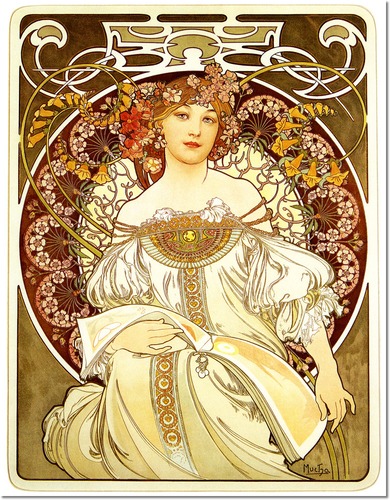
Alphonse Mucha : In Quest of Beauty, a major retrospective, comes to Britain. It will explore Mucha’s idea of beauty – the core principle underlying his artistic philosophy. "Featuring works mainly from Mucha’s Paris period, the exhibition will examine how Mucha’s distinctive style, popularly known as 'le style Mucha' in Paris, evolved and became synonymous with the international Art Nouveau style. The exhibition will also look at how his artistic philosophy is reflected in the development of his work beyond the ‘Art Nouveau’ period, with examples of works produced after his return to the Czech lands in 1910."

"The exhibition will make links between Mucha's work and philosophy and the Art Nouveau environment and Aesthetic collection of the Russell-Cotes Museum. Sir Merton Russell-Cotes's Bournemouth residence, built in the 'Art Nouveau' style as a home for his Japanese and High Victorian art collections, is an expression of the 'cult of beauty' - a notion celebrated by followers of the Aesthetic Movement in Britain. It will provide a fascinating spiritual backdrop to Mucha’s art."READ MORE HERE.

Mucha worked at a time when the lines between commercial art and fine art weren't quite so separate: think Toulouse Lautrec, Aubrey Beardsley. Mucha's art blends strong formal structure with elaborate inventive elements. Often his symbols come from Nature - the fertility of plants, the concept of constant growth and multiplication. The women are provocatively sensual, but unattainable fantasy.  It's elaborate in a 19th century way, but with the freshness of 20th century sensibility.    This, I think, creates an edgy tension which lifts it above the merely pictoral.

Mucha's son married Vitezslava Kapralova, the composer, about whom there's a lot on this site (follow the labels below) . Please read my article "Vitezslava Kapralova : Remarkable Woman, Remarkable Times", on the cultural renaissance in Czech culture between 1918 and 1938.

HAPPINESS