Monday, 16 January 2017

Visionary Der fliegende Holländer Kasper Holten

The Flying Dutchman confronts Daland : Johann Reutter and Gregory Frank, photo Heiki Tuuli, Finnish National Opera

An exceptional Wagner Der fliegende Holländer, so challenging that, at first, it seems shocking. But Kasper Holten's new production, currently at the Finnish National Opera, is also exceptionally intelligent,  a thoughtful approach to the  deeper levels in the opera. Why is the Dutchman doomed ?  Why does he need the love of a woman to break the curse ?  Wagner without ideas isn't Wagner, and this opera is no sea shanty. Holten connects  Der fliegende Holländer to Der Meistersinger von Nürnberg and even to Parsifal by bringing out sub-texts on artistic creativity and metaphysics.  And what amazing theatre this is, too, and very sensitive to the abstract cues in the music. .

Just as the Overture begins quietly with woodwinds, we encounter The Dutchman  (Johan Reuter)  in a contemplative mood.  He's in a studio, possibly a painter who makes portraits. A woman is lying on his bed. Model, lover or muse, we don't now, but as tempi increase, and the orchestra swells like the ocean, Reuter moves outside, exposed to the elements of the storm that is breaking.  Huge figures loom over him, suggesting storm clouds and crashing waves. Darkened figures scurry past, like the cross- currents in the score. Back in his studio, the Dutchman is confronted by female dancers, who writhe as the music does, tantalizing him yet pulling away.  The Overture reaches a crescendo, then decelerates.  We glimpse the private Dutchman, as Reuter's face contorts in agony. He's having a panic attack. Far more moving, and human, than Dutchman-as-Demon. 

Daland (Gregory Frank) and his crew have survived the storm unscathed.  Unlike The Dutchman, Daland is a public person, who likes status and wealth. Here, he's in what might be an art gallery reception, where the rich pose. They don't actually "do" art. Amidst this sophistication, the Steuermann's song seems unsettling, too sincere and too simple to fit in with the pretentious setting. But so it should be, for the Steersman (Tuomas Katajala)  represents earthier values. Significantly, in the libretto, Daland passes responsibility for his ship to the lowly sailor. "Gefahr ist nicht, doch gut ist's, wenn du wachst."  He doesn't realize that the Dutchman has quietly entered the party unnoticed.  Low winds and brass moan, and suddenly the Dutchman materializes and the crowd clears. "Der Frist is um", sings Reuter.  Gold means nothing. "Ew'ge Vernichtung, nimm mich auf!" with intense agony. The party crowd repeat the phrase, but still don't get the full import.  Daland thinks he's been through the same storm. If only he's paid attention to the music Wagner wrote around the Dutchman!  He doesn't even realize what he might be letting his daughter in for. The Dutchman brings out a portrait. Drums beat in the orchestra, but Daland's laying around with his i-pad, oblivious.

The women are seen spinning, their movements reflecting the circular figures in the music though their cheerful singing parodies the infinitely grimmer cycles the Dutchman has to keep repeating.  Pottery classes are middle class, producing nice objects, not necessarily functional, or artistic. Senta (Camilla Nylund) has her sights on greater things. She grabs the clay on her wheel and squishes it up into a shape that vaguely suggests a penis, reminding us that sexuality, in some form or other, is implicit in the true meaning of this opera.  Shen then dons a white painter suit and paints with huge, dramatic brush strokes as she sings her keynote monologue, without missing a beat or inflection in her singing: quite a feat.  The other women look on, uncomprehending. It's interesting how Wagner sets their chorus as quasi-religious chorale.  Nylund jumps bodily into the painting, getting dirty.  The women grab their bags, preparing to flee. Mary, (Sari Nordqvist), the only woman with individual flair, pays attention.  When Erik (Mika Pojhonen) comes with roses, he flinches.  Hes a land person not someone who faces the open seas.  The Steersman's song is exquisitely beautiful because he lives: Erik's music is sincere, but dreams are the only time he lives in the imagination.
 
Senta and the Dutchman meet, and gradually their music builds up towards intense passion. In this production, we see their connection grow as the Dutchman sees a painting Senta's created. He takes out his camera, in deep appreciation. The use of a revolving stage allows the action to flow, marking the subtle gradations in their relationship.  Eventually, the Dutchman and Senta end up, embracing tenderly in bed, but almost immediately the Sailors' chorus intrudes upon their dream  This time, the innocent song sounds frantic, the rhythm clipped with near ostinato violence.   Alcohol fuelled sexuality and fundamental antagonism between the living and the dead. This isn't a party in the normal sense.  Senta sleeps on, but the Dutchman has been through this before. The nightmare's coming back, as it does every seven years. The ghostly chorus surround the bed, their faces masked and menacing, flashing their phones, to blind the Dutchman. When he's encircled, they point at him accusingly.  This staging also emphasizes the way the Norwegian chorus parallel the chorus of the Dutchman's crew, and both adapt the Steersman's tune in brutal new ways.  The village women dance with the Dutchman, but their coldness has a Flower Maiden surrealism.  He tries to make sense by painting on them, as an artist does, but he's doomed, pursued by the singing, the music and the storm that's building up. Demonic lighting effects, sharp angles match visuals to music  Modern technology can whip up cosmic storms of truly metaphysical force.

The music stills, for a moment, and the Dutchman wakes. Senta's still there, asleep. Has he broken the curse.  Erik enters, scolding, showing Senta clips of their happy past on his i-phone. .  For the Dutchman, the nightmare descends again. "Verloren! Ach! Verloren! Ewig verlornes Heil!" The Dutchman sets sail, in his mind. Everything's turning in dizzying circles: we see closeups of Reuter's face as if taken from a small handheld, projected across the entire stage.  "Du kennst mich nicht, du ahnst nicht, wer ich bin!". Reality disintegrates. Do we see the Dutchman shoot himself  We know he cannot die. But suddenly we're back in the art gallery, Senta is showing an installation she's made in which the Dutchman's last moments are preserved forever on endless tape loop.  Has the Dutchman sacrificed his dreams to save Senta? Or has Senta sacrificed herself, after all, to redeem him?  Nylund turns away from the crowd, and we see her, "as" Reuter, her features contorted in agony, as if her soul were disintegrating within.  Is the Dutchman free, or has the curse fallen on Senta in his place ? A tantalizing but brilliant ending, which suggests that being creative is a vocation, where vision matters. Sacrifice and redemption, through art.  Holten's  Der fliegende Holländer  is true Wagner.

Watch this production, conducted for the Finnish National Opera by John Fiore, on Opera Platform only until 17th February. When his Wagner Meistersinger reaches London, no doubt the hate mob will rise in fury, but Kasper Holten absolutely deserves respect for his integrity.

Saturday, 14 January 2017

Why the City of London backs World Class Music Centre


The City of London Corporation has announced that it will fund the completion of the study into a business case for a new, world class centre for music in London.  This is the feasibility study that was in progress until last November when it was abruptly cut short by the government. The Corporation has pledged £2.5 million  towards the £5.5 million cost of the study, of which £1.25 million has already been spent.  A shortfall, but still a tiny proportion of the £80 million the Corporation spends each year on the arts in London. Why does the Corporation value this project?  Because the arts are a major part of the economy.  In a global market,  Britain needs to stay competitive or fall backward.

Opposition to the world class centre for music reflects long-term British resentment against London.  That reductionist philosophy is embedded so deeply into the Arts Council England's DNA that the organization isn't structurally capable of adapting to change, or of reflecting the realities of the business. Fact is, Britain is a  centralized country and always has been.  For a brief time in the Industrial Revolution, northern regions competed with London but the modern economy is now international.  A report released last year (read more here)  showed that in 2014/15 London generated almost as much tax as the next 37 cities, and contributes 30% of the entire tax income in the nation.  The imbalance can be changed by a political agenda that wrecks London, while hoping that the slack can mysteriously be taken up elsewhere.  Alternatively, policy makers could recognize that London generates income for the entire country, and in an international. technological world this isn't going to disappear overnight.

It's nonsense to suggest that a world class centre for London will only benefit London and tourists. Everyone wins when there is a centre for excellence that generates talent, earns income and raises the nation's profile. The arts are "foreign policy", more effective, in the long term, than guns and bombs.  The Victorians were making political statements when they built the Royal Albert Hall and the museums around it.  At the British Museum, one marvels at the Empire that ripped artefacts from Greece, Egypt and Assyria, and gets the implicit message. London's heritage is everyone's heritage, whether or not they go there themselves. And they can, if they care.

Technology is also changing the way the arts reach potential audiences.  Through its Digital Concert Hall, the Berliner Philharmoniker reaches anyone, anywhere in the world with internet access. Increasingly, other orchestras and opera houses are wising up to the potential of digital marketing. Even the Met is streaming its archives online. The day when record companies controlled things is over.  Now orchestras and opera houses can themselves decide artistic content and feasibility. Smaller organizations can co-operate to spread costs. Profits stay closer to source. When listeners can access the world,  geographic boundaries count for less, while opening up the market for diversity.  Orchestras won't all have to sound the same, to fit the old-style mass market, and repertoire can be less narrow.

Yet it's also imperative to recognize that excellence in the arts is generated when there is a large enough critical mass of talent concentrated together so creative people can stimulate each other. Poets can live as hermits, if they wish, but orchestral musicians, almost by definition, operate communally. Even more so with opera houses, where the creative community is even greater, and costs are contained by keeping people together. It's all very well to prioritize micro-mini ventures in out-of-the-way places, but reality is critical mass. All the technology in the world does not compensate for bringing people together in direct, personal contact. The bigger the group, the wider the creative horizons.  Excellence "is" education. I'ts all very well to suggest Birmingham or Glasgow or whatever, but fact is, London is where it's at.  Shakespeare needed to leave Stratford for London to do what he did.

This week, the Elbphilharmonie opened in Hamburg (read my analysis, not just a review,  here).  The NDR Elphilharmonie Orchester is good, though it's not mega-league.  But with the new hall, it's challenged to excel itself, and every orchestra that can will want to perform there, which will again raise the stakes. The city-state of Hamburg, a state of the German federation in its own right, had vision enough to realize that the arts are an important part  of the economy and of the wider community: an investment for the future on many different levels.  London's orchestras are very good indeed, but they're trapped in inadequate facilities. The acoustics of the Royal Festival Hall and the Barbican are only the tip of the iceberg. Berlin, Paris, St Petersburg and now Hamburg: what about London?  Someone seriously suggested that the British economy would survive Brexit by selling more tea, scones and jam, though such things can be made well elsewhere. Not rocket science!   But unfortunately that small-mindedness reflects the reductionist, self-destructive lack of vision that could suffocate the arts and the economy as a whole. 

Read this too Can post Brexit London survive as Europe's cultural and financial capital ?

Thursday, 12 January 2017

Game changer ! Elbphilharmonie grand opening


Das Eröffnungskonzert der Elbphilharmonie, the opening concert of the Elbphilharmonie in Hamburg. The building looms like a giant ship on a promontory on the harbour: a reminder of Hamburg's maritime and commercial heritage. The lower floors match surrounding buildings, while the upper floors and roof reflect the skie : an inspired concept in architectural terms.  But what really makes the Elbphilharmonie interesting is that it's a game changer in many ways, with the potential to transform the whole way the European music business operates.  

"Freude" said the grandees making speeches, which is significant, for great art is inspired by joy, not small=minded negativity. The creative genius of Beethoven stood  at the start and finish of this communal celebration, with the Overture to the Creatures of Prometheus op 43 and the sublime Symphony no 9.  In Greek mythology, Prometheus stole fire from the gods to empower men, an act which symbolizes enlightenment. That's why the arts matter. They generate creativity and, with that, the enthusiasm that generates change in many things, including economic regeneration. This new hall is a landmark that could challenge the dominance of Berlin and Paris. Not for nothing, the concert honoured Johannes Brahms, Hamburg's native son, who lived in Vienna, but remained, at heart, solidly North German.  In Britain, we've no way to compete, since British arts policy favours micro-endeavour. The fact is, excellence needs vision, and commitment.  The long-term benefits to the nation are infinitely greater than can be measured in simple terms.  The drive that went into making Hamburg the major port that it is, is the kind of drive we need in the arts.

Thomas Hengelbrock and the NDR Elbphilharmonie Orchester chose a programme that demonstrated what the new building can do. The platform, larger than usual, nestles surrounded by different tiers of seating, rather like Berlin and Paris, so sound resonates more evenly than in conventional coffin-shaped halls.  Bernd Alois Zimmermann's Photoptosis (1968) tested the acoustic to the limit. Scored for a very large orchestra, the piece can be very loud indeed, but here what struck me most was the richness of sound, not the volume. The big climaxes are carefully constructed, with myriad layers of detail, some so subtle they can get lost. Yet in this hall, even the most refined components can be heard and relished.  Suddenly, the hall was plunged into darkness, small rows of lights shining from the dense gloom like stars. The plangent strains of a Praetorius motet rang out, as if being heard across the centuries. In a split second, the 16th and the 20th century connected. Also, from an eyrie above the platform, the orchestra's principal oboe played Pan, from Britten's Six Metamorphoses from Ovid op 49. Philippe Jaroussky sang Italian baroque airs, accompanied by harp, from a position above the stage, the clear, pure beauty of his voice carrying effortlessly round the large auditorium., In one of the interval clips, he's seen testing the acoustic by exploring with his voice as he walks around.  Then, Messiaen and Wagner, sounding clear and crisp. What a joy it must be for an orchestra to play in these surroundings, especially as the off-stage facilities are luxe class compared to many less generous venues. The best orchestras will now want to visit Hamburg: this superb acoustic will lift the game for everyone. Read more HERE about the technical aspects that make the acoustics in the auditorium.

For this grand opening gala, the whole Philharmonie building exterior became the backdrop for a spectacular light show. This, too, made a statement, since the light show would have been visible across the harbour. The Elbphilharmonie light show could become a feature of Hamburg's civic life, just like the way Hong Kong skyscrapers become a gigantic canvas for illuminations during the Christmas season (where the flat outside wall of the main local concert hall is the focus of a light show)  The arts aren't just for toffs. Involving the wider community outside the concert hall is a form of outreach and education without distracting from the main business of music making.  Indeed, excellence "is" education. It opens up ears and minds. 

This programme also featured Wolfgang Rihm, billed as"Germany's greatest living composer", though he couldn't attend so Hengelbrock raised a placard with Rihm's name on it , a nice humorous touch.  Rihm, Zimmermann and Rolf Liebermann, together with Mendelssohn and Brahms, Wagner and Beethoven: another point being made, that audiences can cope with diversity without having to be coddled. There are other halls in the new Philharmonie, better suited to smaller ensembles and chamber music. There's another concert on Sunday which will also be broadcast. Click on photo at right to see the building in cross-section. Yet another reason why the Elbphilharmonie is a game changer : It represents a new way of bringing music to audiences. HD was a start, but stymied because it depended on cinema distributors who didn't make enough money to promote it. But modern technology means that audiences can listen any time they want online, wherever they may be.  Investing in orchestra-led, or opera-house led  streaming means that those who make music get the full benefits of marketing, and also have greater control over artistic content.  Can record companies still control the market and create instant media darlings when there's good music around for those who care about quality as opposed to celebrity  No more provincial boundaries. And so the concert ended with the Ode to Joy, Beethoven 9, Bryn Terfel, Pavol Breslik, Wiebke Lehmkuhl, Hanna-Elisabeth Müller, the NDR Choir and the Choir of Bayerischen Rundfunks.  "Alle Menschen wurden Bruder"!" we've heard that thousands of times, but this time it felt fresh and real.


Tuesday, 10 January 2017

Imperial princes, building snowmen


Winter scene in the Imperial Palace, Beijing : click on the photo and move your cursor to enlarge to appreciate the detail. The original scroll was three metres tall, painted with meticulous detail.  It was painted by Giuseppe  Castiglione (1688-1766) aka Lian Shi Ning 郎世寧;. Castiglione came from an aristocratic Italian family but became a Jesuit missionary and was sent toi China , arriving in 1715. In line with Jesuit practice, he immersed himself in Chinese culture. Unlike other missionary groups, the Jesuits believed in winning hearts and minds, however long that might take rather than conversion by force.  Castiglione served at the courts of three emperors of the Qing dynasty,  the Kanghsi, Yongzheng and Qianlong. emperors. Using Chinese materials, Castiglione painted in a blend of Chinese and western styles. He did portraits of his emperors seated on their thrones in formal Chinese style, but also posed in more western ways. His portrait of the Emperor Qian Long for example, shows the monarch astride a horse, almost exactly as if he were Louis XV, his almost exact contemporary. Indeed of the two, Qianlong probably outshone Louis.  In the painting above, we see the imperial children, playing in the palace gardens, like kids would do anywhere. They're building a snowman. But being young princes, their snowman is a Chinese lion.

Monday, 9 January 2017

Der fliegende Holländer Madrid Kwangchul Youn


Wagner Der fliegende Holländer from the Teatro Real in Madrid, with Kwangchul Youn as Daland, Samuel Youn as the Dutchman, Ingela Brimberg, Nikolai Schukoff, Kai Rüütel and Benjamin Bruns,  conducted by Pablo Heras-Casado, recorded live 23/12 and now on Culturebox, To read about the visionary Kasper Holten Flying Dutchman at the Finnish National Opera, please click HERE

The presence of Kwangchul Youn and Samuel Youn (not related) made this performance particularly moving. Kwangchul Youn is an Elder Statesman, a Wagnerian of commanding presence and great depth,  while the younger Samuel Youn represents the next generation.  In the context of this opera, this role reversal brought added piquancy to the inter-relationship between The Dutchman and Daland,  The Dutchman has roamed the seas for hundreds of years, and in the process has learned things no mortal should eperience. Daland, with his fixation on worldly goods, cannot comprehend the metaphysical.  What will happen to Daland after he loses his daughter, his greatest treasure?  Will he learn from the Dutchman that there are things in this world and beyond that matter more than status and success.  One measure of really good performances is their ability to generate deeper insight into the meaning of the opera.  Youn and Youn did this themselves by the dynamics between them without changing a word and without help from the staging.  That's true artistry, and it lifts this performance well above routine. 

It's a fallacy that performances need to be ranked: the vast majority are neither very very bad nor very very good  Only pseuds "need" to rank things. It's much more important to identify the good and less good within a performance.  This one was an interesting mix. Kwanchul Youn carried the show; Samuel Youn complementing him well,  There were some very good cameos indeed, especially Kai Rüütel as Mary, so distinctive that her voice alone commanded presence, though she was costumed in unflattering drabness.  She made me understand why Wagner, who didn't waste time on triviality,   made the part significant.  Mary is a leader, not a conformist, and protects Senta though Senta lets down the other women because she doesn't work  As I listened to Rüütel 's firmly assertive yet womanly singing, I thought of Mary and Martha in the gospel of St Luke.  Martha works hard, while Mary dreams.  But Mary focuses on spiritual ideals. When Senta (Ingela Brimberg) clings to the portrait  of the Dutchman, she hopes to save him from his fate, A rather bigger responsibility than spinning. In this production, Rüütel is seen polishing a light casing, then opening it uo to reveal a light bulb.  Such a telling detail!

This production, by Alex Ollé and La Fura dels Baus premiered in 2014 in Lyon, and bears the hallmark of the Fura dels Baus style. Massive structures, dwarfing the characters but providing dramatic visual impact, which in an opera like  Der fliegende Holländer is fundamental, for the Dutchman's ship is much more than a ship. It looms over the villagers like a malign presence. Like the storm it's a creation from hell, not a normal part of Nature.  Daland and his men are seen walking down an extremely steep ladder whose steps are so far apart they probably won't meet industrial safety standard.s The singers seemed to descend with uncertainity, and for good reason: they are in a dangerous situation. A compartment high above the stage is lit to reveal the Dutchman's crew, high above the mortal plane. 

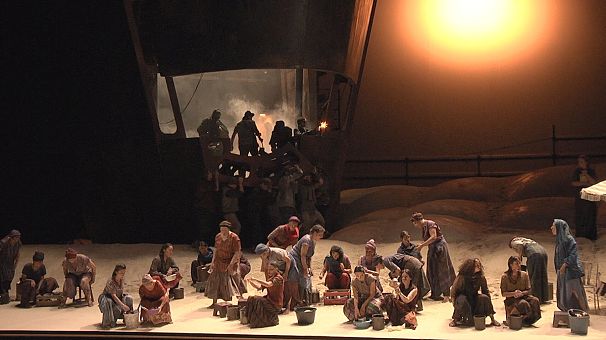
In another typical Fura dels Baus touch, the designs by Urs Schönebaum and  Alfons Flores are monumental but simple, detail added by changes of light and video projections. These are ideally suited to an opera like this where scenes like the storm and the ghost ship are hard to stage by conventional means.  These waves, and the flashes of lightning, were so vivid that they were discomforting. Exactly as they should be, in dramatic terms. Some scenes were less successful, such as the depiction of the women in vaguely Indian or Middle Eastern garb. There's no reason why the action needs to take place in Norway, or Scotland, or wherever, but there's not a whole lot of point transposing it somewhere largely irrelevant except, perhaps, to bring in the idea of the women working on the beach, close to the sea like their menfolk.   The party scene worked rather better, since the singers and chorus "danced" with formalized gestures, the men  enacting movements like launching sails, and the women more fluttery gestures, like spinning.  In contrast, the ghostly sailors don't do anything: they just stand still, apart from one another, lit in mysterious blue.  Like Senta, separate from her peers, thinking, instead of working.

The final scene was particularly effective : demonic shifts of light and texture, obscuring normal boundaries of form,  the undulating sand dunes disintegrating in images of the sea, reflecting the turbulence in the music. Senta puts her hand into the sand, then covers her face in white, powdery paste so that she ends up looking like the Dutchman.  A wonderfully ambiguous ending: Senta's body seems to dissolve in the sea, if it is the sea, or something more demonic. Is the Dutchman redeemed, or is Senta's sacrifice in  vain?  Pablo Heras-Casado conducted enthusiastically. If the brass sounded a bit strange, and the percussion hollow, that worked well in connection with meaning.

Sunday, 8 January 2017

Barbican Spring programme picks

At last, green shoots of Spring emerging from the gloom. The Barbican Spring schedule offers plenty of hope

First off from 13-15 January, Simon Rattle conducts György Ligeti Le Grand Macabre, with the LSO and a strong cast headed by Peter Hoare as Piet the Pot. I love Ligeti's quirky music and enjoyed the ENO production by Alex Ollé and Las furas del Baus back in 2009  Read more here   That was the one with the giant woman whose body "was" the stage.  Le Grand Macabre is as frustrating as it is inventive, so staging it takes some doing  But I'm not sure what Peter Sellars will do to it  No doubt it attracts the mega-trendy crowd as it's selling fast though very expensive. (ROH balcony prices)  On 19/1, however, and just as high profile, Rattle is conducting  Mahler Symphony no 6 together with the world premiere of Mark-Anthony Turnage's Remembering 'in memoriam Evan Scofield'.  This is a keynote concert, which will also be streamed on the LSO website, a wonderful development, since it brings the orchestra to the world

Another British music world premiere the next day, 20/1, Philip Cashian's  The Book of Ingenious Devices, conducted by Oliver Knussen, together with Strauss Macbeth and Elgar Falstaff  An intriguing programme in true Ollie style – will Cashian's piece have Shakespearean connections?  Huw Watkins is the soloist so presumably it's a piano concerto of some sort. A big theme this season is "Russian Revolutionaries",  so plenty of Shostakovich, but more unusually, Galina Ustvolskaya's Symphony no 2 with the Melos Ensemble at LSO St Luke's on 21/1  That weekend, a Philip Glass Total Immersion with better choices than some recent Total Immersions.

All ears and eyes alert for Jonas Kaufmann's four-day residency at the Barbican at the beginning of February That's been sold out for months, so let's hope he will be well enough   Wagner, Strauss (Vier letzte Lieder, nach!)  he's also doing an "in conversation".  Sakari Oramo with the BBCSO and Antonio Pappano with the LSO, both interesting non standard programmes, and Daniel Harding with the LSO on 15/1 with Rachmaninov Symphony no 2 and another Mark-Anthony Turnage premiere,  Håkan with dedicatee Håkan Hardenberger as soloist.

Yet another British composer premiere, Nicola LeFanu's The Crimson Bird for soprano (Rachel Nicholls) and the LSO, conducted by Ilan Volkov on 17/2 and  a Detlev Glanert premiere on 3/3 with Oramo and the BBC SO.  An extended Nash Ensemble residency at LSO St Lukes (lots of RVW chamber music)  and Andreas Scholl on 14/3  Then two concerts with Fabio Luisi on 16th and 19th March I'm opting for the second, with Brahms's German Requiem

François-Xavier Roth starts another After Romanticism series on 30/3 with the LSO - Debussy Jeux, Bartok Piano Concerto no 3 and Mahler Symphony no 1. Then a three-concert series with the New York Philharmonic and Alan Gilbert - John Adams, Mahler, and the European premiere of Esa-Pekka Salonen's Cello Concerto.  Janine Jansen, Murray Perahia and Mariss Jansens with the Bavarian Radio Symphony Orchestra and a keynote Dvořák Requiem on 13/4 with Jiří Bělohlávek, the BBC SO, the BBC Symphony Chorus, Brindley Sherratt, Richard Samek, Jennifer Johnston and Katerina Kněžíková   Then Easter is upon us!

Friday, 6 January 2017

Nothing Venture - Surreal Nostalgia England 1948


Nothing Venture, NOT "nothing ventured". What is a "nothing" venture ?  Perhaps the title is meant to be ironic, since the film is a  fantasy. An old man is writing, correcting his words as he goes "It was a lovely day in June, when three boys, funnily enough  named Tom, Dick and Harry were walking across the sand between Penforth and Bywater, looking for adventure"  Out of nowhere the boys pop up. "We heard you were writing a new book and thought you'd like to include us in it again".  So this is a surreal world which exists in the imagination, as if frozen forever in time. So much for the sentimental nostalgia, laid on with a shovel.  It's not reality, even though it resembles an idealized England that a fortunate few were lucky enough to experience, for a time. This film was released in 1948 by British Lion and Elstree Independent, and made in Viking Studios of Kensington. None of which now exist  But boys of a certain vintage will swoon, transported back to childhoods long past. Delicious escapist dreams!

Tom, Dick and Harry were acted by "The Artemus Boys", Philip, Peter and Jackie, who may or may not have been brothers, since they don't look genetically related, and speak with wildly differing  accents  One is  definitely northern, with vowels as wide as the horizon, though the story is set somewhere on the south coast (Penforth and Bywater don't exist in the same vicinity). But Tom, Dick and Harry cycle off on gearless bikes, through a quaint old town, through fields and  up steep hills, to a tower with a view over several counties, approached through Norfolk Island pines   The boys overhear some men discussing "the Boss"  Just as villains in Enid Blyton are easy to spot because they're not white, these men must be villains because they drive a big car. What are they doing in this remote spot?  Is Michael, a "flatfoot" in a trench coat on their trail?  If so, why is he whistling loudly so all can hear ?  Fortuitously, a lady gets knocked off her horse and Michael drives her and the boys back to her place, Diana's extremely wealthy, and a horse breeder, but she and Michael, rather too posh to be a cop, hit it off "This isn't going to turn into a love story? says one of the boys squeamishly.

Michael, Diana and the boys head off to SoutHEMpton (Diana's accent),stopping off first in a fancy hotel,with a dance band. The two older boys wear tuxes They can''t order food – the menu's in French.  The younger boy gets a job as a busboy to spy on the villains, who are staying in the hotel. Next day, they're down at the docks, where the Queen Mary is docking. Great scene, artistically shot, with music that sounds like parody Elgar though it's the best part of the whole soundtrack  The villains are smuggling a secret weapon. The stiff upper lip earnestness is a satire on the militaristic mindset left over from the war that's just ended, but lives on in "boy's magazines". Hence big words are spoken syllable by syllable with histrionic exaggeration.  Diana doesn't turn up at a race meeting but her horse box does. She's been kidnapped by the villains, one of whom has "ways of making people talk", because he ran a concentration camp during the war (I kid you not!)  Diana's Dad is a scientist who knows secret inventions. Luckily one of the boys followed the horsebox and scribbles a clue in chalk for the others to find   Diana and Dad head to a secret underground chamber beneath the tower   Daddy blows up the secret weapon and Diana embraces Michael. "It did turn out a love story after all"  The author reappears "Good bye old chaps, perhaps we'll meet again" The boys are sen walking back towards the horizon at the beach, whence they came.

The Artemus boys made one previous film The Great  Escapade in 1947 for the same director, John Baxter, with a script by the same writer, Geoffrey Orme, and then seem to have disappeared   Perhaps they're still around, in their 80's but they'll remain forever young in Nothing Venture.. The eldest boy  had star quality, and was very personable.  Baxter and Orme had rather longer careers, Orme writing a segment for Dr Who, in the 60's.  I loved Nothing Venture because of its tongue in cheek good humour, and the shots of a lost England,where people cycle through quaint countryside, and class divisions are entrenched, though the Artemus boys, Diana and Michael break down stereotypes  The music was by Kennedy Russell, who wrote for film. Extra ! A genealogist friend ran a search and found that there haven't been any people named "Artemus" in the UK since the mid 19th century. So, clearly a stage entity.  Pity, it would be nice to know what became of them, esp the bright one. (Subsequent thinking : Artemus is almost certainly a fake name because the boys aren't brothers and two of them clearly aren't thespian material. So who was the talented one ? Someone who can act liie should have been in movies. Compare photos of Richard Attenborough in his youth. Think about it !)
 

Thursday, 5 January 2017

Music in the Holocaust, Wigmore Hall

"Music on the Brink of Destruction", a special programme at the Wigmore Hall, London, featuring  composers caught up in the  Holocaust. Despite the horrors all round them these people made music. Honouring their memory is vital. for they represent the power of the human spirit which cannot be extinguished even in the face of evil.  Millions suffered all over Europe - Jews, Roma,  gays, socialists and ordinary people who fell foul of the regime. The composers of the Holocaust give voice to the forgotten. Through modern research once-lost materials are being recovered. This concert reflects current scholarship and marks the launch of a new initiative:  the ORT Marks Fellowship promoting scholarship and education.

The Passover cantata Chad gadya ("One Little Goat")  written pre 1928 by Dovid Ayznshtat (1880-1942), who died in Treblinka, was unearthed in 2012 in an archive in South Africa by Stephen Muir, who conducted The Clothworkers Consort of Leeds. The soprano parts were particularly beautiful, shining brightly above the firm foundations of the lower voices. This is a work of spiritual conviction with which we can all connect.  It's a substantial work which merits being heard again, in any context. Fortunately this concert was being recorded for future broadcast by the BBC. Not all music from the ghettos was art song: as everywhere, ordinary people found expression in forms they were familiar with.  Thus the selection of songs like Dovid Beyglman's Nit kayn rozhinkes nit kayn mandlen  an ironic take on the traditional lullaby Raisins and almonds.  The song is simple as lullabies should be but the message is painful. Beyglman (!887-1944), who died in Auschwitz, wrote for Polish and Yiddish music theatre.  Dmitry Pokrass  (1899-1978) was Russian and Jewish, and had a career in Soviet music hall and film. His Zog nit keynmol az du geyst dem letstn veg sets a poem by Hirsh Glik, who escaped from an Estonian concentration camp but was caught and killed.  Variety theatre was more than mere entertainment but played a part in maintaining the identity of groups outside the approved mainstream.  

Gideon Klein's String Trio is a very  well known piece  and rightly so for it's highly original. The quirky Allegro introduces the central movement  Variations on a Moravian Theme,  the largest section in the piece, half the full duration. It begins with slow melody evoking nostalgia.  All too soon  the langour is broken by pizzicato suggesting  nervous energy. This interplay between long lines (mainly viola and cello) and spiky fragmented plucking sounds creates a tension that cannot be resolved.  The last movement is molto vivace, almost dementedly upbeat. Driving rhythms, unrelenting pace abruptly cut off mid-flow.  Like Klein himself, who was clearly a distinctive personality despite being deported at 22 and murdered at the age of 25.   The drawing of Klein at right was made in Terezin by a fellow prisoner.  Were it not for ordinary people like the artist and those who saved Klein's manuscripts (and those of other composers) the world today would be culturally impoverished.  Yet again reasons why research like that sponsored by ORT Marks should be supported.

From Pavel Haas's Four Songs on Chinese Poetry we heard on this occasion just the last Probděná noc (Sleepless Night).  A taster - anyone interested should check out the recording by Wolfgang Holzmair, Spiritual Resistance : Music from Theresienstadt which includes large portions of Karel Berman's Reminiscences, a long series of works written from 1938 to 1945 Berman a singer, was the dedicatee and performer of Haas's song in camp.  The photo at the top of this article shows Pavel with his brother Hugo Haas, who was a major movie star and director in their native Czechoslovakia; Read more about Hugo's prophetic film The White Plague HERE.  Pavel ended up in Terezin but Hugo escaped to Hollywood where he continued to make movies, eschewing the big studios to do what he believed in. Read my article Strange Afterlives: Pavel and Hugo HaasIncidentally, most of Hugo's later films reference the "old world" and one even incorporates "Polish theatre", the sub-genre of music theatre and cabaret popular in Yiddish communities. with which so many composers on this programme were associated.

Haas got only one song in this concert to make room for others, but he was and is a very significant figure. For example the highly prolific Viktor Ullmann, represented here by one song, Um Mitternacht im Schlafe schon from his collection Geistliche Lieder Op 20.   Songs on "Chinese" and other oriental themes  were popular throughout Central Europe because they represented a longing for exotic cultures and wern't exclusive to Holocaust composers, though the themes apply. How far these composers knew about the exceptionally brutal Japanese invasion of China, which beganin 1931, I don't know.  Haas and Ullmann are famous enough that they could have recitals devoted to themselves so this concert was a chance to hear musicians like Martin Roman (1910-1996) whose Karussell, Wir reiten auf hölzernen Pfreden was heard here.  Karussell is a particularly good piece, its honky tonk rhythms evoking the circular motions of a fairground carousel. Except that in this case the circus was macabre and the constant flow meant cattle cars. Roman was in Terezin and filmed playing with his band in the Nazi propaganda films which also showed Pavel Haas and Hans Krása.  This concert also commemorated Josima Feldschuh (1929-1943) who died aged only 12 of illness while in hiding. Fortunately her manuscripts and other material were discovered in an archive in Israel a few years ago. Although the piano works we heard weren't much in themselves the very fact that they were written and miraculously saved is a sobering thought.  Another discovery: Gideon Klein's Topol (The Poplar Tree) with spoken narration by David Fligg, who uncovered the work, and Věra Müllerová  as pianist.  

Then another piece, Hans Krása's Passacaglia & Fugue for String Trio, performed often enough to be a staple, particularly for violists, since the viola is given a prominent and very beautiful role reinforced by the depth of the cello.  As the piece progresses the mournful dignity explodes into more manic frenzy where the strings seem almost deliberately out of tune, before gradually retreating into short, unadorned phrases.  then the interplay between all three players is more balanced, the main theme taken up with gusto ending with a final definitive flourish   The players were, as with the Klein String Trio,  Benjamin Nabarro  Krzysztof Chorzelski and Gemma Rosefield.   This was followed by another UK premiere, Mikhail Gnessin's To the Memory of our Dead Children op 63, with the Leonore Piano Trio. Gnessin (1883-1957) was a Russian composer, who for a time lived in Palestine, and in his youth apparently dressed as an Orthodox Jew, though his musical interests were quite modern. His op 63, written in 1947, incorporates a fragment written by his late son The dead child lives on in his father's music  The programme concluded with Zikmund Schul's Two Chassidic Dances op 15, sturdily cheerful, despite having been written in a death camp.  And thus, a reminder that art has the power to make something worthwhile even in the maelstrom.

Tuesday, 3 January 2017

Kitsch Pagliacci in English and colour

Pagliacci in English, sort of, if you can get past the theatrical accent and awkward singing translation. Richard Tauber , from the film version of Pagliacci, made in London in 1936, shot partly in colour and partly in B&W.  Not  Leoncavallo's Pagliacci but a hybrid,with music by Austin Coates and Hanns Eisler, and adaptations to the libretto by John Drinkwater, Max Kortner and no less than Bertolt Brecht !   Apparently the most expensive British movie made at the time, using a new colour process in some parts, the film lost so much money the company folded. Many involved weren't paid. Bertolt Brecht got his money tho' he didn't do much apart from letting his name be used in the credits.Richard Tauber stars, mainly as "himself" sincee he was the raison d'etre behind the whole show. Modern listeners may cringe at kitsch crossover, but for Tauber, that was a way of life !

Please also see my post Camping out with Franz Schubert where Tauber screws the composer, and he screws Schubert, and  Forbidden Music where Tauber's co star is JIMMY DURANTE, a much better film than meets the eye and a lot better than mostTauber showcases.

Enjoy clips from the kitsch Pagliacci HERE HERE and HERE  Middle link is the notorious "On with the Motley". Rrrrrrrroll your "r"s


Monday, 2 January 2017

New Year Gala Teatro la Fenice livestream


New Year Gala 2017 at Teatro La Fenice in Venice, gloriously glamorous !  Highlights of grand Italian opera - Donizetti, Verdi, Rossini and more with Fabio Luisi conducting the Orchestra and Chorus of the Teatro La Fenice, and soloists Rosa Féola and John Osborn   Opera is what these musicians do all the time, year round,  so when they party, they do so with spectacular flair.   Even the details are perfect - watch how the chorus moves in perfect synch : they're clearly not an ordinary choir, they're used to moving together on stage. And rarely will you see choir members so immaculately turned out - each one has been dressed and styled at some time by professionals.  Luisi is clearly in his element surrounded by musicians who think and feel as he does.  A performance to enjoy on repeat, it's that good. Watch HERE on arte.,tv. Also enjoy the short video. For my review HERE of the New Year's Eve Sylvester konzerte in Dresden with the Staatskappele Dresden and Christian Theielmann .

New Year Galas at La Fenice are a grand tradition, and have been broadcast for many years, but access in the past has been relatively restricted, so it's good that this one reaches a bigger audience.  Does the future of classical music lie in musician-generated broadcast?  Digital technology could change the economics of the business, making it less dependent on third parties like record companies, cinema networks etc. Once, only the wealthiest companies, like the Met and the Berliner Philharmoniker, could take the risk,but re-thinking the model could make it feasible for others to reach a a much larger potential market.  The LSO and LPO are streaming some concerts, as are several other orchestras and venues in Europe.  One of the ironies of the internet is that it doesn't bring the world closer because it's dominated by the English language, and thus over-emphasizes English language perspectives. Wiki for example, is skewed towards a very narrow range of sources.  Will audiences benefit from greater access to the world? Or will choice scare some back to caves of comfort  Think of the stock market terms "Bulls" and "Bears". 


Sunday, 1 January 2017

Dresden vs Vienna : New Year concert Thielemann


New Year concerts in Dresden, Vienna, Berlin, Venice, Leipzig and much else - it takes planning to catch them all.  The Silvesterkonzert from Staatskapelle Dresden with Christian Thielemann capped them all: genuinely satisfying as a musical experience as opposed to a fun way to fill time.  Bruch's Violin Concerto no 1 with Nikolaj Znaider, putting his soul into what he was doing.  Intense, serious musicianship, without compromise, complemented by the orchestra, who were magnificent.  At the end of an old year we are looking back as well as looking ahead, and 2016 was particularly traumatic not at all something from which to draw comfort. Znaider's playing was pointedly unflashy and unfrivolous, the understated poise in his playing emphasizing the poignant sadness often missed in less focussed performances.  Znaider made the violin sound exquisitely pure, like the newborn year emerging into an uncertain future: really quite frightening.  When the orchestra joined behind him, their richness intensified the impact: the babe is not alone. I particularly like the way the reflective Bruch concerto should flow almost without a break from the punchy confidence of the overture to Emil Freiherr von Reznicek's Donna Diana (1894), an opera now largely forgotten except for its introduction.  Spooky, especially considering the context.

Yet Thielemann didn't linger. From refined beginnings, the overture to Tchaikovsky's Romeo and Juliet grew purposefully, the warmth in the orchestral timbre evoking passion, rising like sap in the hearts of two young lovers.  But things won't work out well. Dizzying, rushing figures, ferocious angular outbursts: against which the love theme soared, defying violence.  Thielemann shaped the conclusion so it felt particularly tragic, as poignant as Znaider's Bruch. The powerful last chords were an affirmation that there's something magnificent in human endeavour, against all odds.

For a moment, a quick sugar fix, Fritz Kreisler's Schön Rosmarin with Znaider as soloist. But was this escapism  Or a sly dig at Vienna? For this miniature comes from the three Alt-Wiener Tanzweisen.  Are we to think of the New Year's Concert in Vienna, now so commercialized that it's not primarily music?  A friend observed "Dudamel conducted from memory!", not that it takes much to conduct consumer product.  I listened dutifully until I broke down and rushed back to Dresden. There may, however, be even deeper implications than the purely musical.  Thielemann and the Dresdners followed Kreisler with the Overture to Rossini's Guillaume Tell. Wonderfully rousing. But it's rousing because Tell is fighting a war of resistance against Austrian hegemony.  Read into that what you will.  My sympathies are with Tell's integrity and independent spirit. Perhaps to make the point further, the encores were Manuel Ponce's Estrellita with Znaider, a nostalgic little charmer, and Franz von Suppé's Leichte Kavallerie  often associated with Vienna - light cavalry, as opposed to Big Guns.   Listen to the broadcast HERE on medici tv. 

Saturday, 31 December 2016

Happy Hong Kong New Year !


Happy New Year from Hong Kong where they know how to party ! Ten minutes of fireworks (countdown video is extra on another clip)

Wednesday, 28 December 2016

Feral Varèse Arcana Andris Nelsons Berlioz Debussy


Edgard Varèse Arcana with Andris Nelsons and the Berliner Philharmoniker, from the Musikfest Berlin, available til 31/12 in the Digital Concert Hall.  Grab the chance !  Arcana (1925-7)is scored for massive forces-   roughly 120 players altogether,  68 strings, 20 woodwinds, 20 brass and a phalanx of percussionists playing 40 different instruments from timpani to castanets.  Every performance is a feat of logistics, so it doesn't get done as often as it should be.  It's also extremely visual : watching is very much part of the experience.  It's not every day you see rows of trumpets and trombones, some muted, some not,playing together, or 8 horns raised heavenwards. Arcana is big, but its bigness springs from its musical function. Arcana proceeds like a gigantic beast, its component parts articulated to move in stately formation, groups of instruments impacting on each other in constantly varying combinations. I've never quite been sure what Varèse  meant by its title, but I've often imagined it as a mythical creature brought to life by arcane spells and incantations. 

Compared to Varèse's more esoteric innovations,   most for smaller ensembles,  Arcana is relatively easy to follow since it's constructed like a series of variations with interlocking inner cells and permutations thereof.  Although it isn't by any means electronic, it functions like a machine, where different sections operate in parallel and together towards a common purpose.  Very much the Zeitgeist of the 1920's of Futurism and things to come.  Andris Nelson's approach is deliberately unhurried, allowing the monster to waken and walk at its own pace without being pushed. I get a kick from speedier tempi but Nelsons reveals the textures and colours.  Watch him beat the inaudible passages bar by bar showing how silence is part of the structure.  Instinctively, Nelsons half-crouched, like a feral animal, listening to the world around him before making a move. This was intuitive and almost certainly unconscious,  but definitely in tune with the spirit of Arcana and also with the Debussy Prélude à l'après-midi d'un faune which preceded it. Consider the connections between the two pieces, and their elusive physicality.  Someone could do Arcana as ballet, though they'd need a big budget.  It would certainly lend itself to visual patterns and recurring images.

Nelsons' Berlioz Symphonie fantastique op 14, was thus coloured by being heard in conjunction with Varèse and Debussy. Symphonie fantastique is so dramatic that lesser conductors cheat by playing up the dramatic kitsch.  We've all heard this piece so often that it's easy to coast along.  Not Nelsons. He instead  emphasizes the intelligence in the orchestration.  Berlioz's genius lay in the way he could use instruments to create myriad textures and colours. He studied instruments for their own sake, and was open to new, innovative sounds like that of the saxophone.  Not really all that far from Varèse and his experiments with klaxons and ondes martenot.  Yet again, Nelsons emphasized the underlying musical logic and the finesse with which Berlioz built up his palette.  The Berliner Philharmoniker are so good that they can do refinement with natural, unforced élan.  Like a composer using the tools available to him, Nelsons knows this orchestra well enough to inspire them so they play as if the work were fresh and vivid.

Listen out specially for the quiet passages, like in the third movement, where the shepherd  listens to the gentle rustling of leaves and contemplates a moment of solitude. Gradually more complex feelings rush in, but to understand, we must listen attentively, picking up every nuance.  Shepherds, like animals in nature, listening acutely to the sounds around them : the faun again, the "creature" in Arcana  ?  Noisiness dulls the senses.  The Dream of the Night of the Sabbath was vivid because our minds had been cleared of detritus.  Listen to those crazed winds! Some audiences think music exists to serve the listener, and like conductors who deliver in that way. True artists, though, are more likely to think that they (and their audiences) exist to serve the music. Nelsons and the Berliner Philharmoniker belong in the latter category, most definitely. 

Tuesday, 27 December 2016

Schumann, dramatist : Das Paradies und die Peri, Harding, Paris


Schumann Das Paradies und die Peri (Op 59) with Daniel Harding and the Orchestre de Paris from the Philharmonie de Paris, with Christiane Karg, Kate Royal, Gerhild Romberger, Andrew Staples, Allan Clayton and Matthias Goerne last week in Paris, now on arte.tv This is an exceptionally interesting performance, because it reveals insight into Schumann's distinctive ideas on musical drama, eclipsed by the revolution Wagner wrought in operatic form. Das Paradies und die Peri premiered in Leipzig in December 1843, but  Die fliegende Holländer had premiered in Dresden in January the same year. Schumann might seem eclipsed, but he represents an alternative but perfectly valid approach to music as theatre with roots in Germanic traditions like oratorio and Singspiele. Harding's firmly assured yet refined perspective helps us appreciate Schumann on his own terms. This perceptive  Das Paradies und die Peri follows on from Harding's groundbreaking  Szenen aus Goethes Faust  and from his work on Schumann's symphonies. Eventually, the world will value Schumann as Schumann, not as Wagner manqué.  

Das Paradies und die Peri is also seminal because it shows the depth of Schumann's engagement with literary sources. Even for the son of a Leipzig bookseller, Schumann was exceptionally well read and up to date on the latest literary trends. Moore's Lalla Rookh developed the fashion for orientalist fantasy, which intrigued the Romantiker imagination, opening up new horizons  and  alternatives to  western European constraints. The Generic East implied unparalleled extremes, and emotions too wild for Christian convention.  Lalla Rookh is One Thousand and One Arabian Nights on acid. Moore was an opium addict, like Thomas De Quincey and, later, Charles Baudelaire. Nothing like a bit of dope to break inhibitions.  Nonetheless, the literary style of Lalla Rookh is itself utterly relevant. It is written in an exaggerated, verbose style so highly perfumed that it's almost unreadable now, but that was part of its original appeal. Exotic names and words pour forth in hallucinatory frenzy, creating a haze of soporific delights.  How thrilling these references to strange, obscure places, people and objects to readers who had no idea of the real East, or Asia or Africa for that matter.  It was enough that the words sounded wonderful, and, significantly, musical on their own terms."Lalla Rookh", incidentally,  means "Tulip Face" which  was a compliment in times when tulips were prized imports from distant lands. The very context is inherently theatrical, the drama living in the imagination of the audience. Perhaps these days we're too used to passive entertainment, like reality TV, to comprehend.

If anything, Schumann plays down the text so it flowers in his music.  The peri flits freely  between Egypt, Africa,  Syria "the land of roses", "Cashmere (Kashmir) and other places including "Peristan" (the land of Peris?) and ends up by the throne of "Alla" surrounded by lotus blooms.  but Schumann's music is thoroughly German. Some figures, especially in the choruses, evoke the sturdy rhythms of Der Freischütz or even Der Vampyr, but the general style is distinctively Schumann. The narrative develops not through "characters", as in opera, but through commentary, as in oratorio.  The story, as such, is more allegory than plot.  To achieve her goal, the peri must produce three miracles, each episode more symbolic than stageable. Thus the florid text is depicted in indirect speech and in abstract sound. The young hero, for example, in a fanfare followed by tenor (Andrew Staples) and choir, the flow caught in its tracks by the dour tyrant (Matthias Goerne, sounding more bass than usual)  The women's choir weeps : the tyrant lives, the hero dies.  The "action" proceeds through choir ("Sacred is the blood")  and orchestra, surging forwards.  The second Part opens with a depiction of the Nile, (tenor, mezzo, female voices) , the horns inn the orchestra piping out a theme which could come straight from Mendelssohn. Think magic, not historical Eygpt.  The horns add  melancholy gloom. The peri weeps tears for the suffering of humankind, evoked by the interplay of all four soloists.  Kate Royal sings of healing balms, and Christiane Karg of repose, cushioned in (possibly) narcotic perfumes : exquisite songs, separated by delicately muted trumpets, like extended Lieder - one thinks ahead to Schumann's Requiem.

The chorus "Schmucket die Stufen zu Allahs Thron" is glorious, the voices sparkling brightly: but still, the peri cannot enter Eden.  Thus the burnished darkness of "Jetzt sankt des Abends gold'ner Schei" (Goerne), broken briefly by the piercing brightness of the female voices. A haunting flute melody rises out of low cello murmurs, and Goerne returns: a quiet bass voice, singing of flowers, summer and the banks of the Jordan. Yet again, dramatic contrasts in sound. "Peri ! Oeri!" the chorus calls, shrilly, morphing yet again to bass baritone tenderness.  Yet again, resolution comes from the structure of the piece itself and its musical expression. The soloists interact, joined by chorus and orchestra, and the Angel emerges. Divine intervention! This is a part Bernarda Fink has done so memorably, that she's hard to forget, but Christiane Karg does admirably.  With a flourish, Das Paradies und die Peri ends with joyous tumult.  An uplifting performance, idiomatically refined and true to the spirit of Schumann and to the tradition that inspired him.  More to my taste than the several Rattle performances I've heard, yet also more "modern" than Gardiner and Harnoncourt, though I couldn't live without those.  Modern? Yes, for Schumann is modern, and timeless, even if the texts he uses might be alien to modern ears.  

photo Frédéric Désaphi