Tuesday, 2 April 2013

Mahler and Strauss? How Horenstein did it

Today is the 40th anniversary of the death of Jascha Horenstein. Misha Horenstein says

"I was present at the concert preceding this recording, one of my most vivid and lasting musical memories, and also attended one of the recording sessions. The concert opened with Mahler's 4th, then came the intermission followed by three waltzes by Strauss. This programming was a revelation to me, it changed the way I heard both Mahler and Strauss. Later I learned that this was a practice adopted by Mahler himself (and Bruno Walter) for performances of the 1st and 4th symphonies."

"For Horenstein the fourth is not a slight, easy going piece. Charm, for once, is merely a side effect, uppermost is a profoundly disturbing vision, the darker moments fully in focus. Nearly all the tempi are very broad indeed and if one makes casual samplings they seem too slow to work. This is not the case however, and rarely has the work been unfolded with such care for character in detail, or for cohesion in overall shaping. The second movement, with its restless undercurrents, is a revelation, unlike any other you have heard. Its deliberation leads the ear to perceive new dimensions, new angles in the music The third movement, with its deep double bass pizzicati that penetrate the texture like bleeding heartbeats, is wonderfully warm and sustained. Margaret Price, in what I believe is her first commercial recording, sings the last movement with delicacy and great style. R.I.P." 

Follow Misha Horenstein's Mahler Page on facebook. and subscribe to his Youtube channel..  

Monday, 1 April 2013

Verdi Nabucco Royal Opera House

"Gli arredi festivi giù cadano infranti, Il popol di Giuda di lutto s'ammanti!". Verdi's Nabucco at the Royal Opera House respected the spirit of the opera. The people of Judah are in mourning. The Overture is heard against a simple backdrop, focussing attention on the music, and not on the "false idols" of decorative frippery. In this time of crisis, the people concentrate on the fundamentals of their religion.  In this production, we concentrate on the fundamentals of the opera : on Verdi, and on his music. We listen to the orchestra, contemplating what the Temple means. When the chorus gathers and bursts into song, the impact is explosive.

This production, a joint venture between the Royal Opera House and Teatro alla Scala Milan, is strikingly perceptive in musical terms. This staging takes its cue from the invisible images in the orchestration. Daniele Abbado, the director, observes how Verdi contrasts large form against detail. The people of Judah worship a single, austere God, not multiple false idols. The director, Daniele Abbado, observes how Verdi builds the concept into his orchestration.  Just as solo instruments are heard at critical moments in the drama, .individual voices stand clear against the background of massed chorus,. This contrast runs throughout the opera. Abbado's staging reflects musical form : densely concentrated choruses, principals  weaving in and out of the mass. When the crowd parts, and Leo Nucci's Nabucco emerges, the effect is humbling.  The King of the Babylonians is supposed to be all-powerful, but the God of Judah strikes him down. Nabucco isn't divine, but human.

Leo Nucci has been singing Nabucco for decades. It is a privilege to hear him sing it again in this musically-informed production, where we can concentrate on his true artistry. He's no longer young, but neither is Nabucco. Nucci brings out the depth of personality in the role. Babylon is a violent kingdom, and Nabucco sanctions savagery. It's statecraft, after all. He plays a political game of public bluff, placing the crown on his head to assert authority.  Nucci is small of stature, but his voice commands authority. Wisely, in this staging, he's costumed in ordinary clothes, stressing the private side of his character, highlighting his misery and his love for his daughter.  Nucci can create the role through his voice, and Abbado, who respects the drama in the music, lets him do so. When Nucci sings "una lagrima spuntò" he suggests that the madness is the first stage in a journey towards redemption, which culminates in the superb Act Four arias.

Forceful, impressive  performances from Marianna Pizzolato and Ludmyla Monastryrska as Fenena and Abigaille respectively. The women represent dual personality, which Verdi emphasizes in his showpiece writing for the parts. The drama is in the music, the stage directions in the score fairly circumspect.  Vitalij Kowalijow sang Zaccaria with great intensity. His High Priest is a force to be reckoned with, inspired as he is by his profound faith. Andrea Caré sang Ismaele. Robert Lloyd sang the High Priest of Baal. Two singers from the ROH Jette Parker Young Artists Programme, Dušica Bijelic and David Butt Philip sang Anna and Abdallo. Young as they are, they have great promise, justifying the investment that's being put into developing them.

Nabucco, though, is nothing without the choruses. As always, the Royal Opera House choruses, directed by Renato Balsadonna were excellent. Because they weren't required to flaff about "acting", we could cherish their singing. "Va, Pensiaro" was staged so simply that we could listen to the way the voices blended like instruments in an orchestra.  Pure, clean light shone from above, truly "ove olezzano tepide e molli, l'aure dolci". Much effort went into getting balances and positions right. These choruses, and the orchestral playing around them illustrated the meaning of this opera.. The gods of Babylon are hollow structures that cannot endure. The Hebrews survive together because they have  higher, nobler ideals.

Verdi's writing is so inherently dramatic that in some ways, the plot is just a frame for a powerful expression of spiritual values. In this case, the religion is Judaism, but the plight of the Hebrews would have had relevance to the Italy in which Verdi lived, fractured as it was by faction and foreign rule.  Abbado's Nabucco is well informed, true to the wider context of Verdi's music and ideas.
 
This Nabucco won't please audiences who need to follow graven images. There isn't much  bloodthirsty violence, and some details are hard to follow. But that's all the more reason to appreciate what Abbado and conductor Nicola Luisotti are aiming at: a staging based on the music itself.  Even the colours in the staging reflect the subtlety in the orchestration. We don't see black and white but gradations of shades within the spectrum. Far too often, productions are slammed because some people resent a director having an opinion other than their own. But there is no such thing as non-interpretation in performance. Even when we read a score, we are "interpreting" the way the notes relate to each other, and making unconscious decisions about meaning. Sometimes productions are extremely interventionist but popular because they fit assumptions shaped by convention. Such is the hold false gods have on us.  All the more reason, I think, we need to appreciate productions like this which highlight the music and its inherent drama, and connect us to the composer and the ideals he believed in.


A full review with cast list to come in Opera Today
Photos : Copyright Catherine Ashmore, Royal Opera House


Saturday, 30 March 2013

"Is Wagner bad for us ?" Nicholas Spice

How does Wagner addict ?  Nicholas Spice analyzes Wagner's "astonishing musical charisma" :
 
On Leitmotivs : ".......;As the works unfold, the listener moves continuously and fluidly between the music on the one hand and the drama on the other, holding them in a kind of dynamic equilibrium in the mind. The patterned integration of the leitmotifs into the musical fabric – like small marine fossils in certain kinds of sedimentary rock – symbolises the accumulation of experience over time (it was this aspect of Wagner that so excited Proust). And as a formal device, the leitmotifs helped Wagner give coherence and unity to immense spans of musical narrative"

Musical argument as narrative structure : "......  In a play, there is a limit to how slowly (or indeed how fast) the dialogue can be delivered. Pauses and silences have to be used carefully. In Wagner, the music either speeds up the dialogue to increase emotional intensity....................It’s in the use of music to control the narrative flow that his operas may sometimes remind us of film, where it’s the camerawork that creates this plasticity."

On emotional involvement : "...The visionary simplicity of Tristan und Isolde permits us to take it in at a glance, and what we see in this glance is an impossible object. For it seems both large and small, intimate and colossal, at the same time. Here it isn’t a magnifying glass that Wagner gives us, but an electron microscope through which we see, blown up to a size that fills the frame, things which, with the naked eye, we cannot see at all. Or we could think of it as the musical equivalent of the Large Hadron Collider, an immense musical accelerator, built for the sole purpose of detecting the Higgs boson of the universe of love.".

Read the whole article or listen to the podcast of the lecture on which it is based HERE in the London Review of Books. 

Friday, 29 March 2013

Golgotha Frank Martin - Amsterdam

In Amsterdam last week, Stéphane Denève conducted Frank Martin's epic Golgotha, with a superb cast that included Laurent Naouri. Vincent Le Texier, Yann Beuron, Susan Gritton, and Kate Aldrich. Friends were present, others listened online. Alas, I missed it, so please alert me if it's broadcast again.  

Martin's Golgotha gets performed fairly frequently these days, perhaps because it's an alternative to yet more Bach Passions. Those will never be equalled, of course, but Golgotha represents a different aesthetic. Bach was confident in his faith, but in our uncertain times,  Golgotha might speak to those who aren't so sure. 

Significantly, Martin began writing Golgotha in 1945, when Europe was torn apart by war. While he was working on it came news of the Holocaust, of Hiroshima and Nagasaki, and the start of the Cold War. The Soviets marched into Eastern Europe, and the Communists took China. It must have felt like Armageddon.  Martin (1890-1974) was Swiss, theoretically "safe" from political chaos, but moved in 1946 to Amsterdam. This was a huge mid-life upheaval, especially as the Netherlands was still recovering from the German Occupation. In Holland he saw a copy of Rembrandt's etching The Three Crosses which inspired him to write Golgotha. Jesus hangs from the cross in the centre, lit by a dramatic shaft of light from above. Whatever the light may be, it throws everything else into shadow. All the suffering that went before, the soldiers, the world, all meaningless in the face of the divine. Two thieves hang on crosses at the side. One mocks Jesus for willingly letting himself into this situation. The other, who knows a thing or two about lowlifes, recognizes that Jesus isn't a crook.  Jesus turns to him and says  Truly, I say to you, today you will be with me in Paradise.  What it signifies is that even the lowliest sinner can be redeemed.


Thursday, 28 March 2013

Lulu WNO

It was good that Welsh National Opera brought Alban Berg's Lulu to Milton Keynes on a snowy evening. The colours in this staging were so lurid that the London scene came as a relief. That would be an interesting idea to develop, since in some ways Lulu has been seeking death all along.  A much more obvious reason for the bright colours was that David Pountney and his design team (Johan Engels and Jeanne-Marie Lecca) were being faithful to the circus theme which sets the tone for the opera. "Hereinspaziert in die Menagerie". Actors with realistic looking animal masks filled the stage among uprights that looked like reels of film.  This was a good reference to the theme of cinema, for film, even more so than circus, deals with illusion. And Lulu is an opera about illusion, where nothing is quite what it seems.

"There's so much to look at" exclaimed a lady behind me. "Good " said her husband, "we don't have to listen to that music" Again that's a valid point, for this Lulu was a good way of bringing modern music to audiences who think modern music is dangerous. They loved the show, which proves it was a success. Seduced by the colours, the animals, corpses hanging from meat hooks, girl on girl action and two scenes of in your face full frontal nudity, West End audiences would have loved this too. There's something to be said for that.

Because this Lulu is touring together with Janáček The Cunning Little Vixen and Puccini Madama Butterfly, it's not unreasonable to seek a common thread between the three operas.  In his introduction, Pountney makes his concept clear. Berg and Janáček were writing in the same period, when proto-feminist ideas were gaining ground, and sexual freedom provoked challenge. Certainly this is the case with The Cunning Little Vixen, where Janáček explicitly equates the Vixen's personality with natural urges, justifying his own longing for Camila Stosslova who in real life held him at arm's length.  I've written extensively on Janáček 's Dangerous Women and their subversive challenges. I like my Vixens with fangs! Yet Janáček's heroines are ultimately projections of the composer's own fantasies.

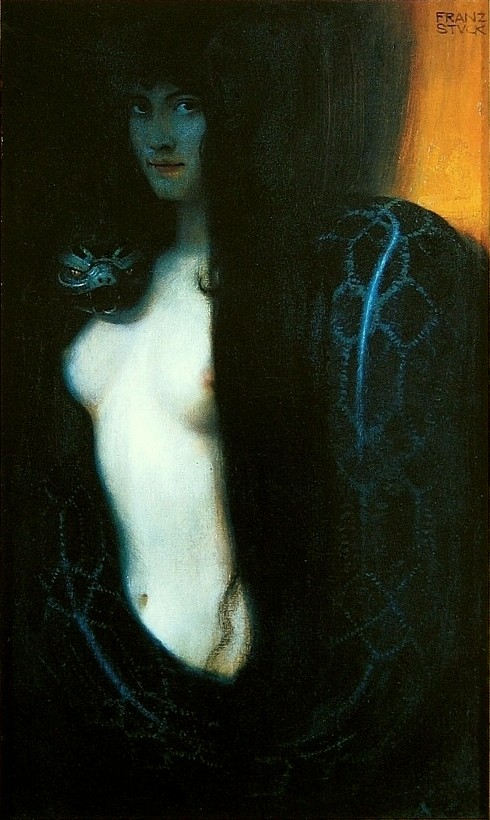
Lulu definitely has a liberation context, for women's rights were very much a part of the Munich Secessionist zeitgeist which was much more radical than the softer focus Viennese Secession. Read about Franziska zu Reventlow and follow the labels below for "Munich" and "women, feisty".  This was the world that inspired Wedekind, Franz von Stuck, and later Strauss and Brecht. Without Munich, we would not have Weimar Berlin. Lots on this site about Weimar, too, and the connections between Brecht and Berg.  Plenty on Weimar film, too, which is relevant in any consideration of Lulu.  See Mädchen in Uniform here. So I'm more than sympathetic with  Pountney's basic approach.

Lulu does say she found herself while she was in prison without men, and Countess Geschwitz talks of studying law and helping women. Berg, whose own sister was a lesbian and a rebel, could have been tongue in cheek quoting quite a few women in that period.  But is Lulu a real person or a projection of other people's fantasies? Is she even a sexual being ? She's had a traumatic life on the streets since she was 12.  She is like an abused child who has learned that sex is a means of survival, not a pleasure. Her seductions are a form of aggression, not lust.  She doesn't trust enough to love.What is her relationship to the decrepit Schilgoch, who like Berg is asthmatic? Not for nothing did the composer double Schilgoch with the Animal Tamer, and write in many references to composing and music.

Given Berg's obsessive compulsive fascination with patterns and secret clues, we can't take anything too literally. Lulu can be interpreted as a cryptic drama arising from musical abstraction.  Krzysztof Warlikowski's recent Lulu with Barbara Hannigan and Christof Loy's much misunderstood ROH production access levels in this amazingly complex opera beyond anything in this WNO production. 

Helene Berg may have guessed at the real danger in Berg's Third Act, which to my mind marks an almost revolutionary new phase in Berg's writing.The Paris scene, for example, starts with the "circus" imagery, but now extends to a wider political sphere. It doesn't depict prostitution per se, but the way society prostitutes itself in pursuit of illusion.  The stock market scenario is central to meaning. Everyone trades, no-one escapes. Lulu is not a free spirit at all.  Some dislike the Paris scene because it's so diverse, but the real meaning is in the music, which spirals in concentric circles.  Is Berg entering new territory where the idea of narrative becomes supplanted by musical drama?  When Berg brings the men back in new guises, he's extending the idea of illusion still further. Jack the Ripper, for example, bears little resemblance to the "real" Jack the Ripper.  The London scene brings Dr Schõn back, which is good symmetry. When I first heard the Third Act soon after its its completion, I couldn't make head or tail of it.  One of the insights of Loy's production is that it takes away the obvious markers in terms of costume, and makes you think about the rarified inner logic. 

The two act version ends with Lulu's escape from prison and her seduction of Alwa on the same sofa on which his father bled to death.  This would have felt right until the full extent of Berg's work was revealed.  According to Douglas Jarman, "Of the 1326 bars only 87 were not fully notated in Berg's short score and with one exception, all these "problematic passages" could be completed with Berg's intentions either by following the indications provided in the score or by doubling the instrumental parts". The exception he mentions is the barrel organ music in scene two, but Jarman says "an indication ...is to be found at the end of the Variation movement of the Symphonic Variations where the first four bars appear...in Berg's own orchestration".  So the Paris scene is true Berg almost in entirety and the barrel organ music is Cerha. Would we reject Mozart's Requiem or Deryck Cooke's performing version of Mahler 10 because they aren't 100% ? Earlier this year Daniel Barenboim conducted a "new" version of Lulu with major cuts, eliminating the Paris scene and the Animal Tamer, and adding spoken texts from Kierkegaard. The WNO production apparently uses a new edition prepared by Eberhard Kloke which changes the Paris Act which was original Berg. The emphasis seems to be to spotlight the prostitution dialogue between Lulu and pimp. Perhaps the WNO Lulu would have worked better in the two act version.

Wednesday, 27 March 2013

György Kurtág Kafka Fragments Linbury

György Kurtág's Kafka Fragments is on at the Linbury Studio Theatre, Royal Opera House. Kafka Fragments is an excellent way to experience Kurtág's highly distinctive music.  Like so much of the composer's work, Kafka Fragments is aphoristic, as cryptic as  epigram, as concise as haiku.

Kurtág and Kafka were made for each other. The "fragments" are taken from letters and diary entries, chosen out of context and often incomplete. Each snippet thus becomes an entity in itself, disassociated from context but rearranged with new relationships. Kurtág often speaks of games of chance. His puzzles fall into place when performers and listeners engage with what they hear.

Kafka Fragments is intriguing because it tests the mettle of those taking part. Performances are surprisingly frequent, though it would be hard to better Juliane Banse and András Keller, who developed their approach together with the composer himself. See my review of their Wigmore Hall concert in 2011. The Linbury Studio production should be good because Claire Booth is singing. She's the muse of contemporary British music. The violinist will be Peter Manning.

Best of all, I think, will be Netia Jones's production. Jones has created a niche for subtle semi-stagings which don't overpower the music, but obliquely hint at levels of meaning. Remember Oliver Knussen's Sendak operas Higgelty Piggelty Pop! and Where the Wild Things Are (reviewed here) ?. And her Before Life and After, a semi staging of Tippett, Britten and Finzi, which has become a perennial on the live circuit ? (reviewed here).  Of Kafka Fragments, Jones says "We are presenting projected translations of the text all the way through. You have to be able to read and understand the actual fragments to grasp their many layers and to know why Kurtág has set them the way he has. The projections also offer moments of illumination. It’s not just about casting light in a physical sense, but offering visual guidance to enable us to grasp the meaning better: fleeting moments when something is illuminated before the light goes off."

This is a completely different approach to Peter Sellars' staging reviewed here, which massacred the music, the composer, and the author. "I get my best ideas when I'm cleaning the bathroom" he told us at the pre-event talk. Whatever Kafka Fragments may or may not be, it's not literal!

ADDENDUM : I was surprised how well Claire Booth created these pieces. While Juliane Banse sings with cool detachment, intensifying the surreal nature of the snippets, Booth sings with feisty, combative vigour. Both approaches are valid. These fragments don't come from formal literature but from random jottings, which reflect Kafka the man rather than Kafka the artist.  Booth brought out the wry humour that Kurtág loves so dearly. It's almost central to his music. "Schlaft, erwacht, schlaft, erwacht!" How boring that routine is ! Kurtág illustrates it so the line sways mechanically like a wind-up toy.

Netia Jones's staging was good because it evoked a feeling of print on paper : images of typescript in black and white, sometimes clear, sometimes fuzzy, sometimes only emerging in short bursts. It made me think about the fragility of written words. These fragments could so easily have been lost, but Kurtág has preserved them. He doesn't tell us how the pieces fit together. That's up to us. It's like a throw of the I-Ching. The runes come up on set sequences, but interpretation is intuitive.  Jones gives us clues, like a shaft of diagonal light, over which Booth walks, as if on a tightrope. We know it's just a film projection, but the image suggests many things.  What I .love about Kurtág is that he opens up possibilities. Listeners who need rigid rules will never "get" his quirky wit.

Monday, 25 March 2013

Easter Weekend Highlights, London, Aldeburgh

Fancy something for the Easter weekend? A friend greeted me "Happy Easter", then corrected himself. "It's not about chocolate eggs and bunnies, it's a time for reflection". 

Good Friday is the only day in the Christian calendar when Mass is not celebrated. The devout pray and contemplate. Not everyone else needs to do so, though. This Friday, there are no less than three performances of Bach St John's Passion BVW 245 . Richard Egarr conducts the Academy of Ancient Music at the Barbican with James Gilchrist, Sarah Connolly, Christopher Purves, Andrew Kennedy, Elizabeth Watts and Matthew Rose. Stephen Layton conducts the Orchestra of the Enlightenment and Polyphony at St John's Smith Square. More unusually, at the Union Chapel, Islington, is Benjamin Britten's English language version of St John's Passion. David Soar sings, so that's reason enough to go. He's good.

 The London Handel Festival is on, too, which is a big event. Laurence Cummings conducts the London Handel Orchestra in Bach's St Matthew's Passion BVW 244 on Friday at St George's, Hanover Square. With Lukas Jablonski, Tim Mead and Anna Starushkevych singing, this will be worth going to. Historic setting, too - this was Handel's local parish.  On Monday, go for Handel La Resurrezione HWV 47 with the same singers. Adrian Butterfield conducts at the Wigmore Hall..

On Sabbath day in the Passover, Verdi's Nabucco at the Royal Opera House, to remind us of context.  Whether the timing was planned or not, I don't know, but it's good.

You could also steer well clear of the city and go to Aldeburgh, where there's a mini Festival this weekend. Christian Curnyn conducts Purcell Dido and Aeneas at Orford Church (not Snape). "The subject matter and the dominance of fate and faith may be rooted in antiquity, but Purcell’s genius assembles compelling dramatic tableaux round an axis of an intense human tragedy, love, leave-taking and lament, sorrow and solace. Removed from theatre or concert hall to a church that resonates to Britten’s own music dramas, these concert performances promise to envelop an audience in the work’s intimacy, power and lyrical beauty – what Britten referred to as ‘those very Purcellian qualities of clarity, strangeness and tenderness’.  Two performances, starting at 9 pm. Before that, Exaudi sings an eclectic programme built around Britten's Sacred and Profane.  It includes Harrison Birtwistle's  Carmen Paschale, where a "medieval text sees the natural dovetail with the divine. His celebratory motet – with birdsong organ solo – premiered ten years before Sacred and Profane at the 1965 Aldeburgh Festival."

Sunday, 24 March 2013

Complete Verdi - 75 CDs for £139.44

Seventy five Verdi CDs for £143.95 until 27th March when the price leaps to £169.99 !  Which still works out to around £2 per disc.  Postage (UK only) is a shocking £1.50. This set includes practically everything Verdi wrote, including orchestral and ballet music.  The choices are pretty good, too. For less than the price of a ticket to Don Carlo at ROH, you can get a complete reference library. At this price, libretti will not be included, but that's hardly a problem.  More details HERE.

A friend has also suggested 30 operas on DVD/Blueray for £499 going up to £550 HERE. 

Roger Quilter Shakespeare songs vol 1 Mark Stone

Roger Quilter's songs have special status in the canon of English music. Quilter (1877-1953) stands apart from the British music mainstream.He didn't have a choral or religious background. Independently wealthy, he trained in Germany, not in England. He found his niche in art song early, producing songs of graceful refinement, many of which are central to the English Song repertoire, and are frequently heard in recital and on recording. Until now, however, there has been no complete edition of his songs, so Mark Stone's latest series, The Complete Songs of Roger Quilter, is greatly welcomed.  Get it from Stone Records in hard copy or track by track HERE.

Quilter specialized in song, and set most of his songs to English poetry. In this first volume of this series of four,  Stone and his pianist Stephen Barlow focus on Quilter's settings of Shakespeare. Surprisingly, there are relatively few song settings of Shakespeare, given his status. Quilter set more Shakespeare than most composers. On this disc, we have Five Shakespeare Setting op 30, Three Shakespeare Songs op 6, Two Shakespeare Songs op 32, Five Shakespeare Songs op 23 and four individual settings. Quilter's choices include the extremely well known Come Away Death, Who is Sylvia, and Hark, Hark the Lark., and poems which have attracted few settings, like 'Tis St Valentine's Day.

Like Hugo Wolf, Quilter lets the poetry  shine with beautifully measured poise. Shakespeare's words in their natural language are so lovely that it's unwise to cloak them with excess verbiage. Quilter doesn't need to obfuscate. He gets straight to the point with delicate economy of gesture. Quilter's Hark, Hark the Lark soars to an ecstatic climax in 64 seconds, like an outburst of spontaneous joy, not unlike Wolf's Er Ist's.  Schubert's setting of the German translation, Horch, horch die Lerch, is exquisite, but it's more Schubert than Shakespeare.

Orpheus and his lute, being an anthem to music, has attracted many settings.  Quilter was an almost exact contemporary of Ralph Vaughan Williams and Edward German. In Quilter's setting the piano evokes the rich timbre of the lute, while German's version has a wilder sense of joy. Quilter was a generation older than Ivor Gurney and Gerald Finzi. Quilter's settings of Fear no more the heat of the sun  and It was a lover and his lass differ from RVW's and Finzi's, but all show how the same words can be used with different effects. It's also interesting to compare Quilter's When icicles hang on the wall with Thomas Arne's, 200 years before. Different times, different approaches.

Similarly, compare Quilter's I will go with my father a-ploughing with the setting by Ivor Gurney. Gurney was an outdoorsman, who responded to the poem with a setting evoking the joy of nature. Quilter's version is more circumspect, closer perhaps to the poet Joseph Campbell. Mark Stone includes in this disc Quilter's settings of Rudyard Kipling and Robert Louis Stevenson.  Sound sample below :

Friday, 22 March 2013

Mysterious Lutosławski Ravel Salonen Philharmonia

Esa-Pekka Salonen's Witold Lutosławski series at the Royal Festival Hall confirms his reputation as an authoritative Lutosławski interpreter. He knew the composer personally, but more importantly understands his idiom intuitively. In this superb concert, Salonen and the Philharmonia brought out the strange, intangible duality that makes Lutosławski's music so intriguing. Salonen's Philharmoinia series follows Simon Rattle's  Lutosławski series last year with the Berliner-Philharmoniker. Both conductors bring their own insights. Comparison is pointless. Salonen, however, has the edge because he stresses the elusive nature of the music. In this programme, he paired Lutosławski with Ravel with surprising results: Ravel has rarely sounded so magical.

Ravel Ma mère l'oye is best known as a ballet, but it's not necessarily episodic story telling. Instead of crude cartoon colours, Salonen and the Philharmonia produced luminous, gossamer-like textures infused with light.  If the tempi were a little slow, it was defined with real delicacy of touch, so it really did feel that the music was hovering in mid-air. This was Mother Goose for adults, with hints of hidden terrors.

In his extensive writings, Lutosławski said that we hear music in the context of our feelings. Salonen's Ravel thus created a mood from which Lutosławski 's Symphony no 4 (1988-92) flowed naturally. This symphony is short, but in 22 minutes it unfolds with the compactness of a much larger piece. Dark chords suggest foreboding. A solo clarinet appears, its bright textures luring us deeper into the piece. Strident strings suggest alarm, or danger : the pace quickens, pauses and returns with wild, driven legato. Strings like whips,  faced off by a solo trumpet, piano, and a trio of trombones.  Perhaps we are in some strange forest, where the flute flutters like an elusive woodbird.  The whole orchestra soars towards a wild climax, which suddenly disintegrates once more to solo clarinet and flute.  A short passage for small drum and percussion, oddly reminiscent of The Rite Of Spring and the music disappears, elusively. What might Lutosławski  be suggesting? Primed by Ravel,  I thought of Jean Cocteau's film  La Belle et la Bête.  Lutosławski's 4th is a Salonen speciality. He recorded it within months of the premiere. We were privileged indeed to hear him conduct it with the Philharmonia.

Matthias Goerne was the soloist in Lutosławski's Les espaces du sommeil (1975). This was written for Dietrich Fischer-Dieskau, but Goerne is well on the way to putting his distinctive stamp on the piece.  The text is by Robert Desnos, the surrealist who died in Terezin. Lutosławski's setting has a hallucinatory quality. Extremes of pitch and volume unsettle any sense of repose. Fischer-Dieskau's voice has a lovely smoky quality on his recording, but Goerne's approach connects more deeply to the character of the music. "Dans le nuit....les forêts s'y heurtent confusément avec les créatures de légende  et cachées dans les fourrées." Goerne begins with a half whispered growl at the lower end of his register, blossoming forth into bright, clear colours that dissipate as soon as they're uttered.  Goerne makes us listen to the composer, rather than to the beauty of the singing per se. His voice is dignified, suggesting the hypnotic pulse of sleep, while his sharp diction reminds us that the mind is alert.  Les espaces du sommeil is a lovely piece but its true wonders lie in its mysteries. Protracted applause after this piece, and shouts of "Bravo!" which we don't often hear from staid RFH audiences.

Lutosławski's Chain 2: Dialogues for Violin and Orchestra (1984-85) is one of three otherwise unrelated pieces in which the composer explores the idea of a "chain" formed of interbraided links. It is almost more than straightforward concerto. In Chain 2, as Charles Bodman Rae writes in hisexcellent notes, "the strands are independent both melodically and harmonically, and their phrases begin and end in different places. The trick is in combining them into a coherent whole."  Jennifer Koh was the soloist, playing with great verve and freedom. Some passages reach such high tessitura that one thinks of Szymanowski, though that might not be deliberate on Lutosławski 's part. The two composers may be Polish, but they occupied very different worlds.

Salonen and the Philharmonia concluded with Ravel's La Valse. My companion had heard snippets of this as members of the orchestra were tuning. We wondered, surely they must know the work so well they hardly need to practise?  Perhaps the reason was that this wasn't any ordinary La Valse, but a much more unusual interpretation. This waltz sounds as if it were being heard through a dream, a dance recreated through the prism of memory and distance. Ravel himself described it as "an impression of a fantastic, fatal whirling motion"  Just as we'd heard Lutosławsk's Fourth through the prism of Ravel, we now hear Ravel through the prism of Lutosławski.  Mysterious, elusive and surreal. 
 
 Photo : Włodzimierz Pniewski & Lech Kowalski 1992

Thursday, 21 March 2013

Perceptive overview of books on Britten

It's Britten's centenary, and there's a big demand for books about him.  But there;s precious little "new" information to unearth. The sensationalist syphilis story has been thoroughly debunked. It's a great angle for the prurient public but bears little relationship to reality. I'm quite appalled at how superficial, and even homophobic, some of the material is.  Read my article Pink Triangles and Britten biography HERE. There are so many aspects of Britten that could be explored, like his relationship with his father, and his connections to conventional British music circles. In the absence of new information, there's an even greater need for interpretive depth. That demands more academic rigour than tabloid journalism. It also benefits from genuine musical awareness. At last, HERE  is an perceptive analysis, worth all the other "reviews" put together. Indeed, I might say, more perceptive than some of the books.


Wednesday, 20 March 2013

Zamponi Ulysses on the Island of Circe

Last chance to catch an opera you may never hear again : Giuseppe Zamponi's Ulisse all'isola di Circe. "Né probablement à Rome vers 1615, Gioseffo Zamponi fait carrière dans les Pays-Bas du Sud en entrant, en 1648, au service de l’archiduc Léopold-Guillaume, gouverneur des Pays-Bas. Son opéra Ulisse nell’isola di Circe, le premier opéra de style italien joué dans les Pays-Bas du Sud, est créé à Bruxelles le 24 février 1650 lors du mariage de Philippe IV d’Espagne avec Marie-Anne d’Autriche. On sait que le spectacle fut rejoué à Bruxelles, en 1655, pour la reine Christine de Suède, avant d’être ressuscité en 2006 ". Strange choice for wedding music since Circe was a sorceress who murdered her husband and lives imprisoned on an island where she weaves sinister spells, surrounded by savage beasts who are in her thrall. When Ulysses's men land on the island they are turned into pigs. One wonders who the lions and wolves might have been ? Many rare operas are rare for a good reason, but Ulisse all'isola di Circe is a genuine discovery.

Perhaps it's because the performance is exceptionally good. The ensemble is Clematis, highly respected European baroque specialists. Clematis is conducted here by Leonardo García-Alarcón, who helped found the group in 2001. Why Clematis?  Clematis  is "a delightfully scented flower that represents the principles of idealism and of creativity. Such a name for an ensemble specialising in baroque music is more than justified, for it is creative in that this repertoire can only live if it receives an interpretation based on inspiration and renewal; it is idealistic in that such creative inspiration must of necessity be based on a great respect for the work as it appears in its original sources."  Poetry like that perfectly describes their grace and refinement. Period instruments are unfairly maligned because they are misunderstood, but they are essential to the whole baroque aesthetic. This performance is outstanding. a perfectly poised balance of energy and refinement, Instruments and voices blend in perfect rococco elegance. Listen to battaglia and to the "distorted" music that describes the effects of Circe's magic potions, and to the ballets which would have been integral to the opera.

The soloists are high level too. Cappella Mediterranea is another specialist ensemble whose members work closely together as well as pursuing separate careers. Céline Scheen  sings Circe and Furio Zanasi sings Ulisse. Interesting sexual tension between them : attraction and repulsion in equal measure. Dominique Vlisse, the countertenor, sings Argesta, doing a long monologue in an "animal" voice. Indeed, lots of "animal" noises and banter in this opera, which must be why it was once so popular. Venus (Mariana Flores) and Mercury (Zachary Wilder) intervene. Baroque was not boring ! This performance took place at the Opéra Royal de Wallonie in 2012. Catch it on BBC Radio 3 for a few more hours. 

Tuesday, 19 March 2013

Verdi I Lombardi - UC Opera Bloomsbury

Don't miss UC Opera's Verdi I Lombardi at the Bloomsbury Theatre.  I Lombardi and Nabucco are almost companion pieces, and the Royal Opera House is doing Verdi Nabucco from 30th March, on a much grander scale, for Nabucco suits grand designs. So if you're going to the ROH Nabucco, it's worth seeing the UC Opera I Lombardi as background.
 
Visually, the UC Opera I Lombardi i is so striking that it would stun audiences in bigger houses with better facilities. The drama starts with a simple, dark backdrop, a monochrome tower, a bright telephone box. The impact is immediate. Verdi set I Lombardi at the time of the First Crusade to conceal its message at a time when much of Italy, once the seat of the Roman Empire, was ruled by foreign powers.This isn't really a battle between Lombardy and Antioch. The Lombards are tearing each other apart with rivalries, rather than facing their true enemies. In Verdi's time, Italy was a disunited conglomeration of small states that could not rise above petty self-interest towards a greater goal.

Although Christian themes dominate the opera, I Lombardi is not anti-Muslim as such.  Oronte, the prince of Antioch, becomes a Christian without much inner anguish.  One can read a nod here to Italian nationalism, since Italians dominated the church, although the Austrians, also Catholic, dominated the state in Northern Italy.Verdi must have been aware of the impact Griselda's hymn to the Virgin Mary would have on audiences. Caught up in reverence, they might, for a moment, forget the pettiness of worldly values and unite in the contemplation of more noble ideals.  In the chorus "Jerusalem !", nearly everyone on stage joins in unison, transfixed by the vision before them.

This staging, designed by Will Bowen, directed by Jamie Hayes, and produced by Rosie Hughes, places the action in a land that hovers between modernity and a fading memory of the past, just as Giselda inhabits an alien land far away from her origins. Phone booths are relics. We don't communicate like that much now.  This is an allusion to the theme of nostalgia that runs through the opera and fuels visions of an idealized future.  The Tower is a Victorian photo of a real pub in The City of London, which you can still visit.. Once it was a tavern where cock fighting took place. It's a subtle detail but cogent. The Lombards are acting out a cock-fight on a grand scale.

Ellan Parry's costumes also follow this theme of unspecified timelessness.  We could be at any time in the last century, or in the present. The men wear sharp suits, as so many Italians aspire to, but preen themselves on machismo. Without true religion, crusaders are no more than street gangs spreading their turf. At the end, chorus and remaining soloists stand together, their faces shining as they contemplate Jerusalem, at last within sight. We don't need to see a mock up. We can hear it in the orchestra and in the voices of the singers, and see it in their shining faces. Jerusalem isn't a physical place but a state of mind.

 UC Opera is part professional, part amateur so the performances were good enough. Charles Peebles conducted. Katharina Blumenthal sang Griselda with firm assurance. John Mackenzie sang Pagano/the Hermit, pushing a supermarket trolley with neon cross. This was wittier than you'd expect. Pagano means "pagan", and the Hermit is an outsider, who has taken a vow of poverty. In these drab surroundings, the jewel colours of the cross shone even more brightly. Jeff Stuart sang Arvino and Adam Smith was a heroic Oronte.  Sally Harrison sang Viclinda and Carola Darwin sang Sophia. Andrew Doll sang the Prior. Edward Cottell sang Pirro  and Joseph Dodd was a distinctive Acciano.

For more information, see the UC Opera website.
Read the full review here on Opera Today


Royal Opera House - new Executive Director

The Royal Opera House has just announced that Alex Beard will take over as Executive Director, after the departure of Tony Hall. Beard is a surprise choice but that's refreshing - he doesn't come from the usual performing arts cliques, and doesn't owe anything to anyone. A position like this needs someone with fresh objectives, who can support the  new creative management at ROH, without too much baggage of his own. Beard is currently Deputy Director of the Tate Gallery,  and its nation-wide group of galleries, which gives him experience broader than "just" London.  The Tate is huge, and financially solid, which is more than can be said for many organizations.  Beard is also on the board at Glyndebourne, so he knows opera, opera patrons and how the business really works from inside.  He's also only 49, despite his long experience, which may suggest he has a good future ahead of him.

"He brings a wealth of managerial experience from his very successful partnership with Nick Serota at Tate, as well as the insights and perspectives that this role has given him.", says Simon Robey, Chairman of the Royal Opera House Board of Trustees. "I am confident he will forge excellent partnerships with our artistic leadership and our executive team, and that they will, together, lead the Opera House to still greater heights.”

Beard wasn't the person I was dreaming of when I speculated on who might be the new head at ROH. That man was more of a wild card, being so "European". Some of the other possible candidates were interesting, some would have been bad news. So Alex Beard looks like an inspired choice.

Monday, 18 March 2013

Wagner Die Feen Chelsea Opera Group

The Chelsea Opera Group brought Wagner's Die Feen to the Queen Elizabeth Hall, London.  Although some of the singing was very good indeed, the performance was, to be kind, somewhat  rough and ready. But this was precisely why it entertained. Wagner's Die Feen was written when he was only 20.years old. It's a work of exuberant teenage enthusiasm. To give it the polished sheen of his mature work would spoil its naive charm.

Growing up in Leipzig and Dresden, there was no way Wagner would not have been influenced  by Carl Maria von Weber. Echoes of Weber keep resounding throughout Die Feen, making us recognize just how great a debt Wagner owed Weber and the whole early Romantic aesthetic, which itself stems from the baroque. That's why it is essential to appreciate operas that might not be "modern taste", like Der Freischütz. Listening through the blinkers of modern taste is bigotry. We can't appreciate Wagner fully without understanding his roots. Although we recognize references to Mozart and Beethoven,  the Weber references dominate. Weber, Mendelssohn and Schumann might have been heading in terms of creating new forms of music theatre. We're blinded by modern taste to think mainly in terms of late 19th century style. Die Feen is interesting because it shows Wagner working within Weber's style without much success. The ensemble writing, for example, isn't elegant.  We need to wait for the quintet in Die Meistersinger before Wagner releases true good-natured harmony. 

It's also interesting to hear how much Die Feen suggests about Wagner's later work. Even at this early stage in his career, Wagner is not following conventional icons, but developing his own. Ada is half-fairy, half-mortal, like Loge. She must hide her identity from Arindal, though they love each other and have raised a family. Lohengrin merely sails away from Eva on his swan-ship. Arindal and Ada are cursed with a ferocity that makes the curse of the Ring look tame. Ada is imprisoned not by a ring of fire but by a block of stone, from which she can only be released by love. The fairies in Die Feen are warrior-like precursors of the Valkyries. Even Lora, Ada's sister, is formidable, more Brünnhilde than fairy tale princess.

Some of the best music in Die Feen is written for the female voices. Ada's call for action is stunning, then completely upstaged by Ada's long, stirring monologue. It feels like a duel between voices as well as between roles. For me, Act 2 made the whole evening worthwhile.  Kristin Sharpin, as Ada, in particular, was impressive, especially the Hélas! monologue, with its sudden leaps up the scale. There's Hélas chorus, too, but the solo writing is infinitely sharper. Why don't we hear more of Sharpin? It takes some doing to trump Elisabeth Meister, whom we all know and love, and who was a superlative Lora. But Wagner gave Ada the bigger part. 

David Danbolt sang Arindal, another huge part complete with mad scene, a reference to Orlando Furioso, where the hero is unmanned by love and grief.  Early Romantic plots may seem ludicrous to us, but to audiences in their time, elaborate plots reflected the sagas of the baroque.  When Robert le Diable came to London, someone sneered that the production didn't take the opera seriously enough. But neither did Meyerbeer nor the generations who flocked to performances. The idea that everything has to be realistic, or that every word counts is an affectation that stems from much later. Wagner created the revolution, but he learned to do so from the early Romantic interest in individualism, poetry and philosophy.  

Good cameos from the soloists who included Mark Stone as Morald, Lora's lover, Andrew Slater as Gernot  and Andrew Rees as Morald.  Emma Carrington sang Farzana and Eva Ganizate sang Zemina, Ada's fairy handmaidens who resolve the convoluted plot by showing Arindal how to save Ada.

I'd really like to hear Die Feen with period instruments, to release the rambunctious energy in the opera. It isn't a great opera by any means, but if all we ever listened to was "great", our culture would be impoverished. In this Wagner anniversary year, we don't necessarily need more re-runs of repertoire we already know. Despite the ropey orchestra and chorus, this Die Feen was worth hearing because it was done with such enthusiasm. Better that a million times than stilted, superficial performances that take themselves too seriously and teach us nothing. The Chelsea Opera Group are largely amateurs, so it's much more important that they're emotionally engaged and enthusiastic. Please also read Mark Berry's review, which will also appear in Opera Today.