Monday, 15 August 2011

RATS! Bayreuth Lohengrin

Of course we all know Lohengrin, don't we? Or do we, really? What a shock is this Bayreuth Wagner Lohengrin on Siemens TV available until 30th August.  (My full review HERE) Of course millions will be screaming, running, like rats, for the exit. But think again. What is Lohengrin really about? What kind of folks inhabit Brabant? They're pretty gullible, assuming Elsa must be a killer because Telramund says so. Then out of nowhere a hero materializes, but why and for what? His name and background are the least of the questions we should be asking. This production, directed by Hans Neuenfels is so unusual it had me rushing home to check the score. And guess what? Neuenfels isn't wrong. We're just so jaded that we forget just how bizarre Wagner's Lohengrin really is.(photo by Janet Stephens - many thanks!)

The whole Montsalvat craziness, for one thing. It's not Christian but blasphemy, and here's it's grafted onto fake-medievalism.  The story predicates on saving Elsa and saving Brabant. But who are the Brabanters and why are they worth saving? Depicting them as rats is a brilliant idea because these rats have personality and are funny. Suddenly, they're sympathetic and....human. The opposite of the po-faced nonentities we usually see who might be painted on a backcloth for all they contribute. Once we start caring about the rats, the Lohengrin story takes on whole new levels. And there's precedent in Wagner himself. Lohengrin isn't quite part-human,  part-swan but he's certainly got strange DNA. So rats that switch from rat to human and back aren't so odd at all. Besides, Neuenfels makes lots of references to other Wagner oddites. And the shock ending! It takes the Parsifal myth to its logical conclusion. This new Virgin Birth is no kinkier than anything else in Montsalvat.

Coming away from Neuenfels, I'm more fascinated than ever by the breadth of Wagner's imagination. What kind of brain came up with plots like he did. And there's a lot more humanity and social responsibility in this Lohengrin than meets the eye. Get past the rat suits and there's a much deeper parable here than you'd expect. Film wise, too, this is excellent. Making opera into film is a new art form. This one shows how well it can be done (photo by Janet Stephens - many thanks!).  HERE IS THE FULL REVIEW (click on link)

Sunday, 14 August 2011

Vítezslava Kaprálová - songs of Czech independence

Vítezslava Kaprálová was five years old when Czechoslovakia gained independence. She left the country before the Germans invaded in 1937, and died in Montpellier, soon after the fall of France. Like the first Czech Republic's, Kaprálová's life ended far too early. Kaprálová is largely forgotten, for anyone who dies aged only 25 leaves little for posterity. They haven't had a chance to fulfil their potential. Kaprálová's known today mainly for having had a brief affair with Bohuslav Martinu, but what music she did leave behind is surprisingly mature.

Kaprálová was born into Czechoslovakia's musical elite. Her father, Vaclav Kapral, was a composer, her mother a singer. They knew everyone in close-knit Czech musical circles. Kapral was a student of Janáček, and contributed an article on the elder composer's choral music in a magazine celebrating Janáček's achievements. Evidently young Kaprálová heard or read the scores of everything Janáček wrote, and no doubt was familar with a great deal more. She came into contact with almost every big name in Czech music circles, so perhaps it was inevitable that she was something of a child prodigy. She started writing her own music from the age of 9 and entered the Brno Conservatory aged 15.

Kaprálová's chamber music is becoming fairly well known because it's original and lively. There's only one recording of her vocal music, however, "Forever Kaprálová" with Dana Burešová (soprano) and Timothy Cheek (Supraphon 2003). You might do well to track down the printed scores because the recording is no great shakes, but some of these songs are so interesting that they should make their way into the repertoire.

Two songs, Morning and Orphaned, were written when Kaprálová wass a teenager. Simple and unadorned, but better that than the over-ambitious pieces young people usually attempt before they learn that less is more. Nonetheless, the songs aren't innocent, for the composer, though young, is well aware of the the way composers around her didn't ape folk idiom but adapted its spirit. Sparks from the Ashes op 5 (1932-3) is a cycle of four songs to texsts by Bohdan Jelinek, a mid 19th century poet who only lived to age 23. The texts are quaintly archaic, the setting isn't. 

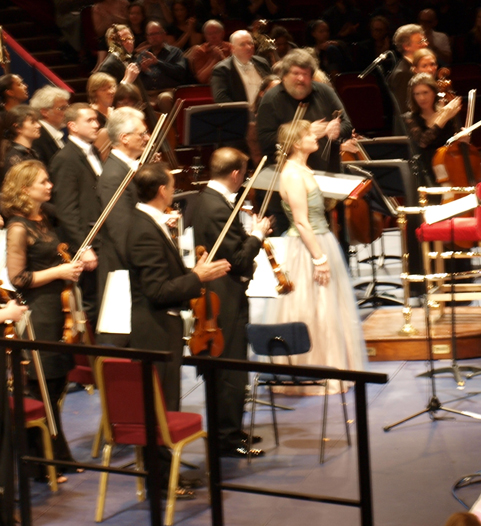
Even better is January, for voice, piano, flute, two violins and cello (1935, the month  when Kaprálová turned 20. This is a beautiful piece, the non-vocal writing exquisitely balanced. Kaprálová was a conductor from her teens (see the photo) and knew how music works in performance, not just in theory. Sophistication in the choice of text, too. The poet is Vítězslav Nezval (1900-58), whom Kaprálová probably knew personaly. He was a musician who studied with Janáček but is better known for his association with the thriving Czech avant garde in the 1920's and 30's, where literature, music and gilm art flourished in a kind of Czech renaissance largely unknown to anglophones. "In the night the frost painted on my window a delicate vase. I am horrified of winter days and vases!" The protagonist sees frozen virgins in a boarded up house, a chill church organ, ceilings falling in. Exquisite balance, the instruments (especially seductive cello) curving round the voice, slowly encircling it. And this is just Kaprálová's op 5!

An apple from the lap is another group of four songs to texts by Jaroslav Seifert (1901-86) another avant garde liberal and colleague of Nezval - Kaprálová chooses contemporary texts, nothing safe or easy. Here, the piano figures are exuberantly quirky, pointing to deeper levels in the imagery.  Kaprálová then takes a creative leap forward. Navždy (Forever)(1936-7) is a 4 song cycle."Wild geese are flying south. Someone is leaving soon and will never return". Obviously Kaprálová didn't know that in leaving for Paris to study with Charles Munch and Nadia Boulanger, that she'd never really return home. Yet there's nothing maudlin about it. In Ruce (Hands) also to a text by Seifert, the protagonist imagines her hands shaped like a lyre, combing through her lover's hair."Then the world fell with us into an abyss...we drank the last drops of wine in Canaan". Like her poets, much older and cannier than she is, Kaprálová mixes different moods deftly. Listen to the piano part in Ruce, where the pianist's hands create another new image, reinforcing the spirit of the poem.

Sbohem a šáteček (Waving Farewell) exists in both piano song and orchestral song. Below, I've added a clip of the latter, sung by a tenor. It's infinitely deeper than the soprano version on the CD I'm refering to. It's a masterpiece. The text is Nerval, not symbolist, but extremely sophisticated emotionally. Two people are parting, knowing they may never meet again. Yet no sentimenatlity. Czech is a language that bristles with consonants and sharp, pungent stresses, nothing like English with its tendency to fluid approximation. "...A waving farewell! Carry on, fate!" the last defiant cry.

Kaprálová's ability to write different moods is demonstrated in several songs that follow, ranging from a Christmas song written for her parents, to cheerful songs of nature and birds, to a beautiful, bell-like Alleuia to songs where melancholy is hinted at, while spirits are held high. There's also a song in memoriam Tomáš Masaryk, probably also an acquaintance though not an intimate.

By 1937, Kaprálová has moved to Paris. She's poised to begin a promsing career. The final song Dopis (Letter) was written four days after Kaprálová's marriage to Jiri Mucha, son of the artist Alphons Mucha, who created Czech art nouveau.  It's tempting to read coded meaning into the song, because it's about a lover rejecting someone who has let them down. Since we don't know what really happened between Kaprálová and Martinu, and why she married Mucha, we can't really speculate. Kaprálová had written songs to strong-minded poems of farewell before, like Sbohem a šáteček and With a white handerchief he waves, one of the group of Vteřiny (Seconds) songs. Had she lived, dare I suggest, Kaprálová might have eclipsed Martinu altogether, much as I like him, as she was such an individualistic original.  We don't know, but we can sing the refrain from The Years are Silent  . "The years are silent, the years go by, the song doesn't die away".


Friday, 12 August 2011

Elgar Caractacus Worcester Three Choirs Festival

"Watchmen alert!" sing the massed choir. Right from the start, Elgar's Caractacus begins defiantly. "The Roman hordes have girdled in our British coast". Then Caractacus takes up the call. "Watchmen alert! The King is here!".The Romans have invaded Britain. Legend has it that the Britons' last stand took place at what is now known  as the Herefordshire Beacon, where the  remains of ancient fortifications can be seen atop a hill with panoramic views over the Malverns. (photo copyright Bob Embleton)

The Britons were facing a crisis situation, but in 1898 Elgar's Britain was at its peak. Basking in the certainties of their manifest destiny, Victorian Imperialists didn't register the irony that they were themselves doing to others what the Roman Imperialists did to their ancestors. In the last big chorus, Elgar's text specifically mentions "the flag of Britain (and) its triple crosses", ie the Union Flag which didn't exist until Stuart times, and British dominion "O'er peoples undiscover'd, inlands we cannot know". The truculence of this oratorio might inspire The English Defence League who clearly forget that if it hadn't been for Empire in the first place there wouldn't be immigration now. Indeed, Caractacus and his tribe were only one segment of a Britain populated from time immemorial by Celts, Picts, Angles, Saxons and other migrants to come. Hearing Caractacus, we can appreciate the pain Elgar experienced when the 1914-18 War destroyed the world he had known before.

At the Three Choirs Festival at Worcester Cathedral the audience is far too fundamentally decent to support the violence of the Far Right. This is what is great and good about the British spirit, and about Three Choirs, where it thrives so well. The locals were discussing the murder of three Muslim youths who were defending the whole community during the riots. We're all British together.

Elgar's Caractacus was very much inspired by the spirit of the landscape around him in the Malverns. The text may be violent, but the music is gloriously pastoral for the most part. The "Woodland Interlude" that begins Scene III is short, but its verdant loveliness pervades the entire work. The Druids worshipped the forces of nature. Dense woodlands were sacred to them just as Worcester Cathedral is to the modern faithful. For Elgar, nature and landscape were almost sacred too. He wrote to a friend (who appears encoded in the Enigma Variations), "the trees are singing my music- or have I sung theirs?"

"The air is sweet, the sky is calm" sings Caractacus, "all nature round is breathing balm.....O spirits of the hill surround, with waving wings this holy ground". Peter Savidge's firm intonation carries authority naturally, without being forced. His diction is so clear that it cuts through the choirs, decisively. He creates Caractacus's character with warmth and sensitivity, more faithful, perhaps to the spirit of the Druids than to High Victorian arrogance. Just listening to Savidge, you can understand why Claudius, the Roman Emperor, was so impressed by Caractacus's moral strength that he treated the Britons with respect. Savidge's O my warriors! was expansive, yet surprisngly tender. Truly "a freeborn chieftain and a people free  ...(whose) soul remains unshackled still"."  

Elgar's forte is the orchestral extension of text, so performance stands or falls on orchestra and conductor. Andrew Davis and the Philharmonia were superlative, technically brighter and sharper than the London Symphony Chorus were for Richard Hickox on their recording almost 20 years ago. Davis delineates the underlying themes so precisely that the music seems to come alive, whispering meaning much as the trees the Druids worshipped whispered meaning to them. Tight dynamics built drama into what might otherwise be fairly stolid Victorian melodrama. When this performance is broadcast on BBC Radio 3 in September, after the Proms. Make make sure to listen, because this is the new benchmark. Hopefully, a recording may be made available. Worcester, and the Three Choirs Festival are sacred ground to Elgar enthusiasts.

What makes the Three Choirs Festival unique, however, is the quality of the choral singing, which is the whole raison d'être behind this 300 year old tradition. Although at moments it wasn't easy to make out all the text, the fault lies not with the voices nor with the choirmaster but with the text itself. English is a language which lends itself to vowels rather than consonants, so it's easy to approximate vocally, which is why it's near universal today. There were many Caractacus figures in Gaul and in the lands of the Franks, so in theory there might be similar works in French or German, but they'd sound completely different. Caractacus and Nabucco share similar ideas, but Verdi and Elgar could not be more dissimilar. The relative imprecision of English makes the Triumphal March sympathetic. The Britons are a ragged bunch of wildmen, very different  to the sophisticated Roman Court, yet they win out since Caractacus is a level-headed fellow.

Brindley Sherratt sang Claudius with such rich resonance that he brought out the depth in the Roman's personality. The Romans may be the enemy, but Sherratt shows what a fundamentally civilized man Claudius is, for he can show mercy without compromising his power. Stephen Roberts Arch Druid/Bard was also deeply impressive.  Judith Howarth reprised Eigen, Caractacus's daughter. Her voice is in excellent form, still pure and sweet though it's been 20 years since she sang it with Richard Hickox. In  At eve to the greenwood she managed the sudden leap up the register with aplomb. Even better was her When the glow of the evening. Ben Johnson sang Orbin, the Druid whom Eigen is in love with. Johnson's very young and this is a fairly demanding part, so he did very well indeed. His bright tone is matched by good Italianate looks and an expressive face - perhaps someone to cast in operatic roles?

Listen out for the BBC Radio 3 broadcast of the Three Choirs Elgar Caractacus as it's superlative. In the meantime, below is a clip from a 1928 recording by Peter Dawson, which Elgar himself would have known. It's But Rome and all her Legions.  It epitomizes the good and the bad in the whole oratorio. The text is lumpen, but listen to the gloriously Elgarian grace in the orchestration. Think of the Dream of Gerontius and read my analysis of that here. More formal review of Caractacus Elgar here.


Thursday, 11 August 2011

Daniel Barenboim Nobel Peace Prize?

Daniel Barenboim has been nominated by the Argentine Government for a Nobel Peace Prize. This should be controversial, as the problems in the Middle East are pretty much intractable. No-one's going to solve anything for a long time. But Barenboim and his friend, the late Edward Said, a Palestinian Christian, had ideals. If people's hearts and minds can be changed, maybe there's a smidgen of hope. Goethe was their inspiration. Thus the choice of Weimar as neutral ground, bringing young people together from all over the Middle East to work together on music, which is non-political and non-partisan. These musicians, though young, are chosen for ability, and work with experienced mentors and musicians. So intense are the pressures on these young players that publicity can put them in danger. In any case, the West-Eastern Divan Orchestra is about the experience of being together. Sometimes, you'd think, when people can't get food, medicines or safety, why invest in music?  But for some of these players, committment to music is as necessary as life. Given the extreme conditions under which some of them live, their very involvement involves an element of courage. And Barenboim himself, too, who doesn't need to prove anything artistically.  He's achieved so much already, he doesn't need money or image, but I think he's acutely aware that idealism is more important.  His books are a turgid read, but his heart is in the right place. (Said was a better writer, it was his job.) Barenboim doesn't run from controversy because he has integrity.  If Barenboim does win the Nobel Prize, he'll come under pressure, but that's all the more reason to respect him.

Mongolian Throat Singing Wars

Mongols, Tuvans, Siberians, Russians and Chinese are at each other's throats over who should register throat singing as part  of UNESCO's register of "the intangible world heritage of humanity".  Western opera fans talk about chest and head voices but throat singing is the ultimate physical use of voice. It's done by using lots of different muscles to shape sound as it moves from lungs through mouth. Once heard, never forgotten.  As you can read from this Mongolian site, there are lots of different variants, just as there are many styles even within genres of western singing.

The Mongol nation once ruled the world. Think Kublai Khan and Attila the Hun, the latter a symbol of many nomadic nations that inhabited central Asia, marauding on each other. That's why the Great Wall of China was built, to keep them out. It didn't work. What a wonderfully rich heritage for a nomadic lifestyle. The Mongols, in a sense, were early "world citizens". So the scrap over who gets UNESCO to register throat singing is a bit of a conundrum.

Western concepts of nationality and fixed borderlines are irrelevant. Cultural identity transcends the sort of boundaries bureaucrats relate to. UNESCO heritage status is important because it is an obligation on governments to put resources into protecting and preserving. Suzhou kunqu opera, which got UNESCO heritage status a few years ago has thrived under this committment. So the problem is that governments and nations aren't the same thing. The idea of nation-state is a fundamentally western concept, and doesn't necessarily apply. Not even in the west. But it shapes the way we percieve things. Western cultural imperialism is so pervasive that we don't even notice.

The  Mongol nation exists in several different jurisdictions. Inner Mongolia, for example, and China have been linked for centuries. The Mongols conquered China, founding the Yuan Dynasty (1271-1368). Instead of bringing Mongol culture to China, the Yuan became fervently Chinese. Similarly, the Manchu, another nomadic nation, conquered China in 1644. Although the Yuan and Qing Dynasties ended, they are still part of one vast heritage. Where does one culture begin and end? Since such issues can never really be resolved there will always be tensions and rightly so. Strictly speaking, no-one owns a culture, because cultures are too diverse to define. Nomadic, one might say, constantly adapting and shifting locale.
The way technology is changing the world, we're all becoming nomads now, our heritage shared through many threads.

Wednesday, 10 August 2011

Bridge, Holt, Saint-Saëns Roth Prom 34

Whatever the rationale behind the programme of BBC Prom 34, eclectic François-Xavier Roth conducted BBC NOW with panache. They sound invigorated and inspired. Listen again HERE. 

Frank Bridge's Enter Spring made a wonderful opening statement. Enter Spring is contemporary with Janáček's Sinfonietta. They're inspired by different things, but both reflect the optimism of the late 1920's. That we know what was to come next makes that optimism all the more poignant. Bridge isn't miniaturist or insular. Birds sing in these hedgerows, perhaps, but Bridge's perspective is the boundless sky, the windswept expanses of the Sussex Downs rolling out towards the sea. What glorious freedom! Definitely not "drawing room" or stylized pastoral. You can understand why young Benjamin Britten, at the premiere, was blown away, and never lost sight of wider horizons. It's a sophisticated work - listen to the deft, almost modernist woodwind passages and the way they flow into broader strokes for full orchestra, marching progessively, relentlessly to the finale. Roth cuts the last moment defiantly - no messing about!

Bridge's Blow out, you bugles! is interesting too for it sounds almost more like improbably early Britten or Gerald Finzi. The vocal line is dominant, Bridge observing Rupert Brooke's poetry with great sensitivity. When the trumpets enter, they can't, then, feel triumphant. One chord is held long enough that it contradicts the idea of a bugle calling violently for action. Deeply ironic. Then the voice does a similar leap ("heritage"). No mistaking where Bridge's sympathies lay. Ben Johnson was the tenor.

Simon Holt's Centauromachy received its Proms and London premiere.  It's already created quite a buzz since it was first heard in Cardiff last year. Read what I wrote about that premiere. It's a fascinating piece because it predicates on duality. It's a double concerto. Flugelhorn and clarinet duel, stalking each other and seductively duet. A centaur is half man, half beast, two states that don't resolve. Holt's music is intriguing because he lets the balance hover. Like Bridge, Holt opens outwards into new dimensions. Is man trapped within beast, or beast trapped within man? Holt may be suggesting that there are things we'll never know for sure, but must keep an open mind.

Only in the second half of the Prom did the logic of this programme really emerge. Saint-Saëns' Organ Symphony might have been written for a cathedral and a very academic organist but in some ways, it's an interior "open horizon". The Royal Albert Hall organ is never timid. Here, Thomas Trotter made it sing gloriously, of a spiritual landscape so glorious that it surpasses anything physical. Forget the cliché about Anglo-French Entente Cordiale. Nationality means nothing in the face of the sublime. 

Tuesday, 9 August 2011

Gardner, Mahler Das klagende Lied Prom 32

Brahms and Mahler: two composers who most adamantly didn't write opera. Edward Gardner's built his success on conducting opera, so Prom 32 was worth hearing to learn how Gardner would shape things. At his high profile debut at the Barbican five years ago Gardner conducted Walton's Symphony No 1, apparently one of Gardner's favourites but one of my least favourites. He made it come over as sincere and heartfelt. Maybe the sincerity came from Gardner himself, but that was no bad thing since it enhanced the good performance. Listen HERE.

Brahms's Violin Concerto is a much greater challenge than Walton, especially with a soloist like Christian Tetzlaff, who played with the freedom that comes from knowing the piece intimately. Beautifully poised, yet personal.  In the cadenza you could imagine Joseph Joachim playing with Brahms in attendance. Gardner and the BBCSO supported him genially - a perfectly valid reading. Making a piece as familar as this sound fun is no mean achievement.  Pity the pause after the first movement was extended to let in hordes of latecomers. If they can't be bothered to check start times, they shouldn't be allowed to spoil the music for others. Note to BBC: enforce wait til interval.

Mahler's Das klagende Lied is a wise choice for any conductor with an opera background, since it's a work where someone with a feel for voice can offer much. It was Vladimir Jurowski's great triumph, when he opened the South Bank season in 2007, and repeated wonderfully in 2010. Because it pre-dates Mahler's symphonic output, interpretation doesn't necessarily depend on profound insight into the composer's trajectory. Das klagende Lied is a magical cantata, not all that far from what Weber, Mendelssohn or  Schumann might have written. Knowing Mahler's predecessors - especially Schumann - is a valuable key to understanding Das klagende Lied, because even at the age of 20, Mahler is finding an original, distinct approach.

There's plenty of narrative coloring, which furthers the "plot" such as there is. Gardner pays close attention to detail, letting the orchestra paint glorious landscapes to enhance the singing. Listen for the lush swathe of strings at the end of of the first movement and the introduction to the second. Imagine dense woods, distant hunting horns, breezes heavy with the scent. Gardner's very good at atmosphere, lingering lovingly so moments like flute and solo violin are highlighted. The reference to Siegfried is well delineated: you can almost hear invisible Rhinemaidens call Rheingold! Rheingold! .It's important, not simply because Mahler worshiped Wagner, like most young men and women in his generation.  In Das klagende Lied, two brothers search for a precious red flower, possession of which will win the hand of a queen. The young brother finds the flower without much effort  and then literally falls asleep on the job.

The text (Mahler's own)  refers to a Weidenbaum, a willow tree, whose branches bend easily .No spine, one might say. Yet Mahler's music refers repeatedly to a Lindenbaum, a linden tree, whose scent is reputedly narcotic. Perhaps that's why the brother with the flower is waylaid by dreams and gets killed. What point is Mahler making her?  I think it can be read on two levels, the first being  a reference to the subcosncious, the pre-psychology of Des Knaben Wunderhorn. Mahler, being a modern man, doesn't ascribe magic to fairies but to dreams. Not so much Freud but Mendelssohn, again. Secondly, Mahler is using motifs familiar to anyone who knows Lieder eines fahrenden Gesellen, which will also get recycled to good effect in Mahler's Symphony no 1. Song symphony in gestation. Even at this early age it shows that if Mahler really wanted to write opera, he might have approached things differently. 

The singers, Melanie Diener, Anna Larsson, Stuart Skelton and Peter Purves were good, though the score makes no special deamnds  Diener and Larsson's dresses, vivid scarlet and emerald green, were well co-ordinated, a nice touch which should take so little effort you wonder why fashion clashes happen so often. Six trebles, not one, but not just for visual impact. It's not easy to find a treble with the stamina to sing this longish part, with its two sudden peaks above the stave, which are so important in creating a supernatural effect. Jurowski was fortunate in having superb singers, but trebles don't keep as their voices break. This, too, is part of the inner drama in Das klagende Lied, and not often understood. Gardner opts for six for practical reasons, because it's much kinder to the singers and expands their impact.

Gardner's Das klagende Lied was appealing because he was scrupulous in defining mood and with the Royal Albert Hall he had resources like a massive off-stage band. At the Proms, most things "are" drama  because the place itself is exciting. Yet maybe Gardner's painstaking effort diffused the overall result. When Donald Runnicles conducted this piece at the Proms in 2005, he was less refined, even somewhat haphazard, but it worked well because that reflected the rustic directness we connect to Des Knaben Wunderhorn. Vladimir Jurowski was constrained by the permutations of the Royal Festival Hall but used the restraint to go for a passionate interpretation that emphasized the supernatural horror that is at the heart of the piece. Mahler describes events through the voice of the bone the Spielmann is playing. It's not a "personality" so much as a recurrent motif that comes back to haunt. The figure of the Spielmann, too, is redolent with symbolic meaning. (For a discussion of this, please see my piece about Franz Schreker's opera Irrelohe). 

There are lots of recordings of Das klagende Lied, and regular concert performances, six at the Proms since 1975, so we're spoiled for choice. (My favourites : Nagano and Jurowski).  Gardner's virtue is that he's genteel and correct, but more freedom and energy would have been closer to the spirit of the piece.

Monday, 8 August 2011

Bayreuth Lohengrin live online, Sunday

Sunday 14th 1600 German time - direct from the Festspielhaus Bayreuth, Richard Wagner's (who else) Lohengrin. HERE IS THE LINK ! Live, online, international, and very high quality, courtesy of Siemens AG. State of the art. If you can wire your PC onto bigscreen TV, you can have a party at home, no airport and hotel, no carbon emissions, no security hassle. Register and pay 14,90 euro in advance, but that's still a quarter of the price of Met HD. On demand screening will be available for 2 weeks until 30th August.

Klaus Florian Vogt - one of the best Lohengrins about! Annette Dasch, Petra Lang, Tomas Tomasson, Georg Zeppenfeld, Samuel Youn, Andris Nelsons conducts - sure to be good. It's the fabled Hans Neuenfels production from last year, the one with the giant mice. In 2009 Siemens brought us the controversial Christoph Marthaler Tristan und Isolde, which I liked (see review HERE)  I still don't get the hospital bed Liebestod, but the first two acts were good. Love or hate Marthaler or Neuenfels, anything would be better than Tankred Dorst's brain-free Die Walküre reviewed HERE.

Two who have already seen Neuenfel's Lohengrin are Opera Cake and Boulezian. Please clip on the links for more.Enjoy reading, enjoy watching!

Sunday, 7 August 2011

Dudamel's Mahler Prom 29 - why?

So people queued round the block for Gustavo Dudamel's Mahler Second Symphony, BBC Prom 29, and no doubt they had fun when they got in. But why? Hardly had the Prom ended and my mailbox started filling with exasperated comments. That's not news, though it might be to some. What is news is the Dudamel Phenomenom, how it came about and where it might be going. 

The media work overtime whipping up hype. But does anyone actually listen to the music? As I've said before, I don't take potshots at easy targets. The Simon Bolivar Symphony Orchestra deserves respect because of what they've come from and achieved against the odds. It was genuinely heart warming to see their faces shine with enthusiasm. That's something they can always be proud of, and good for them. But there are worthy orchestras everywhere, even in places like Kinshasa,in the Congo, which is much poorer than Venezuela. The SBSO are not "international circuit" quality but they deserve appreciation for who they are.

Dudamel, on the other hand, left them behind long ago, in terms of success and exposure, even though he still conducts them in between his big money gigs with LA, Berlin etc. That's good because it shows he remembers his roots. But at this stage in his career, he can't rely any more on the emotive appeal of El Sistema and youthful antics like waving flags.

In 2004, Dudamel won the Bamberg Conducting Competition. That was its first year, and it didn't attract the attention it gets now, but winning Bamberg led to a huge recording contract. When Big Money invests in someone, they control the strings. My friends and I quite liked the 2004 Dudamel as he was fresh and promising  Rattle and Abbado were great supporters, since both of them have a huge committment to supporting young musicians. Dudamel's London performances didn't raise a ripple (Andrew Clements reviewed one) but that's OK. Then, Lucerne. Tom Service gets flown over to Swittzerland and writes an ecstatic interview. Come the next London concert, mass hysteria. Then the 2007 BBC Prom and the rest is history.

How the snowball rolled is fascinating. Dudamel may or may not be the first Youtube discovery, but thousands of people all over the world heard short clips and told their friends. People who might never have listened to  a full concert suddenly discovered classical music. Which again, is a Good Thing, if they continue to listen and learn.  But it isn't necessarily good for music. The following year when Dudamel conducted Berlioz Symphonie fantastique someone on a discussion board, claiming to be a music professor, declared "This is how it should be played" though admitted he'd never heard the piece before, which is a little odd for a music professor. Doesn't say much for some of the "fans".

What excites that kind of audience isn't musicianship but showmanship. Nothing wrong with showmanship per se. Where would Paganini, Chopin etc have been without showmanship? Arguably, pianists and other soloists need flair to make an impact. Conductors, too - think Bernstein and Gergiev. But good solid musicianship should underpin any display. That's the challenge Dudamel has to face now. Maybe he can see through the hype and develop himself critically. But maybe audiences want persona more than substance. Maybe they want to roar. It's normal human behaviour to go with the crowd.  It might be a lot of fun in a place like the Royal Albert Hall when everyone's adrenalin is high, but that's not necessarily the best way to evaluate performance.

Dudamel has to deliver what the audience demand, whether or not they know or care much about the repertoire.  Maybe his job involves playing to the audience, but it should primarily be based on playing the music. And audiences need to think about what they're responding to - atmosphere, the innate quality of the music being played, actual performance standards and the emotional effect of publicity. Mahler eludes some very good conductors indeed, but he's so ubiquitous now and often so badly played that it's hardly surprising that audiences don't mind. I watched the BBC TV broadcast of Prom 29 but came away overwhelmingly depressed. Someone told me that after an earlier Dudamel Prom he felt like a secret dissident at a mass rally. But for me, it feels like tragedy, to hear what media frenzy can do to a musician.

PLEASE read the comments below. This debate isn't about Dudamel but about the way we can be manipulated by the media, (both press and social media). If a performance "needs" to be heard in a mass rally situation, the appeal isn't necessarily musical. After more than 40 years of listening to Mahler I listen to performance as music and don't need mass frenzy to influence me.

Saturday, 6 August 2011

Hiroshima Nagasaki and the Burmese Harp

Sixty six years ago today, a bomb fell on Hiroshima, and another soon after on Nagasaki. The world changed then, whether some realize it or not. Even now, there are many who don't comprehend what this mass destruction meant, and what we might learn from it. Tsutomo Yamaguchi, who survived both bombs, dedicated his life to helping people understand. "I believe in love, in human beings,” he said. “The reason that I hate the atomic bomb is because of what it does to the dignity of human beings....... When you forget the dignity of individual human beings, that it is when you are heading towards the destruction of the Earth.” (For more please read HERE)

Yamaguchi would have understood The Burmese Harp (ビルマの竪琴 Biruma no tategoto) only too well. This film isn't about war so much as the way simple humanity can overcome horrific trauma. So perhaps it's something we should meditate upon.

A Japanese unit is in Burma. One young soldier, Private Mizushima (Shoji Yasui), has built himself a Burmese harp. He plays it so beautifully that his fellow soldiers are lifted out of their situation. Captain Inōye (Rentaro Mikuni) is young, but the kind of leader who cares deeply for his men. He's also a musician, who keeps up their morale by getting them to sing. The men hear of Hiroshima and the end of the war. Inōye sends Mizushima to tell a unit holed up in a mountain to surrender. The news is so shocking to them that they can't  take it in, but before they can reconsider, they're massacred. Mizushima survives, covered by bodies. His wounds are treated by a Buddhist monk and he dons a monk's robes.

Everywhere he sees the bodies of the dead. Mizushima starts to bury them, but there are too many. He's haunted. He realizes he can't go back to normal life. Meanwhile, the war has ended and the unit is in a POW camp. The soldiers are desperate to know if Mizushima is OK. Captain Inōye has trained a parrot to say "Mizushima, come back to Japan" because the men think Mizushima has deserted.

In his wanderings as a monk, in the Burmese villages, Mizushima  taught a Burmese village boy to play the harp. When the soldiers hear the boy play, they know Mizushima has survived. One day, they're crossing a bridge and pass a monk who turns away. Inōye realizes too late it's Mizushima. A Burmese monk delivers a box with the ashes of the dead.  Who sent it ? Eventually it's time for repatriation. The men release the talking parrot. They sense Mizushima is around. He's hiding inside a giant Burmese Buddha. On board the ship home, Captain Inōye reads the men a letter Mizushima has sent. He's decided to be a monk and wander, penniless, over rivers and mountains, in expiation of something he can't express. Being a monk helps, but sometimes the heartbreak is so great he has to break his vows and play his harp to cope.

"Why must this world have such misery ?" he writes,  "Why must there be such inexplicable pain? ....the answers are not for us humans to know. Our work is simply to have the courage to face suffering and irrationality without fear, to have the strength to create peace by one's own example. "

Simple is often the hardest thing to do. This film (directed by Kon Ichikawa, 1956) means a lot to me. Once in the archives I found a transcript of a testimony by Colonel Doi. He had served in China since 1937 and fought in Malaya, the Philippines, Indonesia, Guadalcanal and Okinawa. Could a man survive all that unscathed, even if he was an officer, not frontline fodder? After the war he became a monk in Japan, praying for the souls of thousands who didn't survive, and for those his actions had killed.  When my father went to Japan he saw a disabled veteran begging outside a temple and instinctively bowed. Why, when his brother and friends were killed in a war crime , possibly connected to Col. Doi's men, though not at his command ?"I don't know" said my Dad, "but the soldier suffered too".

For my piece on Ikuma Dan's Symphony no 6 "Hiroshima" please read HERE. 

Please explore this site, lots of posts on Hiroshima and Nagasaki, Chinese and Japanese culture, films, music and history the Holocaust, anti-war, non-violence and Aung San Suu Kyi. (use labels and search box). Here is a link to Kuroi Ame (Black rain) the film about Hiroshima with music based on Toru Takemitsu and here is a link to Kobayashi's The Human Condition.

Friday, 5 August 2011

Frank Bridge at the Proms

Frank Bridge may be this year's BBC Proms hero, "Backstage no longer" as Roger Wright Proms Director says in a very good article in the Guardian.  His music features in five different Proms this year. You can still hear rebroadcasts of Prom 19 where Oliver Knussen conducts There is a Willow Grows Aslant a Brook. Highly recommended (see review)  because it sets Bridge among European contemporaries. Beautiful performance!

Bridge never has been really forgotten, though he's often best known through the Benjamin Britten connection. This doesn't diminish him at all, because what Bridge taught Britten was to have wide horizons. Bridge himself had been taught by Charles Villiers Stanford, so he knew all about teachers who strangled young composers from birth. True creatives, like Vaughan Williams, found their voice when they got out from under Stanford's shadow. Not everyone though is an RVW. Bridge found his independence by turning to Europe and America. As did Benjamin Britten who never was clubbable or part of the insular "British music" scene. So it's significant that Britten, for whom English music meant Tudor and Stuart composers, should make a point of writing Variations on a theme of Frank Bridge.

In his article Wright discreetly touches on the extremism that exists in some parts of the British Music world.  Sometimes you wonder whether the cachet of obscurity is greater than the actual music. A lot of really nice people champion Havergal Brian, for example, good friends whose views I inordinately respect. But god knows, I tried, as did many others who have the Naxos Gothic Symphony buried in a cupboard somewhere. Similarly John Foulds whose Requiem bombed painfully when it  was finally heard again. (Though it may have been the sloppy conducting.) Maybe it's part of the Great British Eccentric Tradition in which ordinary people seem to do extraordinary things. It's a mindset that made the Joyce Hatto scam so plausible for so long. The full extent of that scam really needs to be investigated because it shows how the internet plants can infiltrate public opinion.  Hatto may be gone but the issues haven't, and may resurface in other forms. Generally, though, the mindset is benign and loveable in a dotty sort of way.

Thursday, 4 August 2011

Percy Grainger plays Grieg Morgenstimmung


Percy Grainger plays Edvard Grieg Morgenstimmung. Lots more composer plays composer gems on this site !

Wednesday, 3 August 2011

牡丹亭 Peony Pavilion - Chinese saga and opera.

The Peony Pavilion (牡丹亭)(Mu Tan Ting) is one of the great Chinese classics, and at the Edinburgh Festival 2011, it appears in ballet form with the National Ballet of China. From the clips it looks fun. Tang Xianzu (湯顯祖) (1550-1616) was one of the greatest Chinese playwrights, and Peony Pavilion is only one of several of his sagas that have become famous Chinese operas. The Peony Pavilion is one of China's greatest classics, so knowing about it is absolutely key to understanding Chinese culture.

Every region in China has its own variant of Chinese opera, and within each region there are numerous different styles. Most people in the west have seen Beijing opera masks, but Beijing opera is almost more acrobatics than other forms. My thing is Cantonese opera, glorious for voice as the dialect has nine tones, unlike the main national language which has only four. These nine tones can be varied by varying tempo, alliteration etc, so to me it's exqusite. Generally though,  the finest Chinese opera comes from Suzhou, a city synonymous with elegance, refinement and erudition. "The best scholars, the most beautiful women, the loveliest gardens" (some over 1000 years old). And the finest Suzhou opera is kunqu (崑曲).

Kunqu developed in the Ming Dynasty (1368-1644), China's Golden Age in artistic terms and pre-dates all other forms of opera, both in China and in the west. It now has protected status underr UNESCO. But what's given kunqu a new life has been the work of Professor Pai Hsein-yung (白先勇). The original Peony Pavilion went on for days, the scholarly audience delighting in long literary and philosophic peregrination, which nowadays is lost on most people.

Professor Pai's edition concentrates on the essential drama in the plot A clever girl, Du Liniang, has a vivid dreams about meeting the perfect lover. She believes that destiny will guide her lover to her. She dies. Her parents pine and the family mansion becomes derelict. The man is a destitute scholar, so the gardener takes pity and lets him stay in the secret pavilion. He finds the secret portrait the girl hid in a rock in the deserted pavilion. Dead girl reappears as a ghost. Intense love. Girl gets resurrected! (For detailed synopsis and analysis please read HERE).

How "modern" and universal these themes are - Dreams, the subconscious, love, nature and the supernatural, battle scenes, humour, life after death and the idea that virtue is rewarded. One big sub-theme sends up scholars and pretenders, which must have had scholarly audiences creasing up with laughter.

Du Liniang herself is an amazingly adventurous character. She's rich and spoiled but wants to study like a man. Even her snappy maid runs rings round the old fellow sent to teach her, but it's not nasty, and rather touching. Lots of scholars never went on to fame and fortune. Proactive, creative Du outfoxes everyone - her parents, her tutor, the military, her lover and even death. In the video clip below she is painting her own portrait, the audacious hussy, and hides it in a rock by the pavilion so it will be found by her future lover just like in her dream.Even the minor characters are fun, like the pert maid and a wonderful Bandit Queen.

I took a friend to the 2008 Sadler's Wells performance who didn't know much about Chinese culture and he was overwhelmed. It was so colourful and expressive - emotion transcends language. The new version is still over 10 hours, but it flies by, because the story is so strong and the performance, by the Suzhou Kunqu Opera Company, was superb.There is a DVD available of the 1998 premiere. It's been reissued in "normal" DVD form, but I have the original, in a handpainted padded silk presentation box, and signed by Professor Pai.

Although Chinese opera is very stylized, it's this very stylization that gives it the strength to renew itself. Once you're used to the basic rhythms, gestures and cues, there's a lot of interpretive freedom, even room to improvise. Chinese opera fans, like opera fans in the west, cherish minute details (especially now we have film and CD). But even an ancient form like kunqu isn't a museum piece. Like Du Liniang, it gets resurrected and lives anew. (Please see lots of other posts on this site, which is one of the few which discusses Chinese opera, movies and music  in English). You can download a translation of Tang Xianzu's The Peony Pavilion from Project Gutenberg.

Monday, 1 August 2011

Knussen's devious Nature Puzzles Castiglioni Prom 19

Oliver Knussen is one of my main Proms highlights every year because he's just so much fun! BBC Prom 19 on 29/7 no exception. Honegger, Frank Bridge, Berg, Castiglioni and Debussy? Ollie's trademark is the wit with which he puts programmes together, often so they work on several different levels,, like an intricate puzzle. This takes brains. So catch this Prom on BBC Listen again til Friday.  On radio, you get to hear Knussen talk as well. It's an education. He puts on a bumbling persona, but inside, there's razor-sharp intelligence and formidable understanding of repertoire.

Listen to what Knussen says about Honneger's Pacific 231. Please follow this link to the original film of Pacific 231 made in 1949. Knussen's conducting the same notes but the piece sounds quite different because he's making a connection with the rest of the programme. This piece isn't "about" trains, as Honegger himself said. It's also a study in parallel perceptions of tempo. When you speed along in a train, the landscape seems to whizz past. But in fact the landscape barely moves. Honegger's writing the musical equivalent of optical illusion.

"Modernist Pastoral" says Knussen, reinforcing the idea with Honneger's Pastorale d'été. "An alpine pastorale", says Knussen, "with yodels". Knussen's either clairvoyant or he knew that the BBC Proms this year would include alpine fantasies like William Tell. (Honegger's Swiss).  It doesn't matter. What's interesting here is the way Knussen brings out the keening, soaring legato, so the piece seems to open upward and outward. It feels "observed" and organic. So it falls into place with Debussy's grand La Mer and Frank Bridge's delicate There is a Willow grows aslant a Brook. All three very different pieces, but all tone poems. Since there's lots of Frank Bridge maybe Knussen has an inside track.

Pairing Frank Bridge and Alban Berg? That's a challenge but Knussen pulls it off. Bridge's There is a Willow grows aslant a Brook. seems idyllic on the surface, but was written with the image of Shakespeare's Hamlet Ophelia in mind. Ophelia floats along a limpid brook. But she's dead. Those shimmering surfaces are like the "haze" that rises from Honegger's summer meadow. "This piece plays itself", says Knussen of Bridge. Listen as the textures become more dense and low woodwinds introduce chill. Not a mindless reverie at all. Was this where Britten learned how to put poisoned innocence into music?

And so to Berg's Der Wein. In its "prison de verre" the wine calls out, beguiling the drinker to lose his inhibitions. Rich, luscious orchestration, appealing to those who'd like to rebrand Berg as a New Romantic, and write Schoenberg out of history. But, as Knussen points out, the pitch is a tad too low for sopranos to feel comfortable, creating danger and discomfort. Claire Booth's voice isn't opulent like Jessye Norman's but she brings out the tense vulnerabilty at the heart of this set of songs. Like Lulu.  Der Wein can be heard as a study of parallel realities, coded secrets and intricate symmetries. Berg and Knussen have a lot in common!

From wine in verre to Inverno in-ver, Niccolò Castiglioni's 11-part contemplation.  Titles like "Flowers of Ice", "Winter", "The Frozen Lake". Is Castiglioni nature painting? Extremely hgh pitches. Sharp, sparse textures, sudden flurries where tempo shatters the line. Sounds we've become used to associating with ice, snowflakes, frozen planes of water, even bells heard from a distance.
Inverno in-ver is airconditioning in sound. The BBC Proms should bring it back each summer when the Royal Albert Hall swelters. 

Yet Castiglioni frequently writes pitches almost too high for the human ear, and often relies on minimalist orchestration favouring percussion, or strings, or piano (Castiglioni's instrument)  used as percussion. Modernist tone poem this may be, but there's more to it.  Note the last three segments, "Silence", "An old Adagio" and "ll rumore non fa bene. Il bene non fa rumore" (Noise does no good. The good makes no noise). For me the essence of Castiglioni's music for me is this "still, small voice of peace", more powerful than bluster.

"Castiglioni's like Vivaldi, pitches rising higher and higher with each passing century" quips Knussen. The comparison is apt, for Castiglioni's music feels eternal, transcending time and place. Knussen is one of Castiglioni's big champions, so he gets an amazingly  idiomatic performance from the BBCSO! Single chords stretched so they oscillate, single notes precisely applied. Inverno in-ver is exqusitely beautiful. I've been playing this over and over on repeat, it's so fascinating and inventive. Read more about previous London Castiglioni concerts HERE.

"Lots of moistness in this programme", says Knussen, " brooks, lakes and La Mer".  But the connection goes deeper. "Ravel blends", says Knussen, "Debussy superimposes". Debussy's textures move because they are transparent. Knussen keeps them clean and pure, so the effect is crystalline. Maybe some would prefer an interpretation with more glamour, but Knussen's La Mer connects to the rest of this programme - lines that cross and co-exist, themes deftly defined. Impressionist painting revolutionized art because the colours weren't smudged and seemed shocking modern. That's why Debussy's called an Impressionist. Castiglioni is a Debussy in his own way, even more so than a new Vivaldi.

Das blaue Licht - Riefenstahl

Feral girl leaps off mountains? Not Catalani's La Wally but Junta, wild child of Santa Maria, in Leni Riefenstahl's 1932 movie Das blaue Licht. Some 1930's pilots land in a village in the Italian Alps. It's so remote that there haven't been visitors for 200 years. Real peasants in the film, I think, since their teeth are twisted, missing and black! The children gather round and show the strangers huge chunks of glittering gemstones, and a painting of Junta.

Junta lived in a hut in the high mountains, sleeping on straw, foraging for food, her only friend a young shepherd boy who tends his flock in the alpine meadows. Junta and the boy "converse" with animals, as if they have clairvoyant skills (watch for the shots of attentive goats and dogs). Think of Grieg's Haugtussa, where the shepherd girl has second sight and communes with nature spirits, whom no-one else can see. Many mountain communities have similar legends.

The villagers live tough, repressed lives that centre round church and work, while Junta prances about in a torn minidress and flaunts her bare legs. Some nights when there's a full moon, the locals can see a strange blue light, glinting hiugh up in the mountain peaks. Young men in the village are driven mad and haver to be locked up, or they head off into the mountains and fall to their deaths. The villagers think Junta must be a witch, and drive her away when she comes near.  One day a posthorn call announces the arrival of a painter. A High Romantic, who wears trousers with a flap in front and wants to paint mountains. Like an animal, Junta's instincts are to be wary but gradually she trusts him enough to let him stay in her hut.

One night, when she slips away into the darkness, he follows without her knowing. Higher and higher she climbs, past a waterfall that comes straight down at 90 degrees from a great height. Then she disappears into a crack among the stones. The painter looks in. It's a cave, covered with blue crystals  that emit a wondrous, unearthly glow.Junta sits transfixed, as if she's communing with some unearthly spirit. It's the source of the blue light that drives village lads insane. Having learned Junta's secret, the painter tells the villagers and they head off to the cave while Junta sleeps.

She wakes and climbs back up a 400 metre rockface, absolutely vertical. Apparently, these films were shot without stuntmen, though the angles might have been exaggerated. But there's Riefenstahl climbing up the cliff in a dress, ballerina pumps and bare hands. No ropes, no crampons. In those days even fulltime mountain men dressed in "normal" clothes. The cameramen must have been like goats, too, for some of these shots are breathtaking and taken at dizzying angles. Riefenstahl jumps from pinnacle to pinnacle (as in photo above) clambers up mountain "chimneys" one foot on each side. This whole genre of Bergfilme, pioneered by Dr Arnold Frank, are reverently studied by climbers today.

When Junta gets to her cave, she finds it stripped bare. The villagers have denuded it. Bereft, Junta wanders away in distress and falls to her death. The film is allegory, exquisitely filmed at a stately pace, so you don't rush. Climbers don't rush, they savour every move or they slip. There's hardly any dialogue, since Junta doesn't speak much. In any case the villagers speak an Italian dialect, and the painter speaks German. No real communication, another sub theme in the film.

Reiefenstahl was just 30 when she made Das blaue Licht, which she directed as well as acted in (and did the stunts). Interestingly, the script was written jointly by Riefenstahl and Béla Balázs, a German Jewish writer who lived in Hungary. He was a socialist who went to the Soviet Union after 1933. He wrote a script for Die Dreigroschenoper which Brecht commandeered, and also the libretto for Bartók 's Bluebeard's Castle. Obviously his name was removed by the Nazi censors, and also the names of other Jews involved, but it does shed light on Weimar avant garde artistic circles. Riefenstahl was compromised, but remained adamant to her death, aged 101, that what she did was art.