Thursday, 19 November 2015

Subdued BBCSO Rophé Franck Ravel Berlioz


At the Barbican, Pascal Rophé conducted the BBCSO,  replacing  François-Xavier Roth who was indisposed.   Cancellations happen (as I wrote in my piece on Jonas Kaufmann HERE), so even though Roth wasn't there, the serious music lovers were. Not that Roth appeals to the glitzy fashionista crowd.  The regulars were there anyway, since Rophé has conducted the BBCSO many times.

 More disappointing,the programme changed.  Boulez Livre pour cordes was meant to be the highlight of the evening. It's not all that frequently heard, and Roth is perhaps the most intriguing Boulez conductor around.   Rophé conducts a lot of Boulez too, but this piece is one of the few he can't pull up at short notice. Hardly surprising  since it's a demanding work, not to be attempted at short notice.

Wiser then to substitute César Franck, Le chasseur maudit, a cracker of a show-opener. It's theatre in orchestral sound, beginning with a deliciousl fanfare of hunting horns and low brass and winds, evoking the idea of a huntsman enjoying the hunt. But a darker mood haunts the piece: we hear the suggestion of church bells tolling in the distance. The piece is based on a popular meme in European and French folk culture, wherein those who don't go to church but fool around otherwise will be doomed. Think Gurrelieder, and even Goethe's  Die wandelnde Glocke where the clock jumps out of its case and chases the kid who won't go to church on Sunday, set gloriously by Carl Loewe. Franck evidently takes the side of the rebel rather than the dour, unforgiving church. The piece rollicks on merrily, its moments of shock-horror melodrama delivered with delicious wit.  I don't know how much rehearsal time the BBC SO had with the piece, or whether it's part of their repertoire, but it was jolly enough, though not by any means a great work of art.

Perhaps we need such fairground pleasures on this cold and wet evening. Surprisingly, the lobby at the Barbican was almost empty, and there were many seats unfilled. Perhaps people stayed home to listen on the radio? But BBCSO concerts are frequently broadcast. The arrangement works extremely well because then you get the intense kick of live performance and also a chance to listen again for detail. So what was the strange mood in the Hall? Most unusual.

Spirits lifted again for Jean-Efflam Bavouzet,, playing Ravel's Piano Concerto for Left Hand, a piece which Bavouzet has played so many times that he's joked that he can play with the left hand and send texts with the right ("though only in rehearsal").   The BBC Radio 3 website had originally advertised Bavouzet as conductor of this concert, and I'd half hoped he might conduct from the piano.  No such luck last night,  A good performance and satisying but not perhaps the wildest Bavouzet has ever done. The piece was written for Paul Wittgenstein, who lost his right hand in battle, so its virtuosity came at a high price. The spectacular turns are haunted by darker whispers : perhaps we can hear gunfire in the subtle suggestions of staccato?  Yet again, we needed to escape that grim thought. Bavouzet's encore was Ravel's The Girl with the Flaxen Hair.

Perhaops we needed light-hearted jollies before Berlioz Symphonie fantastique, which, when done well, can be a haunting nightmare lit up, sometimes, with a hint of bombast. But after last week, (in memory of which this concert was dedicated), we know where such things can lead. Another enjoyable experience, though a work as familiar as this should ideally yield more insight in good performance.  Lots of French people in the audience, most of them under 30's. If Parisians can come to London for a concert, why can't Londoners show ?


Hello Walls ! hello, hello


 "Hello Walls, how'd things go for you today? " and the walls reply! "woooo woooo hello, hello"   A Country and Western hit from 1961 which deserves to be up there with the great treasures of surrealist dissociation.  "I'll bet you dread to have to spend another lonely night with me, but lonely walls, I'll keep you company"  What makes it so bizarre is that the walls sing back with a kind of manic cheerfulness   Projecting feelings onto inanimate objects is nothing new. There's even a name for it: "pathetic faillacy". Where would the poetry of the Romantic era be without it?

"Hello Window. Well, I see that you're still here, Aren't you lonely since our darling disappeared? Well, look here, is that a teardop in  the corner of your pane? Now don't you try to tell me it's just rain!"

 Listen closely to the way Faron Young (1932-1995)  shapes his words "darlinnn" "urrr teardrop" and that nasal "pane".  Strange grimaces, nasal whines, contorted tics, but that's exactly what lifts this song and makes it so fascinating.

 "Hello ceiling !  I'm gonna stare at you awhile.... we must all stick together or else i'll lose my mind" (Notice the way he sings the word "to ge -THURRR ", his voice like the twang of a slide guitar)

Many singers have covered it in the last 50 years, with more polish, but Faron Young gives the song a pungent sting that "proper" singing cannot breach. I think it's his sincerity and awkwardness - definitely not a "trained voice" but moving.  In real life, Young was a troubled man, like so  many Country and Western singers seem to have been. Even his physical mannerisms are gauche. Don't those straitlaced folks in the background (singing hello, hello)  realize how bizarre the song really is ?  Look at their stiff body language and their creepy hands.  But that's why I love this song, and this clip, so much. it has no front.

Tuesday, 17 November 2015

Glyndebourne appoints new General Director

Glyndebourne Festival Opera has just announced its new General Director. This is fascinating and quite unexpected. Although I don't know him, with a background like he has, things should be interesting. The Theater an der Wien is small, but innovative, with high standards both in baroque and in modern repertoire. He's also worked in Wexford, so the fit between him and Glyndebourne might be rather good. 

"Sebastian F. Schwarz has been appointed General Director of Glyndebourne, it was announced today. Sebastian, 41, is currently Deputy Artistic Director of Theater an der Wien in Vienna, a role he has occupied for eight years. He will take up his new role at Glyndebourne in May 2016. Gus Christie, Executive Chairman of Glyndebourne, said: ‘I am delighted to confirm this appointment. Sebastian’s pedigree and background will bring a fresh perspective to Glyndebourne and I am confident that he will build on our rich and varied operatic history.’ Sebastian F. Schwarz said: ‘Glyndebourne stands for excellence in performance and it provides an unmistakably English way of experiencing some of the world’s best opera. It is with the greatest joy that I follow the call to this superb company to continue to share my passion and enthusiasm for this most complete of all performing art forms.’ "

 "Born in 1974 in Germany, Sebastian F. Schwarz studied vocal performance and musicology in Berlin and vocal performance and theatre management in Venice. He has held a variety of positions in opera companies, including a period in company management at Wexford Festival Opera in Ireland and as assistant to the opera director at Staatsoper Hamburg. In addition to his role at Theater an der Wien, Sebastian is Artistic Director and co-founder of the Pietro Antonio Cesti International Voice Competition for Baroque Opera in Innsbruck, and CEO and Artistic Director of the Vienna Chamber Opera which was incorporated into Theater an der Wien in 2012, and for which he founded an international ensemble of singers who perform for both companies."

Monday, 16 November 2015

Boito Mefistofele Pape Calleja Opolais Bayerische Staatsoper


Arrigo Boito Mefistofele was broadcast livestream from the Bayerische Staatsoper in Munich last night. What a spectacular production! What an amazing cast - you could hardly wish for better! I loved the audio-only broadcast last month (read more here ) so no way was I going to miss the video version. I was not disappointed.

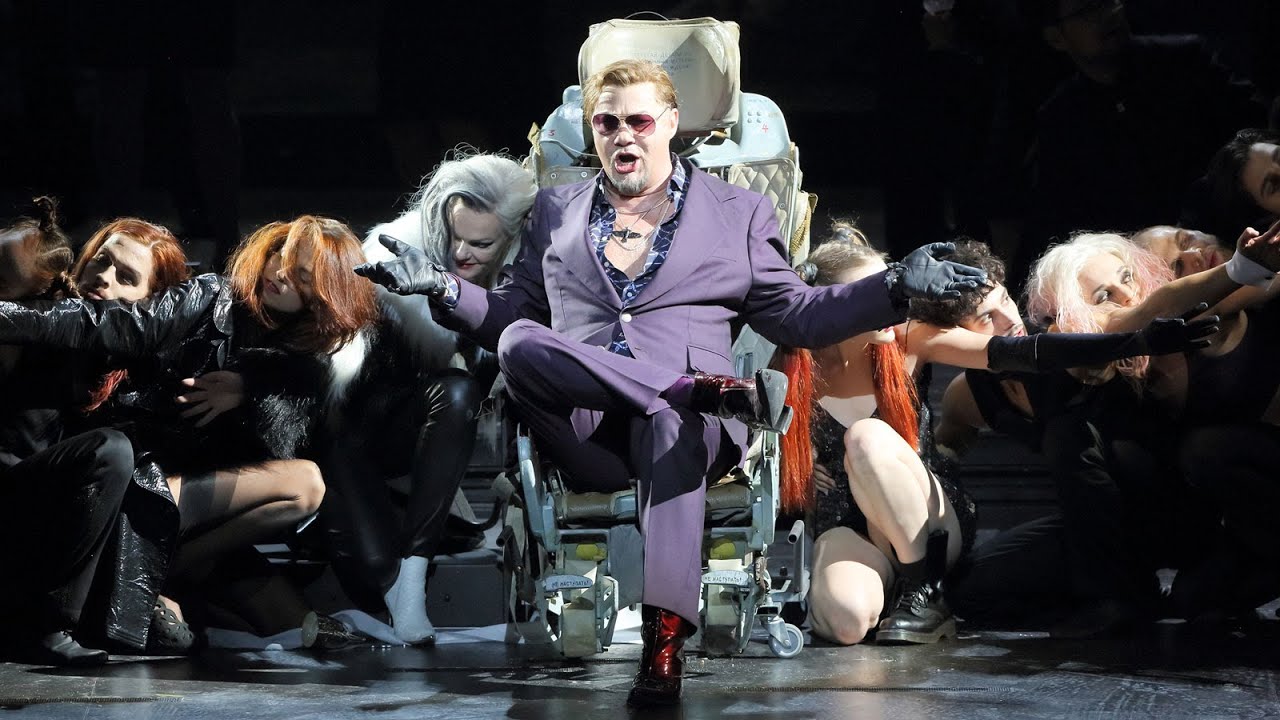
Boito's Mefistofele adapts Goethe's Faust to develop the idea of Mefistofele and his relationship with God.  They are equals, sort of, the Devil a punk with a huge chip on his shoulder, bristling with resentment even as he struts and shows off. Hence the sprawling set, which resembles the inside of some large structure, with pipes and scaffolding. In this sealed cocoon, Mefistofele is king though he's cut off from the real world outside where presumably God reigns.  René Pape, singing Mefistofele, is dressed part rock star, part oligarch, surrounded by groupies in an artificial fantasy world.  Are we in a film set? Or an infernal machine?   Mefistofele watches dull TV clips of John Lennon in  New York and of a plane flying over the NY skyline. We don't  see the Twin Towers, but we can draw our own conclusions without the point being made too obvious.

 Like so many big shots too big for their boots, Mefistofele thinks he can have a conference call with God, and place a bet.  All the while the Heavenly Chorus sing. We don't see them, for they are unsullied by evil.  René Pape is an ideal Mefistofele - suave, slimy and tacky, with that 70's shirt open to his waist. He suggests the Devil's twisted charm, but also makes us feel sorry for Mefistofele and his ardent desperation.  This double-edged portrayal adds depth to Pape's characterization. He whips through his lines with poisonous bite, but one senses that, deep down, Mefistofele is a misguided fool. 

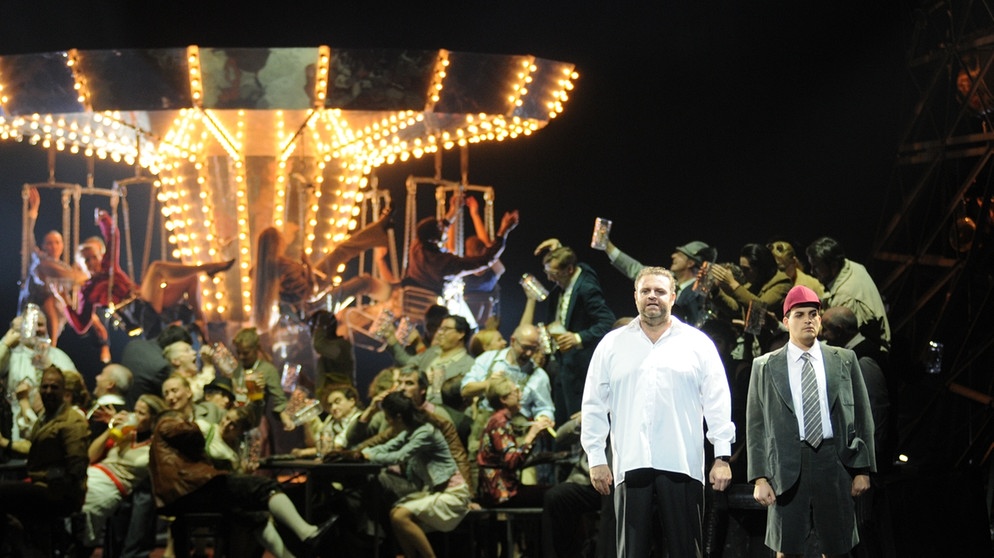
Faust, or a facsimile thereof,  is brought on stage and dressed in white, readied for sacrifice. When the orchestra, conducted by Omar Meir Wellber, begins again, the stage has been transformed, This time it's dominated by a giant fairground carousel. The peasants, as in Faust, are celebrating.  More pointed wit. This production takes place in  Bavaria. The peasants sit at long tables drinking giant steins. Pape picks up a gingerbread heart with the motto "I mog di", "I love you" in Bavarian slang.

Joseph Calleja doesn't automatically spring to mind as an ascetic old monk, but Boito's Faust is different to stereotype.  By changing the part from baritone (in the 1868 version) to tenor in the 1875 Bologna version, the composer capitalized on a voice which could scale heights even French tenors might envy, while retaining the sensual loveliness of the Italian language. Calleja hits the notes and how!  He sings with enthusiastic flourish - this is a Faust who genuinely enjoys sensual pleasures. A wizened old hermit might not understand. Calleja is also a good visual foil to Pape's sophistication: devil and innocent. Or so it seems. Calleja nails,  and holds, stratospheric heights. We can sense that a part as lovely as this will triumph in the end.

Kristine Opolais shines with understated  Grace Kelly elegance, which makes her seduction feel more like rape, for it is, since Faust is not what he really should be. The trio at the end of the scene sparks with tension  Faust and Margherita are swept away by the force of the sharp, dotted rhythms that mark Mefistofele's music.

The Walpurgisnacht scene is demonic: sharp woodwind flurries suggesting hellfire, perhaps, or moonlight? Calleja and Pape sing in tight lockstep "Folletto ! Folleto!". The manic staccato theme is taken up by the chorus, which then switches to quiet whisper, while the orchestra  creates the sprightly "hellfire" motif, first in the woodwinds, then through the celli and basses. The brightness of Calleja's voice contrasts well with Pape's, whose voice grows darker and more malevolent now that Faust is in his realm. The final chorus whips along with crazed energy: the witches are dancing wildly before the "flames" in the orchestra. "Sabba, Sabba, Saboè!"

Back on earth, Opolais sings  L'altra notte in fondo al mare and what follows with great emotional depth. Her Margherita is a woman steeled by suffering.  When she and Calleja sing Lontano, lontano, lontano, they bring out tenderness and tragedy, beauty and pain. Opolais sings the Spunta, l'aurora pallida with such calm heroism that Calleja's O strazio crudel! tears at the heart.  Faust sees the suffering, and women writhing in labour, but soon comes under the spell of Elena, Helen of Troy ((Karine Babajanyan)

In the orchestra  we hear the exquisite harp sequence, setting the tone for the love  duet between Elena and Faust that will follow. The harmony, though, is but a dream. Faust is back in his study, dimly lit, as we might  imagine from the quiet murmurs in the orchestra.  Faust is a very old man again, and in this production is seen in a home for geriatrics.  This is a sharper observation than one might expect because it shows Faust as part of a community, rather than alone, and makes connections to Goethe's Faust, who believed so strongly in society and humankind. It was Wagner (Andrea Borghini)  who thought peasants were a waste of time. This ending also emphasizes the idealism with which Faust defeats Mefistofele.  The good of mankind versus the Devil's enticements.,

"Cammina, cammina" Mefistofele calls. This time, Faust fights back. Calleja sings with undecorated, but  heroic firmness. "Faust! Faust!"  Pape cries, but his prey has slipped from his grasp. The chorus returns, in full, glorious voice with the orchestra in full glory. Even René Pape is no match.  But Mefistofele is defeated. Faust has overcome his sensual needs, choosing instead the greater good of mankind. Heaven breaks through Mefistofele's realm with blinding  light.  The director is Roland Schwab, who started his career with Ruth Berghaus. the sets are by Piero Vinciguerra.  On small   screen broadcast, we might have lost some of the overwhelming impact of the live experience, but we see the details. And what glorious singing! Later, it's occured to me that the other people in the nursing home, who were singing in the finale, might have been angels all along. (see photo below)


Saturday, 14 November 2015

Invisible Theatre made visible : Morgen und Abend Haas ROH


The world premiere of Georg Friedrich Haas Morgen und Abend at the Royal Opera House, London -  so conceptually unique and so unusual that its originality will confound many.  But consider what music is - it's a means of communicating complex, abstract ideas which can't easily be articulated in words. No-one knows what happens when we die, or what the transition might feel like. Morgen und Abend  is a tone poem on a grand scale, with singing and personalities to point the way. It is opera in the very deepest meaning of the word, for it operates on our subliminal senses, activating our response to the human emotions we hear enacted on the stage.

Morgen und Abend begins with an Overture, of sorts. Loud, thudding percussion loud enough that our heartbeats begin to synchronize. The sounds come from the boxes on both sides of the auditorium, like the ears we have on each side of our heads, or the two lungs thar pump within so we can breathe, like the ventricles in our hearts that pump blood to keep us alive. This is "Invisible Theatre", drawing the audience physically into the drama. Perhaps that's why Morgen und Abend is both compelling and disturbing.  Listening becomes an active, not passive experience, challenging emotions we might find hard to deal with.  We, too, are part of the story.

An old man Olai (Klaus Maria Brandauer) sits in an empty room. A door stands on its own without walls. perhaps the man could pass through, but he doesn't. At first he notices the unnatural silence of his surroundings. A midwife (Sarah Wegener) appears, telling the old man that his baby son is born. Yet, listen to the strange broken phrases in the vocal parts, repeating cadences which are taken up subtly by the orchestra.  This isn't normal speech, even by opera standards. Is Olai re-living happy memories in a dream? The boy , named Johannes, "will be a fisherman like me", intones Brandauer  Woodwinds and horns create strange sounds - the crying of a newborn, the agony of a mother.  When Olai was a young man, birth was dangerous, the cusp of life and death.   I nursed someone in his last days, who had nursed me long before. Dying is a lot like being born: you're helpless, you don't know what's coming, you resist.

Another old man rises from his bed.  The atmosphere here, too, is unnaturally still and silent, though the percussion ticks gently, as if marking the passage of time.  The old man is Johannes (Christoph Pohl). He rises from his bed, but notices that his aches and pains have disappeared. Instead, he feels oddly weightless, and the room glows with light, as if objects are floating. Johannes notices that his body doesn't ache as it did before. He feels a strange weightlessness, and objects seem to float in light. Things haven't been the same since Erna, his wife (Helena Rasker), died. Yet he sees her, and she sings to him. Is she real, or an ilusion ?

 Johannes sings about Signe, the name of his mother, who long ago gave him birth, and also the name of his youngest daughter, a symmetry that suggests continuty and subtle change, reflected  in the understated  but complex instrumentation.  Johannes notices that his body doesn't ache as it did before. He feels a strange weightlessness, and objects seem to float in light. Things haven't been the same since Erna, his wife (Helena Rasker), died. Yet he sees her, and she sings.  His old friend Peter (Will Hartmann) appears. Why is Peter's hair so long? Why is he so grey? "Let  me cut your hair for you" sings Johannes, "like we did 50 years ago". "You can't" sings Peter.

Johannes wants to sail again as he used to. "When the  sea as still and calm as this", he sings, "I could sail out far into the west". Like his father Olai before him, Johannes is remembering happiness past.  In the horns and low woodwinds, we hear the roar of the ocean and feel the freedom Johannes must have enjoyed when he was young.  This journey, this time, is different.

Johannes appears in his daughter's house, but she can't see or hear him. Significantly, the part is sung by Sarah Wegener, who sang the Midwife. Yet Signe feels his embrace.. "Passing through a great chill" she sings, "But nothing evil".  Love doesn't die, there's nothing to fear, though Signe doesn't yet know what has happened.   The music bubbles along, occasionally spiking up, with long drawn slow diminuendos. It's as if the complex machinery of a human body is gradually shutting down,  the blood chilling, cells shutting down  Long, keening lines which seem to stretch out to limitless horizons. 

A story this surreal needs abstract presentation.  Greys, whites, silvers blend into each other, changing with light.  Nature itself operates in this way.  Stand on any beach and see the myriad gradations of colour in the sand, in the sky, in the sea.  Nothing is colourless unless you want it to be.

Objects seem to materialize out of nowhere: the props constantly shifting. Johannes's boat seems to disappear as quietly as it came. The effect is as in a dream, or memory, though it's created by a turntable mechanism under the floor, which works so well - and so quietly - that we hardly notice. A lot like the passage of time.

This Morgen und Abend operates on many levels, literally and figuratively. Although the texts are direct and conversational, this makes the characterizations human and sympathetic, allowing the music to work its magic on our emotions.  The libretto is by Jon Fosse, based on his novel Morgon og Kveld.  Against a backcloth the English text is projected, the words moving and changing in tune with music and mood. 

Georg Friedrich Haas (born 1953) is an important composer, so the Royal Opera House gives Morgen und Abend the attention it deserves. The cast are well known and well respected. The director is Graham Vick. The designer is Richard Hudson. But in an opera like this, where the music is protagonist, the orchestra makes all the difference. We  take the Royal Opera House Orchestra for granted because we hear them so often, but as Antonio Pappano has said, they are an extremely good band. Conducted by Michael Boder they sound as idiomatic as a specialist new music ensemble, clearly inspired by the challenge  of  Haas's music.  In 2013, Haas's In Vain was done by the London Sinfonietta. Please read my piece "Invisible Theatre" HERE.   Technically, Haas's music is nowhere as demanding as most of the London Sinfonietta's repertoire, but any comparison is an achievement. 

 Haas's music is beautiful, compelling and poetic. It can stand on its own merits, but conceptually it is sophisticated. New music isn't an easy sell to audiences expecting the music of 100 years ago. This is where the ROH could improve its marketing.  Fortunately the programme notes are good and include a piece by Tim Rutherford-Johnson on Haas's music, but the real need is  to give the public enough good information about the composer that they want to come in the first place.

A more formal version of this review appears in Opera Today (with production photos) 

Thursday, 12 November 2015

Jonas Kaufmann and the Curse of Fandom

Joinas Kaufmann has had to cancel   his appearaances in Carmen at the ROH and the fans go into a rage?  But are these fans at all ?  JK can't help being unwell. Forcing someone to perform when he's not well is cruel.  For a singer, working in such situations can damage the voice long term.   JK went through a difficult patch when he couldn't sing for some months, so why risk that happening? So if fans really are fans, they should realize that singers aren't machines but human beings. Surely they deserve basic kindness? Three years ago, Wise Ruth wrote sensibly about cancellations : her words still hold true.  Even further back, Alfie Boe's promising career was destroyed by his "fans" in much the same way.

Which leads me to wider issues: the curse of fandom.  Healthy fandom is positive,: It supports singers and spurs them on to good things. Everyone's happy. But negative fandom is anti-art.   Recently JK sang Puccini at the Royal Festival Hall, interspersing his arias with orchestral music.  Good for him ! That was a perfectly reasonable thing to do, since placing the arias in the context of the music in the operas enhances appreciation. Singers are not machines.  Concerts are not CD's "live".

But one of the Dirty Little Secrets of the opera world is that a lot of fans don't actually like music.  Negative fans want celebrity, not art.  I adore Jonas Kaufmann, and respect hs art, and so do most of his genuine fans. But marketing controls art these days. Horror of horrors, the market is not always right.

10000 wax cylinders online

The University of California (Santa Barbara) is in the process of digitizing its collection of wax cylinders dating from the late 19th and very early 20th centuries. 10,000 done and 2,000 to come. The limitations of technology then mean that individual recordings are fairly short, so there's no way you'll get  symphonic works, far less full operas. But there are interesting snippets like a few minutes of Ah manon mi tradace from 1901, and Angel's Serenade by Caetano Braga recorded by the Edison Symphony Orchestra, created in order to make recordings for Thomas A Edison. I don't know if they did regular concert work. Hence the preponderance of popular music and ethnographic collections, some made in the field. Edison himself travelled all round the world, recording sounds and making moving pictures. The ethnographic recordings are particularly interesting since they capture a world that no longer exists: Tahitian and Native American performers, for example, and the sounds of Europe and America from times past.

Some of these recordings have been digitized before, but it's still fun to listen in on a world that's long gone, and hear the voices of the dead (literally) announce with great excitement the name of the recording organization. There isn't much in the way of "music" in these performances, but that's hardly the issue. The very novelty of being able to reproduce sound through a machine was a thrill.

Tuesday, 10 November 2015

Verdi's ironies : a thoughtful Force of Destiny, ENO


At the ENO Verdi The Force of Destiny last night someone remarked: "What pretty tunes! Why can't the show be cheery?" Perhaps that's the measure of audiences today, but, quite inadvertently, this stabbed through to the heart of what Verdi might have intended. The music in the Overture surges, as a screaming protest at La forza del destino - relentless fate - a folly which destroys individuals, families, whole nations.  Yet in the midst of this carnage, the Fate theme dances seductively. Is it a "pretty tune" or something disturbing?

Is Verdi telling us that appearances deceive?  The Marquis of Calatrava (Matthew Best) hates Don Alvaro with an irrational fury because Don Alvaro (Gwyn Hughes Jones)  is a half breed. Identities constantly change. Don Carlo (Anthony Michaels-Moore) impersonates a student. Don Alvaro becomes Friar Raffaello. Leonore (Tamara Wilson)  becomes a mysterious hermit but chooses a male monastery. Delusion dominates, not reason.  Don Carlo has been hunting a half breed for years but whern he meets his soldier friend, he doesn't notice ? So much for blind prejudice.  He's obsessed to psychotic extremes even though he doesn't actually know what really happened, or care enough to find out.  The monk, too, collude in delusion, too cowed to wonder why the hermit must be shielded. They're obeying orders. Like soldiers, like Don Carlo, like the racist Marquis, they get caught in the lockstep of doing as they're told, without thinking for themselves.

What is war itself, but delusion on a grand scale? Preziosilla (Rinat Shaham) isn't a simple
gypsy.   Her very first words are "Viva la guerra" . She whips the crowd into bloodthirsty frenzy. Yet as a war widow and a teller of fortunes, she ought to know better. She has a pretty name but a malevolent, almost demonic presence. Wars don't happen without folks like this.  Verdi didn't, I think, write the part to give a bit of tacky local colour. In la forza del destino, the delusions of society are complicit in its destruction.  Even the Church, which distributes alms but not the genuine piety that Jesus taught, "Love their neighbour as thyself". When Friar Melitone (Andrew Shore) tells a woman tthat she could solve her problems by having fewer children, he's being realistic. In Verdi's time, such sentiments would have been even close to blasphemy for they suggest that God doesn't control fate, butb that human beings have responsibility, too.  Melitone has a mellifluous name but it's not ironic like Preziosilla's. He is not a villain but the voice of reason. Suffering is wrong, it should upset us.

Calixto Bieito's La forza del destino is deeply perceptive because it addresses the fundamental forces whch shape what we might call destiny, but which might lie in the human psyche  and an almost Nietzschean will for evil. His Spanish Civil War references are relevant, though probably lost on English-speaking audiences. In any case, they're fairly generic. The focus remains on the Calatrava mania for mindless vendetta.   So we don't see Don Carlo stab Leonore ? She dies because she's caught up in the emotional barbed wire of the craziness around her. By sacrificing herself, she redeems Don Alvaro. Her actions thus break the cycle of selfish, obsessive hatred which has really destroyed the proud house of Calatrava.

The set, designed by Rebecca Ringst, is very effective - Spanish-style facades, seen in strange angles, their underpinning revealed. Video projections (Sarah Derendinger)  suggest what Don Alvaro,and Leonore might have been as children, developing their backstories more than the libretto does, but extend our appreciation of the characters. A little girl draws crazy circles with a mechanical hand: Leonore didn't love Don Alvaro enough to run from her father when she had the chance.

This ENO Force of Destiny moves on to the Met as La forza del destino, which is perhaps why it's fairly muted, and includes a cast of Americans and honorary Americans like Anthony Michaels-Moore. Tamara Wilson created the part of Leonore well, nice warm roundness in her voice, emphasizing the savagery of her fate. Gwyn Hughes Jones sang Don Carlo  even more persuasively. His voice is a treasure, and he has great acting skills, No surprise that he's an ENO favourite, and a reason why the ENO, with its programme of supporting singers with an English (or Welsh) background is to be welcomed. So Wilson and Hughes Jones are generously proportioned? So are their voices, which is what opera is about. It's theatre, the art of imagination, not legally binding documentary. In any case, the theme of feast and fasting runs throughout the opera. Leonore and her father are at dinner when he gets killed. Friar Melitone feeds the starving, though not enough to make them whole. In the monastery, Leonore and Don Alvaro pray and fast but they will not solve their problems until they find spiritual resolution.

If opera should merely be a collection of pretty tunes, then a drama about hate, war and madness  should merit pretty staging.  But Bieito's production deals with the drama and the irony that runs throughout.  Bieito's La Forza del Destino isn't pretty though it's not outrageous. But anyone genuinely interested in Verdi, and the ideas and emotions that motivated him, will do well to learn from this production.

Sunday, 8 November 2015

Hubert Parry English Lyrics - the English language in song

From Somm Recordings, the first of a projected series of songs by Hubert Parry: Twelve Sets of English Lyrics and other songs. This series could lead to a re-evaluation of the development of English art song. The generic title English Lyrics symbolized, writes Jeremy Dibble in his excellent notes, "...an artistic manifesto and advocacy of the English tongue as a force for musical creativity, shaped by the language's inherent accent, syntax, scansion and assonance". (Read Dibble's book on Parry HERE)  In short an approach to singing in English distinct from the British choral tradition. After unification, the German economy prospered so rapidly that it became a major, and global,  competitor with the British Empire. Parry's approach thus mirrors the growth of German Lieder. Why not art song based on great English poetry?  While Stanford set approximations of folk poetry and Elizabethan verse, Parry went for the most challenging. Fourteen of the 30 songs in this volume are settings of Shakespeare. Others include texts by Robert Herrick, Beaumont and Fletcher, Philip Sidney  et al.

Parry's songs are sophisticated art song, far removed from Victorian parlour song or even folksong, with which English song is so often associated, rather ironically since Britain industrialized earlier and more thoroughly than the rest of Europe.  Written between 1874 and 1918, Parry's English Lyrics herald the work of later composers, like Roger Quilter and Gerald Finzi. Parry's knowledge of Shakespeare's plays enhances his settings. The plaintive delicacy of Willow, willow, willow suggests Desdemona's innocence: she doesn't know what's coming but feels distressed and expresses herself in child-like song.  O mistress mine is livelier, even the notes tripping bright and agile. Parry's When icicles hang by the wall sparkles. Short phrases crackle, the way frost makes the sense tingle. The refrain "Tuwitt ! tuwhoo !" seems embedded, wordlessly, in the piano part. This sprightliness also reinforces the contrast between the images of cold and cosy comfort. "When blood is nipt and ways be foul", good folk go about their daily tasks, tending the fire and cooking. A perceptive  setting which challenges Purcell.

Parry responds to No longer mourn for me when i am dead, a setting of Sonnet 71 with great sensitivity.  The sonnet is dignified, but deep emotion breaks through. Parry emphasizes the words "for I love you so" soaring out of the longer phrase in the poem. The piano introduces a firmer mood. From "Oh, if I say, you look upon this verse", Parry's lines stretch as if they could reach out into the future, defying time.
The first set of Shakespeare songs are followed by songs that reflect Parry's appreciation of different poetic styles. To Jocasta on going to the wars and To Althea, from prison, both to texts by Richard Lovelace, blend poise with confidence. ""Stone walls do not a prison make, nor iron bars a cage".  To mark the change in mood, a change in singer. James Gilchrist and Susan Gritton sang the first songs, Roderick Williams most of the next ten. This balance between voices creates further contrast. Williams's direct style is extremely effective in songs like On a time the amorous Silvy Follow a shadow, an altogether more graceful setting of a poem by Ben Jonson, then Ye little birds that sit and sing (Thomas Heywood) where Parry writes brisk bird-like trills which Williams carries off with aplomb.

 Finest of all, To Julia (Robert Herrick) where the ease in Williams's voice lets the sensuality in the song flow pointedly yet discreetly.  Susan Gritton sings two more Herrick settings, and Gilchrist sings Rosaline (Thomas Lodge) with its charming refrain "Heigh ho, fair Rosaline!", soaring up the register at the end with impassioned verve. Under the Greewood Tree, the vigorous, jaunty lines sung by Williams with evident pleasure.  Then Shakespeare with a twist. If Germans could set Shakespeare in translation, so could Parry. It's interesting to compare Parry's "German" Shakespeare to his English Shakespeare.. The piano parts take on greater prominence, as if Parry were remembering Schumann.  To further mark the difference, Gilchrist sang in the English Tenor style, though he normally sings German quite idiomatically.  The English Tenor style is partly based on class pronunciation and on the choral tradition where individual voices have to cut through the voices around them. Hence the crisp articulation of consonants, and the precision of delivery. The very finest English tenors can add great depth to German song - think Bostridge's performances of Henze. With this recording, where Parry addresses the sound of English syntax, we can learn to appreciate the unique quality of the English language in song.

Wednesday, 4 November 2015

Fragrant Handel Acis and Galatea La Nuova Musica


Handel Acis and Galatea  with La Nuova Musica and David Peter Bates. St John's Smith Square is the finest period performing space for baroque music in London, but, since it was built as a church it doesn't have space for anything but the most minimal staging.  But La Nuova Musica confronred the problem with a solution worthy of the  audacious spirit of the baroque. Enhanced by fragrance, this Acis  and Galatea highlighted the fundamental sensuality of the drama by stimulating our sense of smell   Invisible staging, no less!
 
"In Handel's time, scents abounded", said Sarah McCartney, who created the fragrance choreography, for choreography it was indeed, extending the impact of the music.  This Acis and Galatea confronted the sanitized conformity of our  modern world and brought us closer to the creative soul of the period.  Scents cannot be seen, but operate subliminally, affecting perception.

 In a serenata, or pastoral masque like this, mood and imagination are paramount. Presumably the invisible scents contributed to the performers  In a amall performasnce space like St John's Smith Square, every note, every facial expression registers.  It can be intimidating. Happiness pervades this work, even when, for a moment,  that happiness is disrupted, so getting the mood right makes a difference.  The singers seemed relaxed, prompted perhaps by the invisible support of fragrance so the elaborate lines and recaps flowed with freedom and grace.

Ed Lyon sang Acis, Even by the standards we're used to hearing from him, this was a delicious performance. He was singing with evident relish, his ornate lines shaped with panache, his delivery natural and direct. His face is full of character.  Makeup and costume would almost have got in the way, for this Acis felt like a real person.  The duet "Happy We!" positively glowed.  After that, high point, Polyphemus (Christopher Purves)  dominates proceedings, but Lyon's Acis fights back. The trio "The flocks shall leave the mountain" was enunciated with the sharp thrusts of battle. When Acis died, Lyon's voice  descended into haunting diminuendo - very moving.

Nonetheless, Christopher Purves did come near stealing the show.  He, too, has a voice that exudes personality, so his Polyphemus, though a fanciful villain, was witty, even lovable. "I rage, I melt, I burn,",Purves sang, his chest puffed up in mock swagger.  Billows of scent heralded his "O ruddier than the cherry.". Because the smells were subtle rather than oppressive, one paid attention when they emanated an intriguing mix of sulphur, earth and water mint.  In a staged performance, we might encounter smoke and such effects. Here, we visualized  using our imaginations.

Galatea was sung by Augusta Hebbert, substituting at short notice for Katherine Manley. Hebbert has been singing with La Nuova Musica for several years, so she fitted in seamlessly.  By the end of the evening, when Galatea is bereft and the masque revolves around her, Hebbert showed her mettle: a very lovely "Heart the seat of soft delight" ,her voice reflecting the characteristic swaying  between crescendo and diminuendo that gives Acis and Galatea such charm.  This rhythm lends itself to dance. Rupert Charlesworth sang Damon and Nicholas Scott sang Coridon.

When the Royal Opera House did Acis and Galatea with Christopher Hogwood some years ago, the singers were shadowed by dancers. No such resources at St John's Smith Square, but La Nuova Musica played with such vivacity that one could dream dance. Neither did the absence of a formal chorus make much difference.  Singers and orchestra interacted so well that the music communicated with freshness and conviction.  At St John's Smith Square, you're so close to the musicians that you feel part of the proceedings.  Particularly good playing from the leader of the violins and from the oboist whose part feels even bigger in what appears to have  been somewhat reduced instrumentation.  The oboe leads, but is supported by recorder, also doubling piuccolo to create the image of a shepherd's pipe.

La Nuova Musica did  Conti L'issipile at the Wigmore Hall last year. Read the review here in in Opera Today.  They are also doing a recital at the Wigmore Hall with Bejun Mehta later this month and Cesti Orontea on 14/12 at the Wigmore Hall. Next year, they return to St John's Smith Square in the spring.

Monday, 2 November 2015

Markus Stenz LPO Thomas Larcher

Markus Stenz conducted the London Philharmonic Orchestra at the Royal Festival Hall London this week. The concert was broadcast live on BBC Radio. An odd programme beginning with Beethoven Symphony no 1 and ending with Stravinsky The Rite of Spring, the latter better realized than the first.

Between them,  Thomas Larcher's Violin Concerto with Patricia Kopatchinskaja. Larcher's music is programmed quite frequently in London. He's even been the subject of a Thomas Larcher Day at the Wigmore Hall, and has had much support from the Austrian Embassy and the London Sinfonietta. Although I've heard quite a lot of his music, I haven't really written much about it as it's hard to verbalize. It's rather like trying to describe air, or to hold flowing water in your hands. Larcher's Violin Concerto works for me as an evocation of ephemeral moods: fleeting impressions of something invisible flying past, evanescent yet with genuine substance.

Larcher's Violin Concerto, premiered in Vienna in 2009 by Isabelle Faust,  starts with a fairly conventional theme, the violin bowed gently to suggest  a lullaby, as if an infant were being rocked gently back and forth. This momentum seems to flow throughout the piece, holding the elusive textures together, allowing the solist to "converse" thoughtfully with the orchestra.  Other sounds enter - delicately plucked violins, deeper-voiced woodwinds, marimba and harp, beaten metallic percussion that sometimes suggest cowbells, sometimes hurrying , whirling figures. Overall, the evocation of light, movement underpinned by unhurried confidence. Kopatchinskaja carves jagged diagonals with her bow  and the music takes off in frenzied turbulence, skidding off the edges of the scale, so high and so quiet that the notes are barely perceptible. Bell sounds sparkle in the background. Kopatchinskaja draws out long lines that sway upwards and down then extend almost into infinity. Quiet tapping in the percussion, like a steady heartbeat.

Some Thomas Larcher works for me, some doesn't. But his Violin Concerto resonates on a very deep emotional level. Larcher lives a simple life on a mountain in Austria. a fact which is very relevant to his music, which has a purity that feels timeless, beyond  the toxic pollution that so often passes for emotion in this world.  Please also read my piece on Thomas Larcher's Die Nacht der Velorenen, at its London premiere in 2008.

Sunday, 1 November 2015

George Antheil, Daughter of Horror

George Antheil's Ballet Mécanique (1924)  (read more here) is one of the seminal classics of the avant garde. But what happened to him?  Like just about everyone else, he found work in Hollywood, getting work where he could. But his creative spirit wasn't entirely dimmed. .For Halloween, I watched Daughter of Horror (1953)  for which Antheil wrote the soundtrack. His contribution, though, is huge - there are  hardly any spoken words, no dialogue, or even narrative. The music "is" the story. This isn't your average B horror flick. It's an extended musical work, illustrated with images. And gosh, what music!  Think about Tom Waits music videos.  Or Eraserhead and Twin Peaks. George Antheil got there first, establishing the iconography.  The director and producer was John J Parker, who doesn't seem to have made other movies, which also suggests Antheil's primary role as auteur.

A woman walks into the sea, apparently crushed in the surf. She wakes in a bedroom, feeling anxious. As she walks down the stairs she sees a cop arrest a man for beating up a woman.  The music wails: a long wordless vocalize like an unending scream. This might now seem standard horror movie fare, but Antheil was doing this very early on and very well indeed. The singer, incidentally, is Marni Nixon who also had a career outside Hollywood, making some of the first recordings of Charles Ives songs, for example.  The woman wanders into a street that could come straight out of a Tom Waits set. Drunks hang out in the shadows, moving with strange, contorted griomaces - very Tom Wait !  A newspaper seller holds a up a headline about a murder. The woman seems to think she's guilty. The newspaper seller is a dwarf - another Tom Waits image. As is the flower seller from whom the bent cop buys a carnation. A drunk confronts the woman. Does she stab him? Why does the cop beat the drunk into a pulp? 

The woman enters a nightclub. She looks horribly out of place in her repressed tweed suit and no makeup. Listen to the jazz band though,  African drums and, of all things, a French horn. The woman goes in a cab with a strange man.  Served by a butler, the man gobbles a meal, which disgusts the woman, whom he completely ignores. Is she really there in the room with him? She stabs him with a shiny flick knife. The butler seems totally unperturbed. As he dies the man grabs hold of the woman's ornate pendant necklace, the only thing about her appearance that looks individual. Great shots of the elevator and the magnificent marble staircase she runs down. 

Switch to a bit of cod psychoanalysis.  In a graveyard a faceless man shows the woman her fatrher, a drunken, abusive slob, and her mother, a good time girl but frigid..  The sequence of events hardly matters. Aware that the dead man still has her pendant in his hands, the woman  cuts the man's hands open, watched by faceless observers. The actor who plays the woman's father also appears at the beginning of the film as a grinning man, and again later in the crowd who the woman runs into, who raise their arms, Nazi style, against her. She wakes back in her room. Is it all a dream? She opens a cupborad, and there's the dead man's hand, still grasping her pendant, and moving. All this might seem kitsch but the cinematography is very good. The images are carefully chosen, much in the way that 1920's German expressionist films were made.  And thus the connections with George Antheil's past and his glory days in Paris and with the avant garde scene, and the film makers of that era.  How Antheil might have thrived if he'd been able to stay in Paris! On the other hand, without Antheil in Hollywood, we might not have Tom Waits, and,David Lynch and a whole host of film makers both art and schlock, ever since. 

Friday, 30 October 2015

Christoph Prégardien Wigmore Hall complete Schubert Songs

Another highlight of the Wigmore Hall complete Schubert Song series - Christoph Prégardien and Christoph  Schnackertz. The core Wigmore Hall Lieder audience were out in force.  These days, though, there are many young faces among the regulars, a sign that appreciation of serious Lieder excellence is alive and well at the Wigmore Hall.   Prégardien is a perennial favourite, who has been singing at the Wigmore Hall for at least 25 years. Prégardien's programmes are thought-provoking.  His choice focussed on Schubert's settings of Schiller and Mayrhofer, which are Prégardien specialities, but this time he included songs that are less well known, to stimulate the audience's appreciation of the composers craft.  Schubert set 44 songs to texts by Schiller,  of which three were  settings of Der Jüngling am Bache. His first, D 30, dates from as early as 1812.  Prégardian sang the version D192 from 1815. The brooks still runs cheerfully in the piano part, but now the more contemplative approach emphasizes Schiller's image of flowers crushed in fast-flowing waters, an allusion to impermanence and to unfulfilment.  The agile lucidity of Prégardien's timbre captures much of the whimsy of the first version, though the later song is more emotionally rewarding. Later in this Wigmore Hall series, no doubt we'll hear the third version, D 638 (1819), even more poignant. 

For a  moment, though, we remained in charm mode, with Schubert's settings of Ludwig Hölty (1748-1776).  Der Liebende D207 1815 recaptures the sprightly lyricism of the first version of  Der Jüngling am Bache. "Beglückt, beglückt, Wer dich erblickt", bright, sharp consonants, which Prégardien articulated so they sparkled. "Wem süsser Blick, und Wink und Nick Zum sussern Kusse winket". Utterly delicious.  Der Traum D218 1815 feels almost like folksong with its paired phrases suggesting the fluttering of a bird : "Mir träumt, ich war ein Vögelein".  Prégardien captured the lilting charm in the song with delicate but deft clarity.  The sentiments of Die Laube D214, 1815, is decidedly period. "Schauer wird durch meine Nerven haben" and "Wann ich auf der Bahnder Tugend wanke". But Pregardien's respect for the song as song gives it dignity. 

Thus were we prepared for more Schiller. Hoffnung D251 1815 is relatively straightforward compared with D 637, a darker and more beautidul setting of the same poem,. but it made a good transition to the Schiller ballad Ritter Togenberg D397 1816.  Again, the subject is rather "of its time". a knight, rejected by a maiden, goes on the Crusades where he "Schreckt den Muselmann". When he returns, the girl has become a nun. So the knight spends the rest of his life in a hut near the convent until the girl dies and becomes an angel. Strophic ballads aren't that easy to carry off but they are one of Prégardien's great strengths. He sang with direct, unfussy commitment, so the tale felt totally plausible. Context aside, emotions are universal.  

In his programme notes, Richard Stokes quotes Albert Einstein on Die Liebesgötter D 446 1816, to a poem by Johann Peter Uz, as "Anacreontic doggerel". "Cypris meiner Phyllis gleich, sass von Grazien umgeben....mich berauschten Cyperns Reben". Cypris's grapes have made the poem drunk. As a poem this is a howler.  The poet sees nymphs fleeing "mit leichtem Fuss allen Zwang betränkter Kettern flatteren von Fuss zu Fuss und von Blonden und Brünetten". Yer Prégardien makes the song feel right, though he smiled benevolently when singing the florid phrases. If we can take 18th century paintings of Classical Antiquity, we can perhaps take .Uz (1730-1796) on his own terms. In any case, the poem is more risqué than it seems since nymphs hang out with satyrs, and wine frees inhibitions. 

Prégardien and Schnackertz then paired Der Hirt D 490 1816 and Bei dem Grabe meines Vater D496 1816. Both deal with loss. In the first, the poet (Mayerhofer) looks at the tower where his beloved lives now that she's married. In the second, to a poem by Matthias Claudius, the poet mourns his father in conventionally dutiful terms.  Both settings are rather dispassionate, and don't draw from Schubert his finest moments, but we need to hear them to appreciate Schubert's work as a whole. That's the point of a complete song series. In that context, Schubert's songs to Mayrhofer shone all the more brightly.

Five more Schubert settings of Mayrhofer followed :  Der Alpenjjäger, D524 1817, Nach einem Gewitter D561 1817, Tröst  D671 1819, Nachstück  D D672 19, Nachtviolen D752 1822 and Alflösung D 807 1824, all of which Prégardien has performed many times in the past and still does with characteristic grace and intelligence. 

Wednesday, 28 October 2015

Tuesday, 27 October 2015

Calleja Pape Opolais Boito Mefistofele Munich


My fascination with Faust never ends, fuelled again by Arrigo Boito Mefistofele at the Bayerische Staatsoper.  Joseph Calleja, René Pape, Kristine Opolais star - what more could one ask? But listen, too, to the superb choir , central to this version of Faust, and to the orchestra, conducted by Omer Meir Wellber.   READ HERE MY FULL REVIEW of bthe production.

In the Prologue in Heaven  the choir sing reverently, but suddenly the music turns quirky, running along with fast footsteps, a good way to usher in Mefistofele. René Pape is magisterial, absolutely confident. He's challenging God for the soul of Faust . How cheeky the childrens' choir sounds, even though they're singing pious homilies. Calleja, too, is in fine form, almost too luxuriantly Italianate to be an ascetic old scholar, but his singing shows why Boito revised the work for Bologna in 1875.  Calleja's lively tenor suggests the sensuality that Faust must have been repressing inside all his life . Calleja makes one wonder what turned the young Faust into a desiccated ascetic. His tragedy  might well have started long before we meet him in his old age. Calleja's bright, ringing tones also evoke the excitement which has motivated Faust's lifelong search for knowledge. No wonder he can't resist what Mefistofele might have to show him. In his dialogue with Margherita (Kristine Opolais),  Calleja nails,  and holds, stratospheric heights. Outsinging a great soprano takes some doing. The trio at the end of the scene sparks with tension : Faust and Margherita are swept up in the sharp, dotted rhythms that mark Mefistofele's music.

The Walpurgisnacht scene is demonic: sharp woodwind flurries suggesting hellfire, perhaps, or moonlight? Calleja and Pape sing in tight lockstep "Folletto ! Folleto!". The manic staccato theme is taken up by the chorus, which then switches to quiet whisper, while the orchestra  creates the sprightly "hellfire" motif, first in the woodwinds, then through the celli and basses. The brightness of Calleja's voice contrasts well with Pape's, whose voice grows darker and more malevolent now that Faust is his realm. The final chorus whips along with crazed energy: the witches are dancing wildly before the "flames" in the orchestra. "Sabba, Sabba, Saboè!"

Back on earth, Opolais sings  L'altra notte in fondo al mare and what follows with great emotional depth. Her Margherita is a woman steeled by suffering  When she and Calleja sing Lontano, lontano, lontano, they bring out tenderness and tragedy, beauty and pain. Opolais sings the Spunta, l'aurora pallida with such calm heroism that Calleja's O strazio crudel! tears at the heart.  Opolais's  purity contrasts pointedly with the singing of Elena  (Karine Babajanyan)   In the orchestra  we hear the exquisite harp sequence, setting the tone for the love  duet between Elena and Faust that will follow. The harmony, though, is but a dream. Faust is back in his study, dimly lit, as we might  imagine from the quiet murmurs in the orchestra. Perhaps the dawn is coming, though.  "Cammina, cammina" Mefistofele calls. This time, Faust fights back. Calleja sings with undecorated, but  heroic firmness. "Faust !Faust!"  Pape cries, but his prey has slipped from his grasp. The chorus returns, in full, glorious voice with orchestra in full glory. Even René Pape is no match.

This Mefistofele can be heard audio only on BR Klassik for a limited period - recommended ! It's good.  On 15th November, the full video will be broadcast on Staatsoper.tv. Details here.