Saturday, 15 October 2011

Oxford Lieder Festival Big Surprise!

Never underestimate Oxford Lieder, whose 10th anniversary Festival started yesterday. The Festival started with Schubert part-songs in  Radcliffe Square but the keynote gala opening concert featured Birgid Steinberger and Graham Johnson. Steinberger may not be well known in Britain but that doesn't mean she isn't well-known in Lieder circles. Anyone whom Graham Johnson and Julius Drake respects is significant. Oxford Lieder chooses well and wisely, so pay attention!  Anyone who sings Der Hirt auf dem Felsen D965 knows what they're doing. Steinberger is Kammersängerin in Vienna, and amongst other things has performed at Schwarzenberg  and won the prestigious Hugo Wolf prize in Stuttgart. So those who didn't attend this concert didn't know what they were missing.

At first, Steinberger didn't do herself justice. Something clearly was wrong, as her chest sounded tight and congested, though there were many fine moments, indicating what she was really capable of, like a hauntingly well-nuanced "Alleluja" at the end of Die junge Nonne D828. Subtle is a  better marker of good singing than brash and belting. Apparently Steinberger had a severe vocal infection but didn't cancel, knowing how important this first concert in the Oxford Lieder Festival can be. Good singers are conscientious, and know when they're not at their best, which adds to nerves and tension. That's no demerit at all. Sensitivity is by far more important in an artist (and in life in general).

Listening to Steinberger overcome her problems was in itself an education in how song partnerships work. (Masterclass participants, take note). Graham Johnson is a perfect song pianist because he is sensitive too, supporting and enhancing the singer, playing eloquently so some of the pressure is deflected. The act of singing can loosen things up, and experience brings confidence. What a transformation after the interval!

Steinberger was now in her true, vivacious element. Her Das Lied im Grünen D917 sparkled, her voice fresh and clear. There's more to this song than the joys of the countryside. Phrases repeat, but each time with a new twist. Spring symbolizes renewal and rebirth. ".....so haben Wir klüglich die grünende Zeit nicht versäumt, Und wann es gegolten, doch glücklich geträumt, Im Grünen, im Grünen."  Here it sounded truly heartfelt.

Reinvigorated, Steinberger was able to bring out the cheerful, erotic kick in three relatively little known Schubert songs, Das Echo D990c, Heimliches Lieben D922 and Lied der Anna Lyle D830. The word "Küsse!" is invested with such luscious charm that there's no mistaking that the maiden knew full well that the kiss was real, not an echo across a valley. Good programme planning again (Graham Johnson?). Der Winterabend D938 followed the three sensuous frolics, injecting a note of winter and lost love, which deepened the mood before the magnificent climax of the evening, Der Hirt auf dem Felsen D965. (Please read my analysis of Der Winterabend HERE)

Der Hirt auf dem Felsen is a tour de force, which Schubert wrote for Anna Milder-Hauptmann as a vehicle for displaying her extreme vituosity. It also capitalizes on the idea of "Alpine" music that was so fashionable at the time, with which Milder-Hauptmann was associated. Thus the swooping dips and leaps up the scale, evoking mountains and valleys, and the idea of a shepherd, perched high on a rock, playing his flute so the sound will travel long distances and reach his beloved. The echo again, forces of nature that defy convention and restraint. "Je weiter meine Stimme dringt, je heller  sie mir weider klingt" and then the gorgeous dip "da unter", which Steinberger slides down the scale, evoking the depth of the clarinet (Joy Farrell).  Indeed, the three-way flow between voice, clarinet and piano reflects the spatial images in the song, where feelings carry through on different levels across space and presumably time. It's a masterpiuece. What "chamber music for voice" might Schubert have written had he lived?  A superb ending to the first concert in this year's Oxford Lieder Festival. Those who missed it, missed a lot ! More on the Festival, which continues for 2 weeks, HERE)

The painting is Henryk Siemiradzki (1843-1902) a Polish academician much given to depictions of the Holy Land, Middle Eastern cultures and heroic myth. Perhaps Szymanowski knew this picture, for it expresses the anarchic sensuality of the Shepherd in Krol Roger.

Friday, 14 October 2011

Britten - Which war? Whose Requiem?

"Kleenex at the ready… one goes from the critics to the music, knowing that if one should dare to disagree with ‘practically everyone’, one will be made to feel as if one had failed to stand up for ‘God Save the Queen’." 

So said Igor Stravinsky of Benjamin Britten's War Requiem. He has a point, for the image we get of the 1914-18 war is distorted by media emphasis on the Western Front. Stravinsky knew that what happened on the Eastern Front was arguably far more catastrophic. Civilian casualties, famine, ethnic cleansing, the rise of Bolshelvism and the collapse of the Old Order. Benjamin Britten was only 5 when the war ended. His knowledge of that war was filtered through received wisdom. "No-one", someone once told me "can understand war if it happens far away, to other people". It's one thing to be fighting in the trenches, another to be fighting in your home town, your family dying around you. 

So it's good that Ian Bostridge has been thinking "Which war? Whose Requiem?"  Can a piece commissioned to commemorate Coventry tell us about Dresden, Stalingrad, Nanjing, Hiroshima and the Holocaust? Follow the link above to an extract from Bostridge's article in A Part of History: Aspects of the British Experience of the First World War (Continuum, 2008) 

Britten's characteristic emotional reserve causes me problems with the War Requiem and indeed the Sinfonia da Requiem because I'm focused on history, but from a purely musical perspective the War Requiem can be a powerful work.  Here's a commentary on the Barbican Britten War Requiem (Noseda, Bostridge, Keenlyside, Cvilak, LSO). It's much more than just any review, because it's written by Claire Seymour, author of The Operas of Benjamin Britten : Expression and Evasion (Boydell 2007) . "Much of the power of the work lies in its innate contrasts. Owen’s dark, distressing war poems form a counterpoint to the consolations of the requiem mass, and the interweaving of secular and sacred, vernacular and Vulgate, is often challenging, surprising and deeply ironic. A resonant, full orchestral clamour contrasts with delicate, finely fashioned chamber sonorities; soloists and chorus intertwine and counterpoise. Brightness interrupts the darkness, and is then once more overwhelmed by horror and terror."  Maybe the way into Britten's War Requiem is to understand the oblique way Britten dealt with horrifying things

Plenty on this site about war, history, music about war, Hiroshima, the Holocaust and of course about Benjamin Britten

Thursday, 13 October 2011

La Traviata and the Credit Crunch

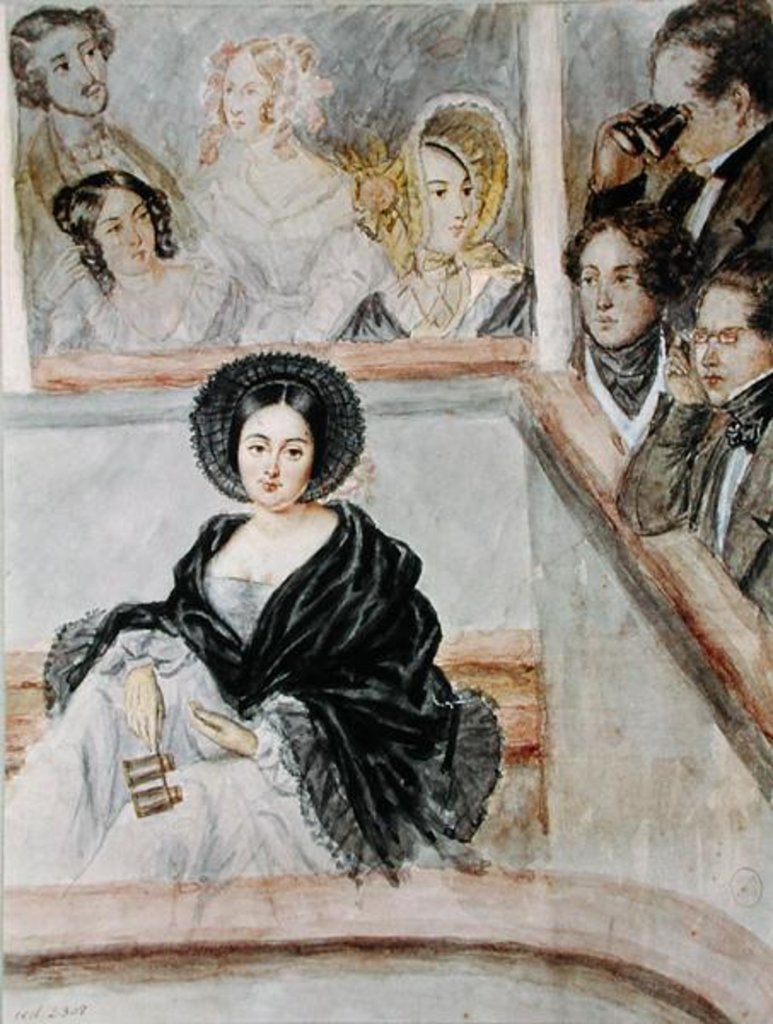
We've all seen the current production of Verdi La Traviata at the Royal Opera House. It runs til February 2012 if you want to catch it again, with different conductors, different casts etc. It's a hardy perennial that's easy on the eye and always pleases. But consider what the opera is really about. That's Marie Duplessis in the picture, the real life model for Marguerite Gautier and Violetta.  A country girl who became a courtesan, living the high life on credit, selling dreams as much as sex.  So here's a lively reminder that opera, like so much else in life, is a glorious illusion. A very different review of the ROH production in Opera Today, by David Chandler :

"One way of thinking about La Traviata is to consider it as a portrayal of bubble wealth that makes artistic capital from the shimmering, rainbow hues of the surface rather than showing any interest in what sustains the bubble....At the heart of La Traviata there is a financial crisis as Violetta attempts to trade in the trappings of wealth for actual cash, but it is touched on as lightly as possible, and really serves simply as a catalyst for the moral crisis that Piave and Verdi wanted to explore."

Tuesday, 11 October 2011

Hartmann Gesangszene - prophecy of collapse

Politicans dare not say what many economists feel in their hearts. This present "recession" is something that cannot be solved by any kind of quantitative easing. It's the biggest financial cataclysm ever known, exacerbated by the sheer size of the world economy and its dependence on technology. Sorry, guys, but this is a Collapse.

So listen to K A Hartmann's Gesangs Szene (1961/2) based on Jean Giradoux Sodom et Gomorrhe (1943). There's an excellent performance from the Berliner Phiharmoniker with Goerne who sings this frequently and with great force). Also recordings by Kubelik/Fischer-Dieskau, (even better orchestrally), Rickenbacher/Nimsgern and early Metzmacher.  Both were written in crisis situations, Hartmann, who had survived the Nazis, may have felt that the Cold War and nuclear weapons would bring about even more destruction. This text deals with empires so powerful they seem invincible.  Giradoux ostensibly writes of Sodom and Gomorrah whose proud empire stretches as far as India. But then an archangel appears in the Heavens and Sodom and Gomorah are wiped out in an instant.

A long, 150 bar introduction paints the scene. Solo flute hovers over the busy tumult in the orchetrsa, followed by oboe, clarinet and basson, played with strange, unsettling distortion (especially vivid in Kubelik's recording).  Sudden, savage discords. From this emerges the baritone, like a macabre master of ceremonies. "Das ist derschönste Spielbeginn". Very calm and controlled but all the scarier for what he has to tell/ "We have seen", he sings, "empires, especially the strongest and fastest-growing and those with the most secure guarantees of stabilty...at the height of their powers of invention and ingenuity..." So technogically advanced was this empire that it marshalled the seas and skies, conquered illness, darkness, ugliness and the weather, cured the common cold and synthesized diamonds. So when Goerne sings the third verse "Wir alle haben Reiche sturzen sehen", it's like a one man chorus in a Greek tragedy.

Then suddenly the voice hushes. A sudden sickness, thought to be extinct, develops and kills the healthiest and strongest.  The text specifically mentions "the mortgages of God" being foreclosed. Suddenly the great halls of power are deserted. "The Wolf is found in the centre of the city, and lice on the bald heads of millionaires".

At first voice and orchestra alternate, then gradually combine. Angular ostinatos underline the voice "Das Übel der Großen Reiche ! Das Tödliche Übel ! (the evil of great empires, the evil, ofv death). It's horrible, horrifying. Huge swirling figures in then orchestra, like windstorms, crashing cymbals - and very quiet drum beats and single notes on harp. "And in this storm, these thundering wavees, this war of wars, nothing survives  but bankruptcy and disgrace, the face of a child, distorted by hunger, the cry of a mad woman....and Death". 

The text has a difficult, wordy syntax, so Hartmann sets it like speech, the solemn pace part of the horror. At times, it feels like quasi-sermon, for there is moral indignation behind the simple, matter-of-fact delivery. The singer hardly needs to rise about semi-speech, the meaning is so intense. Along reprise of the intrioduction, where the symbol of the flute is made clear. "In jedes Vogellied hat ein grauenhafter Ton scheingeschlichen..... Und die Bäche sind clar und spiegelblank die Quellen" The orchestra plays "watery" sounds, wavering and insecure. "Aber ich habe das Wasser gekostet, es ist das Wasser der Sintflut. "
 The oceans the Empire controlled have broken their bounds, nature is wiping out the traces of this grand civilization. But nature has been irrevocably polluted. The waters of the stream are clear, but they're the waters of the Great Flood. The sun is scorching, but it's boiling pitch, unsafe for man. And the song of the bird (the flute) bursts out from its throatlike inexorable thunder.

Hartmann didn't finish setting the last strophe, because he died. So it's intoned as slow speech,  unaccompanied by the orchestra. This numb understatement has dramatic effect, as if suggesting the trauma is too bitter to contemplate. Es ist ein Ende der Welt ! Das Traurigste von allen!"It is the end of the world, the saddest of all.

Only three years ago it seemed that champagne would never stop flowing and things like bribing people to buy expensive cars would kickstart  the economy. Silly bandaids that don't address the structural faults in the system. No-one knows the answers but no-one dares voice the possibilty that what this cancer needs is major surgery and the political equivalent of chemotherapy. No government is getting out of this mess alone. We're facing the scary prospects of the fall of capitalism as we know it, and it's not going to lift if we think only of our own patch. It feels like the 30's all over. Ironically, what lifted that slump was war. This time, war is part of the cause.

From Schuman to Szymanowski

Last week BBC Radio 3 featured composer was William Schuman (one n). This week focuses on  Karol Szymanowski (1882-1937). Five hours, Monday to Friday with repeats.  Online, international and on demand, as always.  Szymanowski is fascinating because he's so eclectic. He was a Polish intellectual fascinated with Middle Eastern culture. A man perhaps more relevant to our time than we think. We underestimate just how open Europeans in Szymanowski's time were to "foreign" things. Szymanowski used his adventures to create unique music beyond the limits of western tradition. So enjoy this Szymanowski series. Fortunately, Szymanowski is by no means as obscure as he was, say, 25 years ago. Recordings are easily available - read about the best ever Third Symphony CD here (Tetzlaff/Boulez) and book to hear it live at the Barbican in May. Lots more on Szymanowski on this blog, incl Krol Roger.

Monday, 10 October 2011

Oxford Lieder Festival 2011 starts Friday

In just ten years, the Oxford Lieder Festival has become Britain's most important Lieder festival, with an international following. It began as a labour of love. Ten years ago, Sholto Kynoch, now Artistic Director and driving force behind Oxford Lieder, was a postgraduate student working with Malcolm Martineau. "It started by accident", he says "I just wanted to play Schubert with friends." That first year, they performed just the three Schubert cycles. Schubert remains at the heart of the Oxford Lieder Festival. There are plans for a huge, ambitious Schubertiade in 2014.

The first weekend of this tenth anniversary year is devoted to Schubert, Every song from Die schöne Müllerin D. 795 to the magnificent Der Hirt auf dem Felsenn D 965 on the opening evening, Friday 14th October, with Graham Johnson, Brigid Steinberger and Joy Farrell (clarinet).

Oxford Lieder does things in depth. There's a two day series of workshops, talks and four concerts considering "The Wagner Effect" on art song, with particular emphasis on the songs of Franz Liszt and Hugo Wolf. Very good speakers, including Amanda Glauert, whose "Hugo Wolf and the Wagnerian Inheritance" is a classic. Oxford Lieder is in the process of recording the complete Hugo Wolf song output. Volumes 1 and 2 ( the Mörike songs) are already available through Stone Records. The discs are unusual in that they feature four different singers (Sophie Daneman, Anna Grevelius, James Gilchrist, Stephan Loges and Sholto Kynoch at the piano) and were recorded live last year in the Holywell Music Room, with its perfect, intimate acoustic. This year, the concert on 18th October is being recorded and will feature Wolf's earliest work and his settings of Keller and Ibsen.

An intensive three day series on Swedish Song follows from 21st October. Oxford Lieder has a tradition of presenting Scandinavian music. This year, Miah Persson, Anna Larsson, and Håkan Vramsmo will be singing Rangström, Sjögren, Nystroem and Grieg . There'll also be premieres of two new works, by Tobias Brostöm and Carin Bartosch Edström. Håkan Hagegård will present one of two masterclasses in Swedish song and be on hand for a screening of Ingmar Bergman's film of Mozart The Magic Flute, in which he sang Papageno.

Although the Oxford Lieder Festival operates on a shoestring, it makes a point of supporting new work. This year's composer in residence is Charlotte Bray, whose work will feature in three separate concerts, culminating with a new song cycle specilly commissioned by Oxford Lieder, to be premiered on 27th October by Roderick Williams. There's a composition workshop on the same day, led by Professor Robert Saxton.

The Oxford Lieder Festival is supported by many major singers, like Wolfgang Holzmair, Florian Boesch, Sir Thomas Allen, Sarah Connolly, Dame Felicity Lott, James Gilchrist and Roderick Williams, all of whom will be giving keynote recitals.

Fundamental to the Oxford Lieder ethos, however, is the idea of nurturing new talent. Each year there's a two week residential masterclass for pairs of singers and pianists. developing practical performance skills. Participants attend the whole Festival, so it's intensive, but rewarding. They also give their own concert. There's also a Young Artists Platform which gives awards and opportunities for singers and peianists to perform year round. This concept of practcal performance means a great deal to Sholto Kynoch. He loves "the buzz between performer and audience, that allows you to put across what you want to with the music". He adds, with enthusiasm, "That two-way dynamic is something I've tried very hard to get at the Festival, and I think it's one of the festival's strongest features."

Most concerts take place in the Holywell Music Room, where Mozart and Hadyn once performed. It's perfect for Lieder because its size allows particularly close communication between performers and the audience. For many that intimacy might be intimidating, but Kynoch's personality encourages performers to give of their best. He gives over 70 concerts a year, as pianist, but he's also a charismatic organizer. The "Oxford Lieder Family" atmosphere, involving both audience and performers, is part of its unique charm. Everyone is valued, whether a big star or a non-professional. There are even workshops for amateurs and part-song recitals in the street to attract people who don't yet realize how much fun singing can be.

For more details, please see the Oxford Lieder Festival website.

Wuchang 10/10/1911


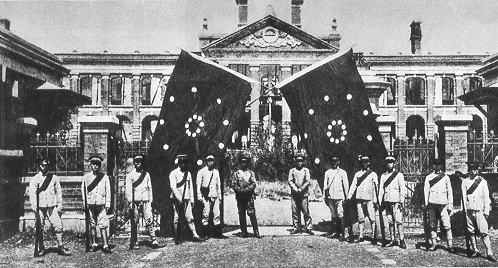
On 10th October 1911, the outbreak of the Chinese Revolution. A revolution that happened almost by accident, evolving from what seemed to be a relatively small local dispute about railways. Sun Yat Sen was abroad, and most of the major political activists were caught unawares. Only a few months before, there'd been an insurrection in Guangzhou (Canton) but then the Manchu rulers reacted savagely. The "72 Martyrs" are commemorated in Yellow Flower Hill, one of the monuments of the Chinese revolution. In Wuchang, however, the dissidents were armed western style militia and held the Manchu armies at bay for 41 days, buying time for the political wing to organize. As revolutions go, the Wuchang Uprising was relatively contained. Five thousand died, mostly soldiers, but compared with what was to happen later it seems so innocent. This time, the Manchu regime collapsed internally, without a struggle, and by February, the child Emperor abdicated. Yuan Shih Kai, a Chinese who theoretically led the Manchu armies, might very well have established himself as the new Emperor, but the idea of a democratic Republic had taken hold. Above a short clip about the background, below historic archive footage of Wuchang 1911.

Sunday, 9 October 2011

Why we should worry about the BBC cuts

£700 million worth of cuts to the BBC from the last year's £3.5 billion expenditure (about 20%) because the licence fee is being frozen. Big cuts to sport, hardly surprising, since that's what commercial broadcasters want to control. Obviously, there's slack in the way any big corporation is run.  For example, most people made redundant get the statutory minimum, around one week per year worked, max £400 per week. You're lucky if you get £5000. It's shocking that the BBC pays up to 2 full years or a maximum of £75000. Since they're laying off thousands of staff, it might be cheaper to keep them on..

But what does it mean to classical music? BBC Radio 3 used to be top of the market but has been spiralling downwards for years. If the BBC continues to self destruct, we might as well listen to Classic FM. Or not at all. The Proms are safe because they're symbolic, but they're planning to slash around 25%  of key elements, like live broadcasts and performers. Cutting waste and management is one thing, but cutting the core of the whole service is plain short-sighted.  The way the recording industry has collapsed. there's a huge niche for live and original. But the BBC don't seem to have twigged how the industry has changed. Are they killing the goose that lays the golden egg?

BBC Radio 3 supports the whole music industry. Nobody makes money from seat sales alone: Broadcast fees make a huge difference to the income of any venture. Now the BBC Plans to cut live broadcasts, which are a key feature of the schedule. We all can hear some of what's on at the Wigmore Hall, for example, without getting into London, and we get to hear top European orchestras and opera companies as well. Smaller venues and festivals may not survive without BBC support. We get to hear what's on at the unusual East Neuk Festival in the Outer Hebrides, for example. Without broadcasts we won't get variety and regional ventures, and places like the Wigmore Hall might not have the leeway to keep standards high. The end result? Less music. less variety, lower quality.

It's because of the BBC that the British audience demographic is so much more integrated than in most countries. This itself keeps standards high, because everyone has to have something worthwhile to offer. Take away these unifying broadcasts and we could turn into a nation of insular one-horse towns, where there's no competition or wider perspective. It also might mean doom to specialist interests. No one-horse town can support specialisms like early music on their own. So will we get safe and boring? One of the cuts targets already announced is new music. The Proms prove that there is an audience for innovation. Eliminate new music and you eliminate development, sponsorship of new talent and composers who'll not reach mass markets in their lifetimes. Remember Schubert, and many others. Whether you like new music or not, it's part of the lifeblood of creativity.

Even the BBC orchestras and singers are possibly under threat. This is nuts, as they are an integral part of the whole industry. Each orchestra has its purpose, and regional significance, and the BBC Singers are world class. In turn, they provide work for musicians, composers, and creatives. Cut back on gimmicks like celebrity presenters, popularity charts, glib talkshows, even the BBC Young Generation Artists Programme (which spins duds and well as goodies). But don't cut the core business. Pretty prattlers (male and female) you can get anytime. You can't replace years of professional experience.  Bizarrely, one of the ideas being floated is to replace orchestral programming with more chamber music. That logic doesn't work. You may have to pay more musicians in an orchestra, but orchestral music is what most people want to hear. They might as well amputate much of the classical tradition. You can't appreciate chamber music without knowing the bigger picture. As for opera, I suspect the BBC won't understand at all. Seriously warped economics.

Meanwhile, they want to keep the plethora of channels , each with its own infrastructure of overheads and cushy management.  Some channels are essential services, like the Asian Network, but what's the point of BBC TV 2 or 3 reduced to doing nothing but repeats? Again, technology has changed the business. With online on demand, we can get repeats any time, we don't need to support a repeats-only channel. For a while BBC Radio 3 was turning into back-to-back repeats of Composer of the Week, recycling the same programmes over and over. Recently, they've gone back to real broadcasting and more realtime concerts. But no more. This time maybe even CotW might be replaced by repeat drivetime drivel, because that's even cheaper. And you don't really need to listen. But maybe that's the long-term strategy. Stop people paying attention and they'll swallow whatever they're given. Perhaps that's the rationale behind having lots of soundbite news snippets instead of in depth investigative journalism. That's not just the BBC of course but a result of the Attention Deficit Disorder that politicians and big business would like the population to develop.

What is going on? Don't they have the business nous to realize that, if you have a unique product, you don't strip it down so it resembles junk anyone else can do? The BBC is our patrimony, and has made this country what it is. It helps keep the whole music industry afloat. Rupert Murdoch, for example,  has long wanted the BBC cut down so his ventures can compete. OTOH, if capitalism is so good, why can't he outshine the BBC without whining?  A good horse can win without the competition being hobbled. Too much short-term thinking and vested interests in this country, not enough vision.

Saturday, 8 October 2011

Within Our Gates


That Within Our Gates should exist at all is pretty remarkable. How did a film like this come to be made at the time it did (1920)? And such high quality despite being low budget and way off grid in mainstream terms. Within Our Gates is a race movie, a sub genre reflecting the apartheid of segregation, which meant that blacks and whites couldn't go to the same cinemas and blacks had to make films for and financed within their community. Like so many very early movies, it was thought lost until 1993 when a single copy turned up in Spain, from which the present restoration was made.  Despite its period, it's remarkably well shot and well preserved. and worth watching, because i's the earliest existing film that deals unflinchingly with racism in the US.  A lot of race movies were pretty camp (like Son of Ingagi, full of private in-jokes) but this is sophisticated, better than many mainstream movies of the time.

Within Our Gates was made by Oscar Micheaux (1884-1951), a self-made man whose intelligence overcame his lack of money and conventional education.  His movies followed on from his books, which dealt analytically with situations facing black people at the time. The protagonist, Sylvia Landry, is an aspirational figure, whose education has been paid for by a secret donor, though she was brought up by poor sharecroppers. She goes up north to raise money for a school for black kids. The plot is complicated by love interests, which serve to show different ways of being black, but revolves around Sylvia's past. Because she is educated, she helps her parents manage their money so they don't get exploited by the evil boss, Philip Gridlestone, who preys on poor whites and blacks, and is hated by all.  Throughout the film, Michaeux is even-handed and fair: neither race has a monopoly on good or bad, all people are fundamentally equal, what they do with their lives isn't defined by race. Hence the dodgy pastor, the crook Conrad and Efram, Gridlestone's servant, who thinks he can win favour with whites by betraying blacks.

Sylvia's stepfather Jasper goes to Gridlestone with proper accounts so he can't be ripped off, but Gridlestone is shot through the window by a white sharecropper whom Gridlestone has cheated in the past.  Knowing he won't get a fair trial, Jasper and the family run off to hide in the swamp, while the mob hunts them down. Eventually both Jasper and his wife are lynched, and their bodies burned. It's shockingly graphic, particularly hard to watch as such things really did happen all the time: perhaps some of this drawn from real life. The mob even try to lynch Emil, Jasper's son, who is about 10, but he escapes by playing dead when the mob shoot at him, and then steals a horse. Will he get away? While all this is happening, Sylvia gets raped by Armand, Gridlestone's brother. Is this the earliest realistic race rape scene on film? Armand only stops when he sees that Sylvia has a scar on her body. She's his natural daughter. He's the one who paid for her to go to school. So maybe he's not completely evil, either.

There are some bizarrely stilted scenes, such as the one where Doctor Vivian asks Sylvia to marry him, by reciting a long list of battles in which US soldiers fought, from Cuba under Roosevelt to Mexico and Europe. "You should be proud of your country", he says. Perhaps there's still footage missing, or the sole copy was adapted for the Spanish market. Nonetheless, it's still a gripping movie because of its even-handed analysis of the political and economic realities everyone, white or black, is caught up in.  Efram, for example, is also lynched even though he tries to be accepted by whites and didn''t commit any crime. The white sharedropper who shot Gridlestone gets killed by mistake during the hunt for Jasper. Implicitly, the film is saying, nothing's fair, but you make what you can of your life, whoever you are. Notice how many white actors there are, working for a black producer and director in a film that hardly glorifies the white South.
Please also read this thought provoking article about race hate in Little Rock, 1953.  And how some things aren't easily wiped away.

Friday, 7 October 2011

Pop song for Sun Yat Sen


October 10th is the 100th anniversary of the uprising that led to the collapse of the Emperor system in China, and the foundation of the Republic of China. It was a small scale local uprising in South China, but unlike most cataclysmic revolutions it was relatively peaceful. Four thousand years of the old system wouldn't change overnight, thus decades of struggle to follow. But Sun Yat Sen was an idealist and non-violent. He could've usurped power like most leaders but instead, he realized that changing systems meant changing minds. Thus the ideals of San Men Ju I (the Three People's Principles) and later the May Fourth modernizing movement. Here is a popular hit tune about Dr Sun. Not many countries do pop songs about historic figures. (Nelson Mandela excepted)

Heinrich Kaminski Dorian Music

Who was Heinrich Kaminski (1886-1946)? Admired by Arnold Schoenberg and a leading figure in German music circles, he's largely forgotten today, though there are signs of a major revival. Listen to Kaminski's Dorische-musik (Dorian Music) on the Berliner Philharmoniker website. Star conductor Andris Nelsons conducts the Berliner Philharmoniker, soloists Amihai Grosz,  Ludwig Quandt and Andreas Buschatz.

It's a gloriously affirmative work, passionately reasserting the ideals of Bach and Beethoven. "Music", Kaminski said, should motivate people to "trace the roots of life and the meaning of human existence". He saw his duty as "bearing witness to the light".

Kaminski's Dorian music starts without hesitation and goes straight into full development, buoyed up by confident purpose. This isn't abstract music for its own sake. Beethovenian forward thrust, direct quotes from Bach. To quote the Berliner Philharmoniker notes "from polyphonic concentration....Kaminski creates free flowing spatial music characterized by extreme tempo and rhythmic shifts....It is a genuinely forward-looking work, gripping in its unique mix of eruptive energy and mystical immersion".
 
It's amazingly uplifting, and spiritually powerful. Yet, note, it was written and first performed in 1934, by Herrmann Scherchen in Switzerland. What, one might think was there to be so confident about? Kaminski's response was, on July 4, 1933, to create an “order of those that love”. The rules of this order demanded that its members “hate no one and nothing, and must not be seduced into hate by evil willfulness or abusive actions. Hate is to be overcome by No-Hate”. Advocates of non-violence, like Gandhi, and Aung San Suu Kyi  think that breaking cycles of hate might just work, though Kaminski's faith in the context of the horrors that were to come might seem naive.

Kaminski was involved with the liberal Munich avant garde, from which his ideals may have sprung, but he was also part of the "inner resistance" of K A Hartmann and others. Perhaps, too, Kaminksi's principles may have come from his father. Kaminski senior had been a Catholic priest, who'd quit the priesthood on principle after the First Vatican Council in 1869/70 (the one that introduced papal infallibility). So in a sense, we owe Kaminski's birth to his father's opposition to the Pope. But the Kaminski family were originally Jewish, from Poland. This status seemed to have confounded the Nazis. He lost his job in Berlin in 1933, apparently for political reasons, but his music wasn't banned until 1938. Then the ban was lifted in 1941 because they thought he was a quarter Jew not a half-Jew. Racial stereotypes aren't rational. Life wasn't kind to Kaminski. He lost most of his family during the war and died himself soon after. But when I listen to his Dorian Music, it's vital, humanistic spirit seems unextinguishable. The piece isn't available on CD, though there are clips on Universal Editions. All the more reason to cherish the Berliner-Philharmoniker performance, which is perhaps as good as it gets. Here are other sources of information, the Kaminski website and an interesting German website.

Thursday, 6 October 2011

How to get a bigger, better organ

How to get a bigger, better organ? Pull out all the stops and sponsor a Pipe. The South Bank needs £1 million to restore the organ at the Royal Festival Hall to its former 7866-pipe glory. Contribute if you can. here's a link with a video.

Philippe Jordan to head Vienna Symphony

Philippe Jordan has been named new Chief Conductor of the Vienna Symphony Orchestra, from 2014/15 when Fabio Luisi steps down. Jordan is the son of Armin Jordan the distinguished Swiss French conductor, but he's made an even bigger name fort himself in recent years. I first heard him conduct Wagner Tristan und Isolde when he was still very young in Switzerland. Terrible production and principals but Jordan saved the show. Since then he's gone on to greater things, conducting everywhere. He can even conduct Mahler with spirit. And he dances too, which makes him elegantly expressive on the podium.
photo : J Ifkovits

Wednesday, 5 October 2011

Boulez Pli selon Pli Ensemble Intercontemporain London

Pierre Boulez conducted Pli selon Pli at the Royal Festival Hall with Barbara Hannigan and Ensemble Intercontemporain and the Lucerne Festival Academy Ensemble. It was the apogee of the South Bank Exquisite Labyrinth weekend. Pli selon Pli contradicts assumptions. It's modern, but delicately beautiful, structurally intricate, yet profoundly emotional. Instruments like celesta, harps, guitar, mandolin and bell-like percussion. How lyrical percussion can be! Strange, limpid semi-harmonies, not simplistic dissonance. Understand Pli selon Pli, and hear how far off the mark myths about modern music (and Boulez) really are.

As vocal music, Pli selon Pli is even more remarkable.  It's based on five poems by Stéphane Mallarmé but Mallarmé isn't a conventional poet, so straight word setting would be pointless. Even translations are futile, because so much depends on the sound and shape of words, images and patterns of expression, and above all, the creative response of the reader. Boulez's Pli selon Pli is thus a highly intuitive "Portrait" of Mallarmé, built round "Improvisations" (all his words)  inspired by three poems, encased by two equally visionary movements.  Unlike conventional song the vocal part is so integrated into the whole that it seems to flow, silently, as an undercurrent beneath the orchestra, only emerging at critical moments. Boulez's approach to voice is so unique that he's unlikely to do opera in any recognizable sense of the term.

Pli selon Pli begins with a single explosive burst. It's significant for the work is built on single chords and cells, every colour kept as pure as possible. As in impressionist painting where brushstrokes shine, as in Debussy, whose influence hovers implicitly. At the core of the orchestra is the celesta, behind the conductor, five harps behind it, supplemented by xylophones, marimba, beaten bells and piano used as a percussion instrument. To the conductor's right, guitar and mandolin. Theya ren't noisy, flashy instruments but central to the whole piece. The celesta is often used because it has a "celestial", other worldly sound, much less dominant than piano. The guitar and mandolin may represent something more humble than, say, violins, evoking the image of poet or troubador. Vocal instruments, in their own way.

With textures as diaphanous as these, every note counts: careful listening mandatory. This is chamber music on a large scale, where listening and silences are part of the process. It feels as if the music is beiung turned over and examined from different angles. Mallarmé's first poem, Don (Gift), has images, but no grammar. Words are separated by spaces filled by dots, which are as essential to meaning as the words themselves. . Boulez expresses this with sequences of single chords, rippling around the voice. You're listening to the spaces and thinking, while the voice stretches forwards, searching and exploring. In this first poem, meaning is suggested by images of rock-like harshness - basalt. lava, winter - contrasted with images of ephemera - foam on waves, memory, loss. When Hannigan sings the word "hiver" (winter) the single notes around her prickle like penetrating frost, the sea itself frozen hard. Ce lac dur oublié que hante sous le givre le transparent glacier".

The Improvisation on Une dentelle s'ablouit combines Mallarmé's puzzles with Boulez's intricate structures, this time in reverse. Like lace, Hannigan's lines trill and twist - horrendously difficult to sing - but behind her the music unravels. Whispering sibilants of cymbals being brushed, a fairly long passage for maracas. Then, as if brought to life by the line flotte plus qu'il ensevelit, the flutes emerge floating the vocal line that's subsumed behind the orchestra. Deftly placed silences again - a long gap between "au creux néant" and musicien" to emphasize dormant creation. Similarly, emphasis on the word "le sein", the key word in "Selon nul ventre que le sein filial on aurait pu naître". Few composers are quite this sensitive to meaning.

Mallarmé throws a wild card with multiple puns on vowels in A la Nue Accablante Tu but Boulez parries with sound that extend the vowels and cut across them with sharp sibilants.  Again, the hard images from the beginning of the cycle, "basse de basalte et des laves", Hannigan's voice intoning darkly, her legato rising and falling like the waves of the sea implicit in the symbols of foam and shipwrecks. The orchestral cells break into patterns that might suggest water, light, churning like the motions of waves. Languid but purposeful.  Gradually a new perspective emerges. Trumpets, tuba, tubular bells, so reminiscent of Messiaen that it feels like a deliberate reference, especially given the meaning of this work as a whole. If Boulez is referring the penultimate section of Et exapecto resurrectionem mortuorum, it gives Pli selon Pli even greater resonance.

Lovely passages for solo celesta, for the double basses, lower strings, and violins, but guitar and mandolin return to the forefront again. The last movement, almost wholly orchestral but for one line, feels like song, with endless choruses from different parts of the orchestra. Arpeggiatos and individual cells but unstoppable forward thrust : the image of waves and the sea. The single vocal line is ironic. "Un peu profound ruisseau" sings Hannigan, "calomnié la mort", stressing gaps betyween words, and shrieking wildly up the scale, as if the line is being drowned by what the orchestra is singing. Towards the end, she no longer sings but exhales, as she did at the beginning of thee whole piece, the word "la mort" barely gasped, as if it's too much to contemplate. As Pierre-Laurent Aimard said during the afternoon piano sessions, one of Boulez's signatures is reverberance that continues long after a performer stops playing. The "music" continues to resound, and should be listened to, as it's part of the whole. Alas, someone started clapping too soon. 

I'm sorry I haven't done an instant review on this as I haven''t been well, but Pli selon Pli is music that repays reflection "fold by fold".  I don't know if I have time to write up the other concerts in thsi excellent series - especially the Aimard/Stefanovich masterclasses and the Eötvös/London Sinfonietta concert with fantastic Clio Gould Anthèmes II. But read Mark Berry in Boulezian instead HERE and HERE. 

Email from a friend :
Seems Boulez did Pli selon Pli from 21 September onwards in Amsterdam, Milan AND Turin, Munich and Paris before London. It had been performed in Lucerne, with just the Lucerne Festival Academy Orchestra (ie bigger than the LFA Ensemble) on 8 September. No wonder he looked a bit worn out.


You might also like these posts : Full video of Boulez conducting Pli selon Pli in Paris, and an interview with Barbara Hannigan by Ivan Hewett.