Tuesday, 12 August 2014

Clara Butt in Full Flow


We can safely say that Clara Butt dwarfed most every other singer of her time. The photo shows her embarking across the Atlantic in 1907 with her family in her wake. Which was more magnificent, the P&;O liner  or the diva ?  Clara Butt stood 6 foot 2 without high heels. She had a remarkably wide range and volume: when she sang in Dover, it was said she could have been heard in Calais. Imagine a voice like that in an opera house! Alas, she never sang a Prom at the Royal Albet Hall.  Her Land of Hope and Glory would have brought the house down and terrified the Huns into abject submission. Below, her first recording of Land of Hope and Glory, from 1911. In her 1930 version, her voice isn't quite so good . Play it full volume for maximum impact.

I've been listening over and over to Alice Coote singing Elgar's Sea Pictures because she's so wonderful; earthier and more mysterious than Janet Baker, whom I love dearly. Both Coote and Baker are wonderful. But Clara Butt is something else. In her time, singers weren't intimidated: they did crossover and other things singers would not dare do today. When Butt premiered Elgar's Sea Pictures in 1899 at Norwich, she took the sea imagery to another level by wearing a mermaid costume . Oh, that the moment would have been preserved for all time! Nowadays she'd be the Butt of all jokes, but I suspect she would have given as good as she got.  She only recorded one song in the set, "Where Corals Lie" but recorded it twice, once in july 1912 in Hayes Middlesex and again around 1920 for Columbia. listen to that recording below. Notice how ropey the orchestra is. They sound like they're imitating a jazz band. Admittedly, Elgar's rhythms are jaunty but any conductor taking such liberties would be crucified today. Butt makes the most of the leaps up the scale, throwing her voice to the winds, so to speak.  So much for polite orthodoxy!


Monday, 11 August 2014

Elgar, Elder, Hallé, Alice Coote Beethoven Prom 31


Elgar, Elder and the Hallé: an ideal combination.. Alice Coote sang  Elgar Sea Pictures at BBC Prom 3: the stuff of dreams. Coote's rich mezzo brings out the sensual undercurrents in the songs, suggesting dark mysteries hidden beneath the depths. "Sea-sound, like violins, To slumber woos and wins, I murmur my soft slumber-song, my slumber song Leave woes, and wails, and sins."  The texts are uneven, but Coote makes them feel natural and sincere. "Thy lips are like a sunset's glow, Thy smile is like a morning sky, Yet leave me, leave me, let me go And see the land where corals lie." When Coote sings "Thy lips", her lips curve round the words: something personal , almost dangerous here, yet exquisitely beautiful. How sensuously Elgar orchestrates these songs! Soloists dance along the singer's line, reaffirming her words. There have been many great Elgar Sea Pictures in the past, but Coote and Elder are right up in the top of the league. If this enters the discography, it will be a top pick.

Please read Claire Seymour's review of Prom 31 Berlioz, Elgar, Helen Grime and Beethoven Symphony no 3 HERE in Opera Today. I also liked Elder's lucid approach to the Eroica, which flowed with freedom and sparkle.

Why the Proms musical apartheid on BBC TV?


From Roger Thomas : "Something very puzzling is happening in BBC TV's coverage of the 2014 Proms. Although the concert items that the BBC labels as New Works are included in their original context in the live (but broadcast on a later date than the actual performance) TV screenings on BBC2 and BBC4, they are excised when the concerts eventually – there are delays compared with previous years when repeats were available almost immediately – appear on BBC iPlayer. Perhaps the delayed appearances on iPlayer are themselves a result of the extra editing involved in this surgery.
 
 If you want to view the New Works again (often a good strategy with a new work anyway) you have to search out the special snippet programmes on the iPlayer index page (something that some might find daunting). Since loading these New Works has been so delayed, there have been quite reasonable complaints elsewhere on the internet from users who thought that some of the New Works had been“censored” by the BBC and had been lost for a repeat viewing altogether. They weren't a million miles off the mark, but I prefer the apartheid simile myself – these works have been banished from the city centre to a township in the suburbs. BBC TV has at last caught up with itself in this resettlement process. So the New Works by Quigang Chen, Roxanna Panufnik, Jonathan Dove and John McLeod (new? – published in 2000 and first performed in 2001) are now available if you are prepared to search them out. 

But there is a wider issue. Why? Is the BBC ashamed of these works (some of which it has commissioned or jointly commissioned and therefore paid for, with licence payers' money). Or does it feel that it will drive away viewers if they are left in their original context – perhaps in some instances a concert planned with some thematic coherence? The New Works are of course of varying degrees of quality and accessibility, but the same could be said of many “Old Works” performed at the Proms. If a 14-year-old work such as McLeod's The Sun Dances is considered too challenging to be broadcast in its concert context beyond the first viewing, where  is the line to be drawn? After all, audiences have found much new music baffling when it was first performed: not just Sacre du Printemps, but even Elgar's second symphony, most of Mahler and, presumably, Beethoven. To stray off the main point, all this also perhaps explains why Oliver Knussen's marvellous long succession over the years of BBC SO Proms featuring out-of-the-mainstream and “new” (or newish) works has been broken, with his banishment to Cadogan Hall in 2014.

Some Prom audiences obviously find new music an unwelcome diversion from an easy-listening life. One misguided columnist in a reputable journal recently described it as “the programmers’ equivalent of cod liver oil, the bit they put in every [sic] concert to keep you in touch with new work, which is Good For You and must be taken along with the cake and jam”. Misguided not least because to boost her argument the columnist invented a work that had never been played at the Proms and had indeed never been written: Elliott Carter's Organ Concerto. The BBC shouldn't encourage such attitudes. It has a fine record for commissioning new music. It's time for a rethink on broadcasting strategy"

Good points! Knussen's at Cadogan Hall because he's doing chamber music. But what is "new" music, anyway? There's a huge difference between music thats been recently written and music that is genuinely original . Alas, the BBC seems to go for the former rather than the latter. Maybe they need to placate politicians who think mass appeal is more important than art. Most of the "new" music this season, with a few exceptions like Harrison Birtwistle, Simon Holt and Sally Beamish, has been pretty banal., and I've listened to nearly all, though I could not face Gabriel Prokofiev. (I did hear snippets.) (To be frank, I think that the BBC is doing some composers a favour by not highlighting their work. Some pieces are so bad they should be disowned to save reputations.)

Music is not like mince or ground beef, where any old bits can be mixed up together and regurgitated as new product. Sure, many people like mince. It's successful, whole fast-food chains flourish. But it's not good for you.

This sort of un-new new music only reinforces the idea that anything new is bad. As my friend has pointed out, most people who hate new music have no idea what they are talking about. But if the BBC takes that lot seriously, we're lost.

A few years ago I went to Aldeburgh, where a coachload of elderly people had come for Bach Mass in B minor. They were early, so many of them sat in on a masterclass with Pierre Boulez. He won them over. He was the same age as most of them, and started by talking about how grim the post-war years were when there were paper shortages, no printed scores, no LPs, no concerts. Then he explained why he got into music. He listened to everything he could, from early music to Webern. He didn't like it all, but he listened.  The main thing, he said, was not to create barriers. Then he went on to explain the piece of the evening in simple human terms. The Bach Mass crowd listened with rapt attention. Perhaps it was different to what they were used to, but they listened. Some even found that they liked it. Afterwards, some came up and warmly shook Boulez's hand.  

Sunday, 10 August 2014

Glyndebourne La Traviata free online


Glyndebourne La Traviata free online in the Telegraph. 
The bad news is that it's this: "all surface, no substance. The setting, framed by two curved and textured walls, is blandly modern, populated in the two party scenes by fashionistas and arty types, staring out across the stage like Tussaud waxworks. All of which prompts too many basic questions. Who are these people? What have they to do with the social distinctions and sexual stigmas of Verdi’s opera? " Read the full article in the Financial Times here. 

[Now that I've watched it myself, I think it's wonderful!  I cannot face the ROH production any longer, even with an extremely good cast (which is doesn't always get). This new Glyndebourne production is so elegant that it's almost minimalist, but there are some very beautiful moments, like the scene at Flora's party lit with jewel colours.  Mark Elder conducts the LPO with similarly elegant gloss - gosh, I cant remember a recent La Trav as beautiful as this, which also supplies the passion the acting lacks. Venera Gimadieva has a stunningly lovely voice - gasp in awe after her big numbers! She's definitely worth hearing again. But will she develop better acting skills ? She makes the right gestures but I'd like to see more personal conviction.]

.La Traviata wouldn't be nearly as popular as it is if it didn't speak to people in different times and cultures; if it didn't resonate with their feelings. No composer sets out to write a historical documentary: good composers deal with human emotions. It's silly to judge productions simply by the way they look.  It''s much more important to assess a production in terms of how it expresses the drama in an opera.. That involves an understanding of the emotional content in any opera. For various reasons, many people don't read feelings well, and emotions might seem difficult to deal with.  But the absence of empathy is a handicap when it comes to understanding the arts, or artists. Without emotion, and empathy, we aren't fully human.  There's no such thing as "interpretation-free".  Emotional intelligence begets visual intelligence. Operas deal with intense emotion. Can we really engage without emotional range?

photo :  Richard Hubert Smith, courtesy Glyndebourne Festival Opera

Saturday, 9 August 2014

Glyndebourne Handel Rinaldo Revived

 
Handel Rinaldo at Glyndebourne tonight. Rinaldo is set in the Crusades but has nothing to do with history, religion or even common sense. Handel's glorious opera works because it's hyper-fantasy. Knights, enchantresses, magic, battle scenes, mountains, oceans – anything but literal realism. Baroque audiences had no delusions that the opera, and all the other Orlando sagas based on Tasso, had anything to do with historical fact. They thought of the past in terms of Classical Antiquity and Arcadian Idyll.  At first I didn't understand Robert Carsen's Rinaldo-as-schoolboy staging and the faux-profound statement emblazoned across the stage "Were the first Crusades the result of...........". Now, however, I get the humour. Schoolboys don't know life, so must learn from experience rather than from books. I think the way into this opera, and staging, is via Tasso, whose Orlando sagas  pitch the idea of hero who wins out despite flaws in himself and in those around him   Bullied schoolboys who escape in fantasy are entirely in order.  (Review of the2014 production shortly in Opera Today)

At the 2011 premiere, Sonia Prina sang Rinaldo. She was a short, feisty dynamo busting with high spirits, as teenage heroes so often are.  Perhaps Robert Carsen created the production around her, She, Carsen and conductor Ottavio Dantone have worked together for a long time. With Prina, Rinaldo-as-schoolboy had a certain logic, allowing some hilarious special effects, like flying across skies and seas on a bicycle. Handel's audiences were keener on spectacle and humour than on grim reality.

In this revival Iestyn Davies sings Rinaldo. In stark contrast to Sonia Prina, he's tall and willowy. While she sang with a contralto's earthiness, he sings with a countertenor's esoteric otherworldliness. Will the production still work?  Tall and geeky is just as much of a teenage meme as short and geeky. Davies has a sense of humour and could well carry it off.  He'd look cute in short pants. Everything pivots on Bruno Ravella, who is directing the revival instead of Carsen. Ravella directed the semi-staging at the 2011 BBC Proms, which was extremely effective because it focussed on the relationships between the characters and the crazy situations they find themselves in.

Although Rinaldo is funny, its deeper levels would not have been lost on baroque audiences. Handel, through Torquato Tasso, is also obliquely mocking the futility of war and power games. If even Almira the dominatrix Queen can make up with ferocious philanderer Argante, there’s hope for all.  Last time round Luca Pisaroni's Argante and Brenda Rae's Armida were so powerful that they dominated the whole opera. Why not imtimations of kinky sex, if you're going to fool around with a sorceress? Baroque audiences weren't prudish.  And we are not so naive that we don't know what goes on in boarding schools. This time round, Pisaroni and Rae won't be singing so the balance might well be different. 

The Forgotten Soldiers of Empire


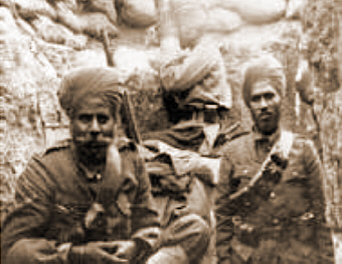
If you do only one thing to remember the First World War do this : watch David Olusoga's powerful documentary Martial Races on BBC i-player (link here)  This opens up a whole new dimensions which many British people know nothing about. We're never going to appreciate the magnitude of 1914-1918 until we appreciate its world-wide significance.

Did Empire save Britain and France? Could they have won the war without using colonial nations?  A million African, Indian, Black American and Chinese people took part, some fighting front line in the trenches, others supplying the back-up labour without which no army can survive. Hundreds of thousands died, and each man left behind a family and a community. These men didn't march off to war cheering. They were not volunteers, but men trapped by circumstances. In Africa and Asia, people were so poor that men would join up from sheer desperation.  Many of the Africans were rounded up by agents and chained. Slaves, not jolly volunteers fighting for a cause.

These men were simple peasants who didn't know much past their own villages, far less about the world. Thousands had never worn shoes in their lives. Suddenly they had to wear heavy, ill-fitting army boots and live in damp trenches.Nowadays even in remote areas people have TV, internet and mobile phones, even a smattering of education. A hundred years ago, these peasants might as well have been rocketed into space, so alien was the environment they found themselves in. Even now there are dozens of different language groups in Africa and Asia. A hundred years ago men from diffrerent villages might not speak the same dialect. Suddenly they're all thrown together, with hardly anyonen to talk to.

The concept of  "Lesser breeds" underpinned Imperialist thinking. The West didn't colonialize for love. Social change and modernization were side effects, not goals. Olusoga reads from British Army records which describe the different communities of the Indian subcontinent as if they were breeds of dogs or horses. Unpleasant as these things are, we need to acknowledge them if we're  to move on.

1914-1918 was a world war, with global causes and global consequences. It came about in many ways as a continuation of colonial rivalry. The British and the French grabbed colonies first, excluding the Germans, Japanese and Americans.  1914-18 didn't happen because some Serb shot an archduke. In the Middle East, the Germans (and their allies the Turks) were struggling with the Russians and British for control of oil fields. Then, as now. And so the British and French used their "resources" in the form of human fodder.

Olusoga's documentary is meticulously well researched and presented. This is the kind of exceptional high quality that the BBC was once known for. Most of this material is well documented in academic circles, but there's  material here that's never been seen in public before. Olusoga makes it human and personal.  To understand our present we need to understand our past. This series is very, very important.

Friday, 8 August 2014

Stravinsky Oedipus Rex Oramo Prom 28


At BBC Prom 28 2014, Sakari Oramo conducted the BBC Symphony Orchestra. No surprises there: he's their popular Chief Conductor, well respected for his years in Birmingham with the CBSO.  The BBCSO are the best of the BBC's stable of orchestras, and with Oramo they have a fine conductor, They're so reliable that anything they do will be worthwhile.

Thanks to the BBC's infatuation with Brett Dean, he probably gets more high-profile gigs than any other living composer. There's logic to this, since the Australian media picks up on his  Proms, which is fair enough. Dean is a genial personality, and builds his work around programmatic images and ideas which most people can connect to, even, or especially, if they do not like music.

Dean's Electric Preludes, written for Richard Tognetti and played by Francesco D'Orazio, illustrates the point. There aren't many pieces for electric violin, so it scores high on novelty value. The very idea  catches attention.  Judith Weir's The Singing (Prom 20) proves how unusual instruments can inspire serious music. But Electric Preludes is little more than the kind of extended riff rock musicians indulge in when they show off at festivals . Clever technical display, but with little substance. Electric guitars and electric violins.: therein lies the populist appeal. At least rock stars improvise creatively. Electric Preludes is noise, with far more self-regard than is good for art.

Most of the new music this Proms season (excepting Simon Holt's excellent Morpheus Wakes Prom 14) has been very banal, but the BBC needs to please its political masters. Almost by definition, mass market popularity must cater to the widest possible audience. But should the BBC sacrifice its artistic ideals?

In a 2007 Prom, Dean's Vexations and Devotions was paired with Beethoven's Symphony no 7.  Comparisons were made connecting Beethoven's glorious concepts with Dean's embarrassingly trite piece about mechanical telephone queues.  Seven years later, we heard Dean and Beethoven together again. Even in a fairly bland performance, Beethoven's Overture to Egmont  left Dean far behind.

Stravinsky's Oedipus Rex deliberately avoids direct emotional appeal, even though the subject is lurid. Imagine how the tabloid press would seize on this story of murder and incest in high places! Stravinsky chose Latin for the text because it distanced the words from conventional music drama, capturing instead the stylised formality of ancient Greek tragedy. This emphasizes the inexorable nature of Fate, from which human beings have no escape. Hence the huge dramatic blocks of sound, the chiaroscuro colouring and the absence of decorative detail. It’s The Rite of Spring minus nature and folklore.

For this Prom, Oramo used a different translation of Cocteau's original text. Roy Kinnear delivered it without the exaggerated RADA declamation other translations invite, responding  with ordinary human feelings.. This worked well with Oramo's approach, which played down the theatrical extremes. Seven years ago Gergiev conducted  Oedipus Rex at the Barbican with Russian soloists: a devastating, emotionally draining experience, but magnificent. Oramo lets us hear the elegance and clear phrasing, reminding us of Stravinsky's ballets, and of  the carefully poised formalism of The Rake's Progress. Both interpretations have their strengths.  Oramo's soloists are also less austere. Allan Clayton sang a bright-toned Oedipus while Hilary Summers sang Jocasta with dark timbre suggesting  queenly maturity.  Brindley Sherratt (Tiresias) and Juha Uusitalo (Creon) added rock-like gravity. The BBC Singers and BBC Symphony Chorus provided excellent support, representing the people of the kingdom as well as an extended Greek Chorus.


Wednesday, 6 August 2014

Berio Sinfonia Shostakovich Petrenko Prom 26

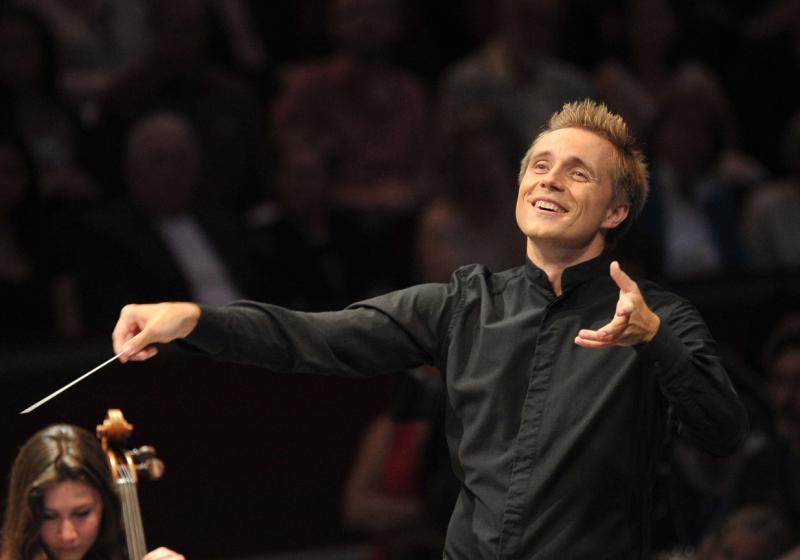
"For the unexpected is always upon us". a voice cries  out from the swirling complexity that is Luciano Berio's Sinfonia, conducted by Vassily Petrenko and played by the European Union Youth Orchestra at Prom  26. Some theories of the origin of the Universe deal with the concept of primordial chaos from which order, of a sort, emerged. Sinfonia might seem, at first, chaotic, but it is, in fact, a carefully thought through coming together of multiple different strands of human experience, operating independently, yet influencing the way we perceive the parts therein. There are quotes from Samuel Beckett and from Claude Lévi-Strauss, the anthropologist of myth. Musically, there are references to Mahler, Debussy, Hindemith, Strauss and even Stockhausen. Sounds interact, slipping in and out of consciousness. Berio even plays with time: there are sections in which performers can insert the present into the score. Hence, the singers of the London Voices say "Thank you Mr Petrenko" and refer to Shostakovich's Symphony no 4 with which Berio's Sinfonia shared the Prom.

Berio's Sinfonia is very much a piece of its time (1968-9), like Bernd Alois Zimmermann's Requiem for Doomed Youth (read more here)  Both quote Myakovsky, the revolutionary poet much loved by the radical left of the time. For a moment, many believed that a new world might emerge from the chaos of the post-war years. Both pieces create a grand collage of sound, referencing ideas and emotions beyong "pure" music. In our increasingly polarized world today, we should respect composers who believed in letting many different voices contribute.

Much is always made of Mahler's influence on Sinfonia, but unfortunately many who repeat the connection don't realize that the quote comes from Mahler's own quote from the song Sankt. Antonius Fischpredigt, in which Mahler is poking fun at a drunken saint preaching to a collection of fish who would never come together in Nature. Besides, the fish don't take heed. They go back to their fractious ways as soon as the song is ended. Berio is having fun, as was Mahler.  Berio is also alluding to Mahler's statement  that "a symphony contains the world". Perhaps it does, but an artist chooses his materials with purpose. There's nothing derivative in Sinfonia, despite the diverse sources: Berio was a true original.

That said, the European  Union Youth Orchestra should be credited for trying, and learning from the piece. It's not easy to pull off, but one hopes that the young players will have learned that there's more to music than repeating the usual fashionable clichés of Mahler influence.

Petrenko and the young orchestra followed with Shostakovich Symphony no 4, another piece too frequently discussed in connection with Mahler without much  insight. This symphony is huge - 12 basses - but this is as much part of the Zeitgeist of the 1930s in which it was written. Shostakovich admired Mahler, as did Benjamin Britten: they had a lot in common when they met. But Mahler didn't own the monopoly on funeral marches or on celestes. Like Berio, Shostakovich was writing an original work of his own.  Petrenko is a very good Shostakovich conductor. He approaches the piece with energy, bringing out the spartan  angularity in those syllabic footsteps, which could easily be heard as mocking Soviet conformity as the mimicking of Mahler. For all its vastness, this symphony has an asperity and bite that is all Shostakovich.

Hiroshima and Nagasaki - NEVER FORGET


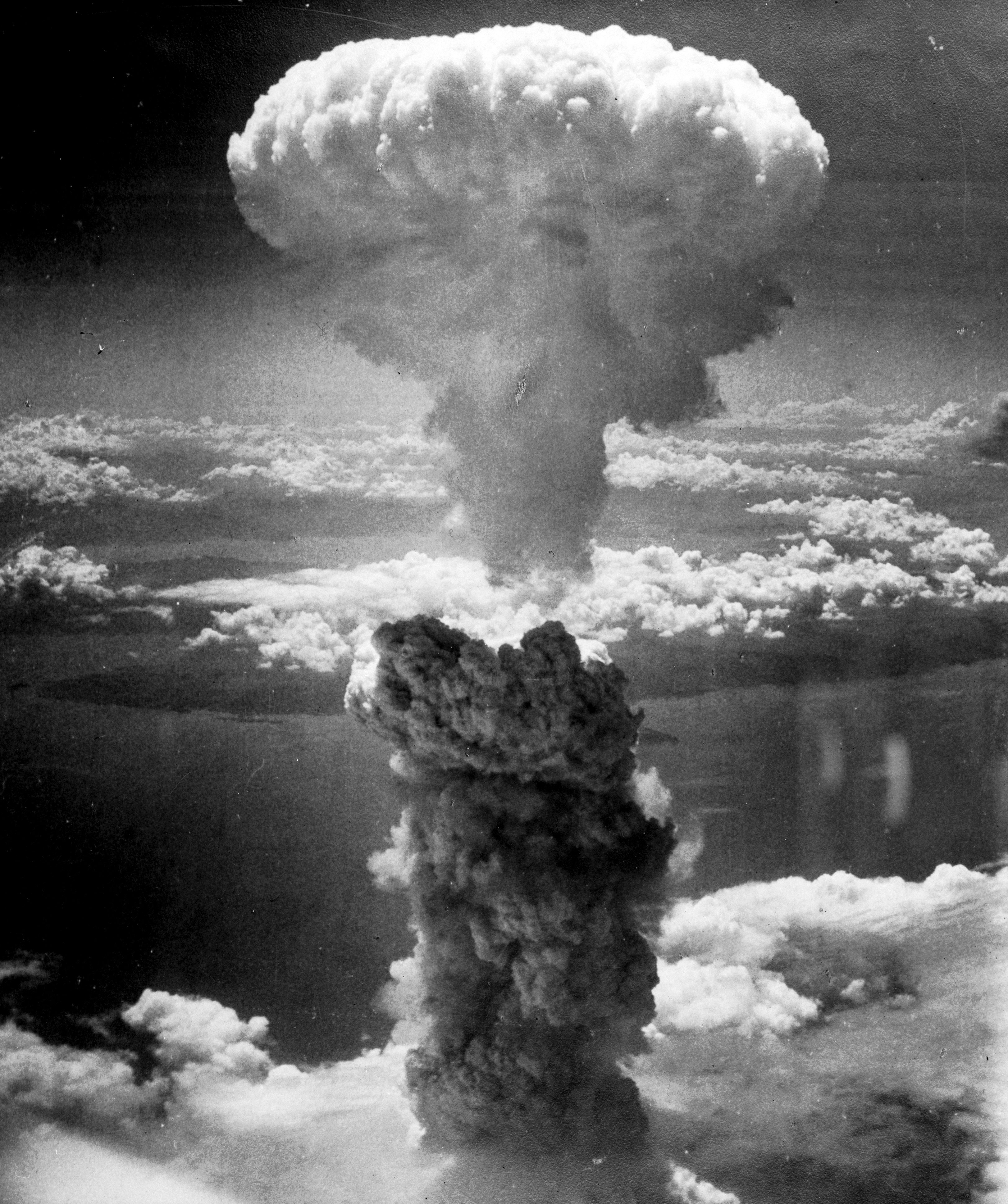
Two days and thirty-one years separate the anniversary of Britain's declaration of war on Germany and the first atomic bomb at Hiroshima . But has the world learned?  Elaborate commemorations are all very well but they don't mean a thing unless they recognize that war per se is no solution to the problems of the world. In 1914 men rushed to fight the "war that would end all wars" which ended up generating an even more savage war. From cheering in London and Berlin to the mass murder of millions all round the world. Indeed, the present conflicts all over the Middle East are themselves a snip off from WWII.  As I've often said 1914 marks the beginning of the Thirty Years War of the 20th century. Maybe it even marks The Second Hundred Years War.

 No , I will not be wearing a poppy this year, either (read this extremely important link), not because I don't care, but because I care too much.

Every year since I started this website I've commemorated Hiroshima and Nagasaki, with links to history, personal accounts, music and film. Look them up by following the link "Hiroshima". This year the juxtaposition of WWI, of Hiroshima and of the conflicts now raging across the world: all too much to bear thinking about. No, I cannot stand any more polite, pious folk pontificating for public display. In 2045 will we commemorate Hiroshima with mushroom-shaped party favours ? Even if it's "all for charity", as Jimmy Savile and his ilk used to say, there is no way to pretty up the fact that war is wrong. Hiroshima and Nagasaki, NEVER FORGET.

Tuesday, 5 August 2014

Salzburg's soulless Don Giovanni


A new Mozart Don Giovanni at the Salzburg Festival with a superb cast and a good conductor. So what went wrong? Excellent singers - Lenneke Ruiten (Donna Anna), Anett Fritsch (Donna Elvira), Valentina Nafornita (Zerlina), Ildebrando D’Arcangelo (Don Giovanni), Luca Pisaroni (Leporello), Tomasz Konieczny (Il Commendatore,) Andrew Staples (Don Ottavio), Alessio Arduini (Masetto), Conductor Christoph Eschenbach. Maybe I was expecting too much, but surely good Mozart in the Haus für Mozart should not be too much to hope for ?

Joyce DiDonato has said  "People need to understand that great performances are aided by great direction." She knows what shes talking about. Good direction isn't about costumes, or props, or physical things, but about drama.  An opera is "about" something. Performers are there to express what the story and music might mean. Every performance, even a 100th revival, should engage with the dynamic of  human relationships. Singers of this calibre can't go wrong. But what were they singing about? They seemed oddly disengaged, almost as if they were bored.

Setting Don Giovanni in a stylish hotel is a good idea, because it allows quick scene changes that don't hold up the pace. Donna Anna might be in a fancy suite, while Masetto and Zerlina's wedding takes place in the ballroom. This solves the problem of fitting in parties and dinner guests. A hotel is also anonymous: a metaphor for Don Giovanni's  soulless pursuits. But there's more to good directing than a set.  Sven-Erik Bechtolf's production unfortunately dwells so much on the impersonal and anonymous that there's almost no insight as to why Don Giovanni does what he does, or why women fall for him. Or, for that matter, why the audience should care.

Luca Pisaroni's Leporello looks bemused the whole time. The look of incomprehension on his face may be the director's take on the drama. Pisaroni has done the part so many times that he knows how much more there is to Leporello than this. Very good singing, but he can, and has, been much more emotionally involved.  When will he sing Don Giovanni himself ? In a production that makes full use of his exceptional skills for characterization, one hopes.

Ildebrando D’Arcangelo sings Don Giovanni well, but the lack of direction lets him down.  He appears in a snakeskin coat, which is a nice touch, since the character is a snake, who slips his skin off when he wants. His many costume changes aren't in themselves a problem, but there's much more to drama than what one wears. Who is Don Giovanni? What drives him? Why does he defy death itself? He's a lot more than a serial seducer. D’Arcangelo falls to the ground when the Commendatore grabs his hand. But at the end he gets up, runs off and chases yet another anonymous woman.  Quite probably, men like Don Giovanni don't learn a thing, but Mozart makes it pretty clear that Don Giovanni is wrong. In this production, so much for the Moral, and for the intensity of its expression.

There are lots of extraneous details, like waiters in devil masks and a rather good scene where D’Arcangelo licks the icing off Zerlina's wedding cake, but these details amount to nothing, if there's no engagement with the deeper ideas in the drama.  There are people who sneer at "Konzept",as if they're being clever. But all the word means is joined-up thinking. It's all very well to have bits of this and bits of that, but without an overall conceptual understanding of what makes a drama work. Maybe some audiences like productions that are purposeless but pretty. But Mozart and da Ponte deserve a whole lot more. How can anyone not engage with music and ideas as powerful as those in Don Giovanni ?  There's no such thing as affect-neutral listening.

Monday, 4 August 2014

Ivor Gurney War Elegy Prom 20

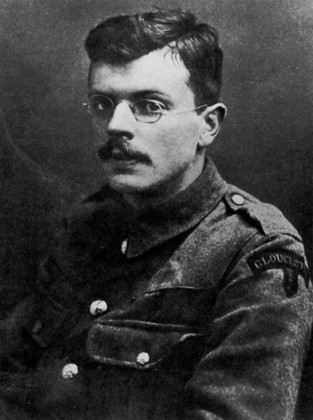
Will Ivor Gurney at last receive the recognition he is due? His War Elegy received its Prom premiere at BBC Prom 20. Gurney's poetry is so well known that it's even taught in schools. so you'd expect that there might be a ripple of interest in the print media. Did millions die to make the world a safer place for Kiss Me Kate and War Horse?

Gurney's War Elegy is fascinating because it moves as a processional. The music seems to approach from a distance. Long, surging lines suggest  forward thrust, percussion pounding like a savage metronome. How grand those long lines seem, and yet so sad. They give way to a more contemplative mood. A solo woodwind plays an elusive melody that soars upwards until it merges with the strings in a new, fuller theme which itself ends when the horns enter. Darker undercurrents make their presence: basses and cellos pick up the "march" the prercussion had earlier defined. Yet again, the full orchestra leads forwards, trumpets and horns in command. Gurney's very structure incorporates  relentless forward movement. Wave after wave, tutti and spareness. Eventually the music rises to a grand crescendo, but cut through with sharp brass calls.: not quite disssonant but enough to dispel comfort. Perhaps this is the heart of the piece, where Gurney is making his point. Soon after, the music recedes, as if those who marched past us for a moment have vanished, pulled away beyond our hearing.

Gurney was only 30 years old when he wrote the War Elegy, yet it is a singular advance on what he'd written before. He's best known for his song settings, so one might ask:   "What Gurney orchestral music?"  as Ian Venables prefaced his talk at the Three Choirs Festival in 2010.  (more here).  In the disruptions of Gurney's life, unpublished manuscripts went missing. Fragments remain, though, and now the Gurney Archive at Gloucester is being carefully mined by Venables (himself a composer), and Philip Lancaster. It's now known that Gurney wrote quite a bit, including two symphonies, and even planned an opera based on  J M Synge's Riders to the Sea, whose theme is also the relentless progression of death.  Read more here about how Venables and Lancaster worked on Gurney's War Elegy.

Gurney's A Gloucestershire Rhapsody and the War Elegy were written around the same time, and completed in 1921, but the War Elegy is much more sophisticated as music, and much more emotionally charged. What might Gurney have heard if he hadn't been incarcerated during the later 1920s and 1930s when so much was happening in musical Europe? His was an original mind, not necessarily one to follow safe convention. I've been listening to Gurney's War Elegy repeatedly (link here) because on the night of the Prom I was in Worcester for the Three Choirs Festival (more here). Just as well. At home I can cry quietly for what we lost in the tragedy of Gurney's life.

Martyn Brabbins conducted the BBC SO. He conducted the Philharmonia in 2010, so he's a bit of a Gurney maven. Prom 20 also included Sally Beamish's The Singing (2006)  a concerto for accordion, played by dedicatee James Crabb. Accordions and bagpipes operate in the same way, but bagpipes make savage music. Crabbe's accordion playing beautifully evokes the horror of the Highland Clearances, ethnic cleansing in the British Isles, not really so long ago. For an encore, he played a transcription of a Rameau piece for harpsichord. Accordions are much under-rated.

Brabbins also conducted William Walton's Symphony no 1. Nice performance, without the turgid shallowness that has put me off the piece for years.

The Fourth of August

The Fourth of August 1914, when Britain declared war on Germany. When war seemed a glamorous, jolly jape.  Lawrence Binyon's poem "The Fourth of August". Yow! Rhyming couplets and a beat as rigid as marching footsteps. The banality is terrifying. Then look at the penultimate verse. At least when Elgar set the poem to his Spirit of England  (read more here) he moderated the violence. I grew up with Lawrence Binyon books on art,  never connecting him to poems like this. It's much more belligerent than the more famous "For the Fallen" but there's time for that in the years ahead.  Yow, the rhyming couplets and steady best, like automatons Lots more war poetry on this site - look up Ivor Gurney and Wilfred Owen.

The Fourth Of August

Now in thy splendour go before us.
Spirit of England, ardent-eyed,
Enkindle this dear earth that bore us
In the hour of peril purified.

The cares we hugged drop out of vision,
Our hearts with deeper thought dilate,
 We step from days of sour division
Into the grandeur of our fate

For us the glorious dead have striven,
They battled that we might be free.
We to their living cause are given;
We arm for men that are to be.

Among the nations nobliest chartered,
England recalls her heritage.
In her is that which is not bartered,
Which force can neither quell nor cage.

For her immortal stars are burning
With her the hope that's never done,
The seed that's in the Spring's returning,
The very flower that seeks the sun.
 
She fights the force that feeds desire on
 Dreams of a prey to seize and kill,
The barren creed of blood and iron,
Vampire of Europe's wasted will.

Endure, O Earth! and thou, awaken,
Purged by this dreadful winnowing fan,
O wronged, untameable, unshaken
Soul of divinely suffering man.

Sunday, 3 August 2014

Three Choirs Festival Worcester Elgar The Apostles


Hearing Elgar at the Three Choirs Festival is an experience without parallel. The Three Choirs tradition goes back 300 years, but is so closely connected to Elgar that his spirit seems to hover. Elgar grew up here: understanding the world in which he lived enhances appreciation of his music. Three Choirs regulars (and the staff) are special, too.  They come for fraternity as much as for music, so theyre unusually kind and friendly, "The best of England" in so many ways. Elgar's  The Apostles has been heard in London several times in the last few years, but there is absolutely nothing quite like hearing it in Worcester, and at the Three Choirs Festival. 

As the introduction to the Apostles unfolded,  Adrian Partington conducting the Philharmonia Orchestra, and the Three Choirs Festival Chorus and Youth Choir created an atmosphere of reverence: those gently circulating sonorities might perhaps suggest the movement of cosmic forces. Indeed, Jesus is about to reveal the Beatitudes to his followers. Yet Elgar made great efforts to include the shofar, the valveless trumpet of Judaic tradition, thus connecting the new faith of Jesus to a much more ancient past. In the acoustic of Worcester Cathedral, the sound reverberated around the building. I've never heard it done with such overwhelming impact. Karl-Heinz Stockhausen, who used physical space as part of performance, would have been impressed. How strange and exotic the shofar must have sounded when first heard by Edwardian audiences!  At Worcester, the impact verged on the point of danger, for indeed, the disciples are setting off on a mission into the unknown.  Christians would suffer for their faith, as have the Jews.  There's no need to minimize the portent. Partington places the shofar player high above the orchestra, near the young sopranos who will later sing Alleujia llke a host of angels, distant enough from the audience but not too distant in meaning, It's theologically astute and works well as music.

Partington is an extremely sensitive choral conductor. Three Choirs Festival  Chorus members know him well. This was choral singing of exceptional clarity and character truly worthy of the occasion. Component parts were distinctly defined. One could hear how they operate together, as groups of individuals united by common purpose. Indeed, it was almost as if the score were coming alive. Three Choirs choruses never disappoint, but this was wonderful.

In comparison, the soloists were relatively uneven, but that's no demerit, given the excellence of the choirs  The  male soloists were a solid foundation, the rock on which Elgar''s music is built. How jolly the apostles sounded together when they first sang "We are the the servants of the Lord"!  The theme recurs repeatedly throughout the music, and  we can identify with them through their trials and tribulations. John Mark Ainsley, Brindley Sherratt and Neal Davies are "luxury casting", strikingly characterized. With his doubts and uncertainties, Judas is a role which modern audiences can relate to. Sherratt (fresh from singing Strauss at the Proms the previous evening - review here) is the bass of choice in this piece because he sings Judas Iscariot with such personality that he creates the part as a personality.  When he repeated the words "Darkness", he made the horror feel palpable. It's a tricky part, with a sudden leap up the scale on "vanish".,plunging to the depths again on the final "darkness".

Marcus Farnsworth sang a steady, youthful Jesus, radiating sincerity. Sarah Fox and Claudia Huckle sang the soprano and mezzo parts.

The Philharmonia Orchestra is one of the best in this country, and their presence has been a great advantage. If the storm sequence seemed somewhat underpowered, they made up for things later: bright, vivid brass, quirkily agile high clarinets, striking horns, lustrous strings and the rolling thunder of the timpani.. But we go to the Three Choirs Festival for more than performance. We go for the astonishing beautiful choirs, for the atmosphere, for the camaraderie, all of which add up to value-added music. "We are the servants of the Lord ! We go forth to the ends of the Earth!" Next year in Hereford!

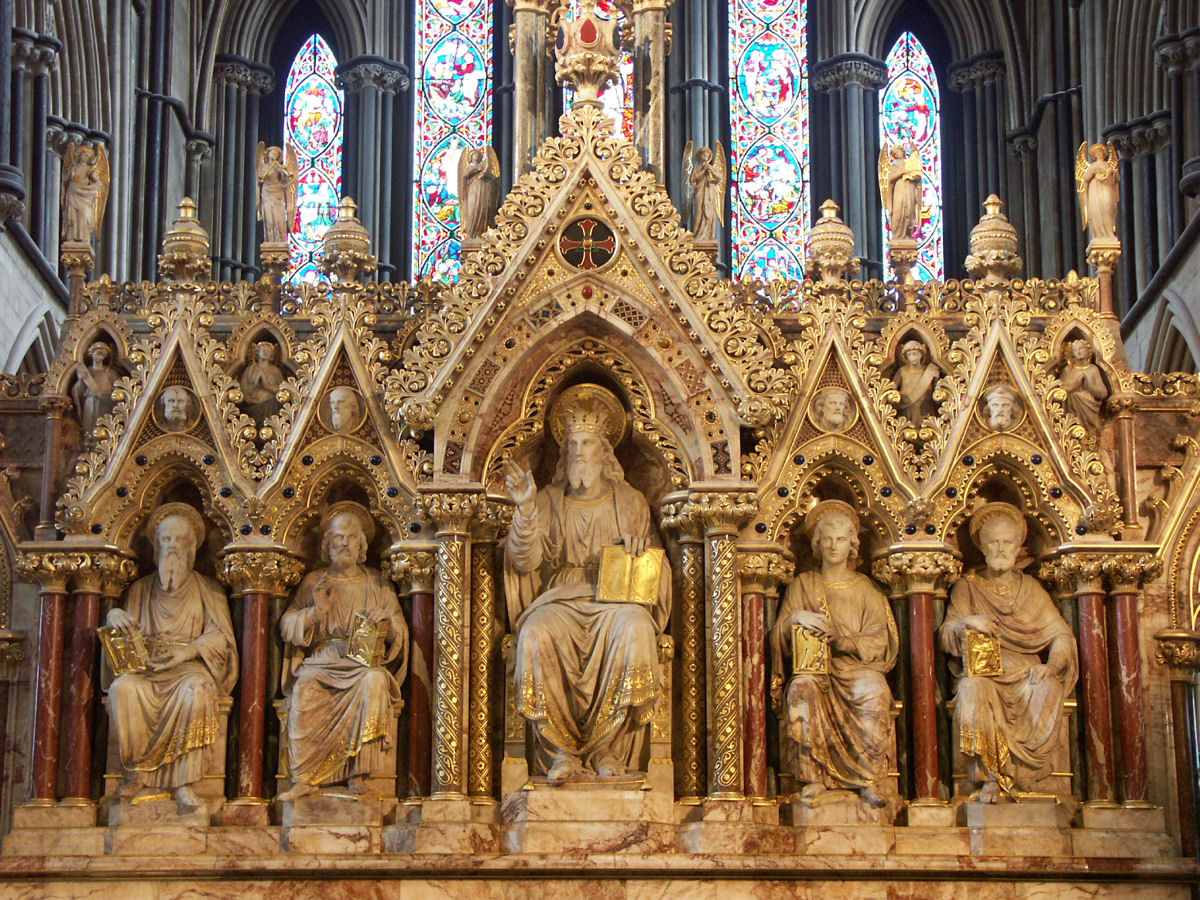
The photo above, by Mattana, 2008, reveals Jesus and his Apostles in Worcester Cathedral. During the Three Choirs Festival, they're hidden behind the performance space, but we know they're there in spirit. Please read my other posts on Elgar The Apostles, on Elgar, and on Three Choirs  by clicking in the labels below.

Saturday, 2 August 2014

Live from Salzburg - Don Giovanni Sunday

LIVE direct from Salzburg Mozart Don Giovanni  Sunday 3/8 6.30 London time (7.30 Salzburg time)

BRILLIANT CAST Lenneke Ruiten (Donna Anna) Anett Fritsch (Donna Elvira) Valentina Nafornita (Zerlina) Ildebrando D’Arcangelo (Don Giovanni) Luca Pisaroni (Leporello) Tomasz Konieczny (Il Commendatore) Andrew Staples (Don Ottavio) Alessio Arduini (Masetto) Conductor : Christoph Eschenbach, Director : Sven-Eric Bechtolf

Friday, 1 August 2014

Strauss Choir and Elgar Symphony Petrenko Prom 19


A Strauss choral work and an Elgar symphony - Vassily Petrenko and the Royal Liverpool Philharmonic Orchestra shook things up with devastating impact at Prom 19.  Strauss's Festival Prelude was written for a grand occasion - the opening of a new concert hall in Vienna in 1913. It's a massive, no-holds-barred piece glorying in drama and excess, ideal for grand surroundings like the Royal Albert Hall  Strauss packs intense power concentrated in a relatively short piece. All those instruments have to make their mark - no room for messing about. Petrenko and his orchestra seemed electrified - taut, energetic tempi, perfect cohesion, every note making an impact. Such vibrant energy,  We know now what Strauss didn't know in 1913. The Hapsburgs  and the gilded magnificence they stood for would be deposed.  Vienna, once capital of a great  empire, would be become capital of a truncated rump. But for a moment, Petrenko made it come alive again. He made us feel the optimism, the bravado, the sense of limitless confidence. This piece is standard Proms fare, but I don't think Ive ever heard it conducted with so much intelligence or purpose.

This set the scene for  Strauss's Deutsche Motette, also from 1913. This piece is even more remarkable, technically, because Strauss does with voices what he does with orchestration. This is a choral piece that defies normal convention. The four basic blocks  of voice type are refined, so the piece operates in 16 parts, blending sounds in a wash of extreme subtlety. Strauss didn't have much time for oratorios and  choral tradition. In Deutsche Motette he redefines the rules. His text is based on Friedrich Rückert's poem Die Schöpfung ist zur Ruh' gegangen,,  (all creation is at rest). The poet describes a panoramic landscape, rendered still in the silence of the night. "Es will der Schlaf auch mich befangen,"  sleep as a form of suspended animation. The balance of voices is essential, for nothing must destabilize this hypnotic magic, lest the spell be broken. A metaphor, too, for the world of 1913, now lost forever.

Exceptionally beautiful singing. This piece is a tour de force requiring great co-operation between singers, though each voice must remain distinct.  Suzanne Shakespeare sang the soprano part, Tara Erraught the mezzo, Adrian Dwyer the tenor and Brindley Sherratt the bass, backed by the BBC Singers.  In a performance as good as this, it would be a bit unfair to pick out exceptional singing but Sherratt and Erraught stood out like stars in the firmament, their lower timbre reinforcing the mystical sensuality at the heart of the piece.

Inger Dam-Jensen was the soloist in Strauss Four Last Songs, also magical songs on the theme of sleep and death. Whoever planned this Prom programme knows their music. Nearly 40 years after the Deutsche Motette, perhaps Strauss was looking back on his life and the world he had known. Although we've all heard more ideal performances of these songs (and the maddeningly superficial Prom with Christine Brewer) , listening to Dam-Jensen with lingering memories of the Deutsche Motette made this a performance to remember fondly.

Liverpool, the Cinderella of British cities, has much to be proud of in Petrenko and the Royal Liverpool Philharmonic Orchestra.  They're a wonderful team. It's a shame we in London don't get to hear enough of them. They're developing a unique sound - vivid and rejuvenating   Petrenko loves Elgar, and hears in him a "Russian soul".  Elgar's Symphony no 2 sounds mysterious with Petrenko. Even the "windflower" motif breezes along elusively. There are many cryptic clues in Elgar's music, many of which will never be solved. Four-square performances may be more common, but Petrenko's approach in many ways gets closer to the magic behind the notes.