Sunday, 19 August 2012

Gergiev Szymanowski Brahms Edinburgh Festival 2

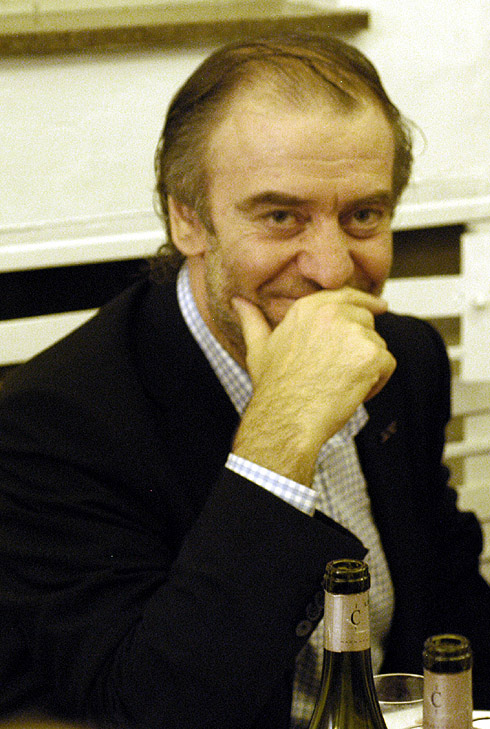
Brahms and Szymanowski? An unlikely combination  but sometimes odd contrasts enhance. What does Gergiev make of them? Gergiev and the LSO are bringing this series to the Barbican soon., but it's now on at the Edinburgh Festival. This is the third Szymanowski Third Symphony in the last year! First, Jurowski and LPO at the RFH, then Eotvos  and the LSO at the Barbican (replacing Boulez)  and now Gergiev !

Only Gergiev and the LSO are doing all the Szymanowski symphonies as a series. Juliet Willaims has been listening to the series in Edinburgh and reports: ( For the first concert, read HERE)

"Last night's performance in the Usher Hall, continuing the Brahms/Szymanowski cycle, saw one work which emphasised the parallels between the composers and one which emphasised their differences.

"It was interesting hearing Brahms' Variations on a Theme by Haydn having heard the set of variations which form the second movement of Szymanowski's second symphony the previous evening. This supported the argument that Szymanowski should be viewed within the European mainstream. Both of these were played well, and other than the Violin Concerto with Nicola Benedettini, this has been the best performance of Szymanowski here to date. Slightly surprising, the Brahms variations followed  his Third Symphony in the programme.

"Song of the Night, as Szymanowksi's Third symphony is subtitled, is a setting for tenor voice (here Steve Davislim, who has also performed this role under Boulez), large chorus and  orchestra of a poem by Rumi, translated into Polish by a friend of the composer's. It speaks of looking up into stars and losing oneself in transcendance and bliss. It is self consciously orientalist and was inspired by travels in North Africa and the near east. The most obvious connection with any other composer's works is that of Scriabin, and in particular the Poem of Ecstasy.

"Although the opportunity to hear this seldom performed work is welcome, it did not sit very easily alongside its companions on the programme. Brahms to me does speak of ecstacy and bliss, especially in his Second and Third symphonies, although he writes candidly about feelings of pain and melancholy, but his bliss is a more moderate, northern European one: a fine sunny day looking out across the beautiful river view at Wiesbaden where the Third was written, rather than a sultry night in a Persian tent like Szymanowski.

"For the synthesis or resolution between these apparantly divergent musical strands, we may have to look to a subsequent Polish composer, Lutoslawski – whose works are performed next week at the Festival – whose influences westwards as well as  eastwards are stronger in my view than those of Szymanowksi. For the synthesis or resolution between these apparantly divergent musical strands, we may have to look to a subsequent Polish composer, Lutoslawski – whose works are performed next week at the Festival – whose influences westwards as well as  eastwards are stronger in my view than those of Szymanowksi. He was profoundly influenced by hearing, at the age of only 11, the first Warsaw performance of this work we have heard last night.

"Brahms as a young man was exercised as to what, after Beethoven, he or any other composer could then bring to the symphonic tradition. However, I find his symphonies some of the most enjoyable of the classical repertoire; they are what I would listen to if I wanted to feel better, to leave the cares of the day behind as the shadows lengthened. At least one Brahms symphony would be in my selection for the infamous desert island; I am simply not sure whether I would choose the Second or the Third – both of which I like very much.

"The style of Brahms which is emerging in these performances does not emphasise these mellow, lyrical qualities of his music. Rather, it is precise and crisp;  devoid of all repeats and occasionally a little fast, it can seem impatient at times. It may to some listeners seem clinically cold or distant from the music's restrained but genuine emotional warmth.

"Edinburgh Festival Chorus returned to the Usher Hall in Szymanowski's also demanding work and were particularly pleasing in the sections of wordless song. Having last seen them in the Delius 'Mass of Life has brought that composer to mind, and this is a comparison which merits a little further pondering, especially this nocturne and the rather differently located nocturne Paris, Song of a Great City, as well actually as with the 'Mass of Life' itself. The other particular commendation I would give is  the LSO's leader, Roman Simovic, who had an enjoyable solo in the Song of Life.

"The works of Rumi are also featured in a another strand of the festival events in Edinburgh, a series of intercultural events held at St Johns Church under the banner 'Festival of Spirituality and Peace'. Performances, readings and workshops on Rumi's writings take place on 19, 22, 24 and 25 August."  

photo of Rumi's tomb by Georges Jansoone

Surroundsound Gurrelieder

Pierre Boulez brought Schoenberg's Gurrelieder into the mainstream with his three performances at the BBC Proms. Thanks to his work at IRCAM, he understood the potential of technology.  No surprise then that in 1974 "in one of the most complex sessions London has hosted, Arnold Schoenberg's Gurrelieder was recorded by CBS for stereo and eventual quadraphonic surround release. The musical, production and engineering background is covered, from both stereo and quadraphonic viewpoints." 

 Read about that recording session here in articles collected by the Stereo Society. Gurrelieder was chosen because it's huge and complex, and balances are hard to achieve. Extremes of volume too, to challenge recording technology. Though I'm not at all a technical person I can follow this because my closest friend for 22 years was one of the pioneers of the mathematics behind sound capture. He wasn't impressed by some surround sound concepts. "We listen with two ears", he'd say, "the brain processes masses of data, but it goes in thru two channels". Some of his work was so advanced that even now its potential might not be realized. Indeed, his work in pure mathematics is so advanced that only the best mathematicians (such as at Oxford in the 60's and 70's) can grasp it. Michael was too ill to take his degree. It was granted anyway because the University recognized his work. He got into sound engineering because there was a demand for what he could do (viz Boulez's Gurrelieder in 1974).

What was Michael Gerzon doing with a techno klutz like me? We met at the Mathematical Institute at Oxford, and the Oxford University Tape Recording Society which met at Ruskin House. Needless to say that was an all-male environment, many of them as socially inept as they were technically adept. When I said I mixed reel to reel tapes splicing with scotch tape they all howled with laughter.  Michael had a voracious appetite for life, squirrelling away all kinds of information, making connections, sparking new ideas. Encyclopaedic knowledge, formidable powers of analysis.  He talked non stop, but always let you get a word in, however dumb you might be.

Once he was in New York,  so he phoned ny father, whom he had never met, though of course they both knew lots about each other through me. What started as a courtesy call went on for 8 hours, each of them taking planned breaks for food, drink and toilet. "This is expensive" said my Dad. "X corporation is paying" said Michael. And so they should, for Michael didn't operate on corporate schedules. If a company wanted the best from him, they gave him room.

For a techno person, he was amazingly empathic. Once, he got lost in the Bronx and walked further and further into territory so decrepit it looked like a war zone. A 6 foot tall hooker confronts him. "You not from round here". Michael's illnesses and lifestyle meant he had a concave chest, deathly pallor and complete indifference to things like haircuts. Giant Hooker could have snapped him in two with bare hands. "I'm lost" he tells her/him. and they start to chat. Finally Hooker walks him back to the train station, to make sure he isn't roughed up by anyone, and they wave goodbye like old mates. Another time, a gang fight started to break out in London. Michael goes up to the two gang leaders and cajoles them out of fighting. All leave not knowing why they stopped, but happy that they did.

For ten years I would speak to Michael several times a day. I'd visit his various homes and we'd picnic in the Oxford Parks, which his techy friends would not believe, since he was such an indoors person. We used to go hear his favourite new music people like Evan Parker, Fred Frith,  But my circumstances changed and I couldn't keep up the intensity.  Then one day out of the blue he phones at 9 am which was strange, since he was a night person, rarely in bed before dawn. He said he's been up all night waiting to call, to tell me how much our friendship meant to him.  "But you are always sick" I said (he had chronic health problems). "This time it's different". Three hour conversation, full of affection and shared memories.. I had a terrible week ahead and didn't call back for a few days. The phone rang on, no answer, which was totally out of character. But I knew even before ringing the hospital.

Friday, 17 August 2012

Edinburgh Festival - Gergiev, Brahms, Szymanowski


Valéry Gergiev's cycle of the Brahms symphonies for the Edinburgh International Festival has started at the Usher Hall., writes Juliet Williams. This opening performance included the first symphonies of both composers and Szymanowski's Violin Concerto, with popular Scottish soloist Nicola Beneditti. Ms Benedetti, who has the honour of performing  at this year's Last Night of the Proms, gave an electrifying performance which was in turn both muscular and tender. Her playing was perhaps the highlight of the evening.

This is an important cycle for two reasons. Firstly, the imaginative and adventurous pairing with a cycle of the major works of Szymanowski is part of a programme to reassess the importance of Szymanowski as the pre-eminent twentieth century Polish composer prior to the Second World War. It rightly features his virtuostic writing for piano, as well as the lush and exotic Third Symphony, subtitled, 'Song of the Night'. Together with the violin concerto performed last night, these give the listener a representative sample of the different periods of Szymanowski's varied and evolving output. iPad users can avail themselves of a new app giving information, excerpts and scores at www.karolszymanowski.pl. 

August's events here in Edinburgh at the International Festival include a  strand looking at links and influences between Scotland and Poland, and these concerts are one of a series of events sponsored by the Adam Mickiewicz Institute, whose objective is to promote Polish culture internationally; later in the month, the Cleveland Orchestra's visit will feature Lutoslawski's orchestral works.

Secondly, the Brahms symphonies is one of the major orchestral cycles for a conductor, and it is interesting  that Gergiev is pairing it with Szymanowski. Brahms was often conscious in his writing that he followed in the footsteps of giants, but here it is the conductor who is in that position. In particular with the LSO, the footprints are those of Haitink, whose recording of Brahms with the LSO remains one of the pre-eminent ones. Gergiev is known for his excellence in the Russian repertoire and has scored well in new works such as the premiere of Sofia Gubaidulina's St John Passion, but the challenge here is  how he will approach a different repertoire and sound world, firmly at the heart of the Germanic classical and romantic tradition.

Last night suggested a promising start in this task, but the relatively introductory nature of the works programmed last night mean that the quality of his cycle can only be fully assessed  as it unfolds. The one-movement violin concerto, composed just after Szymanowski's Third Symphony, was the only fully mature work on the programme. This composer's First Symphony is in fact an incomplete fragment, disowned by the composer after only one performance and only revived posthumously. The two movements, both allegri although with differing rubrics, are important mainly in laying the basis of Szymanowksi's later development.

Brahms' First (published) Symphony, the C Minor of 1876, is a more substantial affair. Although conceived when Brahms was a young man, this symphony had a long gestation of over two decades, so the composer had more time to mature and distil his ideas. Brahms had much to overcome and develop, in particular the challenge of how, and perhaps even if, the post-Beethoven symphony should look and sound, as well as to integrate and respond to the influence of his early mentor Schumann, who had perhaps given an only-partial answer to the post-Beethoven symphonic challenge. He is still more finding his own voice than in his subsequent symphonies but very characteristic elements are well demonstrated in the enjoyable second movement. There was perhaps a rather brisk 'andante', almost impatient, but a very pleasing lyrical tone. Gergiev looked relaxed and brought  apparently effortless precision; calm control but not rigidity, perhaps reflecting the balance of emotion and precision found in Brahms' works.

The cycle continues in Edinburgh on a daily basis, tonight opening with the Tragic Overture and then continuing with the second symphonies respectively of each composer. The highlight is set to be on Saturday, when Brahms' delightful Third Symphony is paired the the sensual 'Song of the Night'. Come back here for updates as the cycle progresses. 

This major cycle will be repeated in the 2012-13 London season, opening over the weekend of 22-23 September, when there is also between the first two performances, on Sunday 23rd September, a  Discovery Day devoted to Szymanowski at the Barbican Centre:. There is also European touring, further details on the orchestra's own website.

Gergiev has an energetic schedule, this cycle closes on Sunday and he then appears again on Tuesday to conduct Prokofiev's Cinderella, but this time at the Proms. As a former opera conductor who excels in Russian repertoire, this has him on home ground and promises well. Nicola Benedetti will play Bruch's first Violin Concerto at the Last Night of the Proms, her third appearance at this year's BBC Proms.

There's lots on Szymanowski on this site, especially his Symphony no 3. Use the search labels or search box.

Thursday, 16 August 2012

3 More Years! Andris Nelsons CBSO

Andris Nelsons, the charismatic conductor of the City of Birmingham Symphony Orchestra, has renewed his tenure on the basis of an annual rolling renewal from the 2014/15 season onwards.That means at least three more exciting years.  Rejoice! Since his appointment, he and the Orchestra have created many 'once in a lifetime' performances such as Wagner's Lohengrin and the 50th Anniversary performed of Britten's War Requiem in Coventry Cathedral.(this can still be heard and watched on thespace). The CBSO says "Over the summer, Andris and the CBSO will be appearing at some of the most prestigious European festivals, including their residency at the Lucerne Festival with the CBSO Chorus. Highlights in the 2012-13 season include Mahler's momentous Resurrection Symphony, Wagner's romantic opera The Flying Dutchman and a Beethoven cycle which features all of the great composer's symphonies." Next Tuesday, 21/8 Nelsons conducts the CBSO at the Proms (Glinka and Shostakovich)

 For full details visit www.cbso.co.uk.

photo: Marco Borrgrave

Delius Prom 43, Paris and beyond

From Juliet Williams, on BBC Prom 43 and more: "As this anniversary year unfolds, Delius' contribution to music has been marked with his works featuring in opening concerts both at the BBC Proms (Sea Drift) – where his Songs of Farewell will appropriately feature in the Last Night too – and at the Edinburgh Festival (Mass of Life). (Review HERE) An important exhibition related to the composer's life is being shown in the ground floor corridor of the Albert Hall throughout the Proms season this year.

"This week also saw the Proms performance of the rarely heard nocturne, 'Paris: the Song of a Great City', given by the Royal Philharmonic under its chief conductor Charles Dutoit (Prom 43). This is another important work in understanding this composer and his work: firstly, it is a pivotal transition from his early to his mature oeuvre, and secondly it is a musical portrait of a city where the composer spent twelve years - a significant part of this life, significant also to him as it was where he met his wife. The work aims to capture the different sides of this city's personality and life. It opens with a sly, suggestive, jazz-referenced entry by woodwind, hinting at nightlife in the French capital, then broadening to offer a whistling wander in the Parisian streets. The composer's characteristic colouring becomes more apparent. Around seven minutes' into the work, it perhaps loses its way a little, before rallying forces to pick up tempo and suggest the grander, formal aspect of the city, the capital and seat of the establishment. Around twenty minutes in, this grandeur and pomp fades suddenly, to be replaced with quiet strings until building again, coda-like to a climax.

"If this performance sounded a little 'thin', this reflects the difficulty which the Albert Hall acoustic can have for delicately-textured works. The work itself, although enjoyable is at times intrinsically lacking in cohesiveness, a recurrent issue for Delius which results in the shorter, more compact works perhaps being his most successful. Devotees of Delius' music and those following the anniversary celebrations closely should also note that there is a significant new production of his A Village Romeo and Juliet at this year's Wexford Festival. A Walk to the Paradise Garden, an extracted piece of incidental music from this opera, was delightfully performed by the BBC National Orchestra of Wales at the BBC Proms on 31st July(Prom 23), for me the highlight of an evening of English 20th century music, notwithstanding the brief duration of that piece. However, Summer Night on the River, probably my ultimate favourite of this composer's works, has been conspicuous by its unseasonal absence from the considerable prominence given to him generally. It is, though, to receive a performance alongside the also very enjoyable On First Hearing the Cuckoo In Spring by the Northern Sinfonietta in the excellent acoustic of the Sage Gateshead on Sat 10th November."
photo : Alejandro Diaz-Caro 
Coming up next L Alberto Cavalcanti's Rien que les heures (Nothing but time) - a day in the life of Paris, an important film from 1926. If you like Berlin : Symphony of a Great City (1929) (follow link to full downlaod) you'll like this. Cavalcanti worked with Ruttmann. 

Wednesday, 15 August 2012

Games with Time : London Sinfonietta Prom 44

Delightful Londoin Sinfonietta experience at BBC Prom 44. Ligeti, Xenakis, Berio, Jonarthan Harvey, Louis Andriessen and John Cage. Mentally challenging but also intensely good fun. "Fun?" sneered someone not so long ago "That's not an acceptable term in music" But anyone who can't appreciate fun can't really appreciate creativity.To paraphrase Samuel Johnson, "when a man is tired of fun, he's tired of life".

This Prom was also a challenge to creative thinking. No orchestra for Ligeti's Poème Symphonique, . Instead 100 metronomes furiously ticking away until their mechanisms run out of steam. Metronomes count time and tempo is a basic building block of music. Like Poème Electronique, it's an installation piece that breaks down rigid assumptions about how we process sound into music.

I've loved Luciano Berio's Sequenza V for years without knowing its background as it works fine as pure music. It's a study of breath control. The trombone emits tentative blips, then creates long, low lines that seem to probe into space. Trombones call to communicate. Byron Fulcher shows how his trombone can peak, sometimes like a moan, sometimes a long exhalation, probing space and reaching outwards. He's dressed as a clown, mocking the Victorian propriety of the Royal Albert Hall. But it's also a reference to a famous clown who lived near Luciano Berio when Berio was a boy. Berio liked humour because it was anti-authoritarian and broke down barriers.

Xenakis Phlegra  refers to the clash between the Gods of Greece and their predecessors, the Titans. Obviously it's not "pictorial" but a confrontation between jagged,  angular pulses and more complex emanations. Woodwinds, brass and percussion weave zigzags  around each other.. Gutsy, "wooden" sounds from the strings. A huge, elliptical emanation from the brass, then a strange blast that suddenly deflates. There's even a snatch of melody, a brief reprise before the piece speeds up maniacally, and ends with pulsating short signals, like transmissions from distant planets.

In Jonathan Harvey's  Mortuos plango, vivos voco, technology is the instrument. A boy's voice sings agains ta recording of  tolling cathedral bells. But the boy himself is now an adult. while his voice rermains that of a child, recorded when the piece was first created. Harvey is playing with time, for what we hear is both something frozen in the past and reconstituted  anew in performance.

Many of the themes in Prom 44 pulled together in Louis Andriessen's  De Snelheid (Velocity) (1984). Two identical groups (saxophone, brass, piano at the sides, flutes, harps, keyboards in the front and centre back what Andriessen calls "Buddha", woodblock percussion that operates as a giant metronome. Regular, unvarying pulse, but one which speeds up quicker and quicker until you can't count the beats. Any faster and the player might disintegrate. It's gloriously punchy and exuberant, but must be hell to play and keep together. The London Sinfonietta have Andriessen's idiom under their skins, so to speak, and have been playing him for years. André Ridder conducted, stylishly.

And then silence. Or not.  After 60 years, John Cage's notorious 4'33 still draws howls of rage from fundamentalists who don't think about what they listen to.  Cage makes us think about the art of listening, why and how we process what we hear around us. 4'33 is like a Cage Musicircus, where we're presented with layers of multiple stimuli. Every "performance" is unique, created by chance and happenstance. Unfortunately at the Proms everyone keeps reverently silent which defeats the purpose. But 4'33 is "music you can perform at home" at any time.  Indeed, in our 24/7 world of mass instant communication, ruled by technology, we need to heed Cage more than ever.

This Prom ended as performance art, volunteers texting randomly, like in an installation space. A cheeky concept!  But fun.

photo : Peter Forster

Tuesday, 14 August 2012

Mälkki Philharmonia Bartók Neuwirth Prom 42

Susanna Mälkki and the Philharmonia together at the BBC Proms.  A match mde in heaven. The Philharmonia is - I'll stick my neck out - the finest orchestra in London, players of great skill, eager to stretch themselves as artists. Remember their Schoenberg Gurrelieder with Esa-Pekka Salonen at the South Bank some years ago?  Much more idiomatic than Saraste  and the BBC SO at the Proms this week. Susanna Mälkki challenges them and they respond. She is Music Director of Ensemble Intercontemporain and has conducted many of the major orchestras in Europe. At BBC Prom 42, Mälkki and the Philharmonia showed what they can achieve together.

This programme was extremely well chosen on many levels. Prokofiev Romeo and Juliet Suite no 1 set the tone. The programme would end with Bartók's Concerto for Orchestra which incorporates elements of dance and makes a wry dig at Shostakovich. Between them, Olga Neuwirth's Remnants of Songs - an Amphigory (a message that purports to convey no meaning)  All three pieces  incorporate references to other works and genres, enhanced when heard togther. Very subtle, but very brainy. Mälkki's Prokofiev is elegant and precise, as dance should be. No need for slushy fake Romaticism. In dance, poise is of the essence. You don't "approximate". Mälkki made Prokofiev move with grace.


Olga Neuwirth's music is purposeful, and with Remnants of Songs - an Amphigory she shows how delicately she can write. Some objected to her Lost Highway when it came to the ENO Young Vic in 2008 because it didn't resemble the David Lynch movie that inspired it. But that was precisely her point: she was writing music, not illustrating film (review here).  Remnants of Songs evolves from fragments of song. Conceptually it's strong: we process what we hear until it sinks into our subconscious, emerges in snatches, often disassembled. The soloist, Lawrence Power, giving the UK premiere, plays delicate wisps that dissolve as soon as you begin to pin them down. Sometimes almost bare chords against silence, then circular figures that turn upon themselves. I thought of a squirrel scurrying about, storing things away for future retreival. Powers bows angular shapes, and the orchestra concludes the second "song" with a splendid, golden semi-fanfare. Power changes tack, plucking  rather than bowing, and the song spirals up and down the scale, gaining in momentum, til it suddenly ceases. Smooth transits. The orchestra responds with loud, dramatic chords, evoking the film noir. The viola dances exuberantly, and the piece ends with a mood of cheeky brightness. Are we hearing faint traces of Schubert in the ending, as we heard in the beginning? It hardly matters, for Neuwirth is blending whimsy with inventive energy. 

The ethereal high theme that begins Bartók's Concerto for Orchestra develops subtly until it emeges with expansive confidence. Mälkki observes detail carefully, so the music seems to oscillate with light and clarity. This highlights the more disturbing undercurrents in the work. Bartók's music keeps churning and changing, tempi spirited along as if propelled by winds of change. As with Mälkki's Prokofiev and Neuwirth, you hear the spirit of dance. Particularly vibrant flutes and piccolo. Then the tam tams reintroduce memories of Magyar traditions. Bartók knew full well what was happening in his native Hungary in 1943. The eerie "night music"gives way to trumpet calls. Firm staccato, disconcerting tempi changes. Yet, Mälkki and the Philharmonia make this concerto feel affirmative. Bartók isn't going to give in to despair.

photo : Simon Fowler

Monday, 13 August 2012

Schoenberg Gurrelieder BBC Prom 41

Arnold Schoenberg's Gurrelieder
is conceived as cosmic panorama. King Waldemar curses God and is himself cursed, doomed to ride the skies forever, inspiring awe and horror. This is an audacious work of theatre for orchestra and voices. No costumes needed, nor staging, though seeing it in a performance space as inherently dramatic as the Royal Albert Hall intensifies its impact. No live Gurrelieder will ever be dull.

Gurrelieder has featured in seven BBC Proms. Pierre Boulez conducted it in 1973, in an astounding performance that is still one of the best recordings available. Andrew Davis opened the 1994 Proms with a Gurrelieder where Hans Hotter gave an outstanding performance as speaker, so remarkable that it's lived in my memory ever since. Jukka-Pekka Saraste and his musicians have a lot to live up to, but their 2012 Proms Gurrelieder did not disappont. Every performance has its merits, and from each we learn.

Wagner's influence was so pervasive that Schoenberg, like Mahler and Hugo Wolf before him, needed to find forms other than opera through which to develop his musical persona.  Saraste emphasizes the "Wagnerisms" in Gurrelieder so forcefully that you keep hearing echoes from Tristan und Isolde in the interaction between Waldemar and Tove. here's even an echo of the Shepherd's  tune in the woodwind passages. King Waldemar's men sound like Gunther's Gibichungs, and the Waldtraube plays as pivotal a role as the Waldvogel. It's relevant that Simon O'Neill, who sang Waldemar, specializes in lower-range Wagnerian roles like Siegmund.  Angela Denoke was a reasonable Tove, and Katarina Karnéus sang a beautifully rounded Wood Dove.

Saraste's emphasis so dominates that the differences betwen Parts 1 and 3 in Gurrelieder are minimized, particularly as Part 1 was conducted more loosely than Part 3. It's a valid approach, and certainly makes the piece approachable. Yet it's not an interpretation that brings out the Schoenberg in Gurrelieder, which is far more original and challenging.

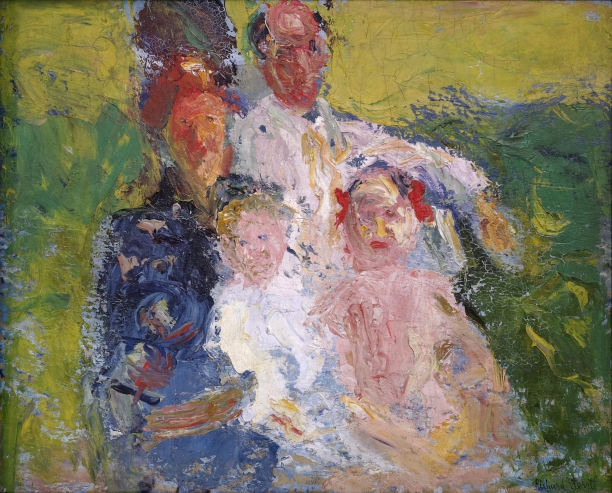
Between the time Schoenberg began Gurrelieder and the time he completed it, he went through trauma in his personal life. The picture above shows Schoenberg and his wife Mathilde Zemlinsky, with their two children. It's a summer afternoon, they're in the Austrian countryside. But the faces are pools of blood. Mathilde and the artist Richard Gerstl had an affair but when it ended, Gerstl killed himself. The following year, Schoenberg (himself a painter) wrote Das Buch der Hängenden Gärten and Ewartung (op 17, 1909). He was now able to resolve the impasse with Gurrelieder.

In Part 2 of Gurrelieder, Waldemar responds to the loss of Tove with "Herrgott, Herrgott, wiesst du was du tatest" . The notes that are later sung as "Herrgott" appear right at the beginning of the whole piece, but are now tranformed. Simon O'Neill doesn't have the most lyrically beautiful voice, but it's right for Waldemar, consumed as he is with cosmic rage. O'Neill uses the idiosyncrasies of his voice intelligently. This Waldemar is maddened by suffering and turns on God. "Lasst mich, Herr, die Kappe deines Hofnarr'n tragen!", he snaps. (Let me wear your jester's cap). As Klaus Narr tells us, Waldemar isn't a nice man, which is perhaps why he's so overwhelmed when Tove loves him. O'Neill seems to have understood the part in context of the whole work, rather than just singing his own part regardless as some of the smaller parts are often done. This I respect more than a "lovely" voice,  Roman Trekel had an even more metallic burr, but sang parts that worked for him. Philip Langridge  (a good Klaus Narr) had an even more awkward voice, but used it to create character better than most.
 
As the ghost of Waldemar rides through the skies, the terrified Peasant (Neal Davies) hides and puts his faith in formulaic prayers. So it's significant that Schoenberg makes so much of  Klaus Narr. He's a jester and plays the fool, but it's his job ito say things to kings (and Gods) that they don't want to hear. Like Waldemar and his hunters, the jester is dead, too, a haunted spirit forced to walk in endless circles, going nowhere. It's not a good thing and he knows it. His music is unsettling, as it should be, despite the mock bucolic text. The joke is on the jester, who must ride with his master in death. Jeffrey Lloyd-Roberts sang correctly but could have expressed more savage irony. From this point, a change is coming, overturning the "Wagnerian" forces that prevailed before. In the orchestra, Saraste lets small instruments like piccolo and xylophone be heard over the big brass and overwhelming strings.

Superlative choruses sang the demonic huntsmen, extremely well-parted so their song moved with the wildness you'd expect from ghosts riding on the wind. As they fade into  "Versinkt! Versinkt", an eerie chill seems to sink in, even in the overheated Royal Albert Hall.
 
The "Wild Hunt of the Summer Wind"
sweeps away all that's gone before. But Waldemar's curse is not resolved. Instead, Schoenberg uses his music and Sprechstimme to herald something completely new. Haunted as I am by Hans Hotter's Speaker I probably expect miracles. This is a part for baritones who retain their musical instincts even when their voices bloom no more, which adds to the meaning of this strange part. As dawn breaks, the ghosts fade, and nature, in its glory, awakes. Wolfgang Schöne still has a voice, and intones the tricky rhythms nicely. But we're definitely not in Wagner territory now. The Speaker addresses "Herr Gänsefuß, Frau Gänsekraut" (Lord Goosefoot, Lady Amaranth), a reference to the "Herrgott" heard earlier. It's also a reference to Waldemar and Tove and their status in the scheme of worldly things. But Goosefoot and Amaranth are tall weeds cut down by wind. This Wind blows the past away, to welcome new growth.

 "Seht die Sonne!" the chorus sang with tumultous vigor, the orchestra resurgent in glorious splendour. "Läßt von lichter Stirne fliegen Strahlenlockenpracht" (and from the sun's glowing brow flies "the spendour of his locks oif light" as the translation by Donna Hewitt puts that last, lovely and very Germanic noun).

Full review and cast list in Opera Today

Berlioz Requiem Grande messe des morts BBC Prom 39

Hector Berlioz Requiem (Grande messe des morts) needs grand performance spaces, so hearing it at BBC Prom 39 at the Royal Albert Hall was a rare treat. Read what Claire Seymour says in Opera Today: 

"Whether the choral forces were an equal match for the brass eruption, probably depended upon where in the vast hall you were seated. Certainly there was some outstanding choral singing; and in any case, despite its Napoleonic scale and celebratory, even aggrandizing air, the Requiem is a work of both spectacle and subtlety. The thunderous passages may be the most well-known, even notorious, but they are short-lived, and much of the score is restrained, Berlioz’s fine ear for instrumental colour always in evidence - even the 10 pairs of cymbals are employed softly en masse."

Sunday, 12 August 2012

Leoš Janáček The Makropulos Case Edinburgh International Festival

Leoš Janáček The Makropulos Case at the Edinburgh International Festival. Juliet William's review in Opera Today; 

 "A mysterious diva, Emilia Marty, appears in town, transfixing all males who cross her path. In addition to her spell-binding powers, she appears to have mysterious knowledge of the matters of the case, to the consternation of the male company. Played out is a contrast between masculinity and femininity; logical and intuition; the tangible and the supernatural."

Saturday, 11 August 2012

Elder Elgar Apostles Prom 37

Mark Elder's Elgar The Apostles (BBC Prom 37) is exceptional, and could be a contender for best Prom of the season. It outclasses Sakari Oramo's performance in 2007, good as that was. It isn't fair to compare the Hallé and the CBSO, for both have long Elgar pedigrees, but Elder has the advantage because he has the ideal Jesus in Jacques Imbrailo.

How can one sing Jesus? And in the context of Elgar's good natured, humane Apostles? or no matter how much Elgar focuses on the Apostles, it is Jesus who who eclipses all else.  Jesus speaks in simple, almost aphoristic sentences, no rhetoric, no fuss. Imbrailo's voice is rich, but pure and calmly confident, his voice so pure and calm that it seems to glow from within. Magnificent trumpet call soars forth, and the choir sing triumphantly, as they announce that the Apostles are being sent out into the world. "We are the Servants of the Lord!" sing the Apostles.  Yet Jesus's words are simple, almost aphoristic. "He that receiveth you, receiveth me.. And he who receiveth me receiveth he that sent me", Imbrailo breathes richness into the long "sent". The Apostles are flushed with pride, but Jesus is humble. Absolutely no need for histrionics. The Apostles are calmed, and the orchestra ends with a simple flourish.

"Blessed are the pure in spirit, for theirs is the Kingdom of Heaven" Imbrailo's natural purity of timbre expresses Jesus's true nature with gentle, understated confidence. Imbrailo's Beatitudes seem to glow from within, lit by genuine sincerity. Where does this beauty come from? I listen, stunned by this sheer grace. You can hear in his Jesus why no-one sings Billy Budd as intuitively as Imbrailo. This is a voice composers should be writing for. In our age more than ever, we need spiritually resplendent singing like this.

The other soloists (Alice Coote, Rebecca Evans, Paul Groves, Davd Kemspter and Clive Bailey) are good, even if I'm not keen on vibrato in the Vigin Mary. and the Hallé choir is magnificent. They fill out the three named apostles when deeper textures are needed. Elder does wonders with the orchestra and singers. This Prom is a glorious reprise of the Manchester performance, captured on CD.

The painting of Jesus and the Apostles is by James Tissot. I chose it because it's so simple - watercolour goache, not oil - and so very different from Tissot's usual portraits of society ladies in fancy gowns.


Delius A Mass of Life - Edinburgh Festival

The Edinburgh International Festival trumps the BBC Proms with Frederick Delius A Mass of Life.  This year's Proms have been big on massed choirs and Masses and on Delius, but Edinburgh has pulled off perhaps the biggest of them all.  Performances are rare because Delius wrote for huge forces. Juliet Williams was there. Please see her full review in Opera Today.

After hearing Leonard Bernstein's execrable Mass, deeply offensive on every level, and James MacMillan's dull, but at least sincere  Credo, Delius's A Mass of Life is a far better experience. Indeed, its flaws make it more human. Which one could never say about Bernstein's self-indulgent ludicrousness. (Let's pray Nico Muhly doesn't even try.)  Tonight, another "real" Mass, Berlioz's Grand Messe des morts, also rarely performed.  Here is what Julie has written about Delius's Mass in Edinburgh :

"It is not often one thinks (The Usher Hall)  may be on the small side, but the piece opened with an effect which I can only describe as a 'wall of sound', a joyous blast surging out. This forceful opening broadens out into first an introductory recitative for male voice, with musical accompaniment of a sparkling character, calling to mind a brook running through a forest; and then a 'dance scene' to which all soloists contribute in turn, together with chorus. These, arguably the highlights of the performance, both strongly recall the soundworld of Mahler.

There is then a sudden shattering of the sunny mood, as night falls on this scene, and the hero cries, 'Woe is me' and confronts his own mortality. Here the change of mood was perhaps gradual rather than sudden, not quite having the dramatic tension which would have drawn out the change of mood with immediacy. The melancholy became much more apparent only later in this fourth scene, when in contemplating impending death, Zarathustra is tortured by visions of a spider spinning its web around his corpse." Please see her full review in Opera Today.


Thursday, 9 August 2012

First Habanera recording 1891

My friend and regular reader has written about the first ever recording of Bizet's Carmen Habanera. It was made in 1891 by Julius Block , a businessman who bought a phonograph off Thomas Edison. This was way before the concept of commercial recording developed.  But fashionable, well-heeled people were fascinated by the novelty. When Block demonstrated the phonograph to the Tsar, the Tsar bought one too. Block persuaded the big stars of the day to play and sing for him. Block's wax cylinders were long thought missing but Ward Marston has cleaned them up and made them available on CD. (read more here)

The first Habanera recording was made with Italian mezzo Adele Borghi (b 1860). The recording lasts 1.33 so isn't complete, but the wonder is that it exists at all. Carmen was "new music" at the time, probably quite racy stuff. Borghi's recording was made only 16 years after the premiere. It's interesting that 19th century people didn't have hang-ups about "traditional" or "conservative" music. Once Carmen caught on, it became a classic. What's more people of the time were sufficiently technology-friendly to experiment with the latest inventions.

The photo shows Emma Calvé as Carmen with her arms uncovered, smoking a cigarette and looking provocative. Calvé also recorded the Habanera, in 1902. In 1905, Jeanne Marie de L'Isle made another recording. Her aunt and teacher was Célestine Galli-Marié, Bizet's first Carmen. Listen HERE for Calvé and HERE for de L'Isle.

Atom bombed children of Hiroshima

Today, 9th August, is the anniversary of the bombing of Nagasaki, three days after Hiroshima. The irony is that Nagasaki was the most westernized, cosmopolitan city in Japan. Madama Butterfly wasn't set there for nothing. Read more about the irony of Nagasaki here, and lots more on Hiroshima, non violence annd even Puccini on this site. And watch the movies I've written about, like The Human Condition (Kobayashi) Black Rain and The Burmese Harp.

For today, a full download of a unique "home movie" made with the ordinary people of Hiroshima, released after the American military occupation of Japan ended in 1952. The film, directed by Kaneto Shindo is based on a novel by Arata Osada.  A young woman called Takako has been living on an idyllic island for five years but finally returns to Hiroshima where she grew up. She meets a beggar, blinded and scarred by radiation burns. He's Iwakichi, a servant of her family. "Go away!" cries Iwakichi, who can't bear for her to see him in this way. But Takako bows to him, a gesture of respect. It helps  to understand non western society to really appreciate this reversal.

Iwakichi's grandson Taro lives in an orphanage. Thousands of bereaved children: a city of survivors haunted by those who are no longer there. Takako wants to adopt Taro but Iwakichi can't bear to lose the last vestige of his former life. Takako, who was a teacher, tracks down her former students. One girl lies dying in a hospital, comforted by thoughts of heaven.  To die so young, but with such dignity.  Eventually Iwakichi sends Taro to Takako and kills himself. The film is badly shot and the subtitles hard to read, but it's such a quiet, moving story that it's worth watching.

Wednesday, 8 August 2012

Oldest Recording in the world?

Is this the oldest recording in the world? The original was made by inventor Emile Berliner,m who patented the first gramophone technology in 1887. The recording itself was lost, but a photograph was printed in a German magazine of 1890. With modern technogy, which I can't comprehend,  it's now possible to hear the recording again., Please read this article about the discovery. There's a soundclip, too. It's Emile Berliner himself reading a verse from Schiller.

Lots more on this site about very early recordings, like Theo Wangemann's first ever Schubert recording 1890!   Wangemann worked for Thomas Ediuson who really got recording off the ground. He'sthe one who from m189 was in Europe rrecording Bismark, bvon Moltke and Jiohannes Brahms himself, the first  recording savvy composer. Follow the link above for sound clip. Elsewhere on this site, the first ever Carmen recording (1905) and clips of composers  recording their own muisc. Even Brahms, playing Brahms ! Mahler playing Mahler, Grieg playing Grieg and Jascha Heifetz before his voice broke.  

photo: Ludmila Pilecka